Calc stuff 2
 Call Kai
 Learn
Learn Practice Test
 Spaced Repetition
 Match
Match Flashcards
 Knowt Play
1/93

There's no tags or description
Looks like no tags are added yet.
Name | Mastery | Learn | Test | Matching | Spaced | Call with Kai | Chat |
|---|
No analytics yet
Send a link to your students to track their progress
94 Terms
n+1xn+1 + C
∫xn dx =
∫x1d(x)
ln|x| + C
∫ ekx dx
kekx+C
Chain Rule: d/dx [f(g(x))] =
f’(g) g’(x)
∫cos(kx) dx =
k1 sin(kx) + c
∫sin(kx) dx =
− k1 cos(kx) + c
∫sec2 x dx =
tan(x) + c
∫csc(x) cot(x) dx =
-csc(x) + c
∫sec(x) tan(x) dx =
sec(x) + C
∫csc² x dx =
-cot(x) + C
Slope of the Secant Line
A measure of the slope of the tangent line, or the rate of change, of f(x) at the given point (a,f(a)) calculated as x−af(x)−f(a) .
Instantaneous Velocity
The limiting values of the average velocities over shorter and shorter time periods.
Limit of a Function
To say that limx→af(x)=L means that as x approaches a, but x=a, then f(x) must approach L.
One-Sided Limits
A limit where the value is different when approaching from either the positive side (x→a+) or the negative side (x→a−).
Infinite Limit Theorem (Positive Even Integer)
If n is a positive even integer, then limx→a+(x−a)n1=∞, limx→a−(x−a)n1=∞, and limx→a(x−a)n1=∞.
Infinite Limit Theorem (Positive Odd Integer)
If n is a positive odd integer, then limx→a+(x−a)n1=∞ and limx→a−(x−a)n1=−∞, hence the two-sided limit is DNE (Does Not Exist).
Sum Law Limits
The limit law stating limx→a[f(x)+g(x)]=limx→af(x)+limx→ag(x).
Limits Product Law
The limit law stating limx→a[f(x)g(x)]=(limx→af(x))(limx→ag(x)).
Direct Substitution Property
If f is a function such that a is in the domain of f, then limx→af(x)=f(a).
Squeeze Theorem
If f(x)≤g(x)≤h(x) when x is near a (but not necessarily equal to a) and limx→af(x)=L=limx→ah(x), then limx→ag(x)=L.
Continuity at a Point
A function f is continuous at a if:
1. f(a) is defined;
2. limx→af(x) exists;
3. limx→af(x)=f(a).
Limit Definition of Derivative
The derivative of a function at a number a, denoted by f′(a), is defined as f′(a)=limh→0hf(a+h)−f(a).
Differentiable at a Number
A function f is differentiable at a number a if the limit f′(a)=limh→0hf(a+h)−f(a) exists.
Differentiability Implies Continuity
If f(x) is differentiable at a, then f is continuous at a.
The Power Rule Derivatives
The differentiation rule stating that for any real number n, dxd[xn]=nxn−1.
The Product Rule
The differentiation rule stating that dxd[f(x)g(x)]=f′(x)g(x)+f(x)g′(x).
The Quotient Rule
The differentiation rule stating that dxd[g(x)f(x)]=[g(x)]2g(x)f′(x)−f(x)g′(x).
Particle at Rest
The state of a moving particle when its velocity at time t is equal to zero (v(t)=0).
Horizontal Tangent Line
A line on a function f(x) where the slope is zero, found by setting the derivative f′(x)=0.
Big Three Limits
limx→0axsin(ax)=1 ;
limx→0ax1−cos(ax)=0 ;
limx→0xtan(x)=1 .
d(x)dln(g(x))
g(x)g′(x)
d(x)d(loga(x))
xln(a)1,x>0 .
d(x)d(logag(x))
g(x)lnag′(x)
d(x)d(ex)
ex
(dx)d(ax)
axln(a)
d(x)d(eg(x))
eg(x)g′(x)
d(x)d(ag(x))
ln(a)ag(x)g′(x)
d(x)dcos−1(x) =
1−x2−1
d(x)dsin−1(x) =
1−x21
d(x)dcot−1(x) =
1+x2−1
d(x)dcsc−1(x) =
∣x∣1−x2−1
d(x)dtan−1(x) =
1+x21
d(x)dsec−1(x)
∣x∣1−x21
sec2(x) =
1 + tan²(x)
d/dx (1/x) =
−x21
d(x)d(x)=
2x1
Particle is slowing down:
v(t) and a(t) have different signs
Particle is moving left/down:
v(t) < 0 (negative)
Particle is moving right/up:
v(t) > 0 (positive)
Particle is speeding up: (|velocity| is getting bigger)
v(t) and a(t) have same sign
Intermediate Value Theorem
If f is continuous on [a,b] and k is any number between f(a) and f(b), then there is at least one number c between a and b such that f(c) = k
Steps for Absolute Mins/Max:
Find critical numbers using derivative
Identify endpoints
f(critical point) and f(end point)
Determine absolute max/min values by comparing the y-values, stated in a sentence
Mean Value Theorem
f′(c)=b−af(b)−f(a)
If f is continuous on [a,b] and differentiable on (a,b), then there exists a number “c” on (a,b):
x = c if a critical number because
f’(x) = 0 or f’(x) is undefined
f(x) is ____ on [a,b] because f’(x) > 0
increasing
f(x) is ____ on [a,b] because f’(x) < 0
decreasing
f(x) is ____ on (a,b) because f’’(x) > 0
concave up
f(x) is ____ on (a,b) because f’’(x) < 0
concave down
f’’(x) = 0 or = DNE and f“(x) changes sign around point c. (Or if f’(x) slope changes sign and f’’(x) = 0 or DNE)
Inflection point
∫tanxdx=
−ln∣cosx∣+C
∫((x2+a2)1)d(x)
a1tan−1(ax)+C
F.T.O.C :∫abf′(x)dx=
f(b)−f(a)
∫abf(x)+g(x)dx=
∫abf(x)d(x)+∫abg(x)d(x)
∫abf(x)−g(x)dx=
∫abf(x)d(x)−∫abg(x)d(x)
∫abcf(x)dx=
c∫abf(x)dx
∫abf(x)dx=
−∫baf(x)dx
∫aaf(x)dx=
0
Average Value of a Function
b−a1∫abf(x)d(x)
Second F.T.O.C. P1:
d(x)d∫axf(t)d(t)= f(x)
Second F.T.O.C. P2:
d(x)d∫ag(x)f(t)d(t)= f(g(x))⋅g′(x)
∫abf(x)dx represents the ___ ______ in the function f from time a to b.
net change
Steps to solve differential equations.
separate variables
integrate each side
make sure to place C on side with independent variable (usually x)
plug initial condition and solve for C (if given)
solve for dependent variable (usually y)
y=Cekt or y=y0ekt
Exponential growth
y= end amount
C or y0 = initial amount
k = growth constant/growth rate
t = time elapsed
y=y0e−kt
Exponential decay
negative sign = decays over time, rather than growing.
Velocity
v(t) = s’(t) = ∫a(t)dt
acceleration
a(t) = v’(t) = s’’(t)
speed
|v'(t)|
average velocity
b−as(b)−s(a) (given v(t)); or b−a1∫abv(t)dt (given a(t))
average acceleration
b−av(b)−v(a) (given v(t)); or b−a1∫aba(t)dt (given a(t))
Displacement
∫abv(t)dt
total distance
∫ab∣v(t)∣dt
position at b
s(b)=s(a)+∫abv(t)dt
Area perpendicular to x-axis; f(x) is top curve, g(x) is bottom, a and b are x-coordinates of point of intersection.
∫ab[f(x)−g(x)]dx=
Area perpendicular to y-axis; f(y) is right curve, g(y) is left curve, a and b are y-coordinates of point of intersection.
∫ab[f(y)−g(y)]d(y)=
Volume steps
Decide whether it’s a dx or dy
Find a formula in terms of x or y
Find the limits (make sure they match x or y)
integrate and evaluate
Volume = ∫Area
Volume of a disc around a Horizontal Axis of rotation
V = ∫abπr2dx
Volume of a washer around a horizontal axis of rotation.
∫ab[πR2−πr2]d(x)
∫abA(x)dx
Volume of a slab (cross-section) around a horizontal axis of rotation. A(x) is the area for the cross section.
Volume of a disc around a vertical axis of rotation
V = ∫abπr2dy
Volume of a washer around a vertical axis of rotation
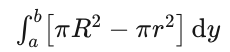
Volume of a slab (cross-section) around a vertical axis of rotation. A(y) is the area for the cross section.
∫abA(y)dy
Volume using shells
V = ∫2πr h (Thickness)
For volume rotated around a vertical axis (y-axis), using shells method.
∫ab2π(r)(h(x))d(x))
For volume rotated around a horizontal axis (x-axis), using shells method.
∫ab2π(r)(h(y))d(y)