BIOL 221 - Lecture 2 Exam
 Call Kai
 Learn
Learn Practice Test
 Spaced Repetition
 Match
Match Flashcards
 Knowt Play
1/52

There's no tags or description
Looks like no tags are added yet.
Name | Mastery | Learn | Test | Matching | Spaced | Call with Kai | Chat |
|---|
No analytics yet
Send a link to your students to track their progress
53 Terms
What are the 4 basic types of tissues?
epithelial, connective, muscle, nervous(nerve)
Definition of Tissue?
cells with similar structures and functions organized in groups/layers
Characteristics of Epithelial Tissues?
tightly packed cells
apical (free) surface
basal surface
basement membrane
have rapid regeneration
are avascular
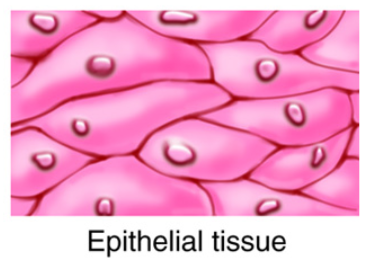
Epithelial Tissue
covers or lines the body surfaces (inside and out)
controls exchange and provides protection
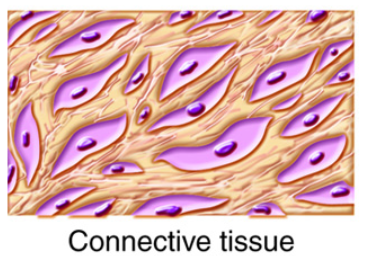
Connective Tissue
cartilage, tendons, ligaments
binds and supports body parts
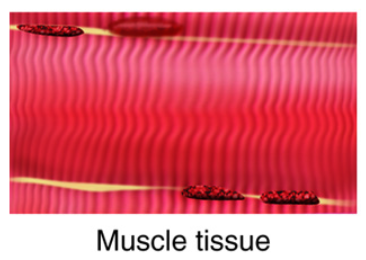
Muscle tissue
for movement of the body
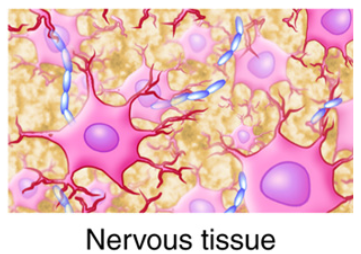
Nervous Tissue
detects changes and transmits information rapidly
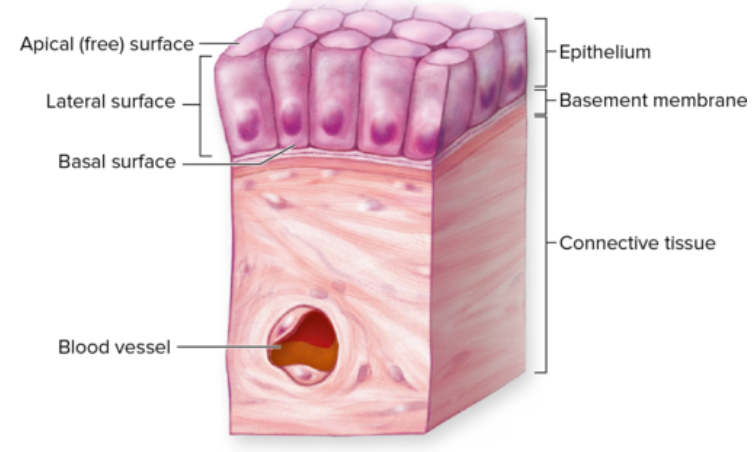
Apical (Free Surface)
exposed to spaces, no attachment to anthing
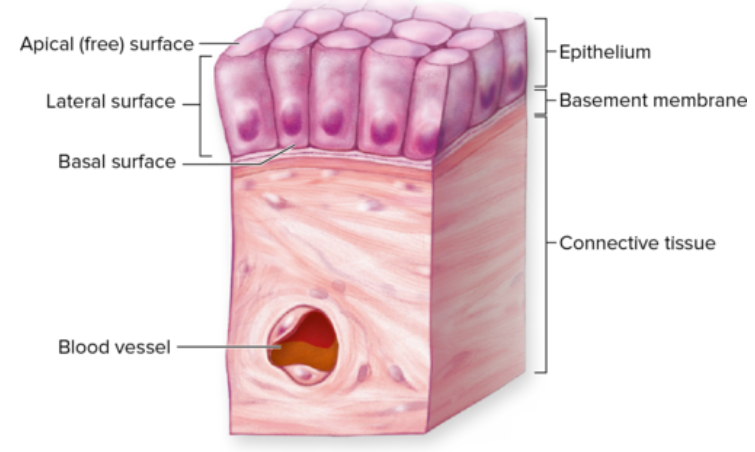
Basal Surface
attaches the cell to the basement membrane
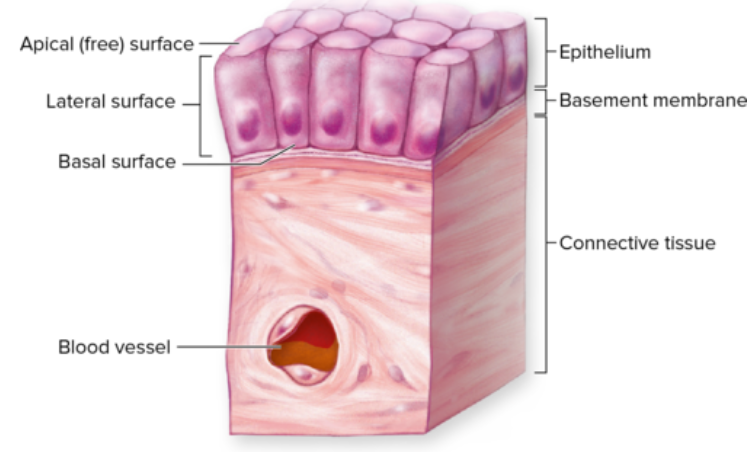
Basement Membrane
attaches to the underlying connective tissue
Surface Epithelium
Covers body surfaces and lines internal spaces with organs
Glandular Epithelium (Exocrine/Endocrine Glands)
produce secretion
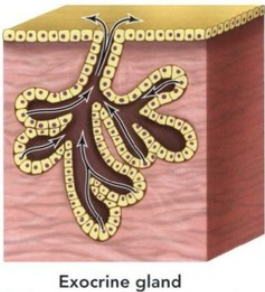
Exocrine glands
they are ducts that are open externally
secrete products onto epithelial surface (salivary glands, mucous glands)
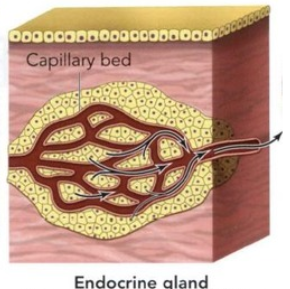
Endocrine Glands
they have no duct
secrete hormones back into the bloodstream (circulates around the body)
Simple Epithelial
1 layer, best for exchange
(diffusion, absorption, secretion)
Stratified Epithelial
more than 1 layer, good for protection
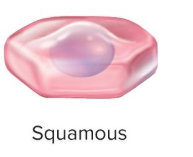
squamous cell shape
flat and is the fastest for diffusion
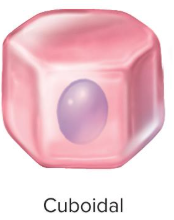
cuboidal cell shape
cubelike, good for secretion and absorption
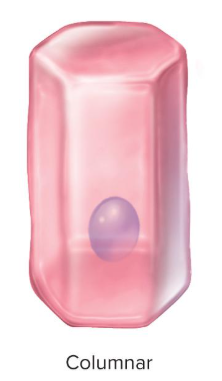
columnar cell shape
columnlike
good for absorption and transportation
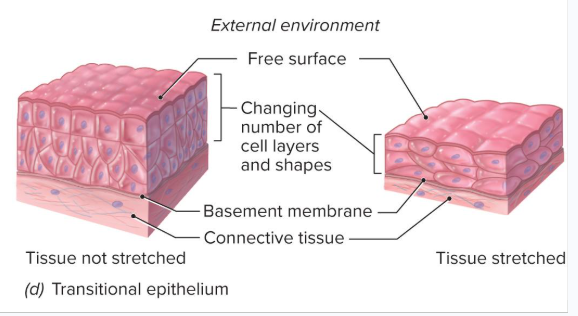
Transitional cell shape
shape varies
good for stretching
Connective tissue characteristics
few loosely arranged cells
large amount of matrix
can be fibrous, solid, semi solid, fluid
is vascular (except cartilage)
are usually covered by epithelium, not exposed to external environment
CT - extracellular matrix
matrix = ground substance + protein fibers
CT - Ground substance
water and dissolved substances
can be fluid, gel like, or solid
CT - Protein Fibers
Collagen - tensile strength
Elastic - stretching
Reticular - provides framework
Connective tissue Categories
loose
dense
specialize
Loose CT Type
(Areolar and Adipose)
loose fibers, more ground substance, softer, more flexible
Areolar CT
under the epithelium, binds skin to muscles
(falls under Loose)
Adipose CT
in places of fat (hips/breasts)
energy storage and insulation
(falls under Loose)
Dense Irregular CT
on the dermis of the skin
dense collagen fibers, resists pulling
Dense Regular CT
on the tendons and ligaments
dense collagen fibers, resists pulling
Specialize Connective Tissue - highly modified matrix
What are the 3 types
cartilage (firm gel)
blood (fluid matrix)
bone (mineralized)
Skeletal Muscle Tissue
attached to bones; voluntary movement;
cells are called muscle fibers
Cardiac Muscle Tissue
heart; moves blood; involuntary
muscle cells
Smooth Muscle Tissue
moves substances through hollow organs, involuntary
muscle cells
Muscle Tissue
use protein fibers for contraction
allows for movement and generating heat
Nerve Tissue
found in brain, spinal cords, nerves (embedded in connective tissue)
regulates body functions
Neuron (nerve cell)
functional units of nerve tissue
specialized to form and transmit nerve impulses in response to environmental changes
Neuroglia (nerve glue)
nourish, insulate, protect neurons
body membranes
thin sheets of tissue that line cavities, cover surfaces, or separate tissues and organs
Epithelial Tissue MEMBRANE
epithelium + underlying areolar connective tissue
Serous Membrane (Epithelial)
line closed body cavities (thoracic and abdominopelvic)
pericardium, pleura, peritoneum
secretes serous fluid, reducing friction
Mucous Membranes (Epithelial)
line cavities open to the external environment
secretes mucus, for lubrication and trapping pathogens
Cutaneous Membrane (Epithelial)
the skin
keratinized (dry surface)
Connective Tissue MEMBRANE
formed only of connective tissue
protect, stabilize, lubricate organs and structures
meninges, perichondrium, periosteum, synovial membranes
Meninges
brain
Perichondrium
lines the cartilage
Periosteum
lines the bones
Synovial membranes
surrounds joints, keep joint in place
Skin is a organ
there are multiple tissues that work together (the integumentary system)
What does skin do?
prevents fluid loss
regulates heat
senses environment
barrier to pathogens
Vitamin D regulation
Epidermis
1st layer of skin - epithelium
only lipid soluble substances can cross epidermis
Dermis
2nd layer of skin - dense irregular connective tissue
stops our skin from being pulled in different directions
Hypodermis
3rd layer of skin - adipose tissue