CH11 - Monetary Policy
0.0(0)
Studied by 0 people Call Kai
 Learn
Learn Practice Test
 Spaced Repetition
 Match
Match Flashcards
 Knowt Play
Card Sorting
1/159

Earn XP
Description and Tags
term 3
Last updated 12:54 PM on 9/7/26
Name | Mastery | Learn | Test | Matching | Spaced | Call with Kai | Chat |
|---|
No analytics yet
Send a link to your students to track their progress
160 Terms
1
New cards
What is monetary policy?
Interest rate decisions taken by the RBA to affect monetary and financial conditions in the economy with the aim of achieving low inflation and full employment
2
New cards
What is the main monetary policy tool of the RBA?
The cash rate
3
New cards
What is the cash rate?
The interest rate on overnight loans in the money market
4
New cards
Why can the RBA influence interest rates throughout the economy?
Because changes in the cash rate influence other interest rates (set by Banks etc.) such as mortgage, deposit, personal and business loan rates
5
New cards
What is the real interest rate?
The nominal interest rate minus the rate of inflation
6
New cards
Why are real interest rates important?
They show the real cost to borrowers and the real return to savers in terms of purchasing power
7
New cards
What happens to the cost of borrowing when interest rates rise?
The cost of borrowing increases
8
New cards
What happens to the reward for saving when interest rates rise?
The reward for saving increases
9
New cards
What happens to saving when interest rates rise?
The reward for saving rises, so households have a greater incentive to save
10
New cards
How does a rise in interest rates affect business investment?
Higher borrowing costs make fewer investment projects profitable, so investment falls
11
New cards
What happens to the cost of borrowing when interest rates fall?
The cost of borrowing decreases
12
New cards
What happens to the reward for saving when interest rates fall?
The reward for saving decreases
13
New cards
What happens to saving when interest rates fall?
The reward for saving falls, so households have less incentive to save
14
New cards
How does a fall in interest rates affect business investment?
Lower borrowing costs make more investment projects profitable, so investment rises
15
New cards
What three components of aggregate demand can monetary policy affect?
Consumption, investment and net exports
16
New cards
What is the overarching objective of the RBA?
To promote the economic prosperity and welfare of the people of Australia
17
New cards
What are the two main monetary policy objectives of the RBA?
Price stability and full employment
18
New cards
What does stability of the currency mean?
Price stability or a low and stable inflation rate
19
New cards
What is the RBA inflation target?
An annual inflation rate of 2 to 3 percent on average over time
20
New cards
Why is the inflation target a range?
Because inflation cannot be fine tuned to one exact rate and the target allows for changes in the business cycle
21
New cards
Why is price stability important?
It protects the value of money and supports confidence, investment, growth and employment
22
New cards
What are benefits of low inflation?
It protects savings, reduces uncertainty, lowers interest rates, improves competitiveness and encourages productive investment
23
New cards
What is headline inflation?
The inflation rate measured by the Consumer Price Index
24
New cards
Why can headline inflation be misleading?
It can be affected by large temporary price movements that may not reflect underlying inflationary pressure
25
New cards
What is underlying inflation?
A measure designed to show more persistent inflationary pressures by reducing the effect of volatile price changes
26
New cards
What is the trimmed mean?
The average inflation rate after trimming away items with the largest price changes
27
New cards
What is the weighted median?
The inflation rate of the item in the middle of the distribution of CPI price changes
28
New cards
Which underlying inflation measure does the textbook say the RBA favours?
The trimmed mean
29
New cards
How does the RBA define full employment?
The maximum level of employment that is consistent with maintaining low and stable inflation
30
New cards
What does NAIRU stand for?
Non Accelerating Inflation Rate of Unemployment
31
New cards
What is the textbook estimate of the NAIRU?
Around 4.5 percent
32
New cards
What is the textbook estimate of the natural rate of unemployment?
Around 4 percent
33
New cards
How can low inflation help achieve full employment?
Low inflation supports consumer and business confidence and encourages investment, which promotes employment growth
34
New cards
What does economic prosperity mean?
Rising living standards over time, usually measured by an increase in real GDP per capita
35
New cards
What does the RBA inflation target help anchor?
Inflation expectations
36
New cards
Why are anchored inflation expectations useful?
They reduce uncertainty and support household and business decision making
37
New cards
What is conventional monetary policy?
The RBA using the cash rate to achieve price stability and full employment
38
New cards
What does a tightening of monetary policy mean?
The RBA increases the cash rate
39
New cards
What does an easing of monetary policy mean?
The RBA decreases the cash rate
40
New cards
What is contractionary monetary policy?
A rise in the cash rate that reduces spending and aggregate demand
41
New cards
What is expansionary monetary policy?
A fall in the cash rate that increases spending and aggregate demand
42
New cards
What is a negative output gap?
When real GDP is below potential GDP
43
New cards
What is a positive output gap?
When real GDP is above potential GDP
44
New cards
How can economic indicators identify a weak economy?
Inflation is low, real GDP is below potential GDP and unemployment is high
45
New cards
How can economic indicators identify an overheating economy?
Inflation is high, real GDP is above potential GDP and unemployment is unusually low
46
New cards
When would the RBA usually use expansionary conventional monetary policy?
When economic activity is weak, unemployment is high or inflation is below target
47
New cards
When will the RBA adopt an expansionary stance?
When the economy is weak, there is a negative output gap, unemployment is high or inflation falls below 2 percent
48
New cards
When would the RBA usually use contractionary conventional monetary policy?
When the economy is growing too quickly and inflationary pressures are high
49
New cards
When will the RBA adopt a contractionary stance?
When the economy is overheating, there is a positive output gap, unemployment is very low or inflation rises above 3 percent
50
New cards
What is the likely main RBA priority when unemployment is high and the economy has a negative output gap?
Full employment
51
New cards
What is the likely main RBA priority when inflation is above target and the economy has a positive output gap?
Price stability
52
New cards
An economy has inflation above 3 percent and real GDP above potential GDP. What stance should the RBA adopt and why?
Adopt contractionary monetary policy by increasing the cash rate. Higher interest rates reduce C, I and NX, decreasing AD and real GDP towards potential GDP while reducing inflationary pressure
53
New cards
An economy has high unemployment and real GDP below potential GDP. What stance should the RBA adopt and why?
Adopt expansionary monetary policy by decreasing the cash rate. Lower interest rates increase C, I and NX, increasing AD, real GDP and employment
54
New cards
Why may the RBA raise the cash rate even though unemployment may rise?
If inflation is above target and the economy has a positive output gap, price stability becomes the main priority. Higher rates reduce AD and inflationary pressure but may also reduce employment
55
New cards
What does it mean that monetary policy is forward looking?
The RBA acts according to expected economic conditions because policy changes affect the economy with a time lag
56
New cards
How far ahead does the textbook say monetary policy may affect the economy?
About six to twelve months
57
New cards
What economic indicators does the RBA monitor?
Inflation, wages, labour market conditions, housing, business investment, the exchange rate, terms of trade, national accounts and international data
58
New cards
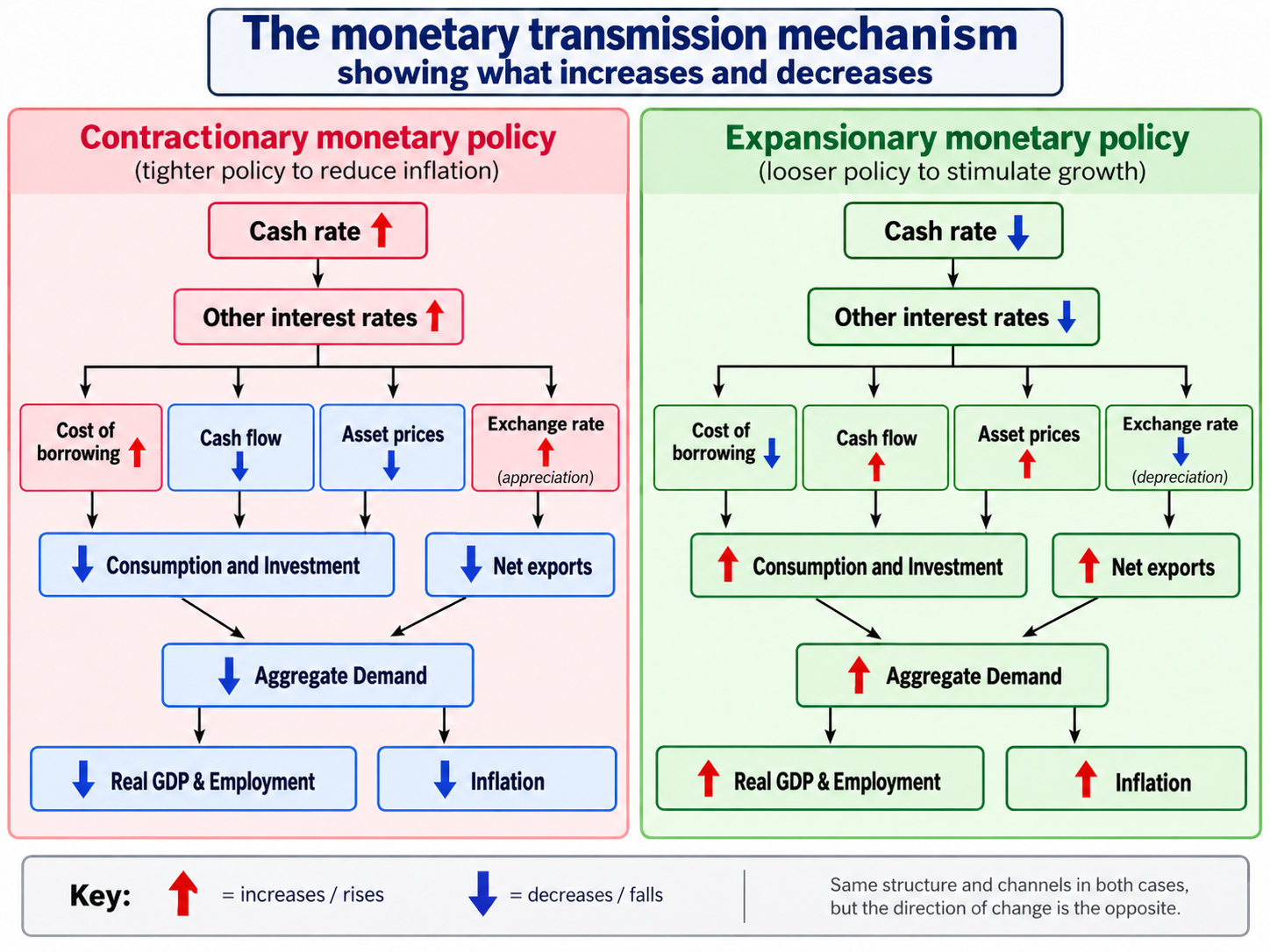
What is the transmission mechanism?
The process by which changes in interest rates affect economic activity and inflation
59
New cards
Why is the transmission mechanism indirect?
Because the RBA changes interest rates and then relies on households and firms to change their behaviour.
60
New cards
Why are monetary policy time lags uncertain?
Because households and firms may respond differently to interest rate changes over time
61
New cards
What are the four channels of the transmission mechanism?
Cost of borrowing, cash flow, asset prices and exchange rate
62
New cards
Illustrate the full Transmission Mechanism Flow Diagram
63
New cards
What is the interest rate differential?
The difference between Australian interest rates and overseas interest rates
64
New cards
Why does a cash rate rise encourage an appreciation of the Australian dollar?
Higher relative Australian returns attract foreign investment, which increases demand for Australian dollars
65
New cards
How does an appreciation affect net exports?
Exports become more expensive to foreign buyers while imports become cheaper, so net exports decrease
66
New cards
How does the exchange rate channel work when the cash rate falls?
Lower Australian interest rates reduce foreign investment, which decreases demand for the Australian dollar and causes depreciation
67
New cards
Why does a cash rate cut encourage a depreciation of the Australian dollar?
Lower relative Australian returns reduce foreign investment and demand for Australian dollars
68
New cards
How does a depreciation affect net exports?
Exports become more competitive while imports become more expensive, so net exports increase
69
New cards
Explain how a cash rate increase reduces inflation through the transmission mechanism
Higher cash rates raise other interest rates. Borrowing costs and repayments rise, asset prices tend to fall and the AUD tends to appreciate. C, I and NX fall, reducing AD, real GDP and inflationary pressure
70
New cards
Explain how a cash rate cut can reduce unemployment
Lower interest rates increase consumption, investment and net exports. AD and real GDP rise, firms increase production and demand more labour, reducing unemployment
71
New cards
What does the RBA do under expansionary monetary policy?
It decreases the cash rate to reduce interest rates and increase aggregate demand
72
New cards
How does expansionary monetary policy affect household saving?
Lower deposit rates reduce the incentive to save and encourage consumption
73
New cards
How does expansionary monetary policy affect real GDP?
Real GDP increases as aggregate demand rises
74
New cards
How does expansionary monetary policy affect employment?
Employment increases as firms increase production
75
New cards
What happens to unemployment when expansionary monetary policy increases real GDP?
Unemployment tends to fall as firms require fewer workers
76
New cards
How does expansionary monetary policy affect inflation?
Inflationary pressure increases as aggregate demand rises
77
New cards
How does expansionary monetary policy close a negative output gap?
It increases aggregate demand and real GDP towards potential GDP
78
New cards
What does the RBA do under contractionary monetary policy?
It increases the cash rate to increase interest rates and reduce aggregate demand
79
New cards
What is the contractionary monetary policy transmission chain?
Cash rate rises, then interest rates rise, then consumption, investment and net exports fall, then aggregate demand falls
80
New cards
What is the full contractionary monetary policy chain?
Cash rate rises, then other interest rates rise, then C, I and NX fall, then AD falls, then real GDP, employment and inflationary pressure fall
81
New cards
How does contractionary monetary policy affect household saving?
Higher deposit rates encourage greater saving while higher loan repayments reduce consumption
82
New cards
How does contractionary monetary policy affect real GDP?
Real GDP decreases as aggregate demand falls
83
New cards
How does contractionary monetary policy affect employment?
Employment decreases as firms reduce production
84
New cards
What happens to unemployment when contractionary monetary policy reduces real GDP?
Unemployment tends to rise as firms require fewer workers
85
New cards
How does contractionary monetary policy affect inflation?
Inflationary pressure decreases as aggregate demand falls
86
New cards
How does contractionary monetary policy close a positive output gap?
It reduces aggregate demand and real GDP towards potential GDP
87
New cards
What happens to AE under expansionary monetary policy?
The aggregate expenditure line shifts upward
88
New cards
How should expansionary monetary policy be shown in the AE model?
AE shifts upward and equilibrium real GDP rises towards potential GDP
89
New cards
Why does monetary policy have a multiplier effect in the AE model?
An initial change in autonomous spending causes further rounds of income and spending
90
New cards
Why does output rise by more than the initial increase in spending in the AE model?
Because of the positive multiplier effect
91
New cards
How would expansionary monetary policy appear in the AE model?
The AE line shifts upward, causing equilibrium real GDP to rise towards potential GDP through a positive multiplier effect
92
New cards
What happens to AE under contractionary monetary policy?
The aggregate expenditure line shifts downward
93
New cards
How should contractionary monetary policy be shown in the AE model?
AE shifts downward and equilibrium real GDP falls towards potential GDP
94
New cards
How would contractionary monetary policy appear in the AE model?
The AE line shifts downward, causing equilibrium real GDP to fall towards potential GDP through a negative multiplier effect
95
New cards
What happens to AD under expansionary monetary policy?
The aggregate demand curve shifts to the right
96
New cards
How should expansionary monetary policy be shown in the AD AS model?
AD shifts right, causing real GDP and the price level to rise
97
New cards
How would expansionary monetary policy appear in the AD AS model?
AD shifts right while SAS and LAS remain unchanged. Real GDP and the price level rise
98
New cards
What happens to AD under contractionary monetary policy?
The aggregate demand curve shifts to the left
99
New cards
How should contractionary monetary policy be shown in the AD AS model?
AD shifts left, causing real GDP and the price level to fall
100
New cards
How would contractionary monetary policy appear in the AD AS model?
AD shifts left while SAS and LAS remain unchanged. Real GDP and the price level fall