Biol 107 Reading Questions
 Call Kai
 Learn
Learn Practice Test
 Spaced Repetition
 Match
Match Flashcards
 Knowt Play
1/30

There's no tags or description
Looks like no tags are added yet.
Name | Mastery | Learn | Test | Matching | Spaced | Call with Kai | Chat |
|---|
No analytics yet
Send a link to your students to track their progress
31 Terms
The partial negative charge in a water molecule occurs because…
the electrons shared between the oxygen and hydrogen atoms spend more time around the oxygen atom nucleus than around the hydrogen atom nucleus
Bonds responsible for cohesion, adhesion, and surface tension properties of water.
Hydrogen Bonding
Liquid ice floats in water because…
Stable hydrogen bonds organize lower-energy water molecules into crystalline lattice structures, thus keeping the molecules farther apart in solid form than in liquid.
Four properties of water
Cohesion and adhesion (high surface tension), high specific heat, less dense solid, solvent properties
What property of water preserves lake and pond ecosystems during the winter?
Ice floating due to fixed hydrogen bonds; the ice insulates the water below and allows the organisms within to survive.
Assume that acid rain has lowered the pH of a lake to pH 5.0. What is the hydroxide ion concentration of this lake?
1 × 10⁻⁹ mol of hydroxide ions per liter of water
Molecules of water required for the polymerization of a 22 monomer-long cellulose molecule
21
Relation of buffers to ocean acidification
CO2 reacts with H2O to form H2CO3, H+ disassociates from H2CO3, and reacts with CO3(2-) (Carbonate) forming HCO3, which strips carbonate from the water, and prevents organisms from using it to create CaCO3 (calcium carbonate) for shells.
Difference between ionic and polar covalent bonds
Polar covalent bonds share electrons unequally, but in ionic bonds, the electron is not shared at all, and requires two atoms with drastically different electronegativity.
Which of these hydrocarbons has a double bond in its carbon skeleton?
C2H4
Enatiomers
Mirror image isomers, bonded to four different atoms/groups. Typically have different functions.
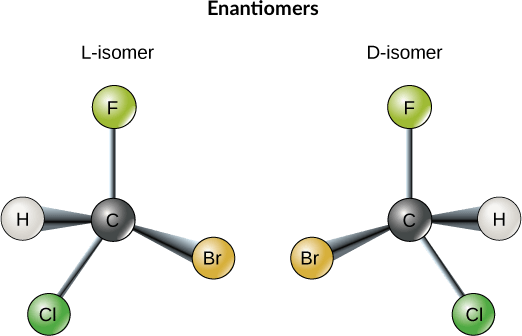

Are these enatiomers?
No

Are these enatiomers?
Yes
A compound contains hydroxyl groups as its predominant functional group. What properties of the molecule can we predict?
It should dissolve in water.
Structural difference between cis and trans fatty acids.
Cis fatty acids have kinks in the chain; trans fats do not.

What is the relationship between these two sugar molecules?
Structural Isomers
What properties do hydroxyl and carbonyl groups give to a molecule?
Ability to form polar bonds (and thus dissolve in water).
Polarity of Sulfhydryl and Methyl Groups?
Nonpolar
Carboxyl Group
Weak acid; polar; organic acid
Amine Group
Weak base; polar; amine
Phosphate Group
polar, charged
Hydroxyl
OH-; Alcohol
Carbonyl
CO; ketone/aldehyde (front/back)
Sulfhydryl
SH; thiol
Cause of carbohydrate polarity.
Polar Hydroxyl and Carbonyl groups
Types of energy storage polysaccharides in order from least branched to most branched.
Amylose, amylopectin, glycogen
Carboxyl group effect on Amino Acids
Ability to peptide bond with the amine groups of other amino acids.
What makes R-Groups hydrophilic?
Presence of oxygen or strongly electronegative atoms
What makes R-Groups hydrophobic?
No oxygen/electronegative atoms; predominant C and H.
What makes R-Groups acidic?
Negative charge; indicated by - (anions) on side chains.
What makes R-Groups basic?
Positive charge; indicated by + (cations) on side chains.