Organic Chem Memorization Test 1
 Call Kai
 Learn
Learn Practice Test
 Spaced Repetition
 Match
Match Flashcards
 Knowt Play
1/67

There's no tags or description
Looks like no tags are added yet.
Name | Mastery | Learn | Test | Matching | Spaced | Call with Kai | Chat |
|---|
No analytics yet
Send a link to your students to track their progress
68 Terms
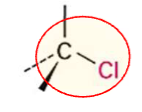
alkyl halide (haloalkane)

alcohol

ether

carbonyl
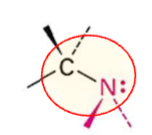
amine

thiol

sulfide

disulfide
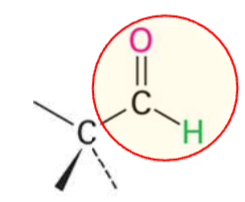
aldehyde

ketone
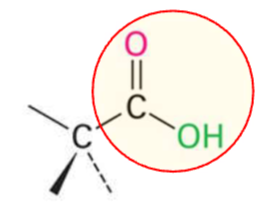
carboxylic acid
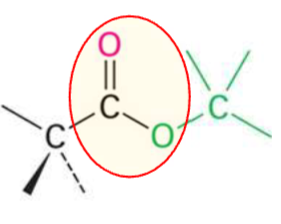
ester

thioester

amide

acid chloride
Methane
1-C
Ethane
2-C
Propane
3-C
Butane
4-C
Pentane
5-C
Hexane
6-C
Heptane
7-C
Octane
8-C
Nonane
9-C
Decane
10-C
staggered
most stable, high distance between atoms
eclipsed
high reactivity, high energy, minimal distance between atoms.
torsional strain
extra energy of eclipsed conformer over staggered conformer
H←→H eclipsed (cause and kJ/mol)
Torsional strain, 4.0 kJ/mol
H←→CH3 eclipsed (cause and kJ/mol)
Torsional Strain, 6.0 kJ/mol
CH3←→CH3 gauche (cause and kJ/mol)
Steric Strain, 3.8 kJ/mol
CH3←→CH3 eclipsed (cause and kJ/mol)
Both torsional and steric, 11.0 kJ/mol
anti-staggered conformation
the two largest or bulkiest substituents are 180 degrees away from each other. 0 kJ/mol
gauche conformation
the two largest or most bulky substituents are 60 degrees from each other, creating steric strain
steric strain
increase in a molecule's energy caused by repulsive forces between non-bonded atoms or bulky groups that are forced closer together than their van der Waals radii allow
syn eclipsed conformation
Least stable conformation, the two largest or bulkiest substituents are lined up as close as possible (pointing in the exact same direction)
Principal Quantam number (n)
describes the energy level (shell)
1 orbital - n=1
2 orbitals - n=2
Angular momentum quantam number (l)
describes the shape of the orbital. Ranges from 0 to (n-1).
0 = s orbital, 1 = p orbital, 2 = d orbital 3 = f orbital
magnetic quantam number (ml)
3-D orientation of EACH INDIVIDUAL ORBITAL. There will be a ml value for ALL values of l. For example, if l = 2, there will be a value for ml=0, ml=1, ml=2.
shape of p orbitals
dumbbell shaped
Nonpolar covalent bonds electronegativity difference
Lower than 0.5
Polar covalent bonds electronegativity difference
Ranging from 0.5 to 2
ionic bonds covalent bonds electronegativity difference
2 or higher
Resonance structures become possible when what appears (2 things)
lone pairs OR pi bonds
Bronsted Lowry definition
Acids donate H+ (protons), bases accept H+ (protons)
Acid/Base Reactions always favor which side?
whichever side gives the weakest acid or base.
Lewis definition
Acids are LP acceptors, bases are LP donors. Acids must have a COMPLETELY available orbital. Lewis bases will always have LP electrons available to donate
What makes a molecule hydrophilic?
OH and NH groups (per every 4 carbons at least). Compounds containing polar bonds and lone pairs also tend to be hydrophilic.
alkenes
have at laest one carbon-carbon double bond
alkyne
have at least one carbon-carbon triple bond
Arenes
have alternating single and double carbon-carbon bonds forming a ring.
alkanes
have only single bonded carbon and hydrogen atoms
alkane formula
CnH2n+2
Which alkanes cannot have any isomers?
methane, ethane, and propane. (not enough carbons)
constitutional (structural) isomers
have the exact same number and type of atoms, just arranged differently.

alkyl group
Formed when one hydrogen atom is removed from an alkane.
n-alkyl group
this group will ALWAYS have it’s disconnected hydrogen be at one of the ends of the molecule.
tertiary carbon/quaternary carbon
3 carbon bonds/4 carbon bonds
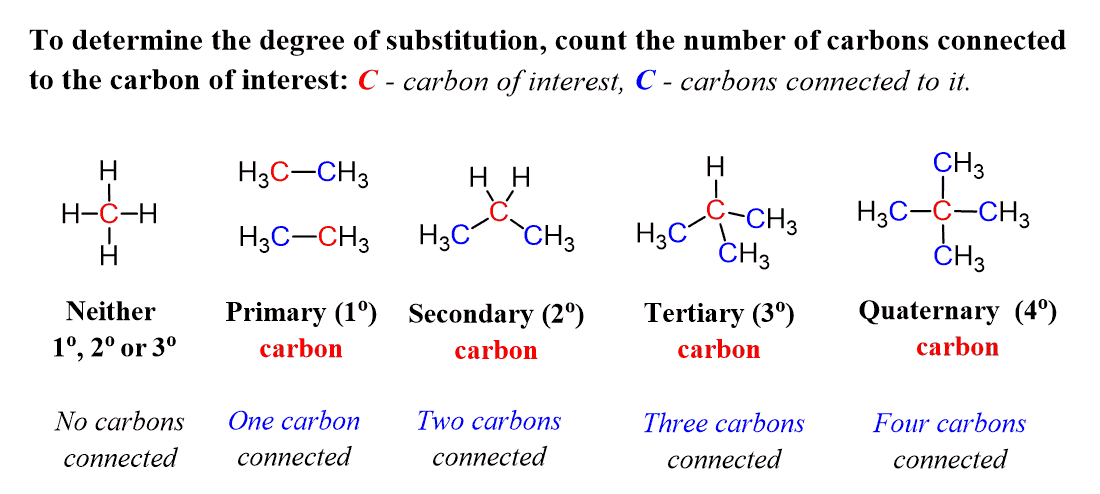
Why is a quaternary alkyl group impossible?
quatenary carbons have 4 carbon bonds, and due to alkyl groups having one available bond (disconnect), it cannot get a 4th carbon bond.
Boiling and melting points of alkanes
Increase as size of alkane increases, due to increase in dispersion forces.
Branching does what to an alkane’s boiling point?
Lowers it, because it reduces the interface (forces) between molecules
conformations
different arrangements of atoms that come from bond rotation
Conformers
atoms that are involved in molecules that have conformations
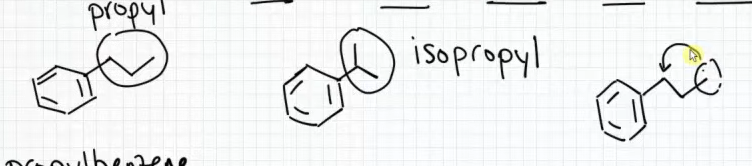
iso (for alkyl groups)
anything can be an iso if the last carbon on the branch is moved to the main part of the branch.
Sec-butyl
a four-carbon Butyl group where attachment to the main molecular chain occurs at a secondary carbon atom

tert-butyl
central carbon atom is bonded to three methyl groups

pKa
(-log(Ka)) Low pKa = strong acid. High pKa = weak acid.
Ka
acid constant. High Ka = strong acid, low Ka = weak acid (partial dissociation)