A&P Exam 1: Intro, Chem, Cell, Active + Passive Transport, Epithelium + Tissue
 Call Kai
 Learn
Learn Practice Test
 Spaced Repetition
 Match
Match Flashcards
 Knowt Play
1/118

There's no tags or description
Looks like no tags are added yet.
Name | Mastery | Learn | Test | Matching | Spaced | Call with Kai | Chat |
|---|
No analytics yet
Send a link to your students to track their progress
119 Terms
What is anatomy?
Study of the structure of body parts and their relationship to one another
What is physiology
Study of normal functioning of living organisms
Pathophysiology
The study of abnormal
functioning
Levels of organization
Biomolecules, organelles & cells, tissues (collections of cells), organs (collections of tissues), organ system (collections of organs), organ systems (collections of organs)

Integration across body systems
Integumentary, Musculoskeletal, Nervous, Cardiovascular, Immune, Respiratory, Renal, Endocrine, Digestive, Reproductive

Cell Theory of Life
1. All living things are made of cells
2. Cells come from cells, not spontaneous

Homeostasis
Homeostasis is a condition of
equilibrium, or balance, in the
body's internal environment

Homostatic mechanism
nervous system (nerve impulses), endocrine system (hormones)

negative feedback (homostatic)
This mechanism causes the variable to change in a direction OPPOSITE to that of the initial change, returning its to its "ideal"
value, (THINK body temp increases->cooling mechanism is sweating -> body temp decreases)

positive feedback
Response enhances or exaggerates original
stimulus and are designed to push levels out of normal ranges (THINK contractions of the uterine smooth muscle
during childbirth)

Cephalic
head

Cervical
neck
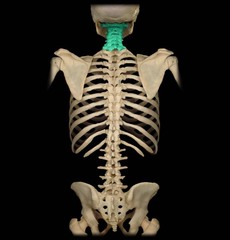
Thoracic
chest

Superior
Higher on the body, nearer to the head (ex: the head is superior to the abdomen.)

Inferior
away from the head or toward the lower part of the body (ex: the navel (belly button) is inferior to the chin)
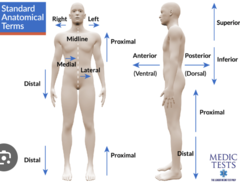
Ventral (anterior)
toward or at the front of the body; in front of (ex: the breastbone is anterior to the spine)
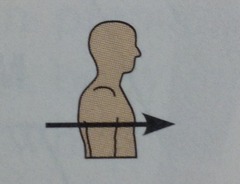
Dorsal (posterior)
Toward or at the back of the body; behind (ex: the heart is posterior to the breastbone)

Medial
toward the midline of the body; on the inner side of (the heart is medial to the arm)

Lateral
away from the midline of the body; on the outer side of (the arms are lateral to the chest)

intermediate
between a more medial and a more lateral structure (the collarbone is intermediate between the breastbone and shoulder)

Proximal
Closer to the origin of the body part or the point of attachment of a limb to the body trunk (the elbow is proximal to the wrist)

Distal
farther from the origin of a body part or the point of attachment of a limb to the body trunk (the knee is distal to the thigh)

Superficial (external)
toward or at the body surface (the skin is superficial to the skeletal muscles)

Deep (internal)
Away from the body surface; more internal (the lungs are deep to the skin)

Body Planes and Sections
The body and its organs may be cut along planes or imaginary lines to produce different types of sections or planes

sagittal plane
divides body into left and right

frontal (coronal) plane
divides the body into anterior (front) and posterior (back) parts

transverse plane
divides the body into superior (upper) and inferior (lower) parts

cranial cavity
contains the brain
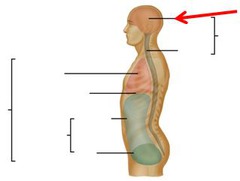
vertebral cavity
contains the spinal cord and the beginnings of the spinal nerves
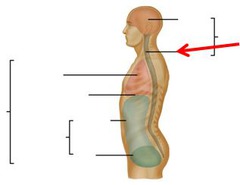
thoracic cavity
contains heart and lungs

abdominopelvic cavity
contains both the abdominal and pelvic cavities

abdominal cavity
Contains stomach, intestines, spleen, and liver, and other organs

pelvic cavity
contains urinary bladder, portions of large intestine, and internal organs of reproduction

Percardium
heart

Pleurae
lungs

peritoneum
abdominopelvic cavity

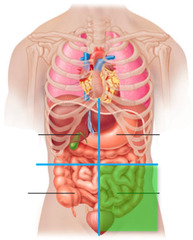
Right Upper Quadrant (RUQ)
Right lobe of liver, gallbladder, right kidney, portions of stomach, small and large intestine

Right Lower Quadrant (RLQ)
contains parts of the small and large intestines, right ovary, right fallopian tube, appendix, right ureter

Left Upper Quadrant (LUQ)
Left lobe of liver, stomach, pancreas, left kidney, spleen, portions of large intestine

Left Lower Quadrant (LLQ)
contains parts of the small and large intestines, left ovary, left fallopian tube, left ureter
chemical
the components of cells; includes nucleic acids, proteins, lipids, carbohydrates

cellular
the smallest unit of life; function depends on cellular organelles and internal structures.
Tissue
organized groups of cells (e.g., muscle cells form muscle tissue)

Histology
study of tissues
Epithelial
lines surfaces and forms a barrier (e.g., lining of digestive tract, skin)

Connective
most diverse; cells contained within an extracellular matrix of fibers and ground
substance. Includes bone, cartilage, adipose, blood, proper connective tissue
muscle
unique due to cells capable of contracting forcibly. Cause movement, change shape of
organs. Examples: biceps muscle, heart, muscle in intestines.

neutral
functions in communication (carrying messages, often over long distances) using
electrical signals.
Organ
comprised of more than one type of tissue to form a distinct structure. Ex - an artery is made of epithelium, smooth muscle, and connective tissue.

organ system
comprised of multiple component tissues and organs to provide a distinct set of
functions for the body.

integumentary system
Protection from environmental hazards; temperature control. (THINK skin, hair, nails, & glands)

skeletal system
gives our bodies structure and protects major organs like the heart, lungs, and brain. Provides support, protects soft tissues, stores minerals and produces blood

Muscular System
produces movement, support, produces heat

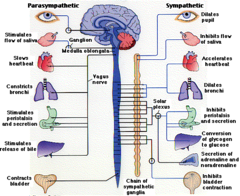
nervous system
Coordination of other systems (usually immediate), memory
(THINK: brain, spinal cord, nerves)
endocrine system
Consists of glands that control many of the body's activities by producing hormones. long-distance communication to regulate long-term changes in body function.
Often works closely with nervous system (Neuroendocrine system)

cardiovascular system
Movement of cells and dissolved materials (cells, nutrients, waste, signals,
gases). Consists of the heart and blood vessels.

lymphoid system
Provides defense against infection; returns fluids to cardiovascular system

respiratory system
Delivery of oxygen/removal of carbon dioxide; modulation of blood and tissue
pH; produces sound

digestive system
body system the breaks down food and absorbs nutrients/water/vitamins

urinary system
eliminates waste, regulates body fluid composition, controls pH (kidneys, ureter, bladder, urethra)

reproductive system
production of sex cells and hormones; supports embryonic development
from fertilization to birth (female)

Matter
Anything that has mass and occupies space

elements in the human body
- Major Elements - 96.1%
Oxygen, Carbon, Hydrogen, Nitrogen
- Lesser Elements - 3.9%
Calcium, Phosphorus, Sulfur, Potassium, Sodium, Chlorine, Magnesium, Iron, Iodine

Atomic Structure
The atom consists of three component parts: Protons, Neutrons, and Electrons.

Difference between molecules and compounds
All compounds are molecules but not all molecules are compounds. The main difference comes down to the types of atoms involved: a molecule can be made of the same element or different elements, while a compound must contain two or more different elements.

Ionic Bonds
Formed when one or more electrons are transferred from one atom to another

Covalent Bonds
Bonds created by sharing electrons with other atoms.

Nonpolar covalent bonds
equal sharing of electrons. (ex: CO2)

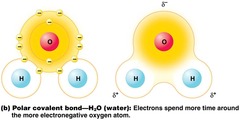
Polar Covalent Bonds
unequal sharing of electrons (ex: H2O)
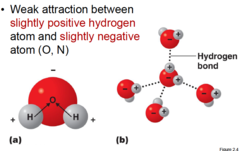
What is a Hydrogen Bond
Very weak bonds; occurs when a hydrogen atom in one molecule is attracted to the electrostatic atom in another molecule (not a true bond)
kinetic energy
energy of motion (action) (ex: THINK: walking, running, throwing a ball)

potential energy
stored (inactive) energy (THINK: child on top of a slide, roller coaster at its highest point.)

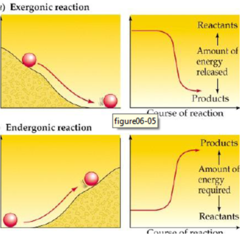
Exergonic
releases energy by breaking bonds. (Catabolic reactions)

Endergonic
absorbs energy by building energy
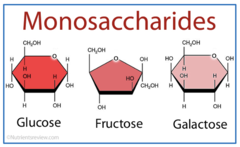
What are the 3 types of Monosaccharides
glucose(most abundant sugars ; Absorbed directly into the bloodstream during digestion), fructose(fruit sugar; Absorbed directly into the bloodstream), galactose (found in dairy; Absorbed directly into the bloodstream during
digestion)
Lipids (fats)
phospholipids (form the main barrier of cell membranes.), cholesterol (a waxy, fat-like substance that your body needs to build cells, make hormones, and digest food), steroids (important part of hormones)

Amino Acids
building blocks of proteins, 9 essential amino acids, 11 non essential amino acids

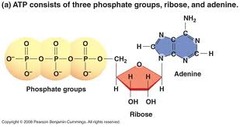
ATP (adenosine triphosphate)
main energy source that cells use for most of their work
Cell Theory
idea that all living things are composed of cells, cells are the basic & smallest units of structure and function in living things, and new cells are produced from existing cells

Hierarchy of Organization
atoms, molecules, macromolecules, organelles, cells, tissues, organs, organ systems, organism

Cell membrane (plasma membrane)
lipids (phospholipids: make up the membrane. They control what enters and what leaves the cell.), proteins (help transport substances and send signals), carbohydrates (help cells recognize and communicate with each other)

essential functions of the cell membrane
protection (LIPIDS- protects the inside of the cell), transport (PROTEINS-controls what enters and what leaves the cell), communication (CARBOHYDRATES-receives signals and communicate with other cells), homeostasis (keeps the cells internal environment stable)

integral proteins vs peripheral proteins
Integral proteins are tightly attached to the membrane; help move substances across. and peripheral proteins are loosely attached to the membrane; help with support and communication

Cellular Extensions
Cilia(fixed, tiny hairs that move substances across the cell surface), Flagella(mobile; long, tail like structures that help the cell move. EX: sperm) and Microvilli (tiny finger like extensions that increase surface area to absorb and secrete nutrients. ex: in the digestive system especially small intestine)

DNA vs RNA
DNA: stores genetic info, deoxyribose sugar, uses T thymine, double strand
RNA: helps make proteins, ribose sugar, uses U uracil, single strand

Karyotype
A display of all the 46 chromosome pairs of a cell arranged by size and shape.

Nucleus
stores DNA ; Control center of the cell

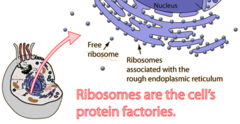
Ribosomes
Makes proteins (protein synthesis)
APE sites
A- (ACCEPTS) enters, P- (Peptidyl) bonded together, E- EXITS

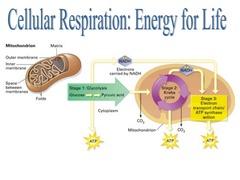
Mitochondria
Powerhouse of the cell. Produces ATP (energy). Neutralize dangerous free radicals. Detoxify harmful or toxic substances.

Endoplasmic Reticulum (ER)
Transports substances, stores newly synthesized molecules,
synthesizes and packages molecules, detoxifies chemicals, and
releases calcium ions involved in muscle contraction (Rough ER) (Smooth ER)

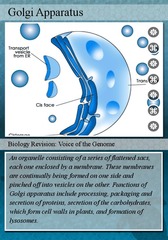
Golgi apparatus
modifies, concentrates (sorts), and packages proteins and lipids
Lysosomes
Break down waste and old cell parts. Digest ingested bacteria, viruses, and toxins. Degrade nonfunctional organelles. Destroy cells in injured or non-useful tissue
(autolysis)

gene expression
Replication (copying DNA), Transcription (DNA into mRNA), Translation (RNA -> Protein; makes proteins)

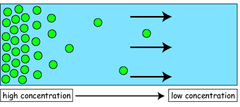
Diffusion (high to low)
Movement of molecules from an area of higher concentration to an area of lower concentration. (no energy)
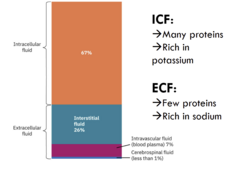
ICF (intracellular fluid) vs ECF (extracellular fluid)
ICF: is fluid inside the cell (cytosol) 2/3 of all body fluids
ECF: fluid outside the cell 1/3 of all body fluids
passive transport
Requires NO energy(no ATP), Movement of molecules from high to low concentration, Moves with the concentration gradient
TYPES: filtration, simple diffusion, facilitated diffusion, osmosis

active transport
Energy (ATP) is required; Moves low to high concentration
Active Process TYPES: Active transport, vesicular transport

Filtration
movement of water (solvent) and substances (solutes) down their concentration gradients due to hydrostatic pressure. EX: Kidneys, liver
