Organization of the Body and Homeostasis
 Call Kai
 Learn
Learn Practice Test
 Spaced Repetition
 Match
Match Flashcards
 Knowt Play
1/34

There's no tags or description
Looks like no tags are added yet.
Name | Mastery | Learn | Test | Matching | Spaced | Call with Kai | Chat |
|---|
No analytics yet
Send a link to your students to track their progress
35 Terms
Physiology
the study of the normal functioning of a living organism and its component parts
includes chemical and physical properties of the body
involves the integration of function across all levels of organization and the entire organism
Types of cells
200 distinct cells
4 broad categories formed from cell differentation
epithelial
connective-tissue
neurons
muscle

Epithelial cells
found at surface of body or hollow organ
specialized to secrete or absorb ions and organic molecules
Connective-tissue cells
from extracellular elements that connect, anchor, and support body structures
Neurons
cells of the nervous system that are specialized to initiate, integrate, and conduct electrical signals to other cells
Muscle cells
specialized cells that contain Actin and myosin filaments capable of generating force and movement
tissues
collection of cells that carry out related functions
4 types: epithelial, connective, nervous, muscle
organs
composed of multiple tissue types and carry out related functions
example (blood vessels have layers of smooth muscle cells, endothelial cells, and fibroblasts)
organ system
contain multiple organs that work together
example: the urinary system has the kidney, ureters, urethra, bladder
integumentary system
composed of the skin
forms a protective boundary that separates the body’s internal environment from the external environment
Digestive system
takes up nutrients and water and eliminates wastes
reproductive system
produces eggs or sperm
immune system
provides defense against foreign invader
endocrine system
coordinates body function through synthesis and release of regulatory molecules
nervous system
coordinates body function through electrical signals and release of regulatory molecules
circulatory system
transports material between all parts of the body
respiratory system
exchanges oxygen and carbon dioxide between the internal and external
musculoskeletal system
provides support and is responsible for movement
urinary system
maintains water and solutes in the internal environment; waste removal
intracellular fluid
fluid located inside cells
extracellular fluid (ECF)
composed of both the fluid in the blood (plasma) and fluid surrounding the cells (interstitial fluid)
serves as a buffer zone between cells and the outside environment
Interstitial fluid
fluid surrounding the cells
located within the interstitium
Total Volume of body fluid
67%: intercellular fluid
26% interstitial fluid
7% plasma

Homeostasis
the relatively stable conditions of internal environment that results from regulatory system actions
physiology: homeostasis is maintained
pathophysiology: homeostasis is not maintained
Dynamic constancy
levels change over short period of time, but remain relatively constant over long periods of time
ex: blood glucose levels peaking after eating, returning to set point via homeostasis
reflex
biological control system linking stimulus with response to maintain homeostasis
specific INVOLUNTARY, unpremeditated, unlearned “built-in” response to a particular stimulus
reflex arc
mediates a reflex
components: stimulus→receptor→afferent (incoming) pathway→integration center→ efferent (outgoing) pathway→ and effector
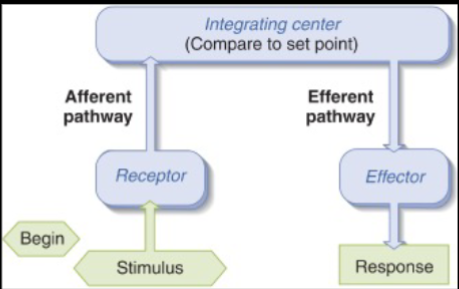
stimulus
a detectable change in the internal or external environment
receptor
detects the change
afferent pathway
the pathway the signal travels between the receptor and the integrating center
integrating center
can recieve signals from many receptors, some of which may respond to quite different types of stimuli
efferent pathway
pathway along which information travels AWAY from the integration center to the effector
Effector
2 specialized classes of tissues: muscles and glands
major effectors of biological control systems
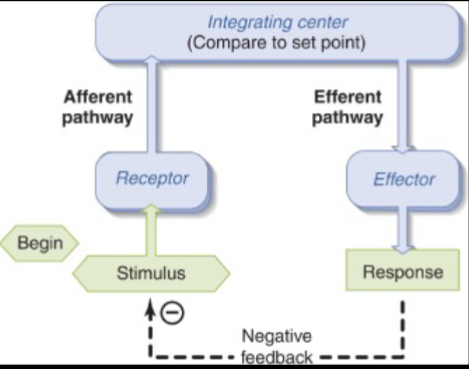
Negative feedback
regulates reflex arcs
shuts the system off once the set point has been reached in order to keep the system at or near the set point
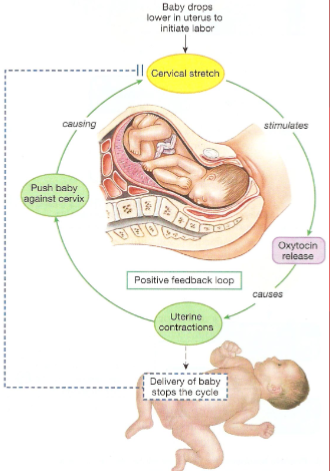
Positive feedback
reinforces a stimulus and are NOT homeostatic
triggers a cycle of ever increasing response
ex: childbirth and the release of oxytocin