ch 12-1 Saturn
 Call Kai
 Learn
Learn Practice Test
 Spaced Repetition
 Match
Match Flashcards
 Knowt Play
1/40

There's no tags or description
Looks like no tags are added yet.
Name | Mastery | Learn | Test | Matching | Spaced | Call with Kai | Chat |
|---|
No analytics yet
Send a link to your students to track their progress
41 Terms
Saturn
6th
2nd largest
less than 1/3 of Jupiter’s mass
no solid surface
less sense
has most planets
bright rings
what is the radius of Saturn?
600,000km
what is the mass of Saturn?
5.7 × 1026
what is the density of Saturn?
700 kg/m3
less than water
least dense planet
would Saturn float if placed in a large enough body of water?
yes, lower mass results in lower interior pressure, gasses less compressed than Jupiter
Saturn’s rotation
rapid and differential, enough to flatten Saturn considerably
atm. rotates at different speeds depends on latitude
10.5 hours
what does atm. rotation period determined by?
tracking weather features
what does Saturn’s lower density cause?
it to be flatter
Saturn’s rings
very prominent; wide but extremely thin
maybe debris from shattered moons
rocky and icey particles
young 10-100 Ma
Saturn’s rapid speed
oblate spheroid
bulges at equator
flatten at poles
who first observed Saturn’s rings?
Galileo
2 lateral components
“ears”
triple bonded
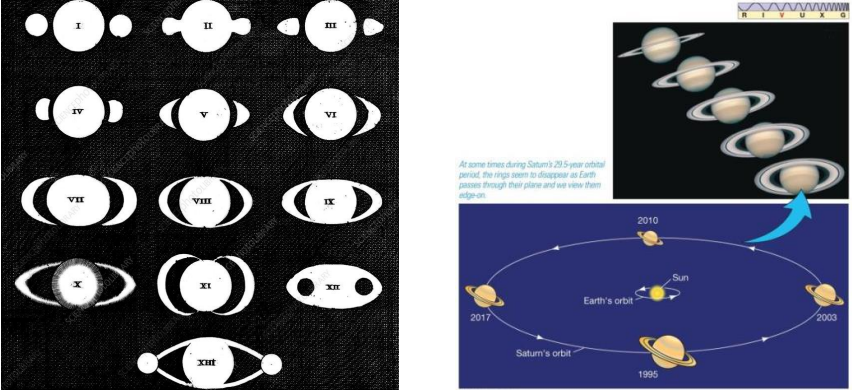
where do Saturn’s ring lie?
in the equatorial plane
as Saturn moves along its orbit, angles at which the rings are illuminated and which we view them vary
what did Huygens discover?
Saturn was surrounded by a thin, flat, independent ring
ecliptic plane
space between planet is thick
how do the view of Saturns rings change?
disappears from Earths view every 10-15 years
appearance changes as tilted plane
what is Saturn’s atmosphere composed of?
mostly molecular hydrogen 92.4%, helium 7.4%, methane 0.2%, and ammonia 0.002%
helium fraction is much less than on Jupiter
chaotic gas envelope
Saturn’s surface
lack solid surface
transition to liquid interior under high pressure
what does Saturn’s atmosphere show?
zone and distant horizontal band structures (parallel to equator), but coloration is much more subdued than Jupiter’s
how does Saturn’s atmosphere form?
in layers with ammonia crystals on top
ammonia hydro surface at lower depth
Saturn’s bands
are more subdue, wider, and colorful
organic and smog likely due to increased sulfur content
what direction do zonal winds flow?
east → west
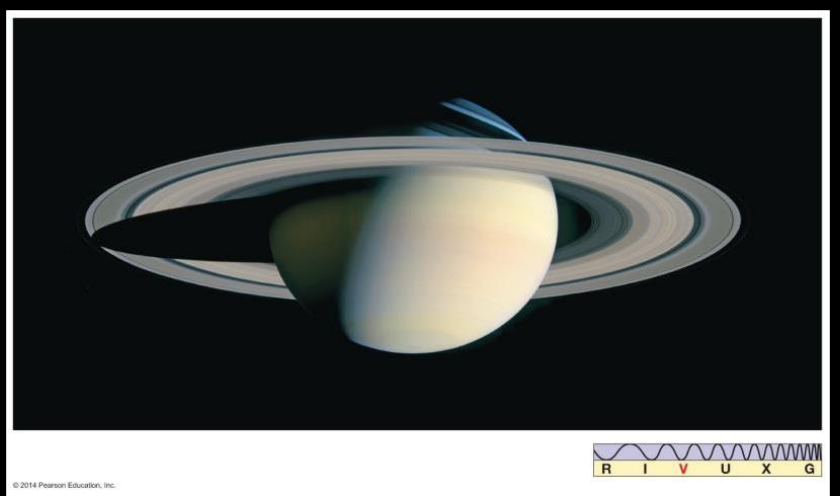
this true-color image shows the delicate coloration of the cloud patterns on Saturn
what is Saturn’s atm. similar to?
similar to Jupiter’s except pressure is lower
what does Saturn’s atm. composed of?
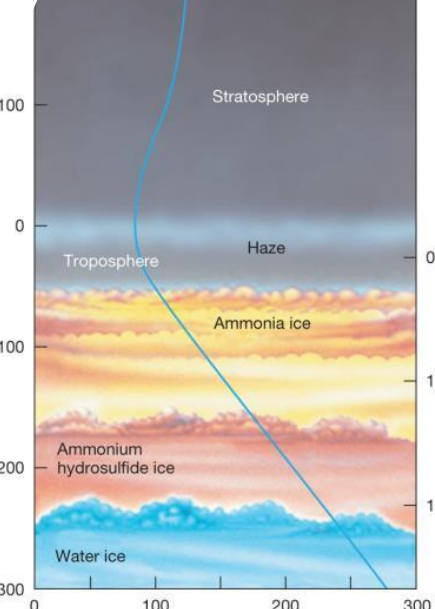
3 cloud layers
cloud layers are thicker (spread further apart) than Jupiter’s; see only top layer (butterscotch appearance)
what is the total thickness of all 3 cloud layers?
200km thick
reason for difference in Saturn’s weaker gravity
butterscotch hue
what are the three cloud layers?
ammonia ice clouds
highest layer
coldest layer
ammonium hydrosulfide clouds
middle layer
made from ammonia + sulfur compounds
water clods
deepest major cloud layer
warmest of the three
what is zonal flow?
wind patterns on Saturn are similar to those on Jupiter
18,000 km/h
same flow as rotation
bands parallel to equator
faster and less east-west alterations
what can Jupiter-style “spots” can turn into?
large storms on Saturn, then dissipate relatively quickly
what are “spots”?
massive storms, spots, hexagonal features
large spots are rare
roughly 30 years during planets northern summer
“great white spots”
planet encircling storm that occurs 1 every Saturn year (~29.5 Earth years)
start as spiral vortices
explosions last long but dissipates quick
giant vortices exist at both poles of Saturn, apparently due to?
jet streams
rotate high above cloud tops
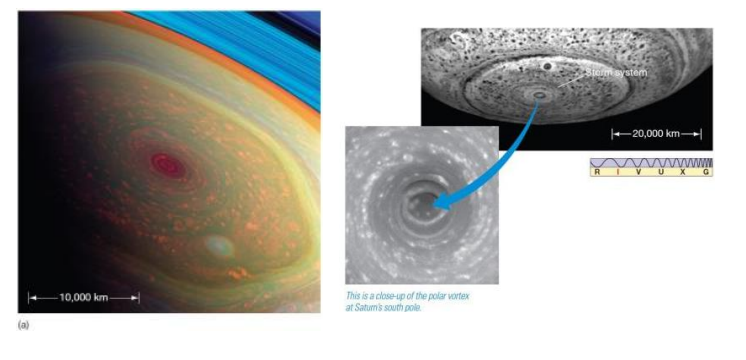
giant vortices at north and south poles
whorl pools → polar vortices
hurricane like cyclone
unique long live hexagonal jet stream
Saturn’s interior and magnetosphere
interior structure similar to Jupiter’s
dense fuzzy core of rock and ice → 20 x mass of Earth
surrounded by liquid hydrogen layer
what does Saturn also radiate?
more energy than it gets from the Sun, but no because of cooling
Why does Saturn radiate more energy than it receives from the Sun?
Because helium condenses into droplets and falls deeper into the planet, releasing gravitational energy as heat.
What is helium rain?
The process in which helium separates from hydrogen, forms droplets, and sinks deeper into Saturn.
How does helium rain heat Saturn?
As helium droplets fall inward, gravitational compression releases energy as heat.
What role does Saturn's gravitational field play in helium rain?
It pulls helium droplets inward, releasing heat through gravitational compression.
extra heat on Saturn
at higher temps. and high pressure, found Jupiter’s interior, liquid helium dissolves in liquids
inside Saturn where internal temp is lower the He doesn’t dissolve so easily and tends to from droplets instead
Saturn’s Magnetosphere
strong magnetic field, but only %5 as strong as Jupiters
extends ~1 million km toward the sun and large enough to contain the planets ring system and innermost 16 small moons
emits radio waves, reflected from Earths ionosphere
what does Saturn’s Magnetosphere create?
Aurorae
sometime from spirals
what was thought about the magnetospheres tilt?
needs tilt to sustain currents through liquids metal deep in planet
without tilt, current dies