TV4001/4002 Small Animal Oncology
 Call Kai
 Learn
Learn Practice Test
 Spaced Repetition
 Match
Match Flashcards
 Knowt Play
1/182

There's no tags or description
Looks like no tags are added yet.
Name | Mastery | Learn | Test | Matching | Spaced | Call with Kai | Chat |
|---|
No analytics yet
Send a link to your students to track their progress
183 Terms
Cluster of molecular disturbances causing abnormal growth regulation
Cells no longer respond to stimuli that regulate growth & differentiation
They also hijack cellular support mechanisms and evade inflam/immune defences
What is cancer?
Smoking, asbestos, radiation exposure.
Most cause: Inflammation, damage to DNA, ROS damage
What are some risk factor for cancer and what do these risk factors for cancer all cause?
Sustaining proliferative signalling
Evading growth suppressors
Activating invasion and metastasis
Enabling replicative immortality
Inducing angiogenesis
Resisting cell death
What are the hallmarks of cancer?
Epithelial, mesenchymal, round cell (based on embryogenic progenitors
What are the 3 broad categories of cancer?
Tumour arising from cell linings/glandular structures. e.g., SCC, ACA
Carcinoma
Tumour arising from connective tissue. e.g., HSA, OSA
Sarcoma
Rate of growth
Manner of growth
Effects in adjacent tissue
Metastasis
Effect on host
What are the features that differentiate benign tumours from malignant ones?
Relatively slow
Expansive
Usually well-defined boundary btw neoplastic and normal tissues. May become encapsulated
What is the rate & manner of growth for benign tumours?
Often rapid. Rarely ceases growing
Invasive
Poorly defined borders, tumour cells extend into and may be scattered throughout adjacent normal tissues
What is the rate & manner of growth for malignant tumours?
Often minimal
May cause pressure necrosis and anatomical deformity
What is the effects in adjacent tissue for benign tumours?
Often serious
Tumour growth and invasion results in destruction of adjacent normal tissues, manifests as ulceration of superficial tissues, or lysis of bone
What is the effects in adjacent tissue for malignant tumours?
does not occur
Does metastasis occur with benign tumours?
Metastasize by lymphatic and haematogenous routes and transcoelomic spread
Does metastasis occur with malignant tumours?
Minimal (can be life threatening if tumour develops in a vital organ e.g. brain)
Outline the effect on host of benign tumours
Life-threatening by virtue of destructive nature of growth and metastatic dissemination to other vital organs
Outline the effect on host of malignant tumours
Anatomical perturbations, i.e., lameness, dyspnoea, seizures, GIT obstruction
What are the local effects of cancer?
General: Weight-loss, pain, malaise, inflammation
Paraneoplastic syndromes
What are the systemic effects of cancer?
Often older pets
Breed predispositions: Rottweiler (OsteoSarcomA - OSA), Golden Retriever (LymphoSarcomA -LSA), GSD (hemangiosarcoma)
Presentations: Sick animal, visible mass/lump
Outline the typical cancer presentations/signalment
BIOPSY!
FNA
Trucut biopsy
Incisional biopsy
Excisional biopsy
What is the diagnostic approach to cancer?
Cells are spread (swash or slide)
Can offer definitive dx in some cases
Adv: Quick, cheap, fairly sensitive. 66% sensitivity for cytology
Outline the use of FNA for diagnosing cancer
Mast cell tumour, lymphosarcoma, melanoma.
Which tumours can FNA offer a diagnostic for?
Small samples (18-14g core)
Easy to sample non-representative area, cannot grade lesion
Not much more sensitive than FNA
Not recommended
Outline the use of a tru-cut biopsy for diagnosing cancer
Cutting a portion of the mass off
Allows to develop a diagnostic approach before intervention
May improves outcome: Histological grade prior to SX
May not add value: No histo grade, risk of seeding tumour into adjacent areas, risk of getting a non-representative region
Outline the use of a incisionial biopsy for diagnosing cancer
Take the whole mass off and send off
Advantage: Diagnostic and potentially curative, less cost, most dx
Disadvantage: May irreparably compromise long term prognosis (take out with two small of margins, and in future to hard to get the rest out
Should always do a pre-excisional biopsy check
Outline the use of an excisional biopsy for diagnosing cancer
Stick a needle in first (FNA)
Full physical (lymph node check, lump-hunt, co-morbidities)
Get a minimal database
Thoracic rads or abdominal U/S
Explain to owner the risks. Get them to sign something indicating you have explained these things
Consider consult with specialist
What is involved in a pre-excisional biopsy check
Never cut off a lump without sending for histopathology
If adamant they cant send ensure that you always place a lump into formalin
What's involved in a post-excisional biopsy check?
Done by a histopathologist
Refers to the histological appearance of a tumour
Categorised in some way (1-4, low, moderate, high)
Associated with biological aggression and likelihood to metastasise
What is cancer grading
Understanding of the level of aggression: How much tissue is required to remove, where can it spread to
PX of the animal: Likelihood of metastasis/ recurrence, median survival time, median disease free interval
TX: Post OP chemo/ radiation. More extensive sx
What does grading allow?
For general clinician
TMN System
Classified according to the nature of the mass, whether it has extended beyond the limits of the mass
What is cancer staging
Local vs systemic
Prognosis according to stage
Establish TX plan: Multimodal approach, lymph node excision, chemo/radiation
What does staging allow?
T0 - Primary neoplasm is not evident
T1 - Less than 1cm, mobile
T2 - 1-3cm in diameter, not deeply attached
T3 - 3-5cm, partially fixed to underlying structures
T4 - >5cm, invading deeper structures
Outline the use of the TNM system to describe: Tumours
N0 - palpably normal size and consistency
N1 - Enlarged, firm (ipsilateral)
N2 - Fixed to surrounding tissue
N3 - Involvement of lymph nodes beyond the first station
Outline the use of the TNM system to describe: Nodes
M0 - No evidence of metastasis
M1 - Single visceral metastasis
M2 - Multiple visceral metastases
Outline the use of the TNM system to describe: Metastasis
Disruption to physiology and homeostasis that occur systemically or distant to the tumour and are not directly related to the mass effect of the tumour
Define paraneoplastic syndromes
Cachexia, fever
Hyperhistaminaemia
Hypercalcaemia
Hypoglycaemia
Hyper(gamma)globulinaemia
Extreme neutrophilia
Erythrocytosis
Hypertrophic osteopathy (Marie's diseases)
Myasthenia gravis
Alopecia
What are some paraneoplastic syndromes?
Mast cell tumours
Results in ulcers
Which tumours can cause Hyperhistaminaemia?
Anal sac adenocarcinoma
Lymphoma
Which tumours can cause hypercalcaemia?
Ca has many roles (heart beat, metabolism, nerve function, blood clotting)
Maintained within range of 1.1-1.5nMol/L (ionised calcium)
What is calcium important for in the body?
Parathyroid and kidneys most important in keeping this so tightly regulated
Thyroid produces calcitonin which decreases calcium in the blood and parathyroid produced PTH which increases calcium in the blood.
How is calcium regulated?
Activates D3 to promote intestinal and kidney resorption and works with D3 to mobilise calcium from the bone.
How does parathyroid hormone increase calcium in the blood?
Humoral
Tumours produce parathyroid hormone related peptides (PTHrP)
E.g. Lymphoma, anal gland adenocarcinoma, multiple myeloma
Cell mediated
Bone mets, osteoclastic activity
Unlikely to be marked hyper-Ca
What are the two forms of hypercalcaemia?
PU/PD (before irreversible kidney damage). Later get irreversible renal failure
Anorexia, V+, constipation
Bradycardia and hypertension
Skeletal muscle weakness
Depression
Stupor, coma, seizures
What are the signs of hypercalcaemia?
Error
Young animal
Lymphoma, apocrine gland adenocarcinoma of anal sac (most common cause in dogs)
Multiple myeloma, lymphoid leukaemia
Primary hyperthyroidism
Bone metastases
Chronic, severe granulomatous disease
Cholecalciferol intoxication
Hypoadrenocorticism (Addison's disease)
What are some differentials causing hypercalcaemia?
Insulinoma, secreting insulin
Large liver tumours (hepatomas, hepatocellular carcinomas)
Leukaemia's
Salivary adenocarcinoma
Non-islet solid tumours (make insulin-like growth factors)
Leukaemia cells may consume blood glucose
What are some causes of Hypoglycaemia?
Oesophageal and large abdominal tumours
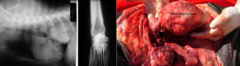
What can cause Hypertrophic osteopathy (Marie's diseases)
Hypertrophic osteopathy (Marie's diseases)
Malignant spirocerca lupi cancer in the distal oesophagus
What is depicted in the following image?
Multiple myeloma (most common), often make a monoclonal Ig (most often A)
Lymphoma
What are some causes of Hyper(gamma)globulinaemia
Causes a hyperviscocity syndrome
Bleeding
Retinopathy
Seizures
Renal disease
Heart disease
What are the signs of hypergammaglobulinaemia?
Involves identifying and treating underlying cause (e.g. Melphalan and prednisone if multiple myeloma)
+/- phelbotomy/ crystalloid fluid replacement
What is your approach to Hypergammaglobulinaemia
Several, esp. kidney/renal tumours
Others include mesothelioma
What can cause erythrocytosis
Multifocal causes
Hard to correct nutritionally (and often not achieved)
Large reason owners put animals down
Cachexia, fever
Thymoma
What can cause myasthenia gravis
Anorexia, weight loss, fatigue, impaired immunity
Cytokines (produced by some tumours) mobilise nutrition for white cells.
What are the signs of cancer cachexia
Cholangiocarcinoma
What can cause paraneoplastic alopecia?
Systemic (PO or IV)
Intralesional/ intracavitary
Neoadjuvant (before sx)
Adjuvant (during or after sx)
What are the types of chemotherapy administration?
Induce a complete & durable remission
Delay development of multiple drug resistance
Minimise morbidity associated with TX and with DZ itself
± Induce a second remission following relapse after primary treatment course
What are the goals of chemotherapy?
Use drugs that are effective as single agents
Combine drugs with different MOA
Use drugs with different toxicities
Use an intermittent TX schedule
TX aggressively
What are the principles of chemotherapy?
Chemotherapy kills a known fraction of the cancerous cells. e.g log 4 - will reduce 10^12 to 10^8
Chemo drugs action work via fractional killing. What is fractional killing?
10^9 cells
What is the detection limit of cancer?
Low dose given constantly over long period of time -> Rate isn't lethal to cancer, isn't given at a cytotoxic conc means body isn't as effected
Goal is to prevent progression, anti-angiogenic and anti-T reg effects.
What is metronomic chemotherapy?
When owners decline conventional therapy or there is incomplete excision of a tumour that can't be fixed.
When would you use metronomic chemotherapy?
Achieve a definitive diagnosis
± Stage tumour
Explain carefully to the owner
Understand the drugs and their potential toxic effects
Understand how to handle the drug safely
What are the prerequisites for chemotherapy?
Some chemo agents are carcinogenic & teratogenic
Adverse effects dependent on dose & exposure time
Some agents are powerful irritants/ vesicants
Why do you need to understand how to handle the drug sefely?
Any excrement are considered cytotoxic -> should be handled only with gloves for 24-72hrs post TX
What are some risks to owners?
Keep separate from other drugs
Never break tablets
Check DOSE and ROUTE before admin
Have everything ready
Owners - provide with gloves & well labelled drugs
All the PPE and equipment used must go into a separate cytotoxic bin (Purple bin)
Outline some considerations regarding drug safety
Good restraint +/- sedation
Start IV catheter placement as distally on each limb as possible
Flush with 5-10ml saline afterwards, before catheter removal
Vein protection: Drawing blood use jugulars, record keeping of which veins used for what drugs & when
Outline some considerations regarding patient safety
Body surface area (BSA) mg/m2
In small dogs -> mg/kg
How are antineoplastic drugs dosed?
Bind and disrupt DNA, interfere with DNA synthesis by intercalating with DNA
Cyclophosphamide, Chlorambucil, Melphalan
What is the MOA of alkylating agents and provide some examples
Alkylating agents
Anthracyclines - anti-tumour antibiotics
Platinum drugs
Antimetabolites
Antimicrotubule agents
Misc: L-asparaginase / Procarbazine
What classes of drugs are commonly used for chemotherapy?
Alkylating agent
IV or oral
Lymphoma, sarcoma, carcinoma
Side effects: Haemorrhagic cystitis, GI signs, Myelosuppressive
Outline the use of Cyclophosphamide
More so dogs
Due to metabolisation in blood stream into number of compounds
Hemorrhagic cyst due to acrolein that enters and sits in the bladder
TX: mesna (antidote), regular walking and diuretics
Cyclophosphamide causing hemorrhagic cystitis
Oral
Nitrogen mustard alkylating agent
For chronic lymphocytic leukemia (CLL) or Multiple myeloma
Possible replacement for cyclophosphamide
Side effects: Myelosuppressive (use it to suppress bone marrow cancers)
Chlorambucil
Alkylating agent
Oral or IV
Myelosuppressive
Used for MM, CLL
Melphalan
Anti-tumour antibiotics
Doxorubicin, Dactrinomycin, Mitoxantrone
What is the MOA of anthracyclines and provide some examples?
Anthracyclines: Anti-tumour antibiotics
Cornerstone drug, lymphoma, sarcoma, carcinoma
Only IV
Best single use drug (go to if tight budget).
Side effects: Severe vesicant, perivascular sloughing, myelosuppression, cumulative cardio toxicosis, cardiomyopathy (dogs), renal failure (cats)
Doxorubicin
Anthracyclines: Anti-tumour antibiotics
Myelosuppression, extravasation reaction, diarrhoea, vomiting
Dactrinomycin
Anthracyclines: Anti-tumour antibiotics
Used for lymphoma, carcinoma
IV
Myelosuppression, GI effects
Mitoxantrone
Cross-link DNA, inhibiting DNA synthesis and function
Carboplatin, Cisplatin
What is the MOA of platinum drugs and provide some examples?
2nd gen platinum drug, like an alkylating agent
Admin via IV, IP (intra-perioneal), Itu (intra-tumour)
Used for OS, M.Mel, CAs
Side-effect: Myelosuppression
Carboplatin
Sarcoma, carcinoma
Renal toxicosis, V+ & D+, Mild myelosuppressive
Not in cats: Fatal pulmonary oedema in cats
Cisplatin
Similar to nucleotides, get incorporated into DNA causing damage
Methotrexate, Cytosine arabinoside, Gemcitabine, 5-Fluorouracil (not in cats)
What is the MOA of antimetabolites and provide some examples?
Antimetabolites
Oral or IV, used for lymphoma
Myelosuppressive, GI toxicity
Methotrexate
Anti-metabolite, interferes with DNA synthesis
Admin via SC, IV, IP, Intrathecal
Myelosuppressive, good blood brain barrier penetration
Indications: Lymphoma
Cytosine arabinoside
Inhibit spindle formation during mitosis
Vincristine, Vinblastine SO4
What is the MOA of antimicrotubule agents and provide some examples?
Antimicrotubule - mitotic spindle inhibitor
Cornerstone Drug; Esp. Mast cell tumours, Lymphoma, and TVT in dogs
Only IV
Side effects: vesicant, mild myelosuppression, anorexia in cats, +/- neuropathy and constipation
Vincristine
Antimicrotubule - mitotic spindle inhibitor
Only IV, For mast cell tumours
Vesicant, myelosuppression, peripherally neuropathy
Vinblastine SO4
Cornerstone drug, many actions, usually orally
Side effects: PU/PD, polyphagia, panting
Is protective against haemorrhagic cystitis
Prednisolone
Enzyme that destroys asparagine (needed by lymphoma cells)
Not cytotoxic
SC or IM
Good early-stage drug (esp. for early stage presumption dx)
Side effect: Anaphylaxis (quite rare), may increase toxicity of vincristine
L-asparaginase
Generally work on rapidly dividing cells
Susceptible tissue: Rapidly dividing tumour, bone marrow, gastrointestinal mucosa (crypts)
How does anti-neoplastic drugs react to normal tissues?
Most common and important form of toxicity
Bone marrow progenitor cells have a high proportion of dividing cells
Cats more commonly affected than dogs
Myelosuppression
Doxorubicin (Highly myelosuppressive)
Cyclophosphamide
Cytosine arabinoside
Melphalan
Vinblastine
Azathioprine
Hydroxyurea
What are some drugs that cause myelosuppression?
Peripheral blood cytopenia's; First granulocytopenia, then thrombocytopenia, and then anaemia.
How does myelosuppression present clinically?
Look at neutrophils (stop chemo and give AB if gets too low), Measure rectal temp regularly (>40 degrees go to vet).
How can you monitor myelosuppression?
Lowest cell count after chemo
Generally 7-10d post-drug admin
Cell counts usually rebound within 1-2d
Nadir
Risk of sepsis is of major concern
Owners to check rectal temp of patient on regular basis; If pyrexia (>40C) or other illness would prompt immediate medical tx
WBCC and differential counts and platelet should be checked regularly
CBC should always be checked 10-14d after doxorubicin therapy
Monitoring the cancer patient during treatment
Nausea and vomiting
Gastroenteritis (seen if sufficient mucosal cells die and slough off)
Constipation (occasionally seen with vincristine)
GI toxicity signs
May be seen with doxorubicin, cyclophosphamide, high dose vincristine
May be due to stimulation of CNS centre, starts at the time of admin and may last for 1-2days
May be due to GI mucosal damage
What can cause GI toxicity?
Metoclopramide, prochlorperazine, ondansetron, maropitant
Cyproheptadine and mirtazipine in cats
What antiemetics are given to treat GIT toxicity?
Leukaemias: Acute & chronic lymphoblastic leukaemia
Plasma cell tumours: Multiple myeloma & solitary lymphoma
Lymphoma
What are the types of lymphoproliferative diseases?
Idiopathic
Some associations with genetic predisposition, familial, retorival, magnetic fields, herbicides
Outline the aetiology of lymphoma