3) Vascular Physiology
 Call Kai
 Learn
Learn Practice Test
 Spaced Repetition
 Match
Match Flashcards
 Knowt Play
1/71

There's no tags or description
Looks like no tags are added yet.
Name | Mastery | Learn | Test | Matching | Spaced | Call with Kai | Chat |
|---|
No analytics yet
Send a link to your students to track their progress
72 Terms
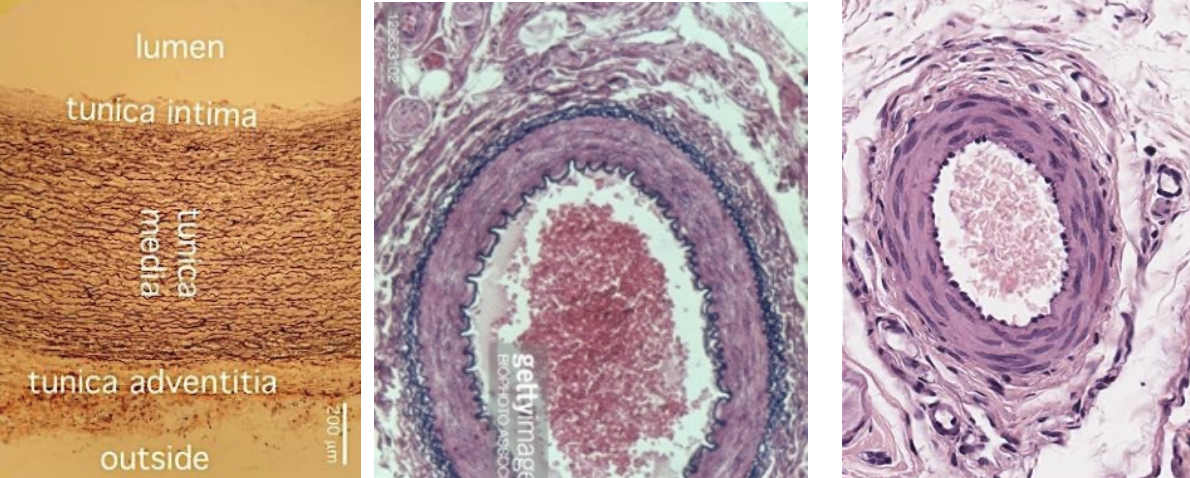
How does a Elastic and Muscular artries, Arterioles appear?
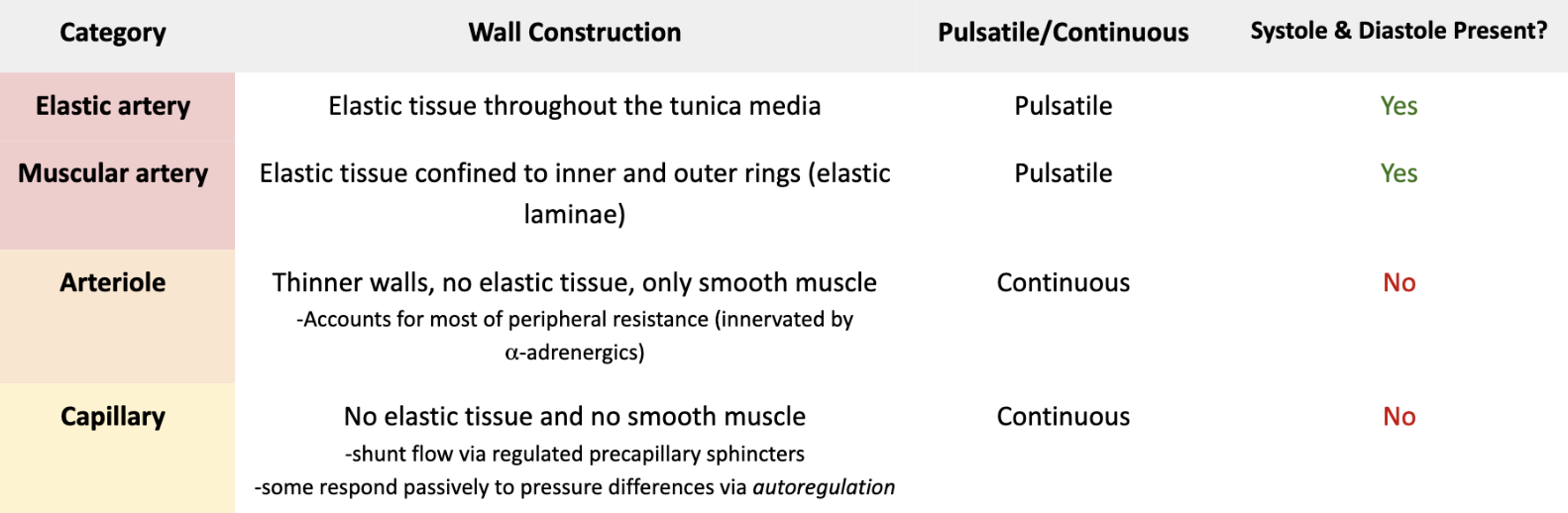
Elastic artery (e.g. aorta) – elastic tissue throughout thickness of tunica media
Muscular artery (e.g. coronaries) – elastic tissue confined to 2 laminae
Arterioles (e.g. central retinal “artery”) – no elastic tissue
Which vessels deal with pulsatile vs non-pulsatile flow?
Pulsatile = Elastic and muscular arteries
vessels with elastic tissue in their walls
Non-Pulsatile = Arterioles, capillaries and veins
vessels without elastic tissue in their walls
What are the characteristics of Elastic and Muscular artery, Arteriole and Capillary?
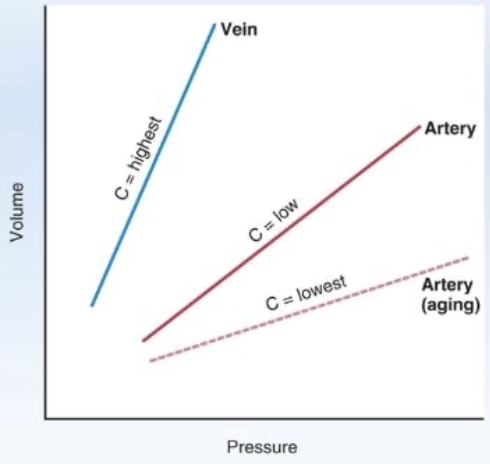
What is vascular capacitance?
vessel’s ability to expand to hold a larger volume
Why do veins have greater capacitance than arteries, despite operating at low pressures?
thinner, less muscular walls
more compliant (↑ capacitance = ↑ compliance)
How is compliance, volume and pressure related?
C = V/P
C = Compliance (ml/mmHg)
V = Volume (ml)
P = Pressure (mmHg)
What happens to arterial compliance with age?
↑ age = ↓ arterial compliance
List the functions of the Vascular system.
Delivers O2 blood
Removes CO2 from blood
Maintains proper flow to sustain blood flow to meet the metabolic needs of the various tissues and organs
What homeostatic roles do arterioles and capillaries play?
Regulate BP, body temp
Produce endocrine regulatory hormones
Physiological adjustments during blood loss, exercise, and changes in body posture
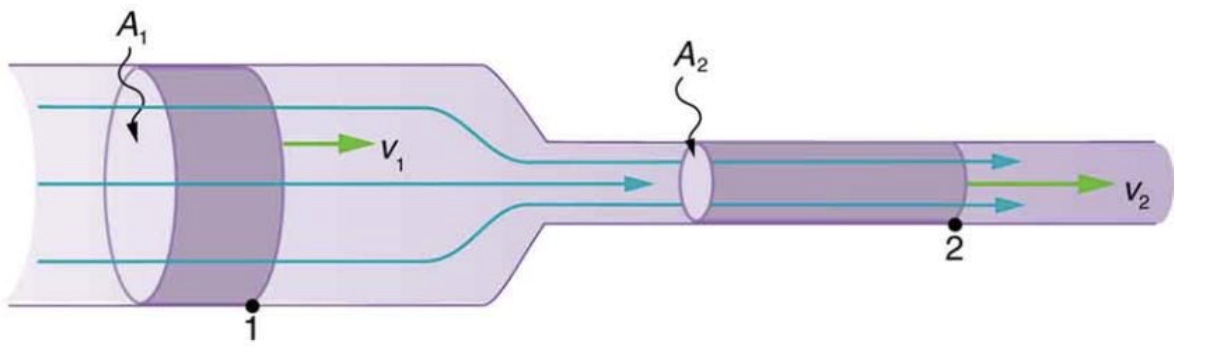
What is the governing equation for velocity of flow?
Velocity = Q/A
Q = volume of flow
A = cross-sectional area
If diameter (area) is fixed, how can you increase/decrease the volume being delivered (i.e. the velocity of the flow)?
↑ flow/volume = ↑ pressure
↓ flow/volume = ↓ pressure
Which 2 key factors in determining how much fluid is moved over time?
Diameter
Pressure
What happens to velocity if a tube narrows (smaller area)?
Speed must increase for the same volume to pass in the same time
Velocity = Q/A
What must be maintained to ensure tissues receive enough O2, and how can the body achieve this?
→ Every tissue requires a constant minimum blood flow to ensure adequate O₂ delivery
Maintain constant pressure + vary flow
Maintain constant flow + vary pressure
What is the body's priority regarding blood flow vs. the eye's priority?
body prioritizes constant blood FLOW
eye prioritizes constant PRESSURE
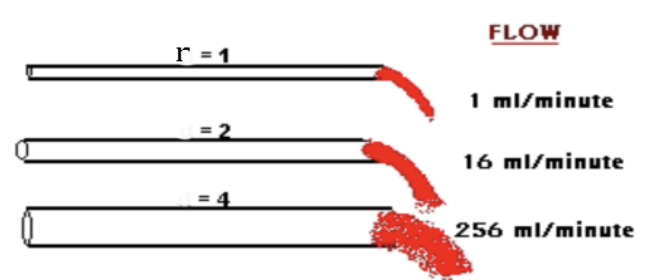
How does vessel radius affect blood flow (velocity) at a constant pressure?
Flow is proportional to the 4th power of the vessel radius (Flow ∝ r⁴)
small change in diameter = big changes in flow
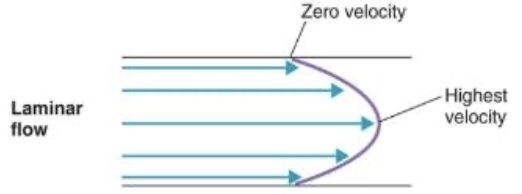
What is Shear (aka ‘Drag’)?
→ drag created by flow along the inner surface of the tube
results from laminar flow at differing velocities
depends on:
How smooth the inside wall is (smooth = ↓ drag; irregular/pinched = ↑ drag)
Fluid viscosity (thicker viscosity = ↑ drag)
Why is shear/drag detrimental? How do endothelial cells respond to drag?
Problem: Shear can damage endothelial cells → beginning of atherosclerosis
Solution: endothelial cells produce a vasodilator (NO)
What is laminar flow?
Smooth flow that is slower near the wall (around 0) and fastest in the center
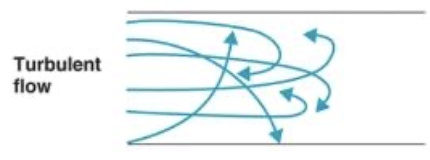
What is Turbulent flow? What causes it?
→ complicated, random, turbulent flow
Cause: irregularities and focal strictures (e.g., heart valves, branch points & atherosclerotic plaques)
How can we determine if flow will be Laminar or Turbulent?
by calculating Reynolds number (dimensionless)
What Reynolds number favors laminar flow?
number < 2000
What factors increase the Reynolds number (favoring turbulence)?
↑ velocity
↓ blood viscosity/thinning the fluid
What does turbulent flow increase the risk of?
Clot formation
What is the Virchow’s Triangle? What are its 3 components?
→ thrombosis results from 1+ of the 3 components of Virchow's Triad
Stasis of blood flow
Endothelial injury
Hypercoagulability
What is the Poiseuille Equation?
R = 8ηl / πr4
R = Resistance
η = viscosity of blood
l = length of blood vessel
r4 = radius of blood vessel
What is the formula for flow (Q) using pressure and resistance?
Q = ΔP/R
How are resistances calculated in series vs parallel?
Series - Additive (Rtotal = R1+R2+…)
Parallel - sum as reciprocals (1/Rtotal = 1/R1+1/R2+…)
How does adding more parallel blood vessels affect resistance and blood flow?
Adding more parallel channels (branches) ↓ total vascular resistance, making it easier for blood to flow
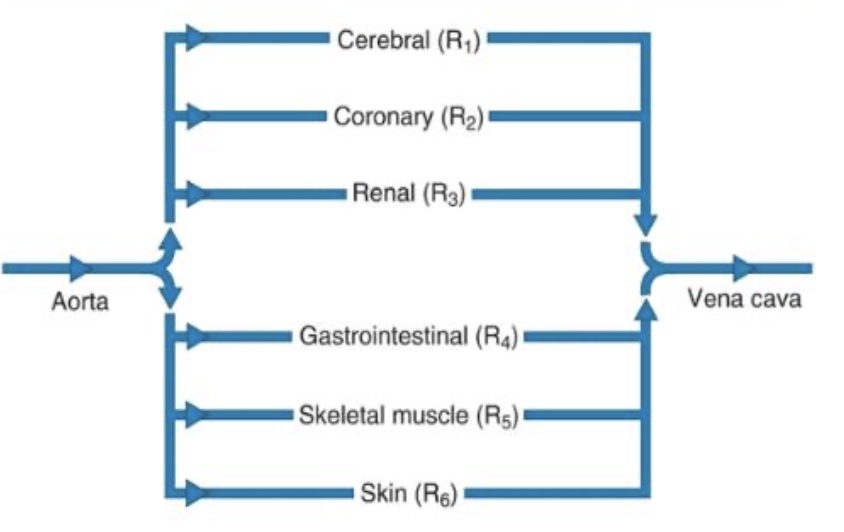
Why is the heart considered two pumps in series?
Right side: ↓ pressure pulmonary pump
Left side: ↑ pressure systemic pump
What are the 3 main ways the body can alter blood flow throughout the heart?
Redistribute flow via regional vasoconstriction/vasodilation (CO stays constant)
Change CO (constant distribution of flow)
Change CO + flow redistribution (e.g., during vigorous exercise)
What is Hydraulic Pressure? Provide 3 examples
→ pressure created by applying a force to a non-compressible fluid that is within a confined space
BP
CSF/ICP
IOP
Body pressures (BP, IOP, CSF) are measured relative to what?
Atmospheric pressure
Where is the largest pressure drop in the vasculature?
arterioles
What is Systolic pressure?
→ pressure in the artery just after blood has been ejected from the left ventricle
highest arterial pressure measured
What is Diastolic pressure?
→ pressure in the artery during ventricular relaxation, when no blood is being ejected from the left ventricle
lowest arterial pressure measured
What is Pulse pressure?
→ magnitude of the swing between SBP and DBP
if BP is 120/80, the pulse pressure is 40
Not the same as MAP
What is the equation for MAP?
MAP = SBP + 2 (DBP) / 3 (this is NOT the avg of SBP & DBP)
MAP = (CO X PR) + Pvenous
PR = peripheral resistance
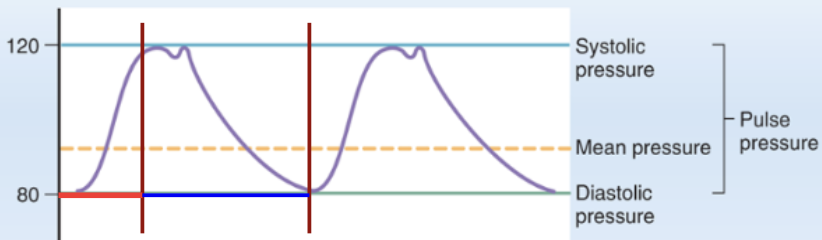
What causes the dicrotic notch (incisura) in the pressure curve?
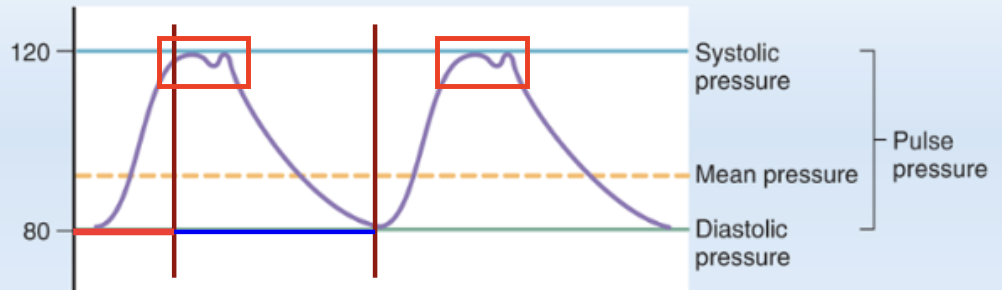
aortic valve closing
What is End Diastolic Volume (EDV)?
volume of blood in the ventriclE, before contraction (end of diastole) (142 mL)
What is End Systolic Volume (ESV)?
blood volume at the end of systole, before refilling begins (end of systole) (47 mL)
What is Stroke Volume?
→ amount of blood that left the ventricle with contraction
SV = EDV – ESV
What is Ejection Fraction? What is a normal EF?
→ fraction of the EDV that leaves the heart during ventricular contraction
represents how “efficient” the heart is
EF = SV/EDV
normal EF = 50% of EDV
What is the formula for Cardiac Output (CO)?
CO = HR x BP
List the factors affecting HR.
Autonomic innervation
Hormones
Fitness level
Age
List the factors affecting SV.
Heart size
Fitness level
Gender
Contractility
Duration of contraction
Preload (EDV)
Afterload (resistance)
List the factors affecting CO.
HR
SV
contractility
blood volume
List the factors affecting Peripheral Resistance (PR).
Humoral constrictors - Ang II, catecholamines (Eph, NE), thromboxane
Humoral dilators - prostaglandins, kinins, NO
Autonomic vascular constrictors - α-adrenergic
Autonomic vascular dilators - β-adrenergic
What is Autoregulation?
→ local vasoconstriction to maintain flow will occur automatically if pressure outside the vessel decreases → ↑ vessel diameter + ↓flow
also influences local resistance
What shows autoregulation, the retina or choroid vessels?
Retina = autoregulation (instant)
Choroid = autonomics (not instant)
Why is a sudden IOP drop dangerous during cataract surgery?
Choroid lacks autoregulation, so vessels dilate massively (instead of vasoconstriction seen in autoregulation) due to the pressure difference → fluid leak
this pushes everything in-front of the choroid (iris,ciliary body, lens) forward through the opening
suprachoroidal space should hold 0 volume, but it can expand holding fluid
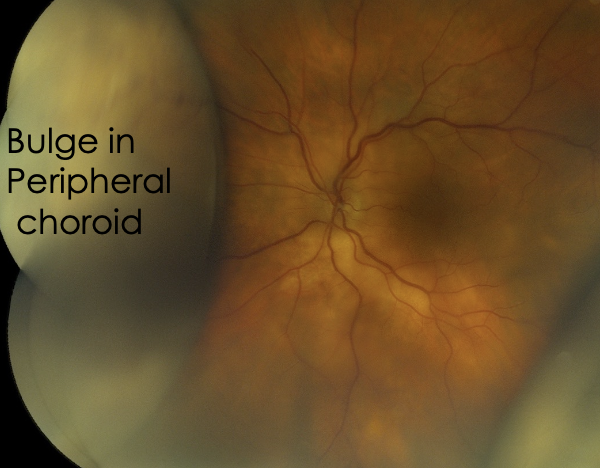
What are "kissing choroidals"?
condition where massive choroidal exudation (fluid leak) causes the choroid and retina to meet in the middle of the vitreous
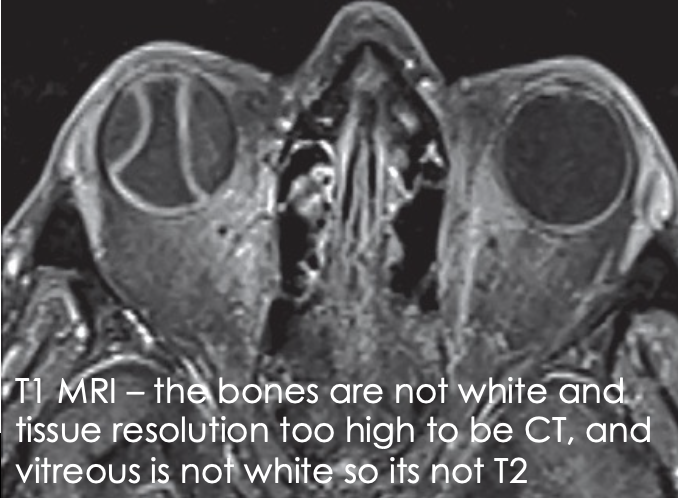
Pressure (Pa) is regulated by 2 main systems. What are they?
Baroreceptor reflex
RAAS system
What is the Baroreceptor reflex?
fast, neural reflex that keeps BP constant using sympathetic/parasympathetic inputs
Where are Baroreceptors located? What pressure changes do each sense?
Carotid sinus (CN 9)
increase & decrease
Aortic arch (CN 10)
increase
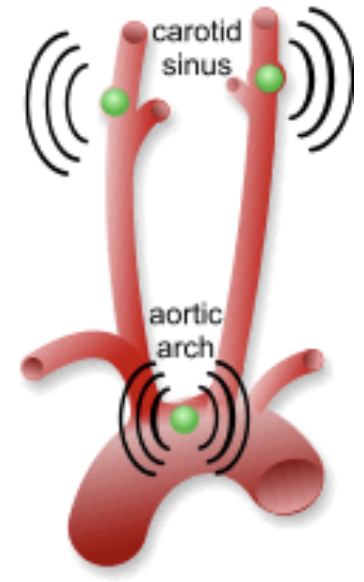
How do baroreceptors respond to increased BP? What is the net result?
↑ BP is detected by baroreceptors
Send signals to the nucleus tractus solitarius (NTS) in the brainstem
NTS activates the cardiac decelerator center & inhibits the cardiac accelerator center & vasoconstriction
Brainstem sends output through 2 pathways: PNS (vagus nerve) & SNS (thoracolumbar system).
PNS output via the vagus nerve stimulates SA node → ↓ HR
↓ SNS output is reduced preventing ↑ HR at SA node & ↓contractility (negative inotropy) at ventricle
Net result:
↓ CO (↓ HR/contractility)
↓ PR (vasodilation of veins) → ↑ venous capacitance → ↓ arterial pressure
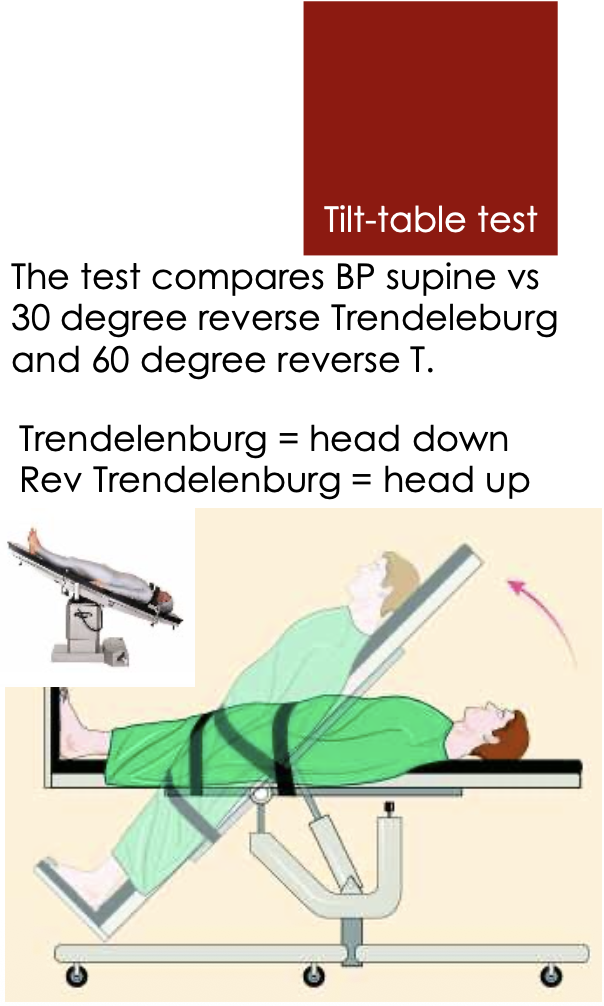
What causes orthostatic hypotension?
Gravity-induced blood pooling in lower extremities, ↓ venous return & ↓CO
How does RAAS affect BP? How does its rate of action compare to that of Baroreceptors?
→ via regular blood volume
slower than baroreceptors
Describe the RAAS pathway.
↓BP reduces renal perfusion pressure into the glomeruli
This triggers juxtaglomerular cells to convert prorenin → renin
Renin released into circulation
Renin cleaves angiotensinogen → Ang I
angiotensinogen = liver-produced protein always present in the blooc
ACE converts Ang I → Ang II (in lungs & kidneys)
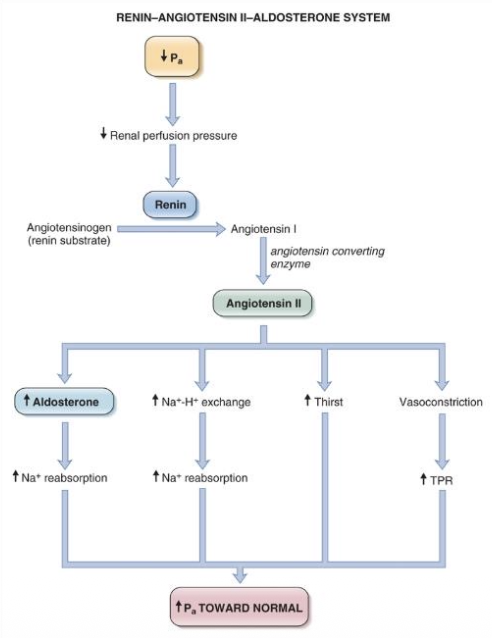
List the actions of Ang II.
Triggers aldosterone release on zona glomerulosa → Na+/water retention → ↑ blood volume
Direct arteriolar vasoconstriction
Stimulates Na-H exchange in kidneys → resorption of Na+
Stimulates ADH → water retention in kidneys
Stimulates hypothalamus to increase thirst
What is the function of ACE2?
converts Ang II (vasocontrictor) into Ang 1-7 (vasodilator) → prevents sustained ↑BP
Where is ACE2 found?
cell surface enzyme in endothelial and mucosal cells (lungs, arteries, heart, kidney, intestines, conjunctiva)
How does COVID-19 interact with ACE2?
uses the ACE2 receptor on cell membrane lipid rafts to enter target cells
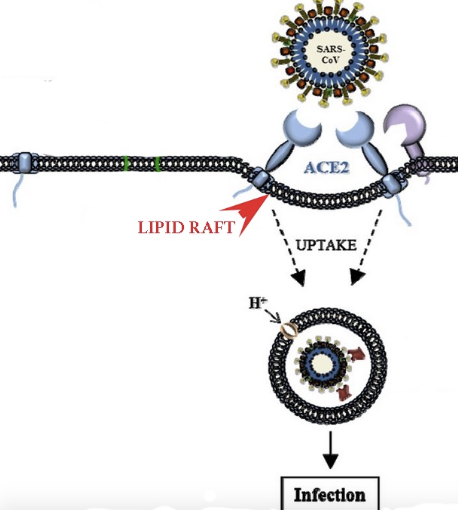
Why did CDC believe it was ok to wear CL during the pandemic?
Priming is a required step for infection that involves a 2nd cell membrane protein needed for viral entry
this priming protein is not present in the conjunctiva, explaining why masks alone are considered sufficient without goggles
Where are Peripheral chemoreceptors for O2 located? What do they detect, and what’s the effect?
Location: Carotid & aortic bodies
Detects:
↓ pO2 → vasoconstriction in skeletal muscle, kidney and splanchnic vascular beds
↑ pCO2
↓ pH
Effect: Transient ↓ HR
What do Central chemoreceptors detect? What’s the effect?
↑ pCO2
↓ pH
Effects:
Both cause brain ischemia → triggers ↑ sympathetic outflow → massive vasoconstriction
Triggers faster breathing in acidemia
Why does ↓ O₂ usually ↑ respiratory rate? Under what circumstance does it not?
↓ pO₂ often leads to CO₂ accumulation & ↓pH → stimulates central chemoreceptors → ↑ resp rate
No CO₂ accumulation & ↓pH → central chemoreceptors would not trigger ↑ resp rate
What is the function of ADH? What is it secreted by?
→ regulates body fluid osmolarity & BP
secreted by the posterior pituitary and
What are the 2 types of ADH receptors and their functions?
V1 (vasoconstriction of smooth muscle)
V2 (renal water reabsorption)
What is the function of Low pressure baroreceptors? Where are they found?
→ sense the “fullness”/changes in blood volume (and ↑ atrial pressure)
found on the venous side (b/c this is where most of the blood volume is)
Location: veins, atria, pulmonary arteries
What occurs if the Low Pressure Baroreceptors sense increased blood volume?
ANP secretion → renal vasodilation → Na+ excretion
ADH inhibition
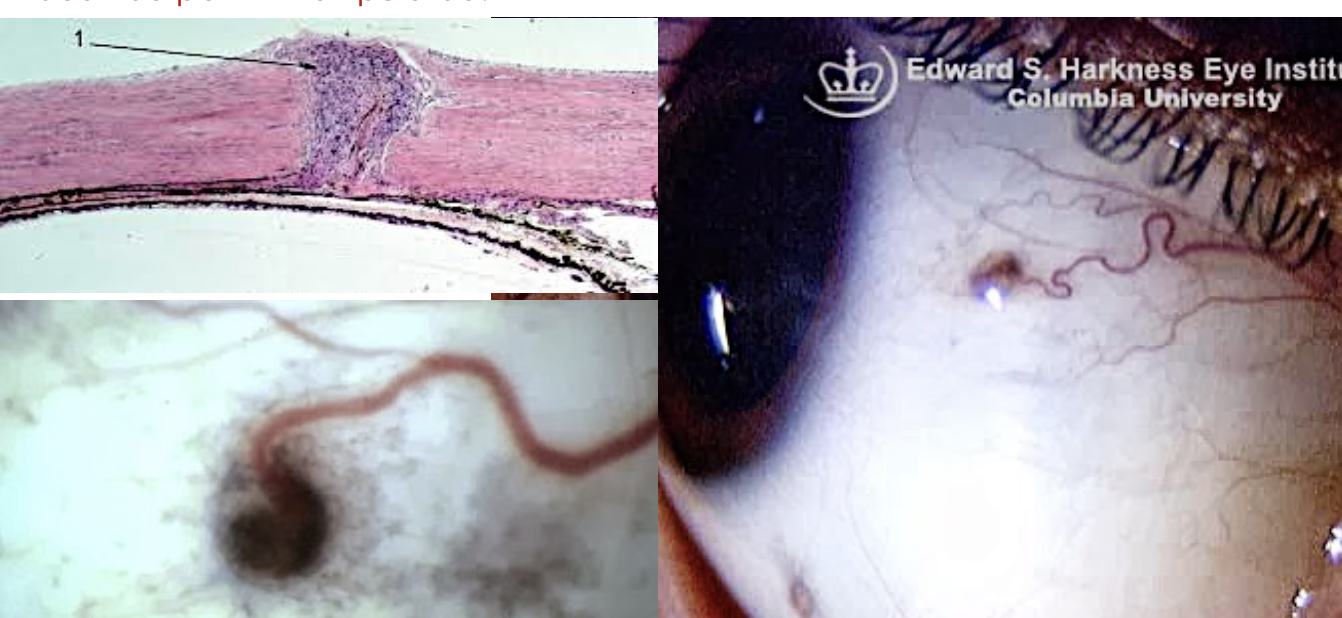
What is an Axenfeld nerve loop?
→ benign congenital loop of a posterior ciliary nerve through the sclera, appearing as a grey/pigmented nodule
3-4mm from the limbus
asymptomatic but can cause localized pain if manipulated