2 structure and function of sensory, relay & motor neurons AO1 +3
 Call Kai
 Learn
Learn Practice Test
 Spaced Repetition
 Match
Match Flashcards
 Knowt Play
1/10

There's no tags or description
Looks like no tags are added yet.
Name | Mastery | Learn | Test | Matching | Spaced | Call with Kai | Chat |
|---|
No analytics yet
Send a link to your students to track their progress
11 Terms
what does information travels through?
neurons in form of electrical impulses called action potentials
when one neuron communicates with another, info changes into electrical form into chemical form (neurotransmitters) at a synapse
in order, how does the neuron cell collects info
1 dendrites
2 cell body - weighs up info recieved and makes binary decision to fire its act. pot. or not
3 axon
4 axon terminal - action potential will travel along the axon to axon term.
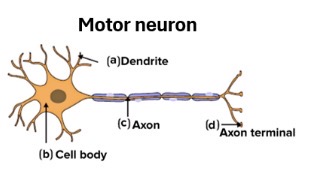
motor neuron
sends commands from the CNS to move muscles
sensory neuron
in PNS
sends signals towards CNS about sensory experience then carry signals away from the organs in th PNS to brain and spinal cord (CNS)
collects info from sensory organs and sends it to the CNS.
its body is not amongst its dendrites but along its axon

relay neuron
form connections between sensory and motor neurons
found only in CNS
conveys info from one neuron to another.
has a short axon

relay neuron
form connections between sensory and motor neurons
found only in CNS
conveys info from one neuron to another.
has a short axon
explain synaptic transmission
action poetential towards the axon terminal in presynaptic neuron
triggers vesicles that contain neurotransmitters move to the cell membrane at the axon terminal and burst, releasing NT into the synapse ten diffuse across the synapse
NT binds to receptors on post synaptic neuron
they dont enter the post SN but bind to receptors which triggers a signal in post SN a new impulese can be set down of next post SN, process then restarts
what happens adter synaptic transmission
once the NT have bound to the receptors and a signal has been sent in the post synaptic neuron, the NT unbind from the receptors
they float back to the presynaptic neuron which recycles at reuptake port back into vesicles
any remaining NT in the synapse are broken down by enzymes and cleared away for the next signal
describe and explain excitation and inhibition
NT either have EX or IN effect on post SN
EX NT makes the post synaptic cell more +ively charged and more likely to fire a new electrical impulse
eg. acetylcholine, is a NT that involved with memory and movement. more impulses make mind more busy and active
IN NT make post SN more negatively charged, therefore less likely to fire a new electrical impulse.
eg. serotonin, makes mind calmer and less busy
summation of cell body
summation happens in cell body of the neuron, where the excitatory and inhibitatory signals are added together.
if there is more EX NT, neurons fires an electrical impusle
if inhibitory NT outweigh, then neuron doesnt fire
how do these neurons work together - pan and touch away
the receptors on skin sense the stimulus
sensory neurons sends an electrical impulse towards CNS from the dendrites along axon to axon terminal
in CNS, the relay neurons carry this signal to motor neuron
transmitted the signal away from CNS towards the muscle
move hand away