sleep P1
 Call Kai
 Learn
Learn Practice Test
 Spaced Repetition
 Match
Match Flashcards
 Knowt Play
1/36

There's no tags or description
Looks like no tags are added yet.
Name | Mastery | Learn | Test | Matching | Spaced | Call with Kai | Chat |
|---|
No analytics yet
Send a link to your students to track their progress
37 Terms
What does consciousness mean?
The awareness of objects and events in the external world and of our own existence and mental experiences at any given moment.
NORMAL WAKING CONSCIOUSNESS (NWC) and ALTERED STATES OF CONSCIOUSNESS (ASC)
NORMAL WAKING CONSCIOUSNESS (NWC)
States of consciousness associated with being awake and aware
of our thoughts and feelings and sensations from the outside
world.
ALTERED STATES OF CONSCIOUSNESS (ASC)
Any state of consciousness that is distinctly different from
NWC, in terms of level of awareness of external events and the
quality of thoughts and feelings that are experienced.
examples
NWC- focused attention, normal wakefulness, listening to teacher, conversation with friend
ASC-unconscious/coma, hypnosis, sleep, daydreaming, meditation, anaesthetised
Types of Altered States
Naturally Occurring ASC involve physiological and psychological changes that occur automatically and are beyond our conscious control.
◦Examples: Sleep (on the study design!) and Daydreaming
◦
Induced ASC involves physiological and psychological changes that have been intentionally produced.
◦Examples: Drug and Alcohol induced ASC (on the study design!), hypnosis, meditation, being anaesthetised.
Sleep
Sleep = a regularly and naturally occurring altered state of consciousness that typically occurs spontaneously and is primarily characterised by a loss of conscious awareness.
Two types of sleep:
-NREM
- REM
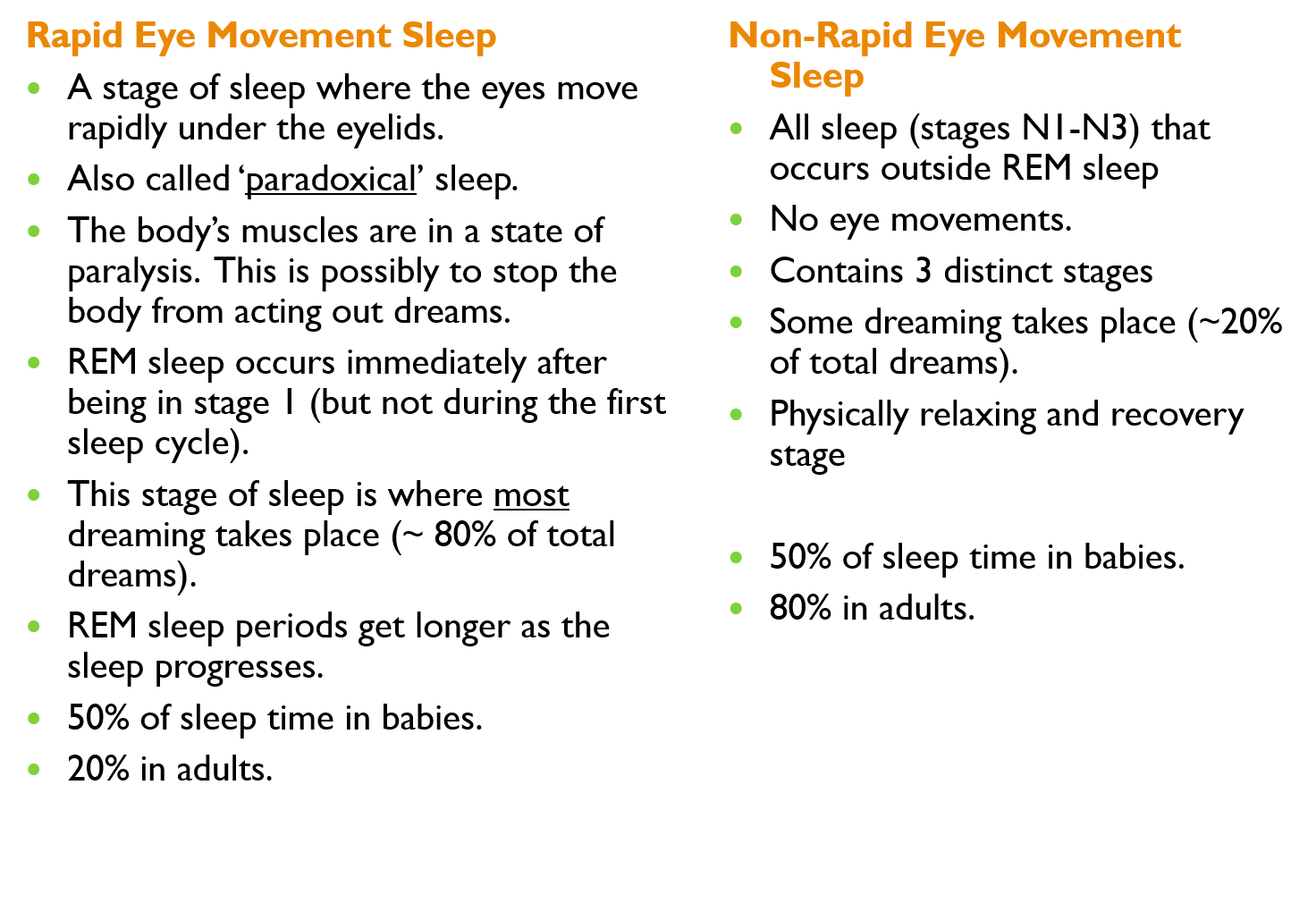
Non-REM Sleep
Approx 80% of our sleep time (50% - babies)
More in first half of the night
May be when body recovers, repairs, replenishes
Three distinct stages from light to deepest sleep then back again
REM Sleep
Period where eyes move rapidly beneath the eye lids
Internal functioning more active than NREM
Skeletal muscles relaxed so no movement
Most dreaming occurs
May embed memories by strengthening neural connections
REM periods lengthen and get closer together as the night progresses (mins à hours)
Infants spend longer in REM than adults (suggests it is required for neurological development.)
Paradoxical sleep:
◦Internal body and brain active
◦External body relaxed
Summary: REM vs NREM
1) Electromyograph (EMG)
Device used to detect, amplify and record the electrical activity of muscles of the body.
Used in conjunction with an EEG.
Detects changes in muscle tone & tension
Electrodes are placed over the muscles of the chin (because this area of the body shows the most dramatic changes during sleep).
2) Electrooculargram (EOG)
A device used to detect, amplify and record the electrical activity of muscles that control eye movement.
Uses electrodes attached to the face around the eyes
Assists in the recognition of REM sleep.
3. Electroencephalograph (EEG)
Electroencephalograph = a device used to detect, amplify and record electrical activity in the brain.
Electrodes are attached to the surface of the scalp that detect the electrical activity of the neurons in the cerebral cortex.
The EEG amplifies and translates the relatively weak electrical activity into a visual pattern of brain waves which are displayed as an electroencephalogram.
Physiological response – electrical activity of the brain
D
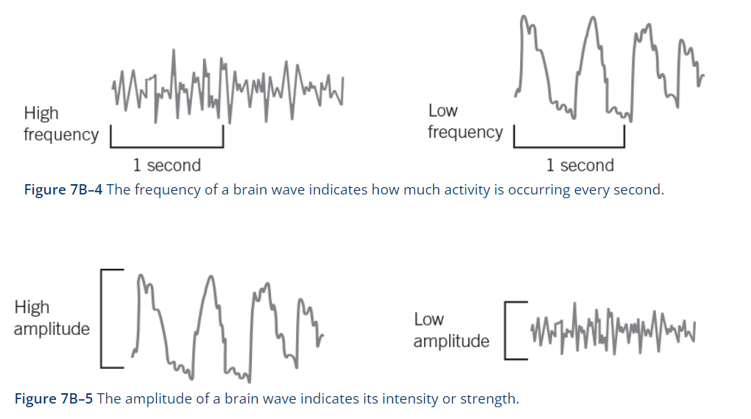
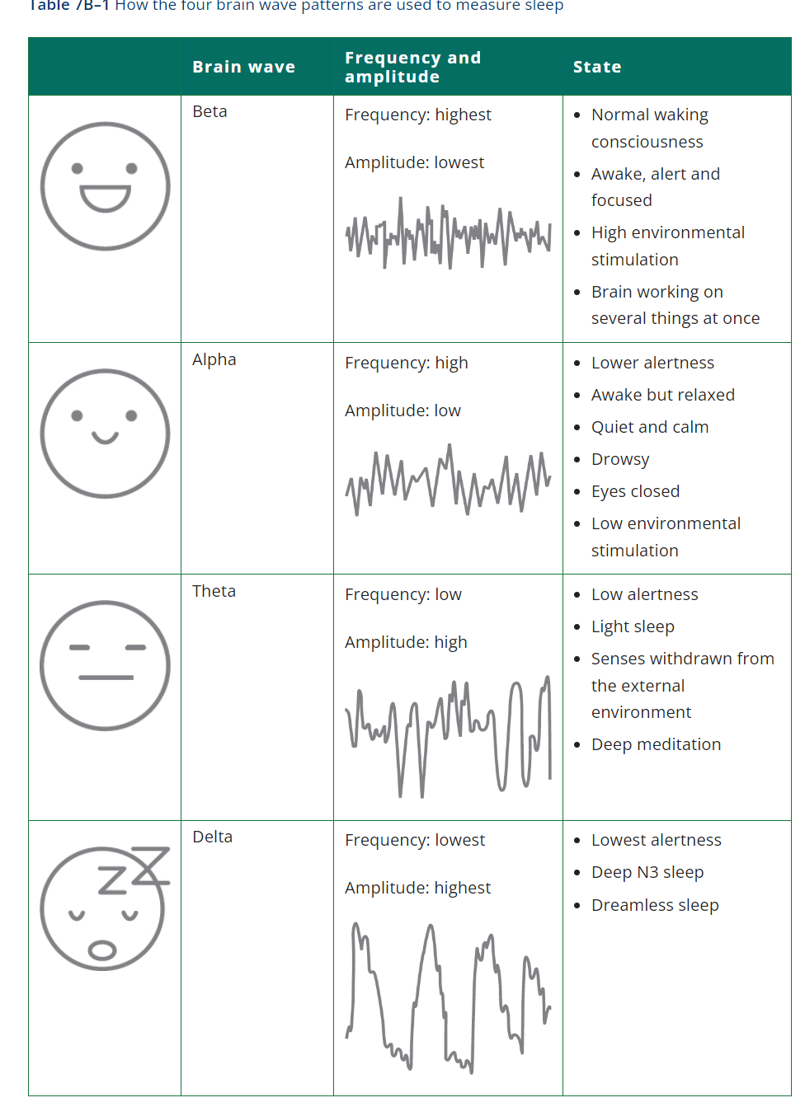
different types and stages of sleep produce different brain waves,
Brain waves are measured in frequency and amplitude
EEGs may be used to identify a particular stage or abnormal brain activity that differs from what would usually be expected.
◦For example, abnormal brain activity during sleep can indicate a sleep disorder, or a particular pattern can determine when a person has fallen asleep
brain waves
Sleep Diaries – Subjective!!
A self-report method is one where an individual is required to record information that can be used by experts – it is a subjective way to measure state of consciousness.
◦Provide more details of things that cannot be directly observed or measured, such as thoughts and feelings.
◦
A Sleep diary or Sleep log is a self-reported record of an individual's sleep and waking time activities, usually over a period of several weeks.
Most commonly used in conjunction with polysomnographic tests to support the assessment of sleep disorders.
Limitations include accuracy of the information (people often forget to write things down, write incomplete or distorted information or leave things out for fear of embarrassment)
Video Monitoring
Sleep laboratories usually record externally observable physiological responses on a video camera.
Video can later be analysed using frame-by-frame analysis and pictures can be enhanced.
Extremely useful in the diagnosis of sleep conditions
Circadian Rhythm
= biological processes that roughly follow a 24 hour cycle.
◦Circadian is derived from latin – ‘about a day’
◦
Are controlled by internal biological processes such as the body temperature cycle
Also influenced by external cues that can influence cyclical changes, such as light, external temperature, noise and food
In humans, the dominant circadian rhythm is the sleep-wake cycle
◦Periods of time during a day when we naturally feel awake and others when we naturally are inactive, asleep or resting
Suprachiasmatic nucleus (SCN)
The suprachiasmatic nucleus (SCN) functions as the master body clock. Found in the hypothalamus.
Many cells in the body can independently maintain a 24-hour circadian rhythm but all are ultimately synchronised and controlled by the SCN.
At specific times in a 24-hour day, the SCN sends signals to regulate various activities in the body and keep it functioning to a daily schedule of sleep and wakefulness.
The SCN can function independently to maintain an approximately 24-hour cycle because of a precise feedback loop of gene expression and inhibition.
However, it is influenced by external cues such as exercise, social activity, eating patterns and temperature.
The SCN is particularly sensitive to light, and this is why the human circadian rhythm is so closely connected to day and night.
SCN and Circadian Rhythms
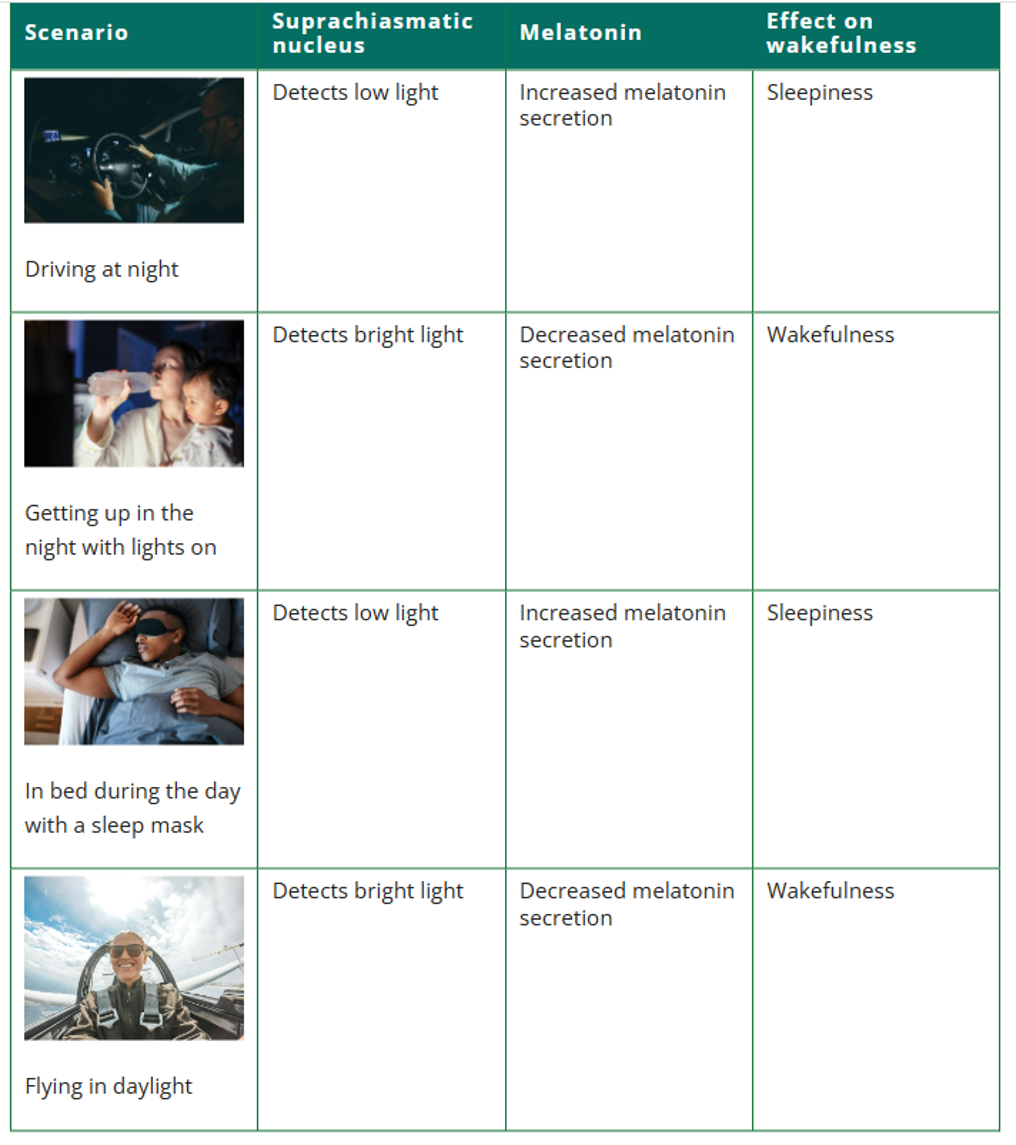
The SCN regulates the circadian rhythm with the help of light signals from the environment.
Light-sensitive neurons in the retinas detect incoming light and send messages to the brain’s SCN about the amount of light in the surroundings.
More light being received by the eyes indicates daytime; less light being received by the eyes indicates night-time.
night
Night:
◦At night-time when the eyes detect no light, the SCN sends a signal to the pineal gland in the human brain.
◦The pineal gland releases melatonin, a hormone that induces drowsiness.
◦The increased release of melatonin induces sleepiness and decreases cell activity.
◦This process ensures that our sleep is connected to night-time.
day
Day:
◦During the day when the eyes detect more light, the SCN sends inhibitory messages to the pineal gland
◦Results in the inhibition of melatonin release by the pineal gland.
◦Less melatonin release by the pineal gland increases cell activity in the body.
◦The result is that a person does not feel drowsy, and therefore wakefulness is promoted during the day.
This process allows the circadian rhythm to be synchronised with the outside world and creates a stable cycle that enables you to feel awake during the day and fall asleep at night.
summary of night
The suprachiasmatic nucleus (SCN)
◦in the hypothalamus
SCN receives information from the eyes about light levels
Lack of light stimulates the SCN to trigger the pineal gland to release the hormone melatonin
Melatonin levels increasing causes us to feel sleepy
summary of day
The suprachiasmatic nucleus (SCN) in the hypothalamus receives information from the eyes about light levels.
Increased light levels stimulate the SCN to reduce signals to the pineal gland.
The pineal gland decreases the release of melatonin.
Melatonin levels decrease, causing us to feel more alert and awake.
examples
Ultradian Rhythms
= biological rhythms that follow a cycle of less than 24 hours.
EG: Sleep cycle is approx. 90 mins
Attention span and concentration believed to be on 90 minute cycles
The Sleep Cycle
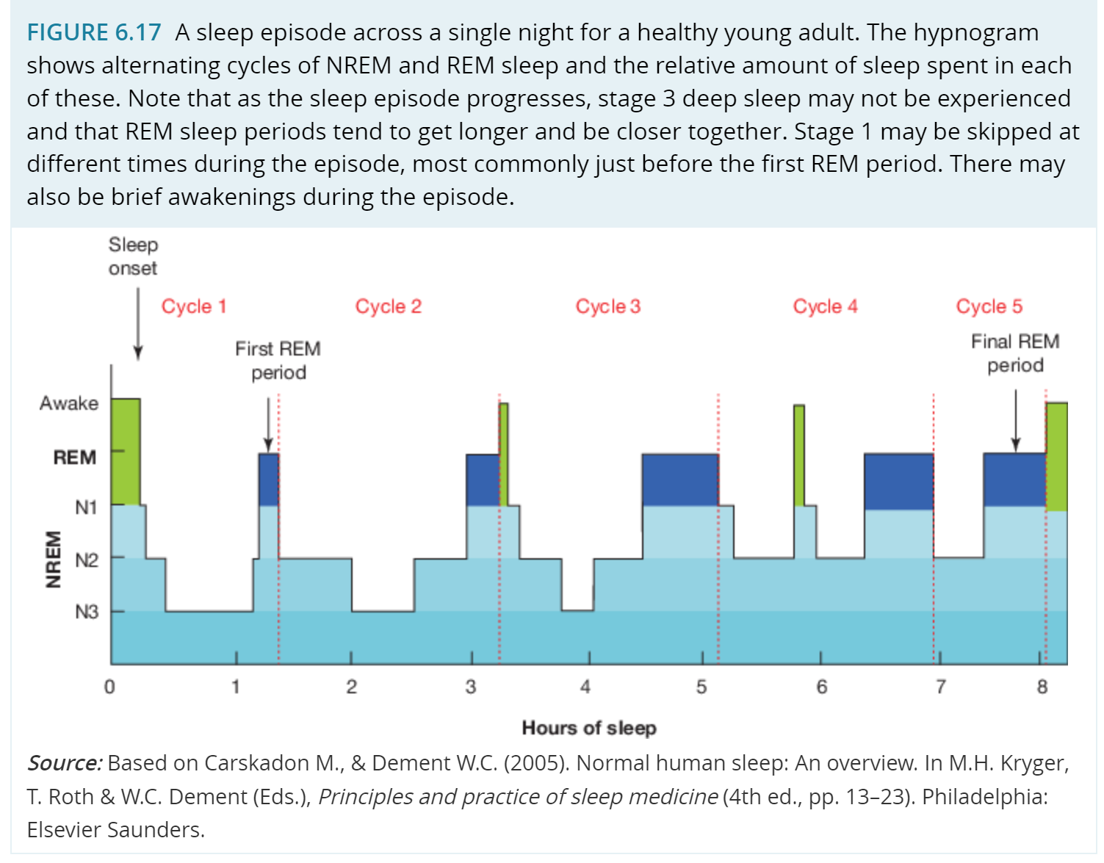
Progression through NREM sleep cycle from Stage N1 to Stage N3 takes about 45-60 minutes before we move back up through stages 3, 2 and then 1. At this time, we experience REM sleep before starting the cycle again.
2, 3, 2, 1, REM……
INFANTS and certain sleep disorders such as narcolepsy, may start at REM sleep
describe the sleep cycle
Characteristics and Patterns of Sleep
Over a typical night we experience two distinct states or types of sleep:
◦1) NREM (non-rapid eye movement sleep)
◦2) REM (rapid eye movement sleep)
◦
These occur in a continuous cycle
A complete sleep cycle consists of a period of NREM sleep (but not necessarily all four stages) and then a period of REM sleep.
A cycle normally lasts 80-120 mins so we go through this cycle approx 4-5 times a night.
Stage 1
NREM Stage 1 (N1)
Physiological changes – decreased heart rate, breathing, body temp and muscle tension
Slow eye rolling movements
Occurs as we drift in and out of true sleep
When sleep begins in the first sleep cycle
Overall slowdown of brain wave patters
Easily awakened
Gradually lose awareness of surrounds
◦Hypnic jerks occur as the muscles relax
Lasts 5-10 minutes
◦Sleeper may feel they were never asleep if woken during this stage.
Stage 2
NREM Stage 2 (N2)
Light sleep
Most people if woken will think they weren’t really asleep but just dozing.
HR, breathing, muscle activity and body movement continue to slow
Body temp continues to drop and eye movement stop
Point at which you are truly asleep,
Sleep is less easily disturbed than in stage 1
Lasts 10-20mins
◦Sleep spindles occur = bursts of higher freq. brain waves
◦K complexes occur in response to arousing stimuli. These are bursts of low frequency, higher amplitude waves.
Stage 3
NREM Stage 3 (N3)
Period of deep sleep
Heart rate and breathing slow to lowest levels
Muscles are completely relaxed – we barely move
No eye movements
Brain waves become slower (largest and slowest – delta waves)
Less responsive to outside world
Difficult to wake and are groggy and disorientated
First sleep cycle can be between 20-40 min in N3 depending on age
As night progresses less and less time is spent in N3 and may disappear altogether.
N3 makes up about 10-15% of total sleep time
Progression through the first NREM…
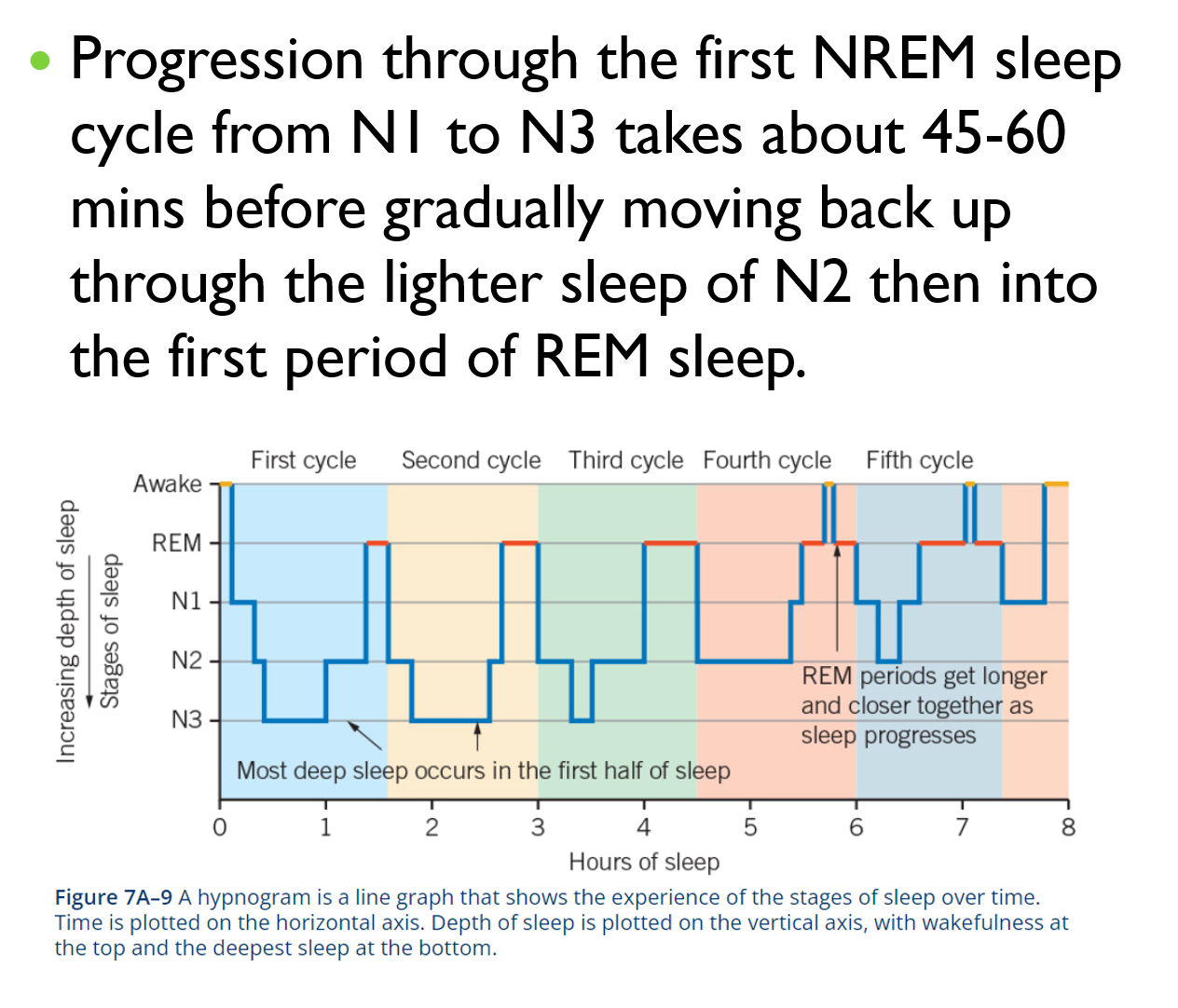
Progression through the first NREM sleep cycle from N1 to N3 takes about 45-60 mins before gradually moving back up through the lighter sleep of N2 then into the first period of REM sleep.
Changes in sleep through the lifespan
As a person ages through the life span, their need for, and experience of, sleep changes in the following ways:
•The total amount of sleep decreases.
•The proportion of REM sleep decreases significantly from birth until 2 years old.
•The amount of N3 sleep decreases, replaced mostly by N2 sleep.
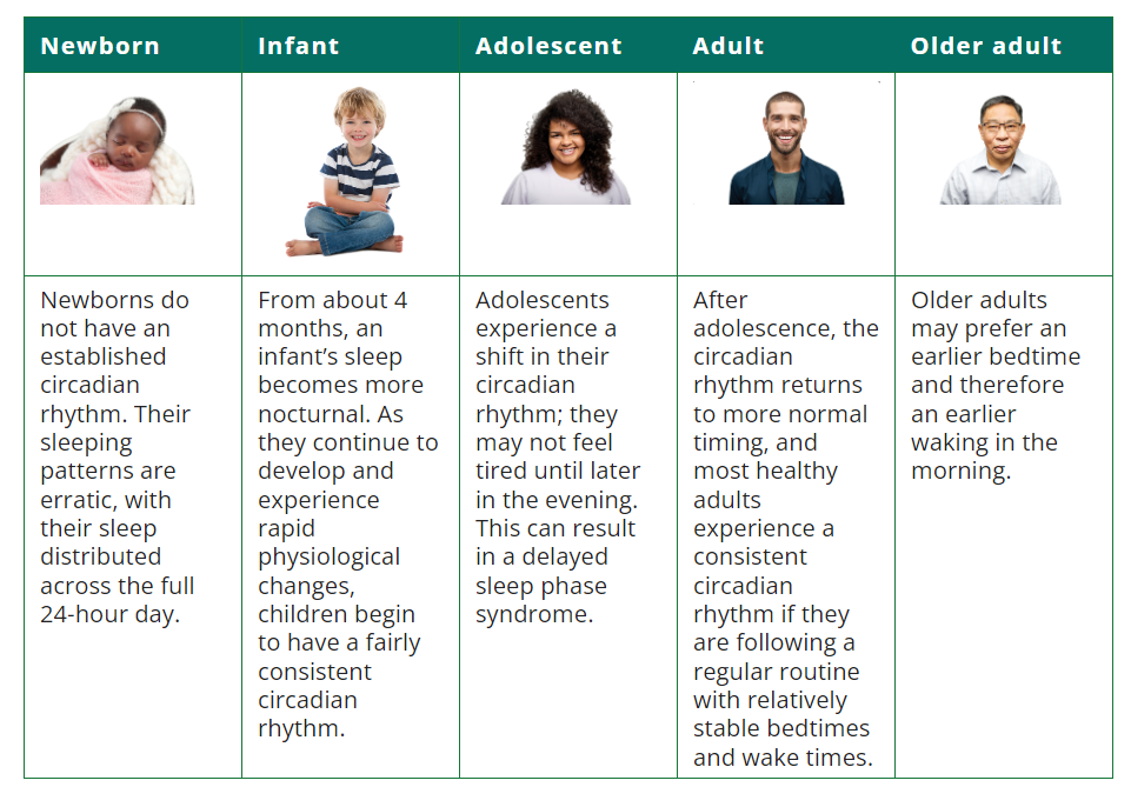
•A circadian phase delay occurs during adolescence (preference for going to sleep later).
•After adolescence, a shift to a circadian phase advance occurs (preference for going to sleep earlier).
•Awakenings during sleep increase from adulthood to old age.
•Sleep efficiency (the percentage of the time in bed that is spent asleep) reduces
Outline of circadian rhythm changes across the life span
Main Function of REM Sleep
‘Brain’
Help embed memories
Mental restoration
Consolidation of learning from that day
Formation of neural pathways
Main Function of NREM Sleep
‘Body’
Body recovers, repairs, replenishes
Physical restoration
Muscle growth and repair
REM versus NREM
Time spent in REM decreases from birth to adolescence then remains relatively stable
◦supports restorative theory – need a lot of REM sleep when young and learning new things to help replenish the mental processes they exhaust during their awake times
◦
Newborn – 50% REM
Child – 20-25% REM
Adolescent – 20% REM
Adult – 20% REM
Elderly – 20% REM
Total Amount of Sleep
Amount of time spent sleeping decreases over lifespan
◦Physical growth, tissue repair and recovery from fatigue occurs during NREM. As we get older and become less active we need less sleep
◦
Newborn – 16 hours
Child – 10-11 hours
Adolescent – 9 hours
Adult – 7-8 hours
Elderly – 6 hours