5.1 Rates, equilibrium and pH (Unfinished)
 Call Kai
 Learn
Learn Practice Test
 Spaced Repetition
 Match
Match Flashcards
 Knowt Play
1/13

Earn XP
Description and Tags
Name | Mastery | Learn | Test | Matching | Spaced | Call with Kai | Chat |
|---|
No analytics yet
Send a link to your students to track their progress
14 Terms
What is rate of reaction defined in physical chemistry?
the change in concentration of a substance in unit time
What is the rate of reaction usual unit?
Its usual unit is mol dm-3s -1
When a graph of concentration of reactant is plotted vs time what is the gradient of the curve
the gradient of the curve is the rate of reaction.
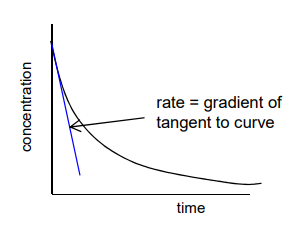
what is the initial rate?
The initial rate is the rate at the start of the reaction where it is fastest
How can reaction rates be calculated from graphs?
Reaction rates can be calculated from graphs of concentration of reactants or products, by drawing a tangent to the curve (at different times) and calculating the gradient of the tangent.
what does the rate equation relate to
The rate equation relates mathematically the rate of reaction to the concentration of the reactants.
For the following reaction:
aA + bB —> products
what is the generalised rate equation?
r is used as symbol for rate
The unit of r is usually mol dm-3 s -1
m, n are called reaction orders
The square brackets [A] means the concentration of A (unit mol dm-3 )
k is called the rate constant
![<ul><li><p>r is used as symbol for rate </p></li><li><p>The unit of r is usually mol dm<sup>-3</sup> s <sup>-1</sup></p></li><li><p>m, n are called reaction orders</p></li><li><p>The square brackets [A] means the concentration of A (unit mol dm<sup>-3</sup> )</p></li><li><p>k is called the rate constant</p></li></ul><p></p>](https://assets.knowt.com/user-attachments/d3fed79c-5455-41b4-88e7-4734c1e8ebac.png)
Explain reaction orders
m, n are called reaction orders
Orders are usually integers 0,1,2
0 means the reaction is zero order with respect to that reactant
1 means first order
2 means second order
the orders have nothing to do with the stoichiometric coefficients in the balanced equation.
They are worked out experimentally.
The total order for a reaction is worked out by adding all the individual orders together (m+n)
What do graphs of initial rate against concentration show?
the different orders
How may have the initial rate been calculated when looking at graphs of initial rate against concentration
from taking gradients from concentration/time graphs.
For a rate concentration graph to show the order of a particular reactant what must happen
the concentration of that reactant must be varied whilst the concentrations of the other reactants should be kept constant.
What is the equation for the rate reaction for zero order and explanation
the concentration of A has no effect on the rate of reaction
r = k[A]0 = k
![<ul><li><p>the concentration of A has no effect on the rate of reaction</p></li><li><p>r = k[A]<sup>0</sup> = k</p></li></ul><p></p>](https://assets.knowt.com/user-attachments/ef9e1549-e985-4a84-b255-7549bd150bfc.png)
What is the equation for the rate reaction for first order and explanation
the rate of reaction is directly proportional to the concentration of A
r = k[A]1
![<ul><li><p>the rate of reaction is directly proportional to the concentration of A </p></li><li><p>r = k[A]<sup>1</sup></p></li></ul><p></p>](https://assets.knowt.com/user-attachments/87c68a5d-cf13-462b-948f-0f91a143d7b8.png)
What is the equation for the rate reaction for second order and explanation
the rate of reaction is proportional to the concentration of A squared
r = k[A]2
![<ul><li><p>the rate of reaction is proportional to the concentration of A squared </p></li><li><p>r = k[A]<sup>2</sup></p></li></ul><p></p>](https://assets.knowt.com/user-attachments/0c662ed8-01aa-4ca6-9852-a2faef876e0f.png)