bioavailability and bioequivalence
 Call Kai
 Learn
Learn Practice Test
 Spaced Repetition
 Match
Match Flashcards
 Knowt Play
1/36

There's no tags or description
Looks like no tags are added yet.
Name | Mastery | Learn | Test | Matching | Spaced | Call with Kai | Chat |
|---|
No analytics yet
Send a link to your students to track their progress
37 Terms
the established non-proprietary common name of active ingredient is known as…
a) chemical name
b) generic name
c) brand name
b) generic name
when the name indicates structure, it is known as…
a) chemical name
b) generic name
c) brand name
a) chemical name
the privately owned trade name of a drug is known as…
a) chemical name
b) generic name
c) brand name
c) brand name
SATA: bioavailability is a reference to the ____ and ____ to which a drug is absorbed.
a) rate
b) dosage
c) cost
d) extent
a) rate
d) extent
T/F: F and ka are used as direct measures of bioavailability
false
too variable
use Cmax, tmax, AUC
Cmax is a measure of…
a) rate only
b) extent only
c) rate and extent
c) rate and extent
tmax is a measure of…
a) rate only
b) extent only
c) rate and extent
a) rate only
AUC is a measure of…
a) rate only
b) extent only
c) rate and extent
b) extent only
how does increasing the dose affect extent, AUC, and Cmax of absorption
increased dose = increased extent = increased AUC = increased Cmax
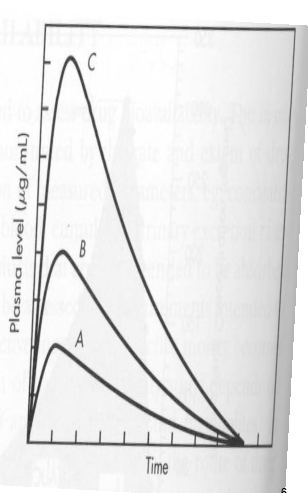
T/F: A, B, and C all have the same tmax, which indicates that they have the same rate of absorption
true
Au (infinity) is a measure of…
a) rate only
b) extent only
c) rate and extent
b) extent only
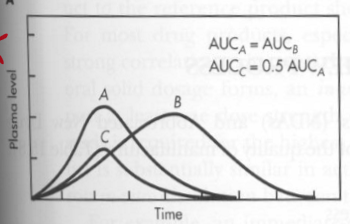
what is the most correct statement when describing the bioequivalence between drug A + B?
a) they have the same rate of absorption and extent of absorption
b) they have the same rate of absorption but different extent of absorption
c) they have different rates of absorption but the same extent of absorption
d) a) they have the different rate of absorption and extent of absorption
c) they have different rates of absorption but the same extent of absorption
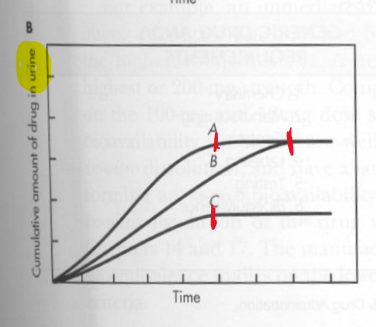
since drug reaches the plateau slower, it has a ____ tmax
longer
test product in relative bioavailability refers to …
generic drug
reference product in relative bioavailability refers to …
brand drug
the reference product in absolute bioavailability refers to…
IV route drug
The AUC calculated after an oral tablet of 50 mg was 136 mg/hr/L. After an oral capsule dose of 150 mg, the calculated AUC was 700 mg/hr/L.
Calculate the relative bioavailability of the tablet with respect to the capsule assuming the elimination and distribution properties of the drug are unchanged between dose administrations.
test = tablet
reference = capsule
136/50 × 150/700 = 0.58 = 58%
The AUC calculated after an oral tablet of 50 mg was 136 mg/hr/L. After an oral capsule dose of 150 mg, the calculated AUC was 700 mg/hr/L. The relative bioavailability of the tablet is 0.58. If the absolute bioavailability of the oral capsule is determined to be 0.98, calculate the absolute bioavailability of the tablet dosage form.
Ftab / Fcap = 0.58
Ftab = Fcap * 0.58
Ftab = 0.98 × 0.58
Ftab = 0.57
T/F: for a plasma concentration versus time plot following the administration of an oral drug dose, the AUC is a measure of the rate of absorption
false
AUC = extent of absorption
data from bioavailability studies help determine appropriate ______
dose regimens
Bioequivalence is demonstrated by …
establishing no statistical difference exists among Cmax, tmax, and AUC
test product should be within 20% of that of the reference product
T/F: bioequivalent drug products show similar bioavailability when studied under similar conditions
true
The rate and extent of absorption of the test drug do not show a significant difference
a) bioavailability
b) bioequivalence
b) bioequivalence
there is no difference in the extent of absorption but a significant difference in the rate of absorption that is intentional, reflected in the label and is medically insignificant
a) bioavailability
b) bioequivalence
b) bioequivalence
what are the methods for assessing bioavailability and bioequivalence
plasma drug concentration
urinary drug excretion
acute pharmacodynamic effect
clinical observations
in
what is a latin-square crossover design for a bioequivalence study?
all subjects gets all products (A, B, C, etc) with sufficient time passed between each administration
difference sequence in each patient
to show no effect on outcome
dispensing an unbranded product or a different brand in place of prescribed product. they have the same dosage form, same active ingredient, but different manufacturers.
a) generic substitution
b) pharmaceutical equivalents
c) therapeutic alternatives
d) pharmaceutical alternatives
a) generic substitution
how to know if a drug is deemed therapeutically equivalent in the Orange book?
A = deemed therapeutically equivalent
B = inadequate evidence of bioequivalence
same therapeutic entity but presented as different forms or different dosage forms, and strengths by a single manufacturer.
a) pharmaceutical equivalents
b) pharmaceutical alternatives
c) therapeutic alternatives
d) therapeutic equivalents
b) pharmaceutical alternatives
same active ingredient, same amount, dosage form, route of administration. However, differed in outside features (packaging, label, shape, color, etc) or release mechanism or excipients.
a) pharmaceutical equivalents
b) pharmaceutical alternatives
c) therapeutic alternatives
d) therapeutic equivalents
a) pharmaceutical equivalents
differenct active ingredients that share the same indications and used for the same therapeutic objectives
a) pharmaceutical equivalents
b) pharmaceutical alternatives
c) therapeutic alternatives
d) therapeutic equivalents
c) therapeutic alternatives
pharmaceutic equivalents that are expected to ave same clinical effect and safety profile. Indicated by A in the Orange Book.
a) pharmaceutical equivalents
b) pharmaceutical alternatives
c) therapeutic alternatives
d) therapeutic equivalents
d) therapeutic equivalents
NDA (new drug applications) must have ..
animal and clinical data
bioavailability data
ANDAs (abbreviated new drug applications) must have…
bioequivalence data
what is the biopharmaceutics classification system used for?
used to predict in vivo absorption based on solubility and permeability characteristics
what is class 1 of biopharmaceutics classification system
high solubility - high permeability
what is class 4 of biopharmaceutics classification system
low solubility - low permeability