Chapter 11: Rotational Dynamics & Static Equilibrium
 Studied by 0 people
 Call Kai
 Learn
Learn Practice Test
 Spaced Repetition
 Match
Match Flashcards
 Knowt Play
1/16

There's no tags or description
Looks like no tags are added yet.
Name | Mastery | Learn | Test | Matching | Spaced |
|---|
No study sessions yet.
17 Terms
Torque
The ability of a force F to rotate the body around an axis
depends on the magnitude of its tangential component Ft and the distance the Force is applied ( r )
Torque = τ = (F)rsin(θ)
r: distance from rotational axis
F: force
θ: angle between F & r
unit: Newton-meters Nm
Torque is a vector
If r is larger, torque is…
larger
Newton’s Law of Rotation
Found from Newton’s Second Law
Ft = mat
τ = Ftr = matr
τ = m(αr)r = (mr²)α
τ = Iα
For more than one force, we can generalize: τnet = Iα in radians
The torque due to the tangential component of force causes…
an angular acceleration around the rotation axis
If the turning tendency of the force is counterclockwise, the torque will be…
positive
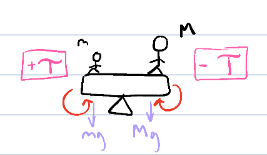
If the turning tendency of the force is clockwise, the torque will be…
negative
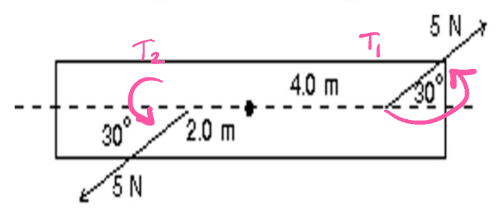
A rod is pivoted about its center. A 5-N force is applied 4 m from the pivot and another 5-N force is applied 2 m from the pivot, as shown. The magnitude of the total torque about the pivot (in N*m) is?
F1 = 5 N
r1 = 4 m
F2 = 5 N
r2 = 2 m
τ1 = Frsin(theta) = (5 N)(4 m)(sin(30)) = 10
counterclockwise → +10
τ2 = Frsin(theta) = (5 N)(2 m)(sin(30)) = 5
counterclockwise → +5
τ1 + τ2 = τ = 15 N*m
Equilibrium & Torque: Conditions
The net external force must be zero at equilibrium
∑F = 0
OR ∑Fx = 0 & ∑Fy = 0
translational equilibrium → no translational motion
no sliding, no accelerating
a = 0
v = constant or = 0
The net external torque must be zero at equilibrium
∑τ = 0
rotational equilibrium → no rotational motion
no spinning, no rotating
α = 0
no angular acceleration
ω = constant or = 0
spinning at constant rate or not spinning at all
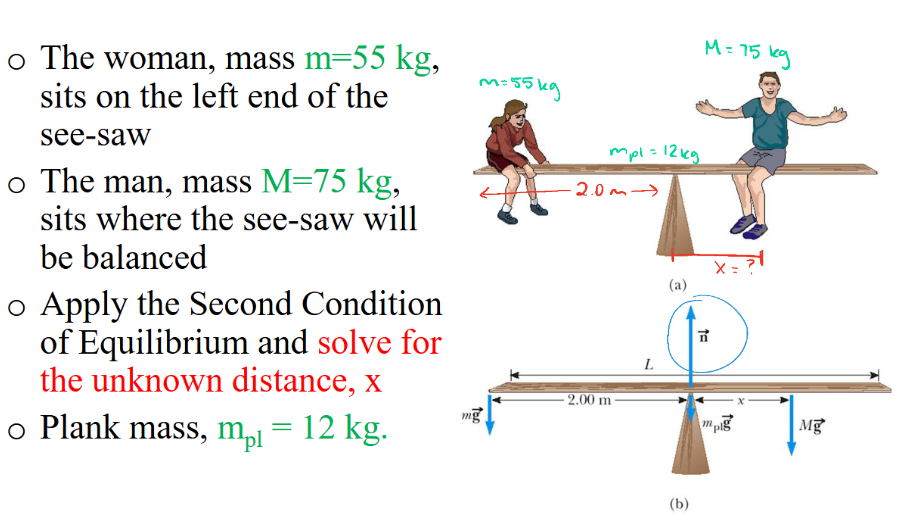
∑τ = 0
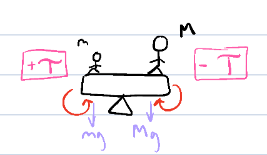
m = 55 kg
M = 75 kg
mpl = 12 kg
d = 2.0 m
x = ?
∑τ = 0
τ = Frsin(theta)
F = mg
mg *r *1
τmg = +mg(2.0m) - Mg(x) + n(0) - mplg(0)
mg → cc → positive
Mg → clockwise → negative
n → r = 0 b/c r is distance from pivot point
mpl → r = 0
τmg = +mg(2.0m) - Mg(x)
τmg = (55 kg)(2.0 m) - (75 kg)(x)
x = 15 m
r is the distance from the…
pivot point
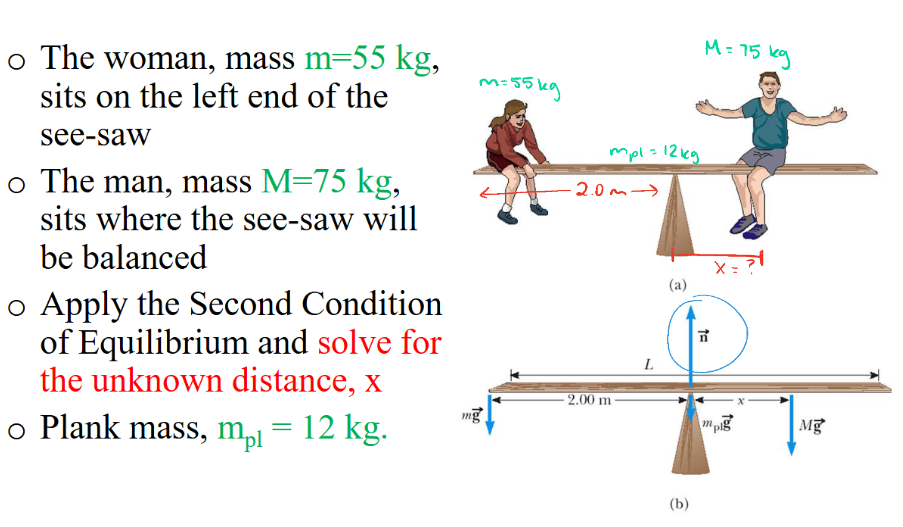
If we do the Lady as the pivot point…
∑τ = 0
τ = Frsin(theta)
F = mg
mg *r *1
τmg = mg(0m) - Mg(2+x) + n(2) - mplg(2)
mg → r = 0 b/c r is distance from pivot point
Mg → clockwise → negative; distance 2+x from pp
n → r = 2 b/c r is distance from pp
the n is positive because it is an upward acting force, counterclockwise lifing board on right
mpl → r = 2; clockwise → negative
τmg = -(75 kg)(2+x) + 2n - (12 kg)(2)
Angular Momentum
rotational equivalent of linear momentum
L = Iω
kg*m²/s
I: Moment of Inertia
how spread out your mass is
ω: angular velocity
spin speed
∑τ = ΔL/Δt
L = (mv²)/ω
Conservation of Angular Momentum
If the net external torque acting on a system is 0, the angular momentum L of the system remains constant, no matter what changes take place within the system
Li = Lf in an isolated system
rotational
linear: pi = pf
Iiωi = Ifωf
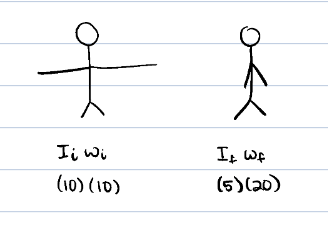
Which is faster?
Iiωi = Ifωf
If no external torques act
angular momentum remains constant
1: I increases, ω must decrease
2: I decreases, ω must increase
So, she is faster in the second position
More condensed space typically equals…
an increased angular velocity due to conservation of angular momentum.
Rotational Work & Power
a torque acting through an angular displacement does work, just as a force acting through a distance does
W = τΔθ
Power is the rate at which work is done, for rotational motion and translational motion
P = W/Δt = τ(Δθ/Δt) = τω
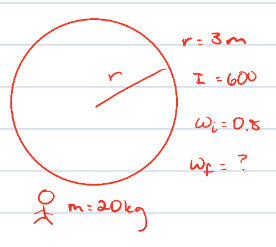
A playground merry-go-round has a radius of 3.0 m and a rotational inertia of 600 kg × m². It is initially spinning at 0.80 rad/s when a 20-kg child crawls from the center to the rim. When the child reaches the rim, the angular velocity of the merry-go-round is what?
r = 3.0 m
I = 600 kg*m²
ωi = 0.80 rad/s
m = 20 kg
ωf = ?
Iiωi = Ifωf
(600 kg*m²)(0.80 rad/s) = (600 + mr²)(ωf)
480 = (600 + (20 kg*3.0²))(ωf)
ωf = 0.62 rad/s