Pancreatic and Biliary Secretion
 Call Kai
 Learn
Learn Practice Test
 Spaced Repetition
 Match
Match Flashcards
 Knowt Play
1/71

There's no tags or description
Looks like no tags are added yet.
Name | Mastery | Learn | Test | Matching | Spaced | Call with Kai | Chat |
|---|
No analytics yet
Send a link to your students to track their progress
72 Terms
T/F: Pancreatic acinar cells mainly produce inactive enzymes, not active enzymes.
True
What are the inactive enzymes produced in pancreatic acinar cells? (7)
1. Trypsinogen
2. Chymotrypsinogen
3. Proelastase
4. Proprotease E
5. Procarboxypeptidase A
6. Procarboxypeptidase B
7. Procolipase
What are the active enzymes produced in pancreatic acinar cells? (5)
1. a-Amylase
2. Carboxyl ester lipase
3. Lipase
4. RNAse
5. DNAse
What 2 compounds stimulate protein secretion by pancreatic acinus cells?
1. CCK
2. Ach
T/F: The pancreas has one of the highest rates of de novo protein synthesis in the body.
True
____% of bicarbonate is secreted from surface cells in the duodenum in response to gastric acid, while ___% of bicarbonate is secreted by the pancreas.
40, 60
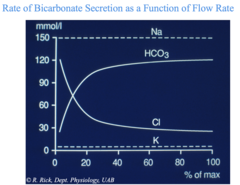
T/F: The rate of bicarbonate secretion from the pancreas is independent of the flow rate of pancreatic juice.
False
A low pancreatic juice flow rate corresponds with the pancreatic juice being mostly made up of what compound?
NaCl

A high pancreatic juice flow rate corresponds with the pancreatic juice being mostly made up of what compound?
Sodium Bicarbonate
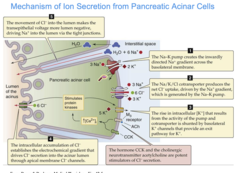
What is the mechanism of ion secretion from pancreatic acinar cells? (6 steps)
1. An Na-K pump creates an inward Na+ gradient.
2. The Na/K/Cl cotransporter produces a new Cl- uptake, driven by the previously generated Na+ gradient
3. The Na-K pump activity results in a rise in intracellular K+. this K+ is shunted by K+ channels.
4. Intracellular accumulation of Cl- drives Cl- secretion into the acinar lumen.
5. The movement of Cl- into the lumen drives Na+ movement into the lumen via tight junctions.
6. Water moves with the Na+. The end result is NaCl in the lumen of the acinus
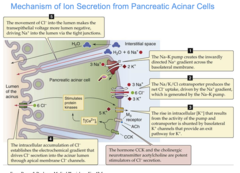
What is the primary secretion product from pancreatic acinar cells?
isotonic NaCl
What is the mechanism of ion transport in the pancreatic duct? (5 steps)
1. The Cl- in the lumen of the duct is exchanged with an HCO3-, resulting in HCO3- in the lumen pancreatic duct.
2. Other HCO3- is pulled out of the blood and into the acinar cell via an Na/HCO3 cotransporter. The HCO3- then enters the lumen via the Cl-HCO3 exchanger.
3. More HCO3- is generated by the activity of carbonic anhydrase. The HCO3- then enters the lumen via the Cl-HCO3 exchanger.
4. All of the intracellular HCO3- makes the lumen potential negative. this pulls Na+ into the lumen of the pancreatic duct via tight junctions. The Na+ pulls water with it.
5. The final product is Sodium bicarbonate in the lumen of the pancreatic duct.

What is the secondary secretion from pancreatic acinar cells?
isotonic sodium bicarbonate
Where does carbonic anhydrase (in pancreatic duct cells) get the necessary OH- to react with CO2?
The OH needed for this conversion is gained by splitting H2O. The protons from splitting H2O leaves the duct cell via an Na-H exchanger and an H+ pump.

_____% of the fluid secreted from the pancreas originates in the duct.
90
What ion must be exchanged in order for bicarbonate to be secreted into the pancreatic duct?
Cl-
What channel is used as a "failsafe" to ensure there is enough Cl- in the pancreatic duct lumen to be exchanged for HCO3-?
CFTR (Cystic fibrosis transmembrane regulator)

T/F: Both pancreatic juice and saliva end as isotonic solutions.
False
What hormone is the most powerful stimulus for bicarbonate secretion in the pancreatic duct?
secretin
How does secretin stimulate bicarbonate secretion in the pancreatic duct?
1. secretin activates adenylyl cyclase, raising intracellular cAMP concentration.
2. The increase in cAMP stimulates protein kinase A
3. Protein kinase A phosphorylates CFTR, activating CFTR.
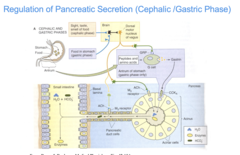
How is pancreatic secretion regulated during the cephalic/gastric phases of digestion? (2 steps)
1. both the sight of food (cephalic) and food in the stomach (gastric) trigger the release of Gastrin from G cells in the stomach.
2. Gastrin can act on CCKa on acinar cells, so it can activate pancreatic secretion using the same receptor as CCK. CCK stimulates pancreatic acinar cell secretion.
How is pancreatic secretion regulated during the duodenal/intestinal phases of digestion? (3 mechanisms)
1. Protein and lipid breakdown in the duodenum stimulates a vasovagal reflex that releases Ach to M3 receptors on both acinus and ductal cells. Ach stimulates both acinus and ductal secretion.
2. Acid stimulates S cells in the duodenum, stimulating secretin, which stimulates HCO3- secretion in the duct.
3. Protein and lipid breakdown in the duodenum also stimulate I cells to secrete CCK, which stimulates acinar cell secretion.

What is the mechanism of neural regulation of pancreatic secretion during the cephalic phase of digestion?
vagal efferents input onto acinar cells and ducts; accounts for 10% of secretion
What is the mechanism of neural regulation of pancreatic secretion during the gastric phase of digestion?
distension induces vagovagal reflex from stomach wall to pancreas
What is the mechanism of neural regulation of pancreatic secretion during the intestinal phase of digestion?
vagovagal reflex from afferents in duodenal mucosa responding to products of digestion
The presence of fatty acids stimulate the release of what hormone from S cells in the duodenum?
secretin
The presence of fat, peptides, and amino acids stimulate the release of what hormone from I cells in the duodenum?
CCK
Why is it beneficial that secretin, CCK, and Ach all act synergistically to regulate pancreatic secretion?
the synergistic work allows the body to conserve hormones.
Bile is the exocrine secretion from what organ?
the liver
T/F: Gallbladder bile is concentrated almost 10-fold compared to hepatic bile.
True
Bile acids are derivatives of what compound?
Cholesterol
What is the difference between primary bile acids and secondary bile acids?
primary bile acids have an extra OH group, which means they are more water soluble than secondary bile acids

How are primary bile acids converted to secondary bile acids?
via 7a-dehydroxylating bacteria in the gut.
While primary bile acids are produced in the liver, secondary biles acids are produced where?
the intestines
How are tertiary bile acids made?
a small amount of secondary bile acids are returned to the liver via the portal vein and are recycled
The oxidation of cholesterol in the liver results in what?
cholic acid
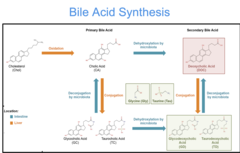
What 2 amino acids can be conjugated to cholic acid, lowering the pKa of the bile acid?
1. Glycine (Gly)
2. Taurine (Tau)

What is the benefit of conjugating bile acids with glycine or taurine?
the conjugation makes bile acids more soluble

T/F: Both primary and secondary bile acids can be conjugated in the liver.
True
How are bile acids transported by hepatocytes from the blood to the bile canaliculus?
via secondary active transport using a bile-Na+ pump.
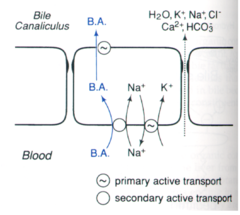
What transporters are responsible for the secretion of the fluid portion of bile?
bile duct transporters

What 3 compounds promote bile acid secretion in the bile ducts?
1. Secretin
2. Glucagon
3. VIP

What compound inhibits bile acid secretion in the bile ducts?
somatostatin
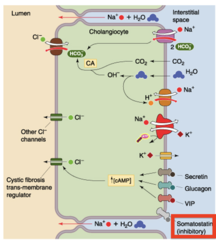
T/F: The bile duct transporters are identical to the pancreatic duct transporters, like CFTR and a Cl-HCO3 exchanger.
True
How can cystic fibrosis affect bile secretion?
a non-functional CFTR results in a large decrease in fluid secretion from bile duct transporters. less fluid secretion increases the risk of a blocked bile duct.
What is the enterohepatic circulation of bile?
the cycling of bile salts from the liver to the small intestine and back

After participating in fat digestion and absorption, most bile salts are reabsorbed by active transport where in the small intestine?
the terminal ileum
T/F: Bile salts promote their own synthesis and inhibit their own secretion.
False
T/F: Bile salts inhibit their own synthesis and promote their own secretion.
True
Why do we store bile acids in the gallbladder instead of just letting them circulate? (3 reasons)
1. bile salts are toxic to enterocytes in the GI tract
2. bile salts are subject to loss with rapid intestinal transit
3. bile salts are subject to modification by intestinal bacteria.
Why is water able to be pulled out of bile by the gallbladder?
the removal of water from bile is coupled with the transport of Na+ and Cl- out of the lumen of the gallbladder

What are 4 stimuli that regulate bile acid secretion?
1. Bile acids in portal circulation
2. secretin
3. CCK
4. Vagus
Bile acids in portal circulation (inhibit/stimulate) bile flow and (inhibit/stimulate) bile acid synthesis by targeting the liver and hepatocytes.
stimulate, inhibit
Bile acids in portal circulation regulate bile acid secretion by targeting what two structures?
1. liver
2. hepatocytes
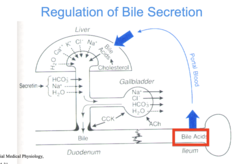
Secretin (inhibits/stimulates) the secretion of water and HCO3 in the liver and bile ducts.
stimulates
CCK (inhibits/stimulates) gallbladder contraction and causes the sphincter of Oddi to (relax/contract).
stimulates, relax
Vagus stimulation will (inhibit/stimulate) contraction of the gallbladder.
stimulate
Bile acids that are reabsorbed from the blood and secreted into the bile canaliculus of the liver are absorbed via what type(s) of transport?
active
Bile acids that are reabsorbed by the terminal ileum are absorbed via what type(s) of transport?
passive and secondary active
What are the 3 mechanisms of jaundice?
1. Pre-hepatic
2. Intra-hepatic
3. Post-hepatic
What is pre-hepatic jaundice?
There is an increase in the rate of red blood cell breakdown causing an increase in Bilirubin production
What are some causes of pre-hepatic jaundice? (3)
1. sickle cell anemia
2. thalassemia
3. hemolytic disease of the newborn
What is intra-hepatic jaundice?
decreased conjugation or uptake of bilirubin by the liver
What are some causes of intra-hepatic jaundice? (3)
1. hepatitis
2. cirrhosis
3. liver cancer
What jaundice mechanism is most often associated with neonatal jaundice?
intra-hepatic
What is post-hepatic jaundice?
obstruction of bile flow
How is bilirubin made?
the breakdown of red blood cells in the liver.
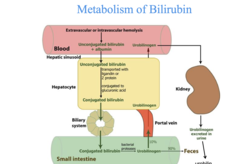
What plasma protein does unconjugated bilirubin initially bind to?
albumin
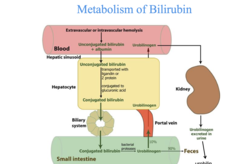
How is bilirubin able to enter the biliary system?
unconjugated bilirubin is conjugated to glucuronide in hepatocytes. the conjugated bilirubin is able to enter the biliary system

What happens to conjugated bilirubin in the small intestine?
it is converted to urobilinogen by bacterial proteases.
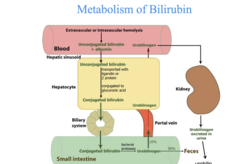
What are the 2 mechanisms of excreting urobilinogen?
1. directly excreted into feces (90%)
2. transported to hepatocytes by the portal vein, then enters the blood to travel to the kidneys. urobilinogen is then excreted in urine (10%)
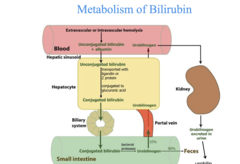
Urobilinogen is oxidised into what two compounds when excreted?
1. urobilin
2. stercobilin