Plant Biology and Botany Exam Practice Flashcards
 Call Kai
 Learn
Learn Practice Test
 Spaced Repetition
 Match
Match Flashcards
 Knowt Play
1/277

Earn XP
Description and Tags
A complete set of vocabulary practice flashcards covering introductory plant biology, biological chemistry, cell structures, cell division, and plant tissues based on lecture material.
Name | Mastery | Learn | Test | Matching | Spaced | Call with Kai | Chat |
|---|
No analytics yet
Send a link to your students to track their progress
278 Terms
Plant Anatomy
The discipline of botany studying the internal structures of plants.
Plant Physiology
The discipline of botany pertaining to plant metabolism and other plant (chemical) processes.
Plant Taxonomy
The branch of botany that studies how plants are organized and classified into groups such as genus and family.
Plant Systematics
The field of botany dealing with plant evolutionary history/diversity and the development of methods for grouping plants based on the relationships between them.
Plant Geography
The discipline of botany concerned with the location that plants are situated and the reasons for their distribution.
Plant Ecology
The study of how plants interact with each other and with their surrounding environment.
Plant Morphology
The study of plant form, structure, and how plants grow and change over time (development).
Ethnobotany
The practical field examining the traditional and commercial uses of plants and plant products by humans.
Hypothesis
A tentative, unproven explanation for an observation formulated as a specific, testable statement. Good hypotheses have both null and alternative.

Null Hypothesis (H_0)
A hypothesis stating that the independent variable is not connected to the dependent variable.
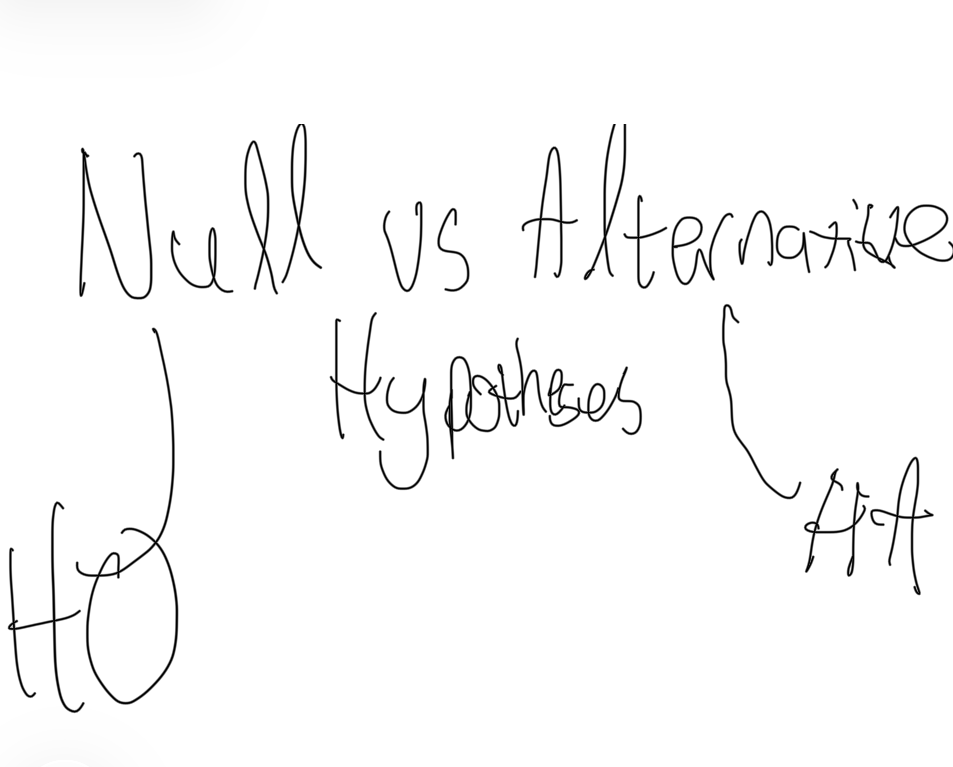
Alternative Hypothesis (H_A)
A hypothesis stating that the independent variable is directly connected to the dependent variable.
Independent Variable (I.V.)
The portion of an experiment being actively manipulated and controlled by the experimenter, also referred to as the treatment.
Dependent Variable (D.V.)
The portion of an experiment responding to changes in the independent variable, also referred to as the response.
Controlled Variable (C.V.)
A specific aspect or factor that remains constant across all experimental and test groups.
Emergent Property
A characteristic present in larger levels of the biological hierarchy that emerges from the cooperation of levels beneath it.
Atomic Number
The number of protons in an atom's nucleus, which determines its chemical element and atomic properties.
Atomic Mass
The combined total number of protons and neutrons located within an atomic nucleus.
Isotope
An alternate expression (slightly different) of an element that differs in atomic mass.
Radioactive Decay
The predictable and constant process by which an unstable atomic nucleus degrades over time.
Ionic Bond
A polar chemical bond formed when one atom donates or steals an electron, holding the resulting charged ions together by opposite electrical charges.
Covalent Bond
A strong chemical bond formed when two atoms share electrons to fill their valence electron orbitals.
Functional Group
An atom or molecular group covalently bonded to a carbon backbone in an organic compound that determines its pH, polarity, and chemical behavior.
Isomer
Molecules that share the exact same chemical formula but possess different structural arrangements.
Hydrolysis Reaction
A chemical reaction that changes molecules and requires water (Add water).
Condensation Reaction
A dehydration reaction that changes molecules and forms water (Extracting Water)
Carbohydrate
An organic molecule consisting of carbon, hydrogen, and oxygen in a 1:2:1 ratio that acts as a fuel source, energy storage, and structural component.
Organic Molecules
Macromolecules composed primarily of carbon and hydrogen atoms, including carbohydrates, proteins, lipids, and nucleic acids.

Monosaccharide
The monomer and subunit of carbohydrates that serves as an easily accessible energy source and yields non-carbohydrate molecules when broken down.
Polysaccharide
A complex carbohydrate composed of hundreds to thousands of monosaccharide monomers linked into long chains.
Starch
A plant polysaccharide used for energy and sugar storage that serves as a primary fuel source for animals.
Glycogen
A highly branched sugar storage polysaccharide found in animal muscle and liver cells.
Cellulose
The most abundant polysaccharide on Earth, forming an indigestible, rigid structural framework in plant cell walls.
Chitin
An indigestible structural polysaccharide that forms the exoskeletons of arthropods.
Peptide Bond
A covalent chemical bond connecting amino acids together into polypeptide chains.
Denature
The loss of a protein's specific three-dimensional shape due to environmental effects, causing a loss or alteration of its biological function.
Triglyceride
A lipid macromolecule composed of a glycerol head bonded to 3 fatty acid hydrocarbon tails.
Phospholipid
A lipid molecule consisting of a polar phosphate head and 2 non-polar hydrocarbon (fatty acid) tails, forming cell membrane bilayers.
DNA & RNA Base Pairings
The specific pairing rules where DNA pairs Adenine with Thymine and Cytosine with Guanine (A−T, C−G), while RNA pairs Adenine with Uracil and Cytosine with Guanine (A−U, C−G).

Cell Theory
The foundational biological concept stating that all living organisms are composed of cells, the cell is the basic unit of life, and all cells arise from preexisting cells.
Volume grows much more than surface area as a cell increases in size. Larger surface area to volume ratio enables more efficient communication. Surface area affects volume.
Describe the Surface to Volume Ratio
Plasma Membrane
Selective phospholipid bilayer regulating substance entry and exit.
Rough Endoplasmic Reticulum (RER)
Ribosome-studded organelle synthesizing and exporting proteins.
Smooth Endoplasmic Reticulum (SER)
Endomembrane organelle synthesizing lipids/carbohydrates and detoxifying cells.
Golgi Apparatus
Organelle that modifies, packages, and ships vesicles.
Peroxisome
Membrane sac containing catalase that breaks down fatty acids and toxic H2O2.
Central Vacuole
Large water-filled plant organelle generating hydrostatic turgor pressure for support.

Plastid
Plant organelle family for carbohydrate production or pigment storage.
The 3 Different Types of Plastids
Chloroplast, Chromoplast, Leucoplast.

Chloroplast
Photosynthetic double-membrane organelle containing chlorophyll, stroma, and thylakoids.
Chromoplast
Atype of plastid that contains pigments other than chlorophyll, contributing to the coloration of fruits and flowers. Red, orange, yellow.
Leucoplast
a type of plastid that is colorless and primarily involved in the storage of starches, proteins, and lipids in plant cells.

Cytoskeleton
Protein fiber network (actin, intermediate filaments, microtubules) maintaining cell shape and driving movement.
What are the different components of the Cytoskeleton?
Actin filaments, intermediate filaments, and microtubules.

Intermediate Filament
Cytoskeletal fiber (8−11nm) providing mechanical tensile strength.
Actin Filament
Microfilament (7nm) working with myosin for cell movement and structural support.
Microtubule
Hollow tubulin cylinder using motor proteins (kinesin/dynein) for transport and chromosome division.
Plasmodesmata
Membrane-lined wall channels connecting cytoplasm between adjacent plant cells.
Cell Cycle
Life cycle of a cell: Interphase (G1, S, G2) and Mitotic Phase (Mitosis, Cytokinesis).
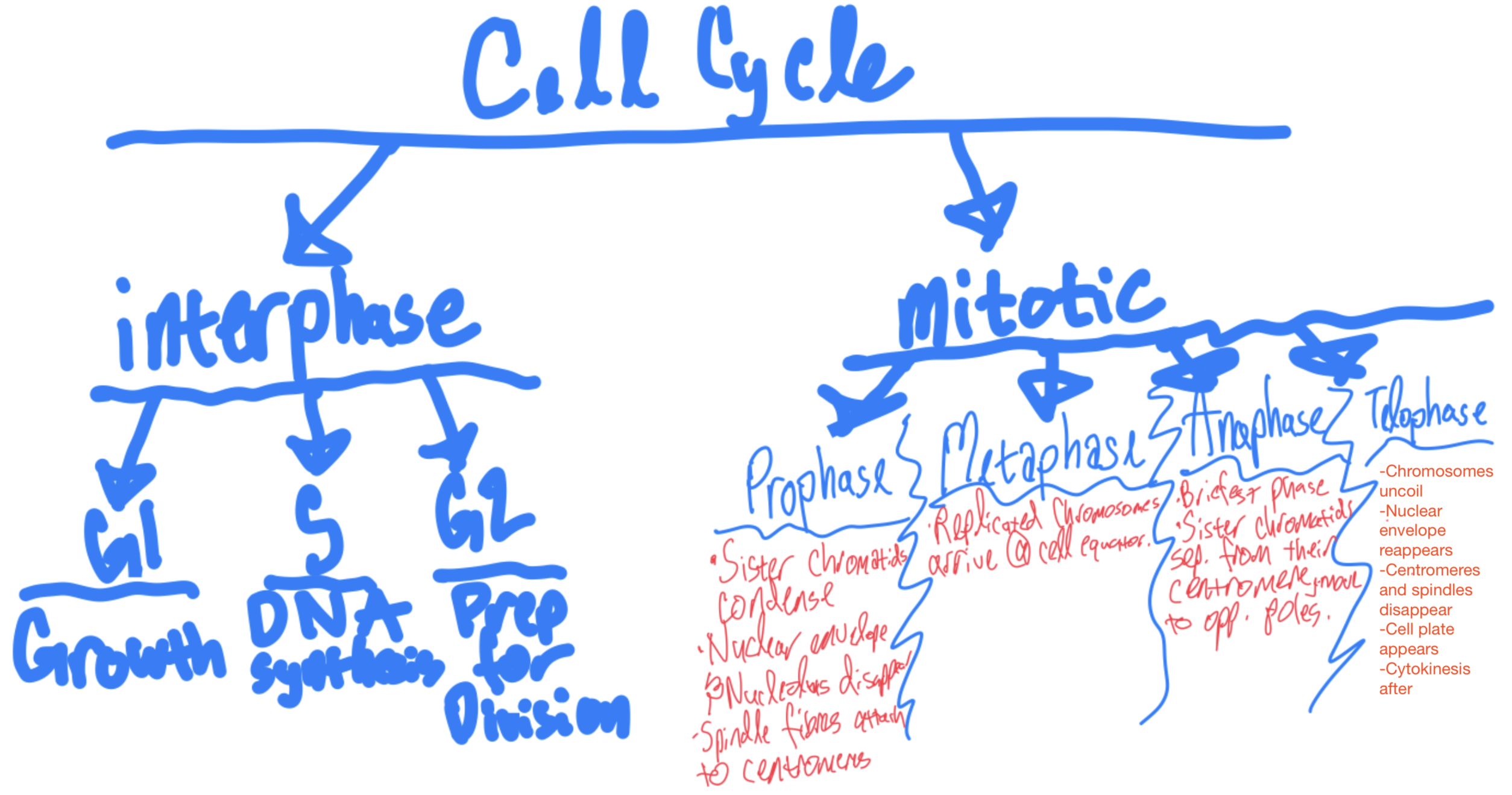
Interphase
Cell cycle growth stage where organelle duplication and DNA replication occur.
Prophase
First mitotic stage: chromatin condenses, nuclear envelope degrades, and spindles attach.
Metaphase
Mitotic stage where chromosomes align along the equator (metaphase plate).
Anaphase
Mitotic stage where sister chromatids separate toward opposite poles.
Telophase
Final mitotic stage: nuclei reform, chromosomes uncoil, and spindles dissolve.
Cytokinesis
Cytoplasmic division yielding two daughter cells via a cleavage furrow (animals) or cell plate (plants).
Plant Tissues
Plant organizational levels categorized into Meristematic, Simple, and Complex tissues.

Apical Meristem
Undifferentiated tip tissue driving primary growth (length) in roots and shoots.
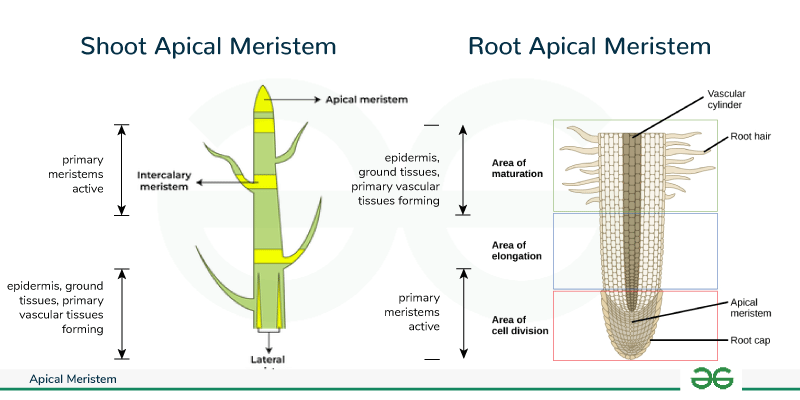
Protoderm
Primary meristem giving rise to dermal tissue (epidermis).
Procambium
Primary meristem differentiating into primary vascular tissues (xylem and phloem).

Primary vs. Secondary Growth
Primary growth increases length via apical meristems; secondary growth increases girth via lateral meristems.
Parenchyma
Versatile, thin-walled simple plant tissue used for storage, metabolism, and repair.
Collenchyma
Simple plant tissue with unevenly thickened primary walls offering flexible support.
Sclerenchyma
Rigid simple plant tissue with thick lignified secondary walls; dead at maturity.
Xylem
Vascular tissue (vessel elements, tracheids) conducting water and minerals upward.
Phloem
Vascular tissue (sieve tubes, companion cells) conducting sugars throughout the plant.
Cuticle
Waxy cutin layer on leaf/stem epidermis preventing water loss.
Stomata
Epidermal pores regulated by guard cells for gas exchange and transpiration.
Periderm
Protective suberin-rich woody outer layer replacing epidermis during secondary growth.
True or False: A hypothesis should always have both Null and Alternative Hypotheses.
True
Null Hypothesis (H0) vs. Alternative Hypothesis (HA)
Null (H0) states no relationship between IV and DV; Alternative (HA) states a relationship exists.
Components of an Experiment
Independent variable, dependent variable, controlled variables, experimental group, and control group.
Seven Disciplines of Botany
Plant Anatomy, Physiology, Taxonomy, Systematics, Geography, Ecology, and Morphology.
Five Major Roles of Plants
Oxygen production, food source, ecosystem habitat, societal impact, and environmental protection.
Six Ways Humans Depend on Plants
Food (agriculture), oxygen (respiration), textiles (clothing), medicine (drugs), energy (fuels), and soil protection.
Impact of Human Population Growth on Plants
Increases resource demands and environmental stress, requiring technological innovations.
Three Ways Humans Impact Plants
Environmental degradation (pollution/deforestation), causing extinction, and introducing invasive species.
Pollution
A large surge of a substance or contaminant into an environment.
Last Step of Scientific Method
Peer review.
Scientific Method Steps
Observation, Question, Hypothesis, Experiment, Data Analysis, Conclusion, Report Results, Peer Review.
Experimental Group
Test group exposed to the independent variable.
Control Group
Baseline group not exposed to the independent variable.
Hierarchy of Life (Small to Large)
Atoms, Molecules, Cells, Tissues, Organs, Organ Systems, Organism, Population, Community, Ecosystem, Biosphere.
Variable
A specific factor altered in an experiment.
Principle
A generalization established through accumulated data.
Theory
A broad explanation backed by tested generalizations.
Cell Biology
Study of cell structure and function.
Plant Genetics
Study of plant heredity and variation.
Molecule
Two or more bonded atoms.
Compound
Substance composed of two or more different elements bonded together.
True or False: All molecules are compounds.
False
True or False: All compounds are molecules.
True