Lecture 13: Non exertional myopathies or rhabdomyolysis (Disease of muscle 2)
 Call Kai
 Learn
Learn Practice Test
 Spaced Repetition
 Match
Match Flashcards
 Knowt Play
1/29

There's no tags or description
Looks like no tags are added yet.
Name | Mastery | Learn | Test | Matching | Spaced | Call with Kai | Chat |
|---|
No analytics yet
Send a link to your students to track their progress
30 Terms
- a disruption of skeletal muscle integrity
- patients experience myalgia, weakness, and myoglobinuria.
- It is accompanied by a significant increase in muscle enzymes
What is rhabdomyolysis?
- kidneys (acute kidney injury)
What organ is at risk of injury for horses with rhabdomyolysis?
1. C. perfringens
2. C. septicum
3. C. chauvoei
4. C. sporogenes
(gram positive and strive in a anaerobic environment)
What is the etiology of clostridial myositis?
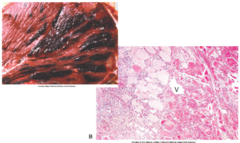
- often via inoculation through a needle (banamine) or penetrating wound with C. Perfringens (most common)
- anaerobic (LOW O2) environment allows bacteria to thrive
- bacteria thrives and releases endotoxins
How does a horse get clostridial myositis?
- swollen, hot, discolored over a local area at first
- over time it cools, become insensitive, and sloughs
- crepitus
- malodorous serosanguinous fluid
- "cooked" muscle appearance when you cut into it
What is seen with local clostridial myositis?
- depression, fever, toxemia
- tremors, ataxia, dyspnea, recumbency
- coma +/- death
What is seen with general clostridial myositis, when it becomes more severe?
- history and clinical signs (usually enough)
- Hemoconcentration, stress leukogram, toxemia
- moderately increased CK and ASK
- U/S: fluid and hyperechoic gas accumulation
- Aspirates: rod shaped bacteria on anaerobic culutre
How do you diagnose clostridial myositis?
1. stabilize P if in shock or toxemia
2. create an unfavorable conditions for bacteria = fenestration and debridement
3. admin an IV high does of beta lactam antibiotics (K pen or metronidazol)
4. supportive care : fluids, NSAIDS, SAID once
How do you treat clostridial myositis, even though its prognosis is guarded to poor?
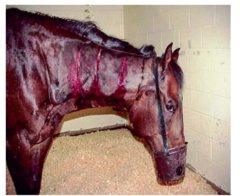
- an autosomal codominant disease with variable degrees of clinical signs due to a gene mutation (MyHM1)
- Immune-mediated myositis --> muscle atrophy of top line
- non-exertional rhabdomyolysis --> severe muscle damage of top line
What is myosin-heavy chain myopathy (MYMH) in American quarter horses? What are the 2 possible outcomes?
- infection or vaccine against any respiratory infection like influenza and strangles
The most common cause of rapid atrophy of the topline in AQH and APH is myosin-heavy chain myopathy (MYMH). What are its triggers?
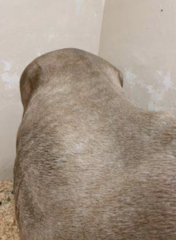
- rapid muscle atrophy (days)
- stiffness, weakness, malaise
- location: epaxial and gluteal muscles
What is seen with immune mediated myositis a form of MyHM?
- muscle destruction
- pain, reluctance to move
- myoglobinuria
- increased muscle enzymes (CK and AST)
What is seen with non exertional rhabdomyolysis, a form of MyHM?
- high CK (100,000+) and AST
- genetic testing
- muscle biopsy (not usually needed)
How do you diagnose myosin-heavy chain myopathy (MYMH)?
- dexamethasone followed by prednisolone
- monitor CBC
- treat rhabdomyolysis is present
----------
- balanced nutrition: concentrate high with high quality protein
- extend time between vaccines
- avoid strangle vaccine
How do you treat and prevent myosin-heavy chain myopathy (MYMH)?
- heterozygous: muscle mass returns in 2-3 months w/ TX
- homozygous: atrophy more severe and recurrence possible
What is the prognosis for myosin-heavy chain myopathy (MYMH)?
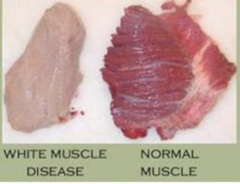
- fast growing young foals that are born to mares with deficiency in Vit E or selenium
Who is white muscle disease seen in commonly, a nutrient myodegeneration?
- eating rapidly growing fertilized plants
- on poorly aerated acidic soil
- on volcanic rock
How might mares become selenium deficient leading to white muscle disease of their foal?
- on dry lot = no grass or poor quality hay
- eating heated pelleted feed
How might mares become vit E deficient leading to white muscle disease of their foal?
- weakness, dysphagia, aspiration pneumonia
- stiffness, trembling, firm muscles, difficulty rising
What are the clinical signs for subacute white muscle disease, a nutrient myodegeneration?
- rapidly progressive weakness, recumbency, death
- affecting large muscle groups
- tachycardia, arrhythmia, murmur
- respiratory distress, pulmonary edema, aspiration pneumonia
(skeletal slower onset)
What are the clinical signs for acute white muscle disease, a nutrient myodegeneration?
- moderate to marked increase in CK and AST
- low whole blood Se or Vit E
- increase K, P, Na
- decrease Cl and Ca
- dehydration
- GSH-Px in RBC
What can be the clinical pathology seen with white muscle disease?
- bilateral symmetric myodegeneration
- myonecrosis
You can take a muscle biopsy to diagnose white muscle disease. What is seen on pathology?
1. supportive care --> stall rest
2. treat Se or Vit E deficiency
3. control complications
What is the treatment for white muscle disease?
- Vit E/ Se sups
- high quality forage
- monitor blood levels
How can you prevent white muscle disease?
- guarded in the foals
What is the prognosis for white muscle disease?
- a highly fatal acquired lipid storage myopathy
- caused by the seeds from box elder trees
- several horses will be affected
What is Hypoglycin A myopathy (a seasonal pasture myopathy)?
- season: fall and early spring after a windly rain
- horses that are young or new to pasture
- wooded pasture with wind
What are the risk factors for Hypoglycin A myopathy (a seasonal pasture myopathy)?
- sudden onset and rapidly progressive
- acute muscle weakness, sweating, fasciculation
- stiffness, tachycardia/pnea, recumbency
- myoglobinuria
- collapse, death from CR failure could occur
What are the clinical signs for Hypoglycin A myopathy (a seasonal pasture myopathy) caused by the seed of box elder trees like in horses?
- markedly increased CK, AST, and myoglobinuria
- hypercalcemia, lactic acidemia increased troponin I
What does the lab work look like with Hypoglycin A myopathy (a seasonal pasture myopathy)?
- aggressive fluid therapy, DMSO, vit E/C, NSAIDs
- < 25% survive = guarded to poor
What is the treatment and prognosis for Hypoglycin A myopathy (a seasonal pasture myopathy)?