Morphology, Syntax, Semantics, and Pragmatics Lecture Review
 Call Kai
 Learn
Learn Practice Test
 Spaced Repetition
 Match
Match Flashcards
1/39

Earn XP
Description and Tags
Comprehensive vocabulary flashcards covering the four primary branches of linguistics: Morphology, Syntax, Semantics, and Pragmatics.
Name | Mastery | Learn | Test | Matching | Spaced | Call with Kai | Chat |
|---|
No analytics yet
Send a link to your students to track their progress
40 Terms
Allomorph
One of the variant pronunciations of a morpheme, among which the choice is determined by context.
Example: [z], [ɪz] and [s].
Blend
Kind of compound in which at least one of the components is reproduced only partially.
Example: smog, combining elements of smoke and fog.
Bound morpheme
Morpheme or allomorph that cannot stand on its own as a word.
Example: "hear" is free but "-ing" is bound.
Onomatopoeia
Resemblance between the sound of a word and what it denotes.
Example: cock-a-doodle-do.
Idiom
Something that is clearly larger than a word may nevertheless have a meaning that is not entirely predictable from the meanings of the words that compose it.
Example: keep tabs on
Morpheme
The smaller parts of words.
Example: jumped → jump and "-ed"
Morphology
Area of grammar concerned with the structure of words and with relationships between words involving the morphemes that compose them.
Example:
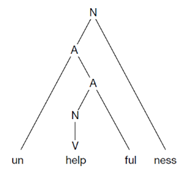
Free morpheme
Morphemes that can stand on their own are called free. Example: “wife” is free but wive- is bound.
Prefix
Bound morpheme that precedes the root.
Example: en- in enlarge
Suffix
Bound morpheme that follows the root.
Example: -ance in performance
Syntactic category
A family-of-expressions that can substitute for one another without loss of grammatically.
Example: A police officer found the pappy.
Your neighbor found the puppy.
This yellow cat found the puppy.
He found the puppy.
Syntax
The part of the grammar that represents a speaker’s knowledge of these structures and their formation.
Example: The boy found the ball.
The boy found quickly. X
Structure
Refers to word order. Example: "Athens defeated Sparta" does not have the same meaning as "Sparta defeated Athens."
Syntactic rules
Determine the order of words in a sentence, and how the words are grouped. Example: The child found the puppy may be grouped into (the child) and (found the puppy).
Phrase structure tree
A formal device for representing speaker knowledge.
Lexicon
The part of the grammar that contains the knowledge speakers have about individual words and morphemes.
Conventions (Syntactic trees)
One convention is that the root of the tree, the S, occurs at the top instead of the bottom. Example: S→NPVP.
Deep Structure
The level where grammatical relations of subject and direct object are interpreted semantically. Example: [Agent: The dog] [Action: chased] [Theme: the cat].
Grammatical
Sequences of words that conform to the rules of syntax are said to be well formed.
Ungrammatical
Sequences of words that violate the syntactic rules are therefore ill formed. Example: The boy found the quickly.
Semantics
The study of the linguistic meaning of morphemes, words, phrases, and sentences.
Semantic properties
Components that make for finer and finer distinctions in meaning. Example: Plod is distinguished from walk by the property "slow."
Semantic features
A formal or notational device for expressing the presence or absence of semantic properties by pluses and minuses. Example: father is +male, +human, +parent.
Homonyms
Different words that are pronounced the same, but may or may not be spelled the same. Example: To, too, and two.
Polysemous
When a word has multiple meanings that are related conceptually or historically. Example: guard, music, bear.
Homographs
Words spelled the same, possibly pronounced the same, and having different meanings. Example: trunk of an elephant and trunk for storing clothes.
Antonyms
Words that are opposite in meaning. Example: beautiful and ugly.
Metonyms
A word used in place of another word or expression to convey the same meaning. Example: The use of "brass" to refer to military officers.
Hyponyms
Words that share a feature indicating they all belong to the same class. Example: lion, tiger, leopard, and lynx have the feature [+feline].
Contradiction
Negative entailment, where the truth of one sentence necessarily implies the falseness of another sentence. Example: "Scott is a baby" and "Scott is an adult."
Pragmatics
Area of linguistics concerned with the interpretation of linguistic meaning in context.
Anaphora
The process of replacing a longer expression by a pronoun or another kind of "pro-form."
Pronouns
Words that may be used in place of noun phrases or used to refer to an entity presumably known to the discourse participants.
Missing Parts
Process related to anaphora where whole phrases are replaced with pro-forms. Example: ONE: My aunt washed the dishes. TWO: My uncle dried.
Situational Context
Knowledge of who is speaking, who is listening, what objects are being discussed, and general facts about the world we live in.
Maxim
States that a speaker's contribution to the discourse should be as informative as is required—neither more nor less (the maxim of quantity).
Presupposition
Facts whose truth is required in order that the utterance be appropriate. Example: "Have you stopped hugging Sue?" presupposes you once hugged Sue.
Deixis
Words and expressions whose reference relies entirely on the situational context of the utterance and can only be understood in light of these circumstances.
Deictic
Terms such as "you", "there", and "now" that require knowledge of the person, place, or time of the utterance to be interpreted referentially.
Illocutionary force
The intent of an utterance dependent on context; part of speech act theory within pragmatics. Example: The act of bequeathing via a performative verb.