(Preview) Forearm&Hand Muscles
 Call Kai
 Learn
Learn Practice Test
 Spaced Repetition
 Match
Match Flashcards
 Knowt Play
1/20

There's no tags or description
Looks like no tags are added yet.
Name | Mastery | Learn | Test | Matching | Spaced | Call with Kai | Chat |
|---|
No analytics yet
Send a link to your students to track their progress
21 Terms
ulna osteology
-semilunar notch: articulates w/ trochlea of humerus
-olecranon process: most superior part of ulna
-radial notch: articulates with head of radius
-styloid process: distal

radius osteology
*mobile during pronation/supination
-radial tuberosity: insertion biceps brachii
-head: articulates with radial notch of ulna
-neck
-ulnar notch: articulates w/ distal ulna
-styloid process

radioulnar ligaments
1.Radial collateral l.
2.Annular l. (*holds head of radius against ulna)
3.Ulnar collateral l.
4.Interosseous membrane
5.Radioulnar l. (dorsal)
*tendons pass over dorsal tubercle

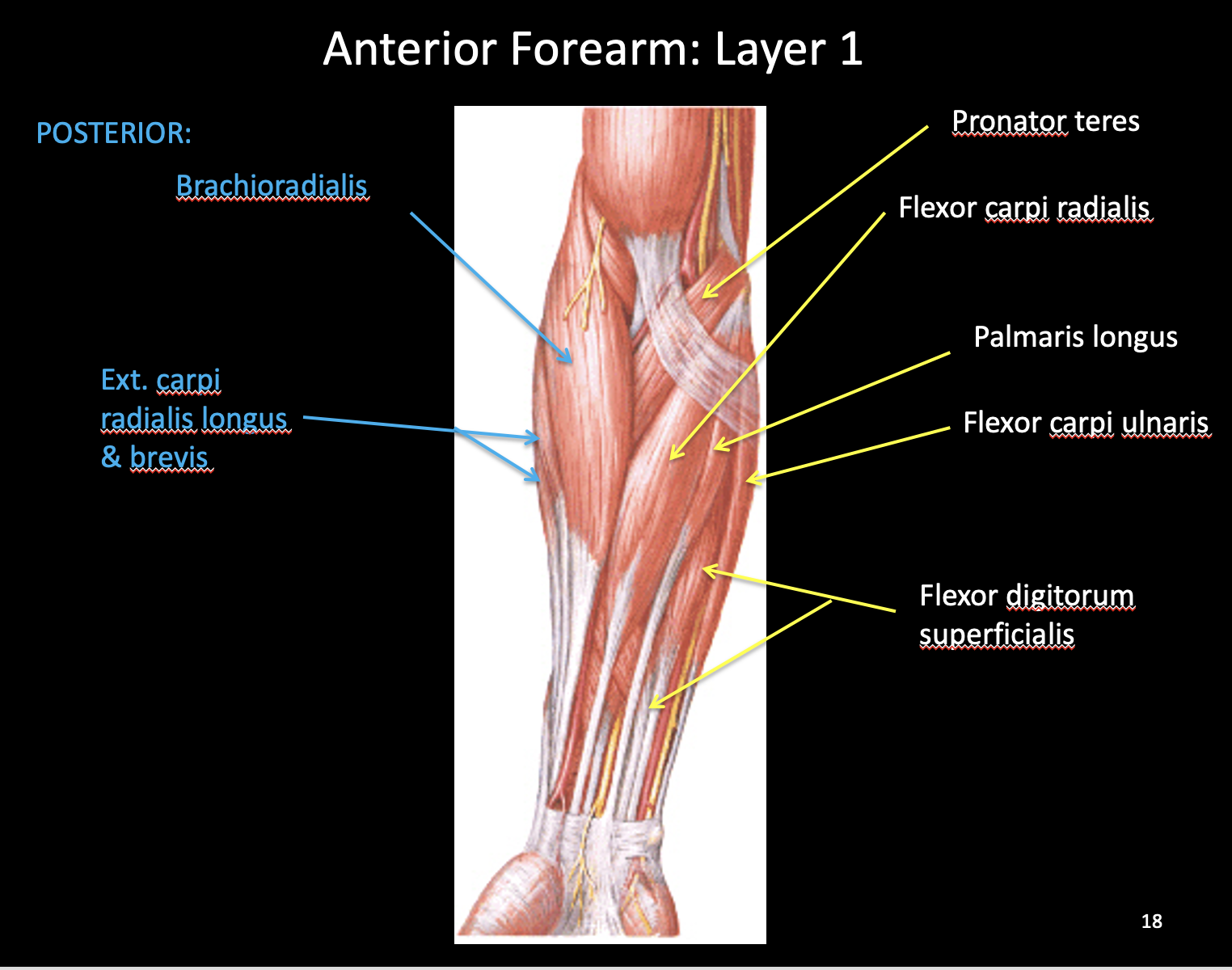
generel anterior forearm origin, insertion, innervations, and blood supply
•Origin of muscles: medial epicondyle of humerus (mostly)
•Insertion of muscles: look at the name of the muscle for a hint
•Innervation: Median n. (mostly) / Ulnar n.
•Blood supply: Ulnar a. / Anterior Interossesous a. / Radial a.
anterior forearm: layer 1
“Purple Frogs Play Ultimate Sports”
anteriore forearm: layer 2

anterior forearm: layer 3
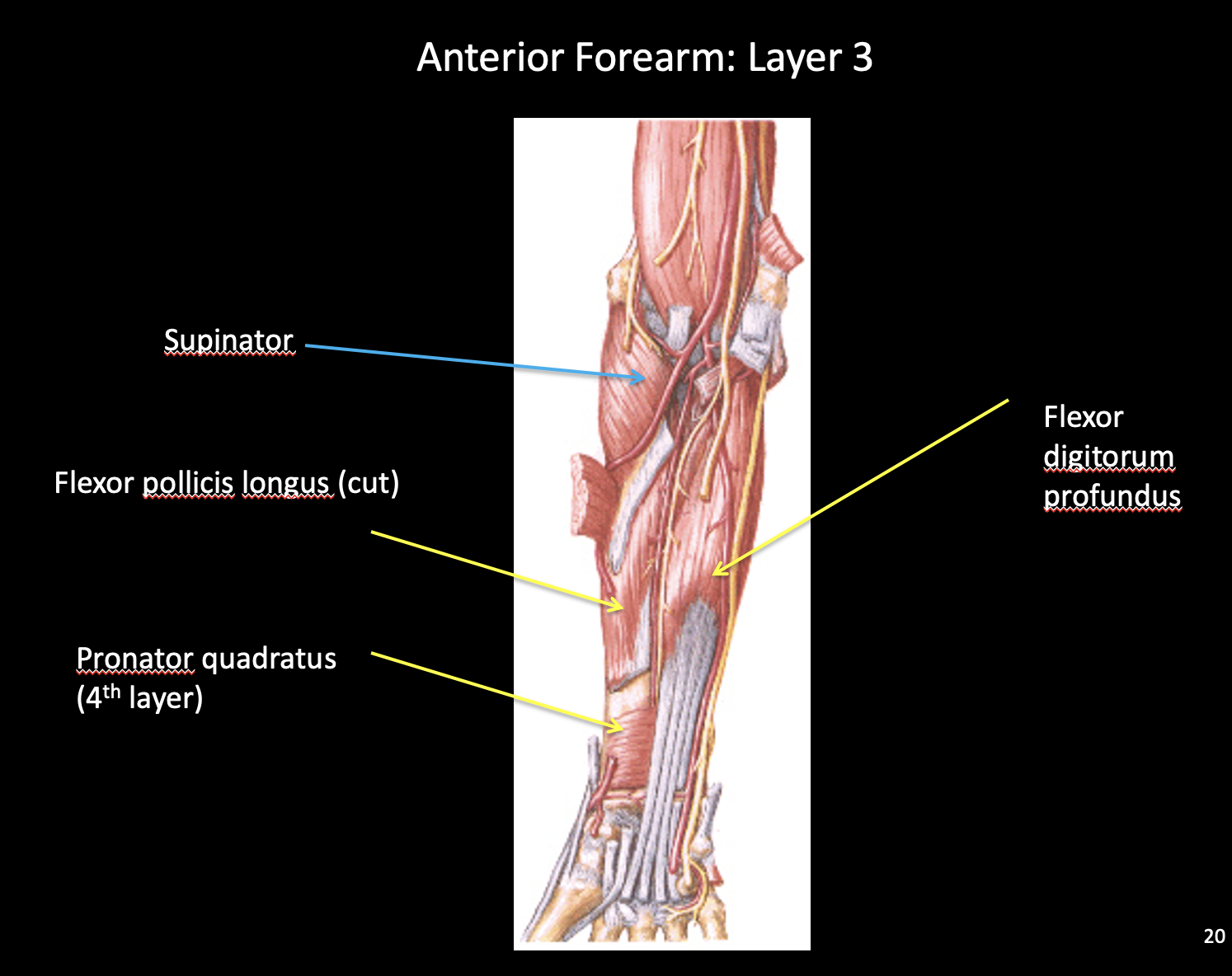
Palmar Hand: Flexor Digitorum Superficialis and Profundus
-FDP and FDS have different insertions that alter their function
-FDP:
i: distal phalanx 2,3,4,5
act: flex DIP and PIP
-FDS:
i: middle phalanx
act: flex PIP

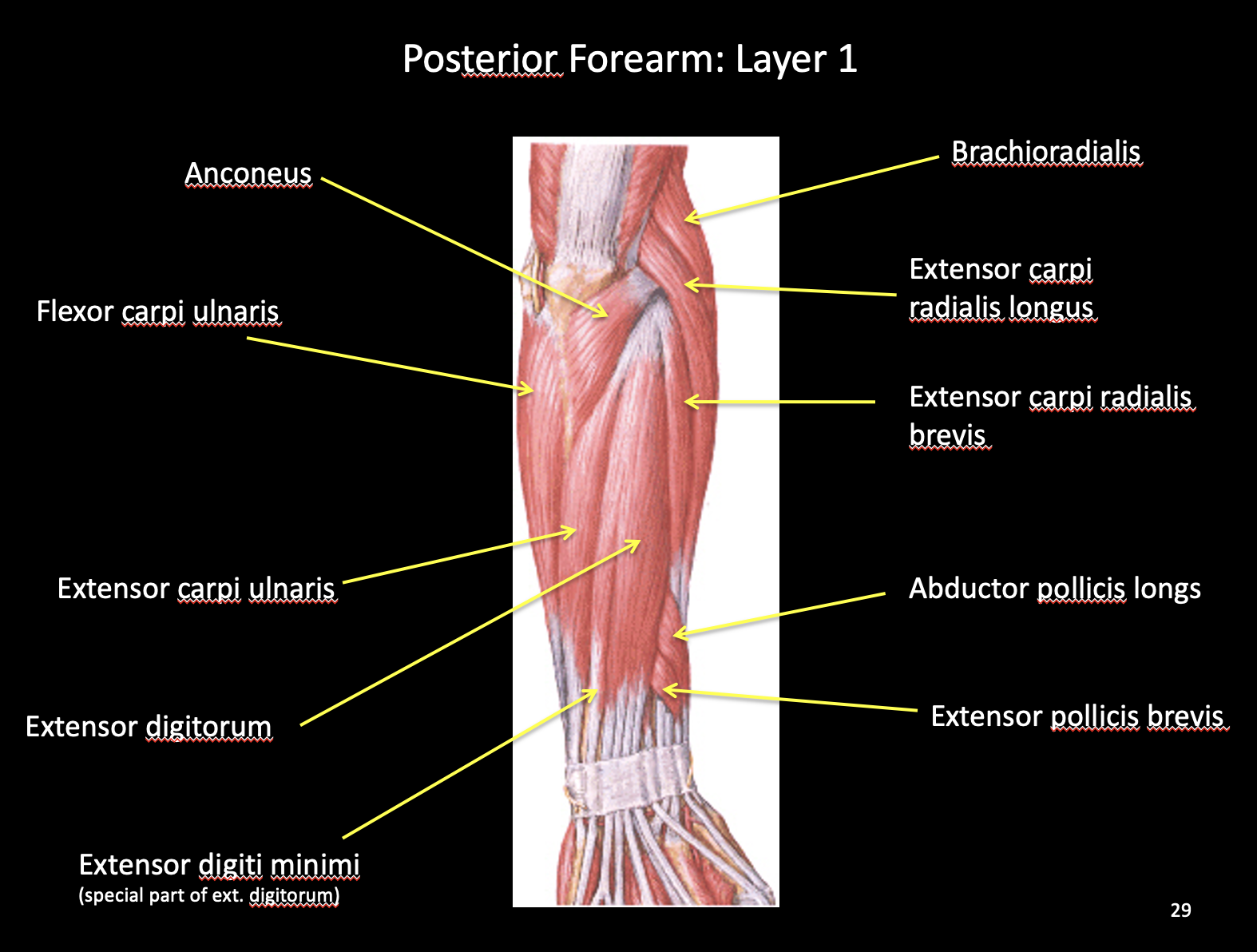
generel posterior forearm origin, insertion, innervation, and blood supply
•Origin of muscles: lateral epicondyle of humerus (mostly)
•Insertion of muscles: look at the name of the muscle for a hint
•Innervation: Radial n.
•Blood supply: Posterior Interossesous a. / Interosseous recurrent a.
posterior forearm: layer 1
“Bad children certainly do make us angry”
posterior forearm: layer 2
“Some adults beleive love infects”

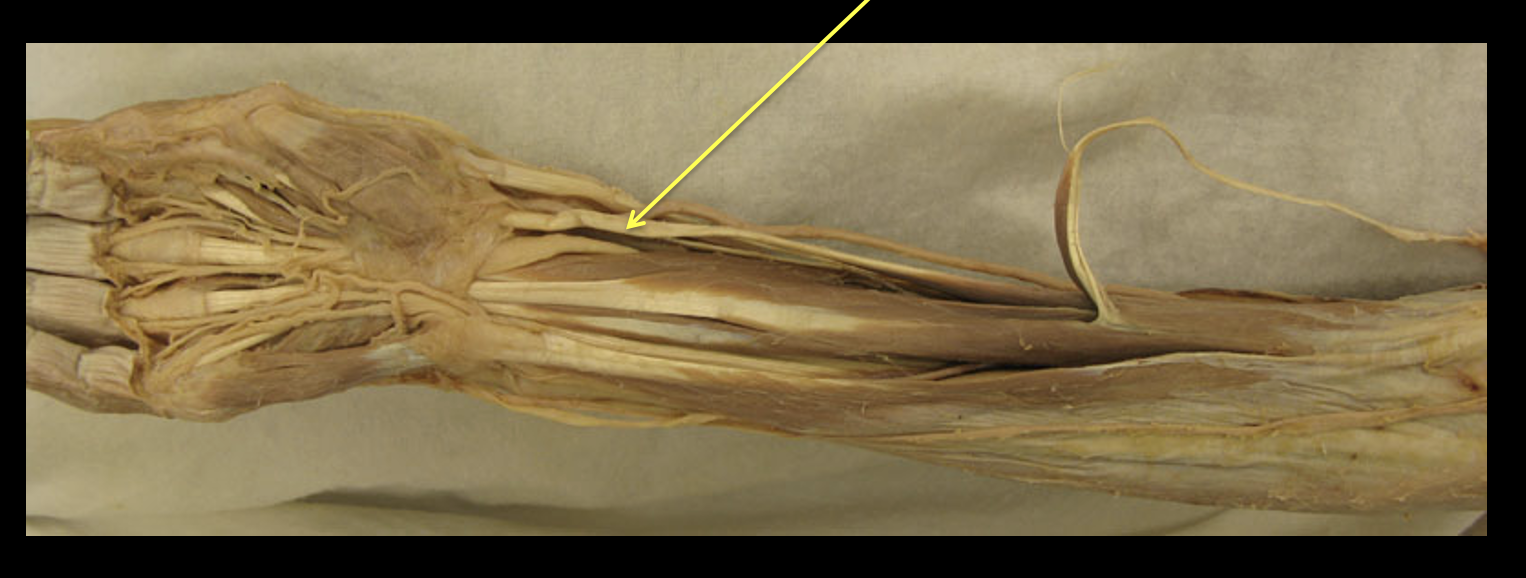
what happens if either FCU or FCR were severely weakened or paralyzed?
-both need to contract at the same time to flex normally
-if one doesn’t work will deviate to the other side
bc have different innervations
intrinsic hand muscles
+adductor pollicis

lumbricals muscle table
-Origin: tendons of flexor digitorum profundus muscle in palm
-Insertion: extensor expansion of 1st phalanx (fingers 2 - 5)
-Innervation
median nerve (lateral 2)
ulnar nerve (medial 2)
-Action: flex fingers at metacarpophalangeal joints and extend fingers at interphalangeal joint

palmar interosseous muscle table
-Origin: mid-axis side of metacarpals 2, 4, 5
-Insertion: extensor expansion on 1st phalanx of corresponding digit
-Innervation: ulnar nerve
-Action: adduct fingers toward 3rd finger

dorsal interosseous muscle table
-Origin: sides of metacarpals
-Insertion: extensor expansion over proximal phalanx of fingers 2-4
-Innervation: deep branch of ulnar nerve
-Action: abduct the fingers

palmar vs dorsal interossei actions
•“DAB with the PAD”
–Dorsal interossei ABduct
–Palmal interossei ADduct
hypothenar muscels
-act on 5th digit
-Flexor digiti minimi brevis; abductor digiti minimi; opponens digiti minimi

thenar muscles
-act on the thumb
-in=median nerve/recurrent median nerve
•Flexor pollicis brevis
•Abductor pollicis brevis
•Opponens pollicis
actions of the pollex


muscels of the thumb + innervation
