BB450 Unit 2
 Call Kai
 Learn
Learn Practice Test
 Spaced Repetition
 Match
Match Flashcards
 Knowt Play
1/32

There's no tags or description
Looks like no tags are added yet.
Name | Mastery | Learn | Test | Matching | Spaced | Call with Kai | Chat |
|---|
No analytics yet
Send a link to your students to track their progress
33 Terms
Explain the enzyme inhibition model
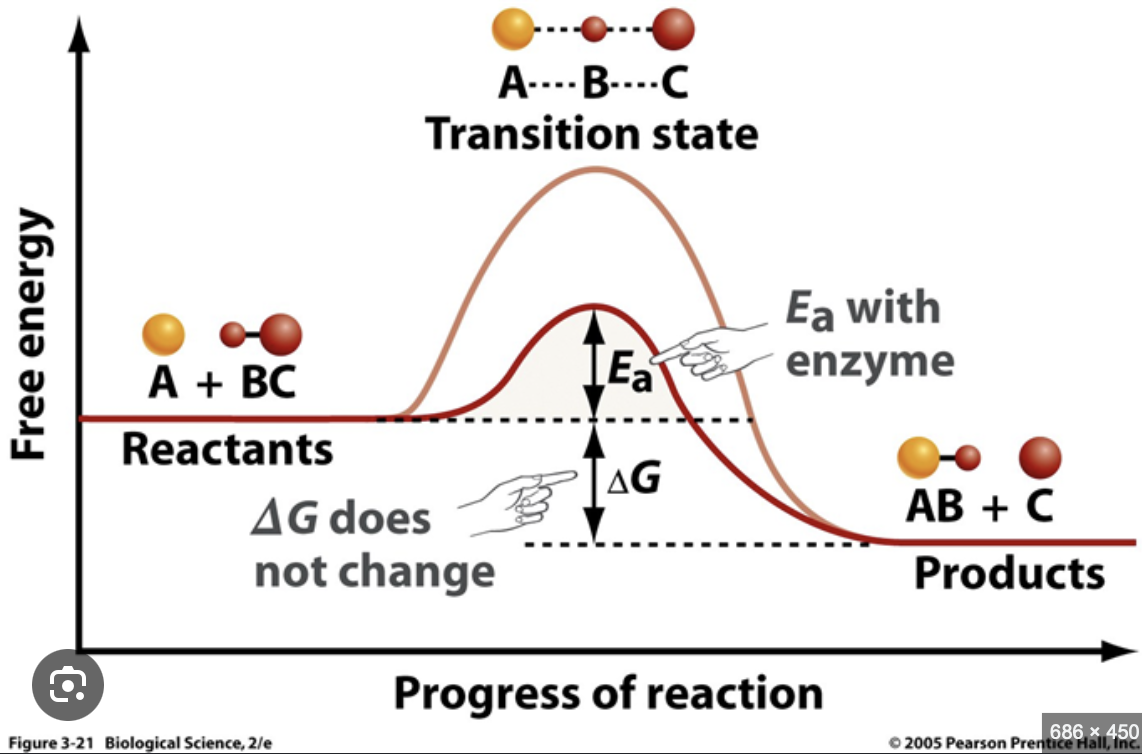
How do enzymes catalyze reactions
Enzymes bind to reaction molecules (enzyme substrate) in a formation thatt stabilized intermediate structure allowing the intermediate to be less enegretically unfavorable meaning less energy is needed to reach transition state, thus lowering activation energy of reaction making reaction occur more quickly
How much can enzymes reduce activation energy?
depends on
1) amount of susbtrate present
2) amount of enzyme present
3) catalytic properies of enzyme
Explain the induced fit model
a more accurate version of the old lock and key model, explaining that when a subtrates bind in the actve site of an enzyme, the shape of the enzyme will change slightly, changing the shape of active site making it fit the two binded substrates perfectly.
lock ad key model is not accurtae bc if the substrates just fit into the enzyme there would be no driving force to cause the substrates to interact and allow catalysis to occur. the shape change of the enzyme that occurs upon the binding of the substrate forces the subtrates into close proximity to they react—- a DRIVING FORCE OF CATALYSIS
What is reaction velocity
The concentration of product formed per unt time.
Time for enzyme to convert subtrate to product depends on 2 things:
1) the substrate molecule must diffuse to and bind the active site of the enzyme (depends on substrate concentration)
2) how long the substrate is held at acive site while catalysis occurs (intristic property of enzyme) tt will always be the same and independent of subtratae concentration.
the amount of time for substrate to diffuse to active site does depend on conc of subtrate moelcules present bc it takes longer for substrate molecules to randomly interact with ensyme if there are not many of them
reactions with higher sustrate concentration have a higher reaction velocity (occurs faster) and more product will be made more quickly as a result.
higher susbtrate concentraions = higher reaction velocity
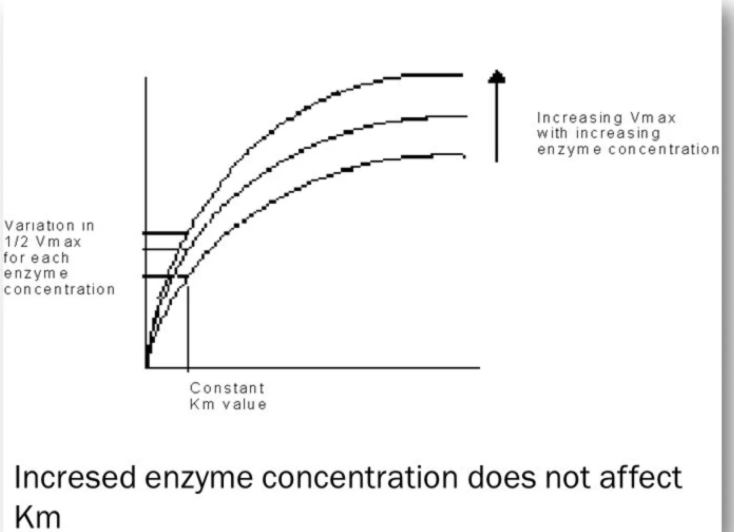
What is the reaction velocity per substrate concentration model, and how is it impacted by the addition of enzymes
Reaction velocity (Y axis) as a function of substrate concentration (X axis)
How is reaction velocity impacted by very high subrate concentrations? what is Vmax?
f conc of subtrate is high enough the active site of enzyme will be constantly occupies, the enzyme is saturated, and the substrate is at a saturating concentration.
if substrate concentration increases beyond the point of saturation, there is no effect on how quicly product can be made since enzymes active site is already working at max capacity. eventually, the reaction velocity will plateu at the maximim rate past saturating cincentration.This maximum reaction velocity is known as VMax
What impacts Vmax
Vmax is not fixed for each enzyme, instead it depends on the amount of enzyme that is added to a reaction when the velocity measurements are made. If there are more enzymes molecules available to catalyze reactions, then susbtrate can be converted to product faster.
Explain Kcat (turn over number)
At the point of saturation and at maximum reaction velocty The time required to convert susbtarte product only depends on the amount of time it takes for catalysis to occur at active site (turn over numbe) which is the number of substrate molecules converted nu one active site per second under saturating substrate concentrarion, and therefore shows the fastest possible rate of enzymatic reaction on a per actve site basis.
KcatKcat is the turnover number and is an intrinstic propery of an enzyme.
Kcat=Vmax/(number of active sites X total enzyme concentration)
The higher the Kcat value, the faster an enzyme can convert the most susbtrate molecules into prodct
Kcat is or is not constant for a given enzyme
Is.
this means that no matter how much enzyme we add to an experiemnt, Kcat will always stay the same given we use the same enzyme
Kcat vs Vmax
Kcat= a constant for a specific enzyme (independent of enzyme concentration)
Vmax= depends on enzyme concentration
Give an example of an enzyme that has a very high Kcat, a very low kcat, and define what is a “perfect enzyme?”
Kcat (turnover rate); number of susbtrate molecules converted to product in one second
Catalase- Kcat of 40,000,000
Catalase’s turn over rate is so fast that it is only limited by how quickly the substrate and producrs can diffuse into and away from the active site (how fast they enter the actve site, bind, and leave the active site).
Fumerase- Kcat of 800
Enzymes such as catalase that are limited only by the rate of diffusion are called perfect enzymes.
Explain Km (michaelis constant)
the substrate concentration in which V=1/2Vmax (half maximum reaction velocity)
This corresponds to a second intrinstic property of an enzyme.
Km relates to the enzymes affinity for its substrate. An enzyme that has a high affinity for its substrate will more readily bind to it, and as a result, the enzyme will require a lower concentration to reach saturation and Vmax.
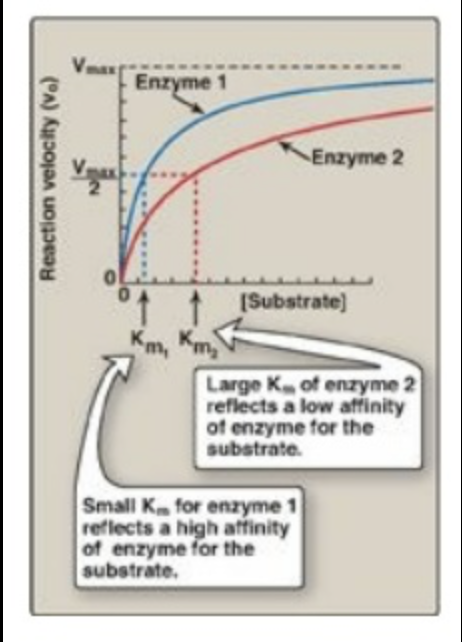
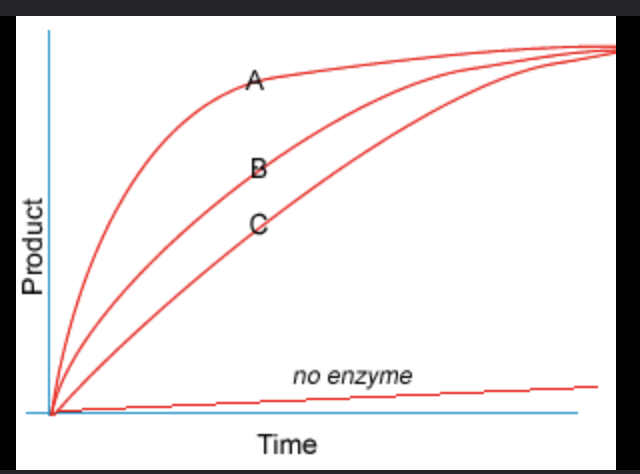
which enyme has a higher affinity for its substrate
A (steepest has higher affinity)
A high Km corresponds to a _____ affinity of enzyme for substrate
Low
Explain the michaelis-menton equation for an enzymatic reaction
v=Vma[S]/Km+[S]
How you can solve for reaction velocity in the presence of a specific substrate concentration
It is often more convienent to use the inveretd equation of the michaelis-menton equation known as the lineweaver-Burk (or double reciprocal) plot. Lineweaver-Burk=1/v=(Km/Vmax[S]) + ([S]/Vmax[S]), (is the same as y=mx+b) because it gives a straigh line when grapghed intead of the hyberpolic shape of the V vs [S] graph

For the new equation, we see that the y-axis is 1/V and the x is 1/[S]. the slope is Km /Vmax and y intersept is 1/Vmax. Linewevaer burk is useful to compare enzyme kinetics in presence of different enzymes inhibitors
Explain the types of enzyme inhibtion, what is an enzyme inhibitor
Inhibitor: a molecule that binds tp the enzyme and prevents the enzye from catalyzing reaction
Competive inhibors-inhibitor can directly prevent enzyme from binding to substrate by binding to the active site itself. inhibitor is dompeteing with substrate to bind to active site. if we were to keep increase susbatre, evetually there woul dbe more susbtrate than inhibitor and substrate would outcomepet the inhibitor. the Vmax in presence of competeive inhibior is the same as the Vmax of the reaction without inhibition (it just takes a higher S to get there)
Noncompetive- inhibitor can find som eplace other than the active site on the enzyme, and preventing catalysis from occuring. binding is independent of substrate binding. they can cause conformationak changes in enzyme to prevent binding, release of product, or reaction. If inhibitor is bound to enzyme, it cannot function.Substrate cannot out compete inhibitor, even under high S inhibitor can still bind and inhibit enzyme. High [S] cannot overcome noncompetetive inhibition
Uncompetetive- inhibitor can lock substrate into place after substrate has binded to the active site. the inhibtor cant bind UNtil substrate is bound. This means that as [S] increases, there is more opportunity for inhibtion. at low [S], there are fewe opportunitys for inhibiton.
Each of these use different methods to inhibit, and affects the reactions (such as Vmax and Km) differently.
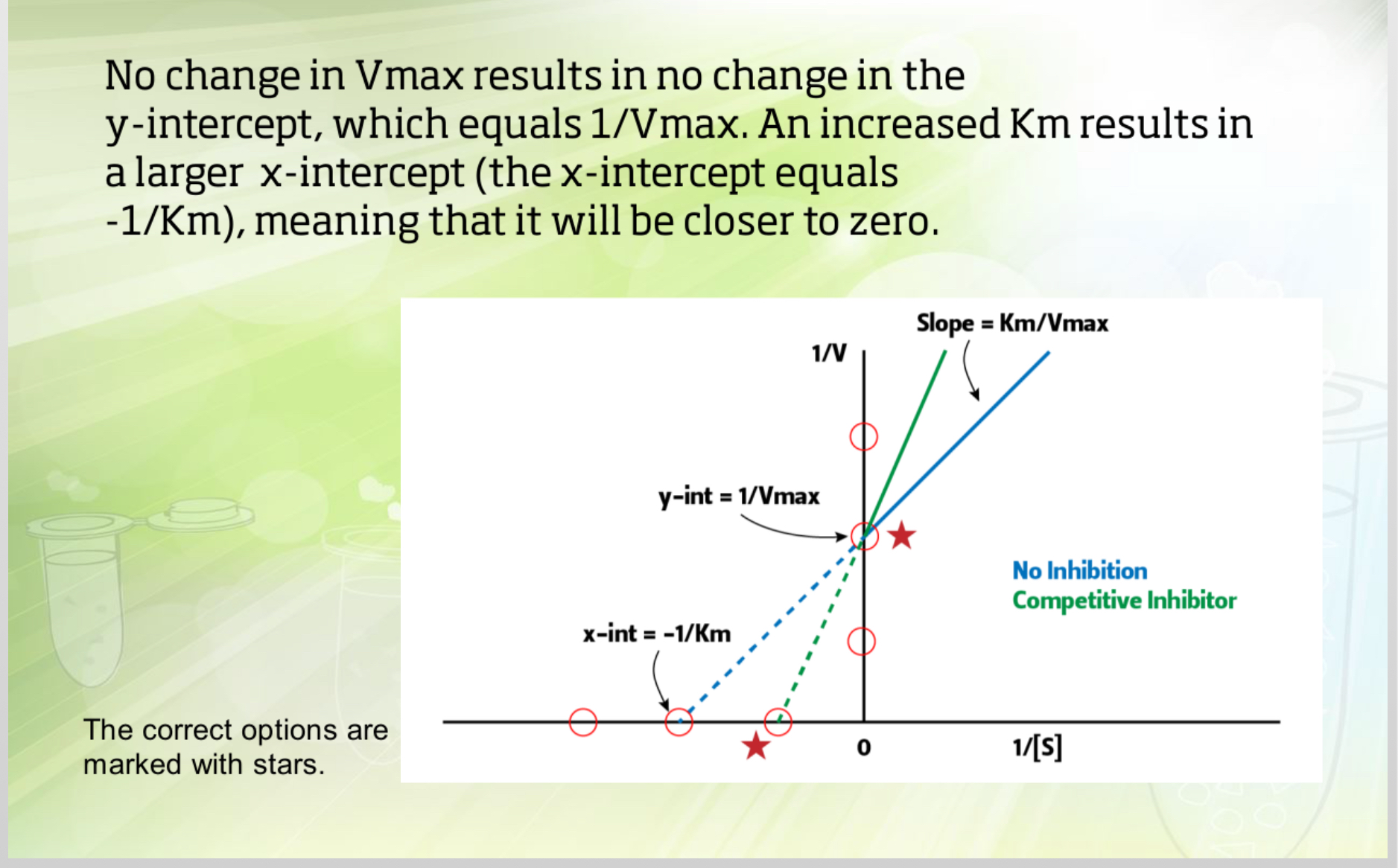
how does the Km of the reaction change in the presence of a competetive inhibitor? What about Vmax
It increases
-There would be no chaneg in the y-intercept, but an increase in Km would result in a larger x-intercept (closer to 0)/
Vmax is unchanged.
What effect does noncompetetive inhibitors have on the Vmax and Km of a reaction
Vmax is smaller. Inhibition cannot be overcome with high [S], so the max reaction velocity will be reduced relative ti when there is no inhibition.
Km in unchanged. Binding of the substrate and inhibitor are independent of one another, so the [S] required to achieve Vmax/2 is unchanged.
![<p>Vmax is smaller. Inhibition cannot be overcome with high [S], so the max reaction velocity will be reduced relative ti when there is no inhibition.</p><p>Km in unchanged. Binding of the substrate and inhibitor are independent of one another, so the [S] required to achieve Vmax/2 is unchanged.</p><p></p>](https://assets.knowt.com/user-attachments/887e9123-e73b-4bb3-9830-aee893ed343f.png)
What effect does uncompetetive inhibition have on the Vmax of a reaction? what about Km?
Vmax is smaller. Not only is high [S] unable to overcome inhibition, but there will actually be more inhiubition with higher [S]. This is because the inhibitor can only bind to enzymes that are bound to substrate and therefore Vmax will be reduced relattive to when there is no inhibition.
Km; 1/2Vmax is smaller, so Km is smaller too. When enzyme binds to substrates, it is called ES. When an uncompetetive inhibitor binds to the ES complex, it is called ESI. Inhibitor will rapidly decrease pool of ES by binding and changing it to ESI. At this point, the reaction will shift the direction of the reactions to maintain equillibrium (lechatelier principle) to counter rapid depletion of ES, more ES will be formed by, for example, increasing substrate to the enzyme. WHen an uncompetetive inhibitor is present, more substratre will bind to enzyme than they would if there was no inhibitor present. This means the enzyme becomes saturated at a lower substrate concentration, and 1/2Vmax also occurs at lower substrate concentration.
A decreased Vmax results in a laregr value for the y-intercept, which equals 1/Vmax. A decreased Km results in a smaller x-intercept value (the x-intercept equals -1/Km), meaning that it will be farther from 0.
![<p>Vmax is smaller. Not only is high [S] unable to overcome inhibition, but there will actually be more inhiubition with higher [S]. This is because the inhibitor can only bind to enzymes that are bound to substrate and therefore Vmax will be reduced relattive to when there is no inhibition.</p><p>Km; 1/2Vmax is smaller, so Km is smaller too. When enzyme binds to substrates, it is called ES. When an uncompetetive inhibitor binds to the ES complex, it is called ESI. Inhibitor will rapidly decrease pool of ES by binding and changing it to ESI. At this point, the reaction will shift the direction of the reactions to maintain equillibrium (lechatelier principle) to counter rapid depletion of ES, more ES will be formed by, for example, increasing substrate to the enzyme. WHen an uncompetetive inhibitor is present, more substratre will bind to enzyme than they would if there was no inhibitor present. This means the enzyme becomes saturated at a lower substrate concentration, and 1/2Vmax also occurs at lower substrate concentration.</p><p></p><p>A decreased Vmax results in a laregr value for the y-intercept, which equals 1/Vmax. A decreased Km results in a smaller x-intercept value (the x-intercept equals -1/Km), meaning that it will be farther from 0.</p>](https://assets.knowt.com/user-attachments/474583fa-a672-4fe4-a32d-9d19be8d01aa.png)
Enyme is saturated at a lower substrate concetration. 1/2Vmax also occurs at a lower substrate concentration. What effect does uncompetetive inhibition have on Km
Km is smaller. the enzyme saturates at a lower [S], meaning that Vmax is reached at a lower [S] (since Vmax occurs at enzyme saturation). Therefore, Km, which is the [S] at Vmax/2, is also smaller.
![<p>Km is smaller. the enzyme saturates at a lower [S], meaning that Vmax is reached at a lower [S] (since Vmax occurs at enzyme saturation). Therefore, Km, which is the [S] at Vmax/2, is also smaller.</p>](https://assets.knowt.com/user-attachments/18379692-d7b1-4afc-b24c-2fcbe65a7a40.png)
Inhibitors can be useful clinically by altering the production and balance of carious cellular products, in turn affecting cellular function. Give an example
They can be effective therapeutics that disrupt the function of, for example, cancer cells.
Enzyme checkpoints:
-What is chymoptrypsin
-What is hexokinas an example of
-What is enolase an example of
Chymotrypsin is a serine protease (enzyme that breaks down protiens) with a hell understood mechanism involving acid-base catalysis, covalent catalysis, and transtion state stabilization.
Hexokinase is an example of how the induced fit mechanisms of catalysis works
Enolase is an example of how metal ions can act as cofactors in catalysis
Experimental determination of reaction mechanisms
A catalytic triad is a very commmon comb ibnateoin of very reactve r groups side chains from asparatate, histodine and serine (for example). There are also catalysic diads, ad the number after is ther number in the polypeptide chain in the protein.
Catalytic triad helps us understand what is going on in the active site of an enzyme. We do this by looking at sequence of protien and how it folds, look at active site and active aa residues that will be very reactive. Once they get an idea of what might be involved, they will test the mutated version of serine 195 and express protiens to see the rection, and if the reaction is lowed down, we know it is important. If we do this with another aa and its not impacted, we know it is not involved. If mutataed to someting differend and it makes rate of catalysis slow down, then we can figire out what AAs are involved. We can also look and deduce what chm reactions are occuring in active site with substrate, with stepwise, figure out what the mechanisms are.
Example is chymotrypsin
What is chymotrypsin
A protease (an enzyme that catalyzes the hydrolytic cleavage of peptide bonds) at an optimal actvity of pH 8.
It is a pancreative digestive enzyme that cleaved proteins after an aromatic residue.
There are two phases of chymotrypsin mechanism;
1) acylation phase in which the peptide bond is cleaved and an ester linkage if formed between the peptide carbonyl carbon and the enzyme
2) deacylation phase in which the ester linkage hydrolyzed and the noncovalent enzyme is regenerated. enzyme is never permamently changed.
Can you look at a protein sequence and see catalytic site
No. In some cases (liek chymotrypsin, the different AA residues are far away from each other n the protien sequence, and only get close when protein is folded.
Chymotrypsin mechanism
1) When chymotrypsin is a free enzyme, it has a catalytic triad of serine, histidine and asparagine. When the substrate (a polypeptide) binds, the side chain (aromatic) of the residue adjacent to the peptide bond to be cleaved nestles in a hydrophobic pocket on the enzym , positoning the peptide bond for attack. Remember, we want to cleaves after aromatic residue.
2) A conforational change allows the histidine to remove a proton from serine to form a strongly nucleophillic alkoxide ions ((RO⁻) is the highly reactive, negatively charged conjugate base of an alcohol.) The interaction of Ser195 and His57 generates this alkoxide ion on Ser195. The ion will attack the peptide carbonal group, forming a tetrahedryl acyl-enzyme. This is accompanied by formation of a short lived negative charge on the carbonyl oxygen of the substrate, which is stabilized by hydrogen bonding in the oxynanion hole.
3) Because the neg charge is unstable, the tetrahedral intermediate collapses, and the carbon oxygen double bond reforms. The reformation of the double bond with the carbon displaces the bond between the carbon and the amino group (nitrogen bond) of the peptide linkage, breaking the peptide bond. Then the histidine will donate a proton to the amino leavig group, facilitating its displacement. This forms the first reaction product, Product 1, which leaves the active site. The rest of the initial substrate remains in the active site as part of the acyl-enzyme intermediate, becasue it is covalently linked to the actice site serine.
4) In the final setp of the acylation phase, water enters the active site. Now the deacylation begins. First, the histidine deprotonates the incoming water molecule (by general base catalysis) to produce a strongly nucleophillic hydroxide ion that attacks the ester linkage of the acylenzyme intermediate, producing a new tetrahedral intermediate. Within the new intermediate, the carbonyl oxygen again takes on a temporary negative charge within the oxyanion hole.