AP Calculus AB Unit 1: Limits and Continuity
 Call Kai
 Learn
Learn Practice Test
 Spaced Repetition
 Match
Match Flashcards
 Knowt Play
1/65

There's no tags or description
Looks like no tags are added yet.
Name | Mastery | Learn | Test | Matching | Spaced | Call with Kai | Chat |
|---|
No analytics yet
Send a link to your students to track their progress
66 Terms
Horizontal Asymptote
The line y = b is a horizontal asymptote of the graph of a function y = f(x) if either limx→∞ f(x) = b or limx→-∞ f(x) = b.
sin0
0
sin(π/6)
1/2
sin(π/4)
1/√2 = √2/2
sin(π/3)
√3/2
sin (π/2)
1
sinπ
0
sin(3π/2)
-1
sin2π
0
cos0
1
cos(π/6)
√3/2
cos(π/4)
1/√2 = √2/2
cos(π/2)
0
cosπ
-1
cos(3π/2)
0
cos2π
1
tan0
0
tan(π/6)
1/√3 = √3/3
tan(π/4)
1
tan(π/3)
√3
tan(π/2)
undefined
tanθ (in terms of sine and/or cosine)
sinθ/cosθ
cotθ (in terms of sine and/or cosine)
1/tanθ
cscθ (in terms of sine and/or cosine)
1/sinθ
secθ (in terms of sine and/or cosine)
1/cosθ
An odd function is...
... symmetric with respect to the origin, like y=x^3, y=sinx, or y=tanx. f(-x) = -f(x)
graph of y = sinx

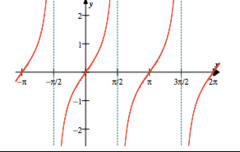
graph of y = tanx
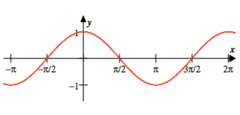
graph of y = cosx
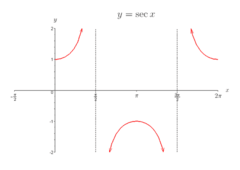
graph of y = secx
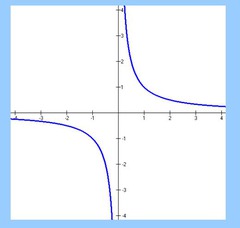
graph of y = 1/x
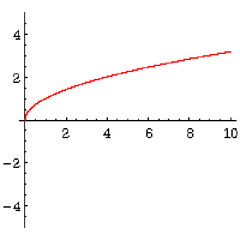
graph of y =√x
graph of y = √1-x^2

graph of y = |x|

graph of y = lnx

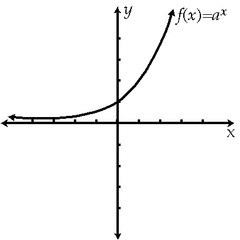
graph of y = e^x
An even function is...
...symmetric with respect to the y-axis (like y = x^2, y = cosx, or y = |x|
ƒ(-x) = -ƒ(x)
A horizontal asymptote occurs at y = b when...
... lim ƒ (x) = b
x →±∞
A vertical asymptote occurs at x = a when...
... lim ƒ ( x ) = ±∞
x→a⁺⁻
indicated by substitution yielding ƒ(a) = nonzero/0
ƒ(x) is continuous at x = c when...
1. ƒ(c) exists
2. lim ƒ(x) exists; and
x→c
3.lim ƒ(x) = f(c)
x→c
Intermediate Value Theorem: If f is continuous on [a,b], then...
... there exists some c in [a,b] such that f(c) = k for any y-value k between f(a) and f(b)
Average rate of change is...
∆y/∆x = (ƒ(b) - f(a)) / (b-a)
A secant line is...
..the line connecting two points on a curve.
Instantaneous rate of change is...
lim (ƒ(a+h) - ƒ(a)) / h
h→0
A tangent line is...
...the line through a point on a curve with slope equal to the slope of the curve at that point.
A normal line is...
... the line perpendicular to the tangent line at the point of tangency.
Point-slope form of a linear equation
y-y₁ = m(x-x₁)
Verbal Definition of a Limit
The y-value that a function approaches as the x-value gets closer and closer to a point c from left and right.

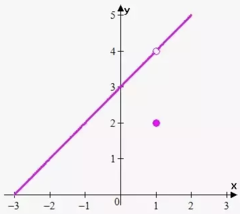
How can a limit exist at a point where a function value does not exist?
Where a hiccup function exists, where there is a hole at c, but the graph approaches the same y-value as it approaches c from the left and right.
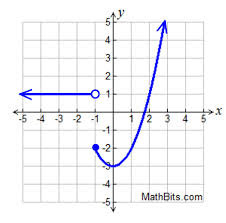
How can a function value exist at a point where a limit does not exist?
If c does not approach the same y-value from both side, then the limit does not exist, but there is a function value when approaching c from either left or right.
Three cases in which a limit DNE (does not exist):
1. differing behavior from left and right
2. unbounded behavior (limit approaching infinity)
3. oscillating behavior
What is an indeterminate form and what does it indicate?
0/0 is called an indeterminate form that is yielded when using direct substitution to find a limit value and indicates that there is a hole in the graph. Therefore, another method must be used to find the limit.
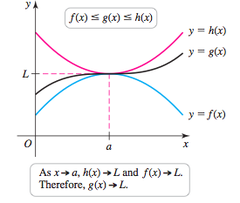
The Sandwich Theorem
If f(x) ≤ g(x) ≤ h(x) for all values where x ≠ c in some interval about c, and limx→c f(x) = limx→c h(x) = L, then limx→c g(x) = L.
- therefore all limits have the same value at y values at c
If direct substitution yields the indeterminate form 0/0, try:
1. simplifying complex fractions
2. factor (trnomial, GCF, difference of two squares)
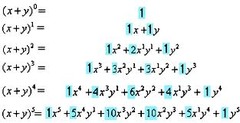
3. expanding a binomial power
Pascal's Triangle
Why do we only care about certain terms in the numerator and denominator?
b/c the terms with the highest degrees in the denominator and numerator increase the fastest
End behavior and asymptotes when the larger degree is in the denominator?
for rational functions f(x) = ax^m+... and g(x) = bx^n +...
End Behavior: limx→±∞ f(x)/g(x) = 0
Horizontal Asymptote: y = 0
End behavior and asymptotes when the largest degrees in the denominator and numerator are equal?
for rational functions f(x) = ax^m+... and g(x) = bx^n +...
End Behavior: limx→±∞ f(x)/g(x) = a/b
Horizontal Asymptote: y = a/b [the ratio of leading coefficients]
End behavior and asymptotes when the largest degree is in the numerator?
for rational functions f(x) = ax^m+... and g(x) = bx^n +...
End Behavior: limx→±∞ f(x)/g(x) = DNE
Horizontal Asymptote: no horizontal asymptotes
What must be true about a function if it has a horizontal asymptote?
The limit as x approaches ±∞ exists.
If a function has a horizontal asymptote y = k, what must be true about this function?
The limit as x approaches ±∞ of f(x) exists.
List these functions from the slowest relative growth rate to the fastest relative growth rate based on f(100) [explain why]:
cosx
a^x , where a > 1
x^n, where n > 0
logx
1. cosx [b/c the range of cosx always stays between -1 and 1
2. logx [b/c this logarithms always produces a gradual concave down slope]
3. x^n [b/c a polynomial is only ever increasing based on a constrained exponent, so x is the variable]
4. a^x [b/c an exponential is continuously compounded based on a variable exponent x, so as the exponential approaches infinity, the exponential function will always be greater than the polynomial functions; however it is important to note that an exponential function, at some point, may be less than a polynomial]
How can a function have more than one horizontal asymptote?
If the value of the limit as x approaches -∞ of f(x) is different from the value of the limit as x approaches +∞ of f(x).
Why is lim x→-∞ e^x equivalent to lim x→∞ 1/e^x?
b/c e^-∞ = 1/e^∞
Vertical Asymptote
line x = a is a vertical asymptote of the graph of a function y = f(x) if either limx→a⁺ f(x) = ±∞ or limx→a⁻ f(x) = ±∞
-occurs when a value of x makes the denominator 0
-0/0 means there's a hole in the graph
-nonzero/0 means a vertical asymptote (limit DNE)
How can we tell whether the function approaches +∞ or −∞ at a vertical asymptote?
1. find which value(s) of x makes the denominator zero and the value(s) of x that makes the numerator zero
2. put the zeroes on a line and test the direction of the graph on the left and right of the x value that makes the denominator zero
3. the sign (positive or negative) of evaluated number on the graph towards the left and right of the x value making the denominator zero tells you whether the function if approaching ±∞
- if the graph behavior towards the left/right if negative, then the graph is approaching -∞ and vice-versa