General and Lab Concepts
 Call Kai
 Learn
Learn Practice Test
 Spaced Repetition
 Match
Match Flashcards
 Knowt Play
1/70

There's no tags or description
Looks like no tags are added yet.
Name | Mastery | Learn | Test | Matching | Spaced | Call with Kai | Chat |
|---|
No analytics yet
Send a link to your students to track their progress
71 Terms
What defines a specific chemical element?
The atomic number (number of protons).
What is the smallest unit of an element that retains its specific properties?
An atom.
An atom that loses electrons to become positively charged is called a _____.
cation
An atom that gains electrons to become negatively charged is called an _____.
anion
Term: Molecule
Definition: Two or more atoms joined by covalent bonds.
How does a compound differ from a molecule?
A compound must consist of atoms from at least two different elements.
What is a polyatomic ion?
An ion composed of two or more covalently bonded atoms.
Elements that exist as individual atoms in their stable elemental form are termed _____.
monatomic
List the seven elements that naturally exist as diatomic molecules.
H
N
F
O
I
C
Br
What mnemonic is used to remember the seven diatomic elements?
Have No Fear Of Ice Cold Beer.
Term: Allotrope
Definition: Different structural forms of the same element resulting from different atomic arrangements.
Provide an example of two carbon allotropes.
Diamond and graphite.
Ionic compounds typically form through the attraction between which two types of elements?
A metal and a nonmetal.
Why is ammonium chloride (NH4Cl) classified as an ionic compound despite containing only nonmetals?
It contains the polyatomic cation ammonium (NH4+).
Molecular (covalent) compounds are composed of two or more _____.
nonmetals
When naming ionic compounds, how is the oxidation state of a transition metal indicated?
With a Roman numeral in parentheses.
In an ionic compound, the name of a monatomic anion is modified by changing its ending to _____.
"-ide"
Which group 13 metal always exhibits a $+3$ oxidation state and does not require a Roman numeral in its name?
Aluminum ($Al$).
List the three transition metals mentioned that do not require Roman numerals because they have fixed charges.
Zinc ($+2$), Cadmium ($+2$), and Silver ($+1$).
Why does magnesium nitrate,not require a Roman numeral in its name?
Magnesium is a Group 2 metal and always has a 2 charge.
What are the three essential components of an oxyacid?
Hydrogen, oxygen, and a central nonmetal atom.
If a polyatomic anion ends in "-ate," the corresponding oxyacid name will end in _____.
"-ic acid"
If a polyatomic anion ends in "-ite," the corresponding oxyacid name will end in _____.
"-ous acid"
When naming a molecular compound, under what condition is the prefix "mono-" skipped for the first element?
If there is only one atom of the first element.
Concept: Binary Acid
Definition: A molecule consisting of hydrogen bonded to one other nonmetal element.
What is the naming pattern for binary acids?
Hydro- + [root of nonmetal] + -ic acid.
When naming molecular compounds, if a prefix ending in "-a" meets an element starting with a vowel, what happens to the "-a"?
The final "-a" is dropped.
What is the SI base unit for thermodynamic temperature?
Kelvin
What is the SI base unit for the amount of a substance?
(mol)
What is the SI base unit for mass?
Kilogram (kg)
Prefix: Giga ($G$)
109
Prefix: Nano
10-9
Prefix: Mega
106
Prefix: Micro (μ)
10-6
How many cubic centimeters are equal to 1mL
1cm3
The process of converting between different units using conversion fractions is known as _____.
dimensional analysis
What is the mathematical formula for density?
density = mass/volume
_____ refers to how close repeated measurements are to each other.
Precision
_____ indicates how close a measurement is to the accepted theoretical value.
Accuracy
What is the formula for calculating percent error?
% error=Theoretical∣Theoretical−Experimental∣×100.
When a number contains a decimal point, how are significant figures counted?
From left to right, starting with the first nonzero digit.
In a number without a decimal point, which digits are NOT considered significant?
Trailing zeros.
How many significant figures are in the number 0.1230?
Four.
How many significant figures are in the number 1010?
Three.
When multiplying or dividing, the final answer must have the same number of significant figures as the factor with the _____.
fewest significant figures
When adding or subtracting, the final answer should be rounded to the same _____ as the least precise number.
decimal place
What lab instrument uses a prism to disperse light to measure solution concentration?
Spectrophotometer.
Which piece of lab equipment separates immiscible liquids using polarity and density differences?
Separatory funnel.
In a separatory funnel containing an aqueous and an organic layer, which layer typically settles at the bottom?
The denser layer.
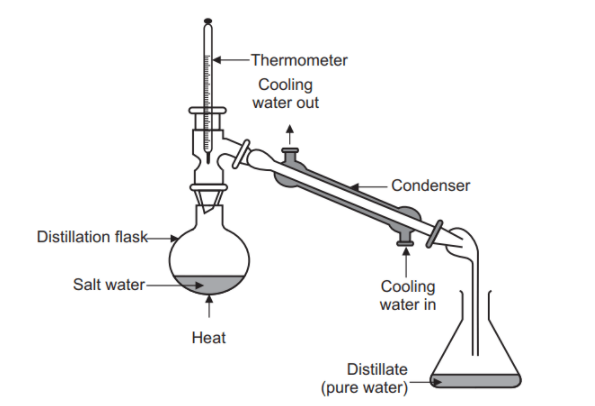
What is the function of a condenser in distillation?
To cool vapor back into liquid for collection.
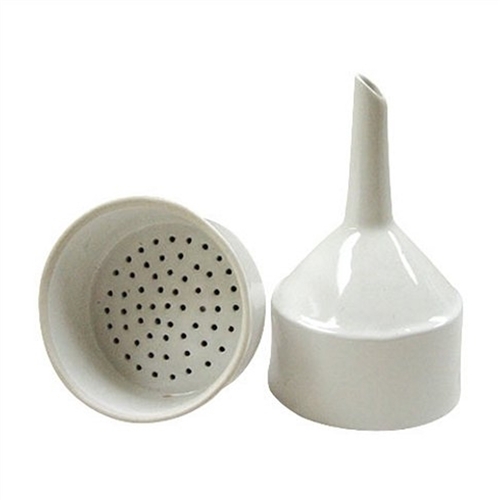
The _____ funnel is used specifically in vacuum filtration to isolate solid products.
Buchner
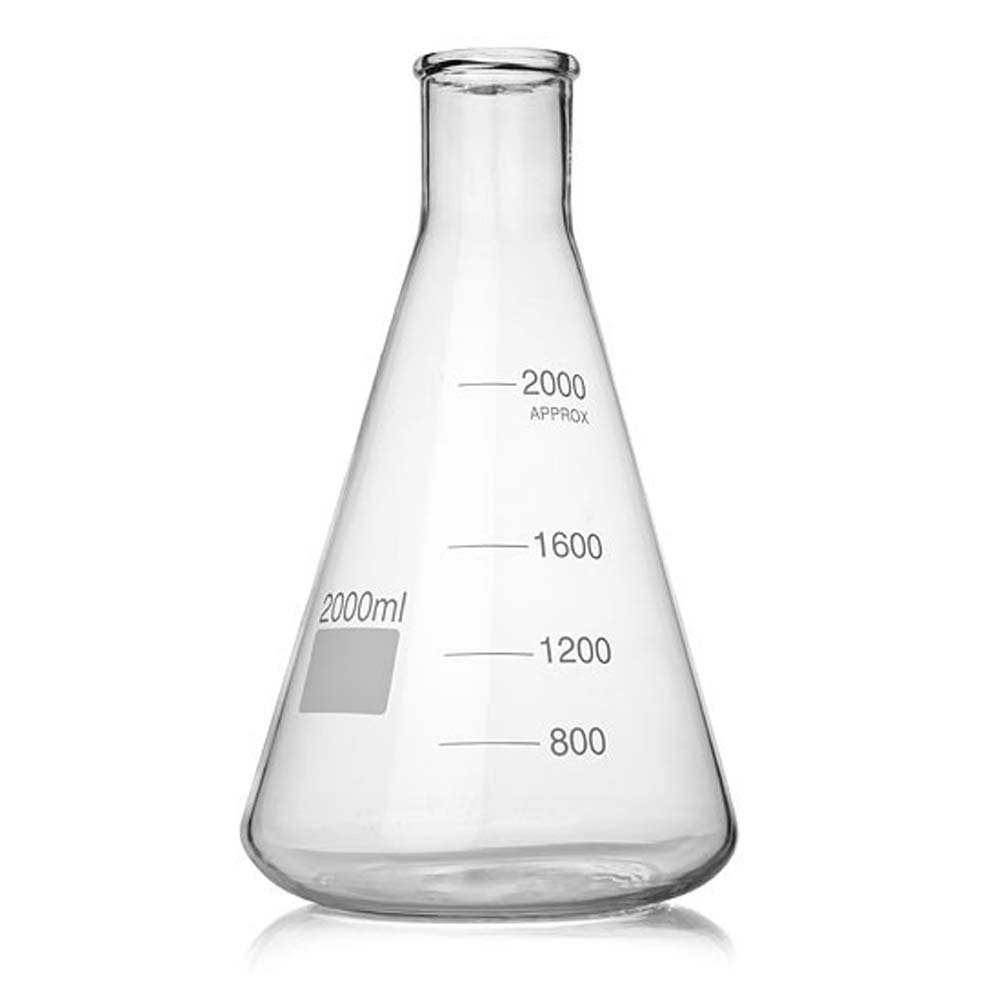
Why is an Erlenmeyer flask preferred over a beaker for titrations?
Its narrow neck helps prevent splashing while mixing.
Where must a researcher's eye be level to accurately read a volume in a graduated cylinder?
At the bottom of the meniscus.
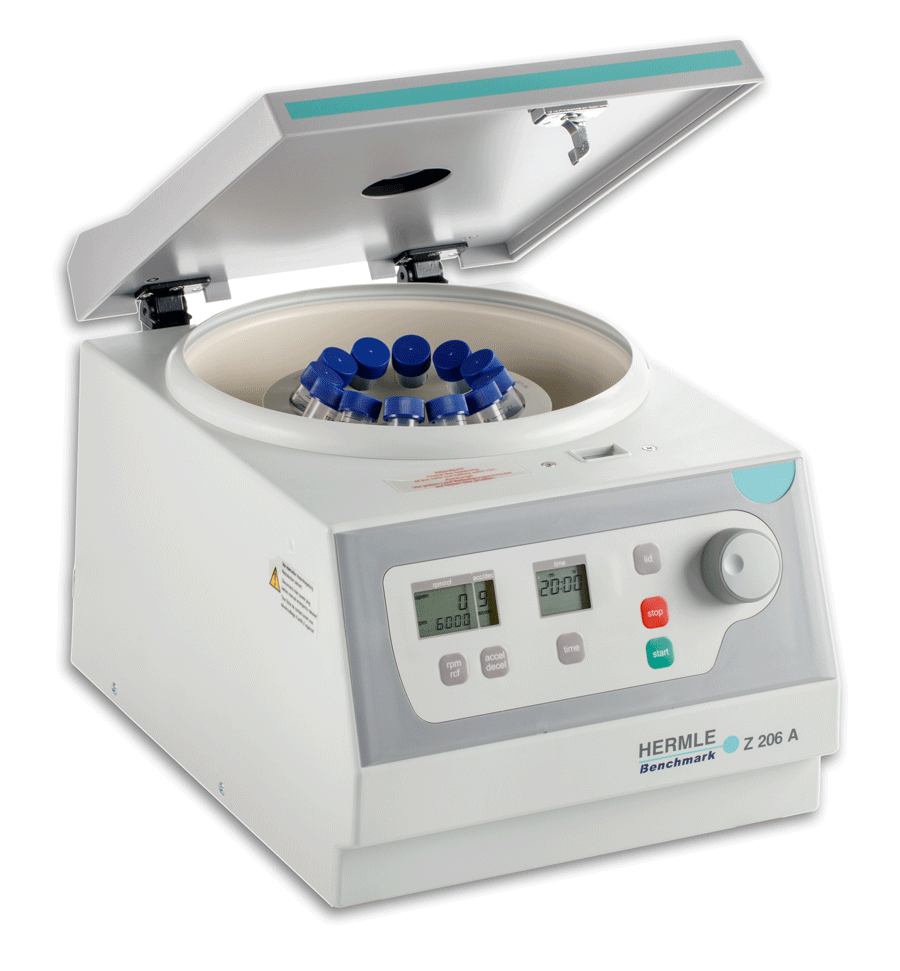
What lab device separates components by spinning them at high speeds?
Centrifuge.
Term: Supernatant
The less dense liquid component remaining on top after centrifugation.
How must centrifuge tubes be arranged to ensure the machine is balanced?
Directly across from each other with equal mass.
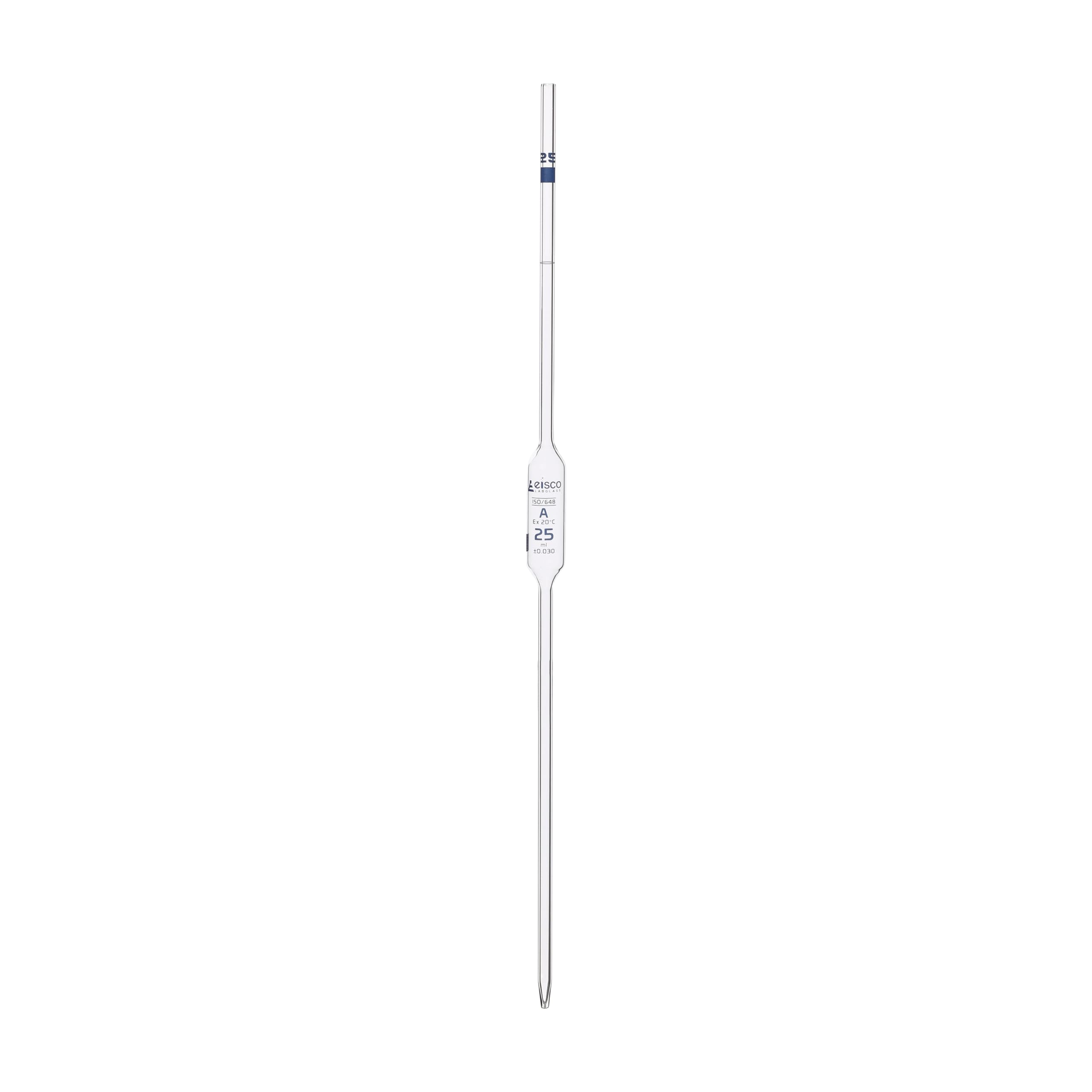
What is the most accurate tool for delivering a single, specific volume of liquid?
Volumetric pipette.
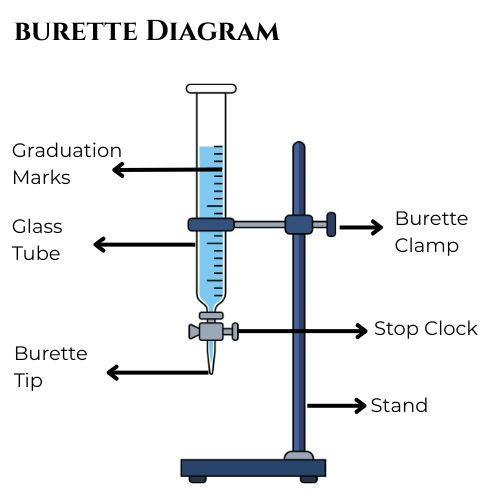
Which piece of glassware is marked in 0.1 mL increments and used for controlled additions in titrations?
Burette.
What is the primary purpose of a volumetric flask?
To prepare solutions of precise volumes.
What is the safe method for heating a test tube?
Indirectly using a water bath.
What is the critical rule for diluting strong acids?
Always add acid to water (never water to acid).
Why must a lab coat be removed before exiting the laboratory?
To avoid contaminating outside areas with hazardous substances.
How should broken glass be disposed of in the lab?
In a designated glass disposal container.
A pH meter should typically be calibrated using buffer solutions of which two pH values?
pH 4 and pH 10
Concept: Parallax Error
An inaccurate reading caused by viewing a measurement from an angle rather than at eye level.
When weighing dry reagents, why is the balance "tared" with the weigh paper first?
To ensure only the sample's mass is measured, excluding the paper.
Why should excess reagent never be returned to its original bottle?
To maintain sample purity and prevent contamination.
According to the spectrophotometer diagram, what component follows the entrance slit?
Dispersing prism.
What component of the spectrophotometer immediately precedes the light meter?
Sample.
List the components of a spectrophotometer in the order light travels through them.
Light source, entrance slit, prism, exit slit, sample, light meter.
What term describes the curved surface of a liquid in a container?
Meniscus.