4.1 : PSYCHOLOGICAL CONSEQUENCES OF STRESS AND TRAUMA
 Call Kai
 Learn
Learn Practice Test
 Spaced Repetition
 Match
Match Flashcards
 Knowt Play
1/41

There's no tags or description
Looks like no tags are added yet.
Name | Mastery | Learn | Test | Matching | Spaced | Call with Kai | Chat |
|---|
No analytics yet
Send a link to your students to track their progress
42 Terms
Trauma
is an emotional response to a terrible, extraordinary event like an accident, rape, or natural disaster
Immediately after the event, shock and denial are typical.
Longer term reactions include unpredictable emotions, flashbacks, strained relationships and even physical symptoms like headaches or nausea.
Stress
Something that happens in a person's environment that is overwhelming and that the person believes will stretch their ability to cope in a healthy way (Lazarus as cited by Dulmus & Hilarski, 2003)
Crisis
A situation that disrupts the status quo, leaves the person feeling powerless, and causes the individual to feel "that things might never be the same." (Everstine & Everstine, 2006)
Trauma
" is an experience that causes a person to feel afraid, overwhelmed, out of control, and broken. It affects how people view themselves, others, and the world around them." (Corrado, 2019)
Allostasis load/ Chronic stress
_______ helps us adapt and survive in the face of stress, crisis, and trauma. We can experience allostatic load if we put too much pressure on this system (allostasis) to calm us down from ongoing stress. Allostatic load leads to significant health consequences.
understandable
The effect of trauma on an individual can be conceptualized as an _______ response to painful situations or conditions.
developmental outcomes
Because the brain is organizing at such an explosive rate in the first years of life, experiences during this period have more potential to impact ____________.
Big “T” traumas
· dangerous and life threatening events
. a major event - typically considered "traumatic" by others
· single or multiple events
· lasting negative effect on your sense of safety in the world
· may cause you to experience PTSD symptoms
small “t” traumas
. adverse life experiences
· more subtle
· distressing/disturbing life event that typically isn't perceived as "trauma"
. tends to affect your sense of self, self-esteem, self- confidence
· usually accumulates over a lifetime from childhood
EVENTS
EXPERIENCE
EFFECTS
The Three Es of Trauma
Abuse, loss, chronic stressors
Wild range of events can potentially cause trauma, such as…
● Early occurrence
● Blaming or shaming
● Being silenced or not believed
● Perpetrator is a trusted caregiver
● Exposure to perpetrator
Factors Increasing the Impact of Trauma
Secondary Trauma
is another form of trauma. With this form of trauma, a person develops trauma symptoms from close contact with someone who has experienced a traumatic event.
Family members, mental health professionals, and others who care for those who have experienced a traumatic event are at risk of vicarious trauma. The symptoms often mirror those of PTSD.
vicarious trauma
other name for Secondary Trauma
Adverse Childhood Experiences
Biological Impacts and Health Risks
Long-Term Health and Social Problems
Trauma Linked to Health Challenges Over the Lifespan
Adverse Childhood Experience Study (ACE Study)
_____________ was an extensive study examining the impact of negative events in early childhood on people over their lifespan.
stress, dose-response, 18
The ACE Score gives a picture of the total amount of _____ during childhood. Research has shown what is called a "_______" connection between the number of adverse childhood experiences (ACEs), or potentially traumatic experiences a person had before age ____, and health risks later in life.
Peter Levine
"Traumatic symptoms are not caused by the event itself. They arise when residual energy from the experience is not discharged from the body. This energy remains trapped in the nervous system where it can wreak havoc on our bodies and minds ... "
Peter Levine
a contemporary psychologist specializing in trauma
Levine
who developed Somatic Experiencing therapy?
Somatic Experiencing Therapy
It is believed that ___________ works body by releasing the trauma that becomes "trapped" in the
freeze response
One aspect of this dysregulation is known as the _______, our body's primitive defense against danger.
Flight, Fight, or Freeze: The Trauma Response
● The brain signals the body to respond to a perceived threat, and the body prepares.
● Ordinarily, when the threat is gone, the body returns to "baseline."
● But if an ongoing threat is perceived, the body doesn't return to baseline, remains prepared for threat, resulting in a "trauma response."
baseline
Ordinarily, when the threat is gone, the body returns to "________."
trauma response
But if an ongoing threat is perceived, the body doesn't return to baseline, remains prepared for threat, resulting in a "________."
Fight
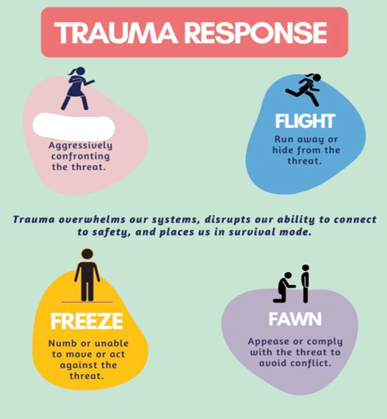
Flight

Freeze
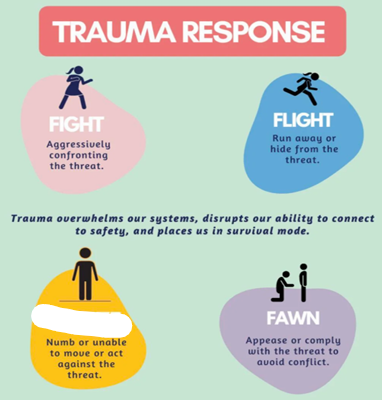
Fawn

Hyper-Arousal
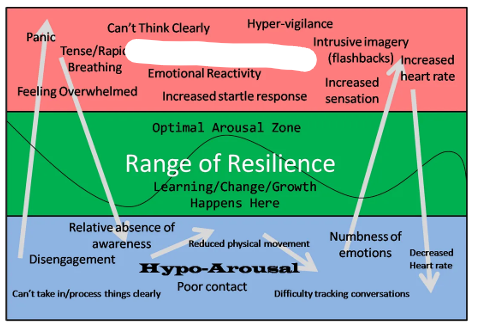
Hypo-Arousal
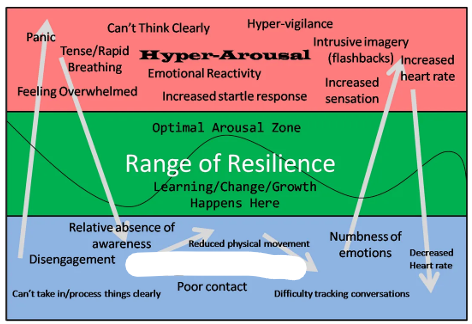
Optimal Arousal Zone
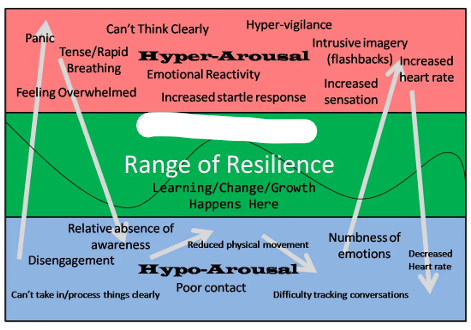
Learning/Change/Growth Happens Here
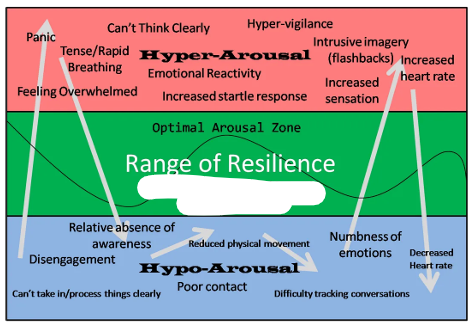
Resilience
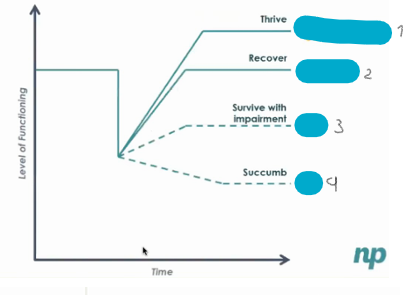
is defined as "The ability of an individual, family, or community to cope with adversity and trauma and adapt to challenges or change."
Resilience
is promoted in part by supportive relationships and social connectedness, as well as addressing sources of adversity.
Post-Traumatic Growth (PTG)
It was developed by psychologists Richard Tedeschi PhD, and Lawrence Calhoun, PhD, in the 1990s
Post-Traumatic Growth (PTG)
Holds that who endure psychological struggle following adversity can often see positive growth afterward.

Strongly Recommended (APA)
Trauma-Informed CBT
Cognitive Processing Therapy
Behavior Modification
Technique: Prolonged Exposure (Flooding)
Conditionally Recommended (APA)
Brief Eclectic Psychotherapy (CBT + Psychoanalytic)
EMDR
Narrative Exposure Therapy
Medications
1. Level of functioning
2. Time

1)Thrive
2)Recover
3)Survive with Impairment
4)Succumb
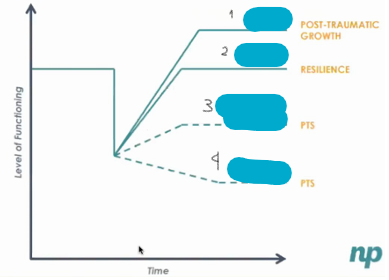
1)Post-traumatic growth
2)Resilience
3 & 4) PTS