General Laboratory Practice Solo 2 Lecture 3
 Call Kai
 Learn
Learn Practice Test
 Spaced Repetition
 Match
Match Flashcards
 Knowt Play
1/30

Earn XP
Description and Tags
Name | Mastery | Learn | Test | Matching | Spaced | Call with Kai | Chat |
|---|
No analytics yet
Send a link to your students to track their progress
31 Terms
Reference Values
Results of a certain type of quantity obtained from a single individual or group of individuals corresponding to a stated description
The value range for a test or analyte that most of the random population using the same testing method included
Recommended for use by the International Federation of Clinical Chemistry and Laboratory Medicine (IFCC)
Normal Values
Used in the past, but the term has become obsolete. Lacks conformity (no stated description) with different connotations
Health-Associated
Values associated with non-diseased state
Distinctions help prevent the misunderstanding that reference values are associated only with health
Diabetic patient, hospitalized diabetic patient, ambulatory diabetic patient
Subject-Based
Previous values from the same individual obtained when the individual was in a defined state of health
Population-Based
Obtained from a group of systematically defined reference individuals. The type of values referred to when the term reference values is used without any qualifying words
Establishment of Reference Values
Data collected during the medical interview, clinical examination, and supplementary investigations must be interpreted by comparison with reference data
Positive diagnosis: Condition of the patient resembles what is considered typical of a particular disease
Diagnosis by exclusion: Observed symptoms and signs do not fit the pattern characterized by a set of alternative diseases
A patient’s lab result is not medically useful if appropriate data for comparison are lacking
Guidelines
Reference Individuals should be clearly defined
Patient should resemble reference individuals
Conditions in which the sample was obtained and processed for analysis should be known
All quantities compared should be of the same type
All lab results should be produced with the use of adequately standardized methods under sufficient analytical quality control
Stages in the pathogenesis of the disease that are the objectives for the diagnosis should be stated
Diagnostic sensitivity and specificity, prevalence, and clinical costs of misclassification should be known for all tests used
Reference Individual
An individual selected as the basis for comparison with individuals under clinical investigation through the use of defined criteria
Statements describing the source population
Specification of criteria or health
Disease of interest
Random sample…
… of individuals in the parent population that meet the selection criteria
Best reference sample obtained after all practical consideration
Data interpreted with caution because of possible bias
Selection of Reference Individuals
Must be a random sample from the parent population who fulfill the selection criteria
The defined set of criteria includes:
statement source of population
specification of criteria for health or disease of interest
Essential Components required for a set of reference values are
Analytical method: Should include information on equipment, reagents, calibrators, type of raw data, and calculation method
Quality control
Reliability Criteria
Sample Collection
Pre-analytical standardization to reduce bias and variation
Preparation of the individual
Sample collection
Handling of specimen before analysis
Analytical Procedure and QC
Specifications carefully established and described to be reproducible
Method: Equipment, reagents, calibrators, raw data, calculations
Quality control
Reliability criteria
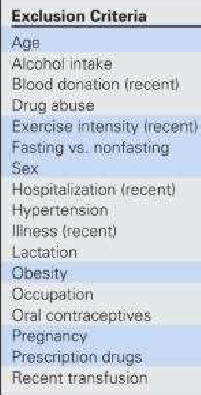
Exclusion Criteria
Used in establishing Health-Associated reference values
Diseases: Cancer, Lupus
Risk Factors: Obesity, occupation, genetics, hypertension
Medication: Drug treatment for disease, drug abuse, oral contraceptives, alcohol, tobacco
Physiological State: Pregnancy, Stress, Excessive exercise
Evaluation of reference values
After the analysis of reference specimens is performed, the reference values are subject to
Partitioning of the reference values into appropriate groups
Inspection of distribution of each group
Identification and handling of outliers
Determination of reference limits
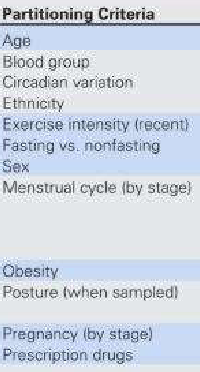
Partitioniong Criteria
Use of specific criteria in the sub classification of reference groups to reduce the biological variation in each group
Age
Sex
Genetic Factor: Ethnic origin, ABO group, Histocompatibility antigens (HLA) typing, genes
Physiological Factor: Stage in menstrual cycle, stage in pregnancy, physical conditions
Other Factors: Socioeconomic, Environmental, Chronobiological (Periodic phenomena)
Inspection of Distribution
Display the reference distribution graphically (histogram) and subsequently examined for
Highly deviating values (Outliers) that may represent Erroneous Values
Bimodal or polymodal distributions indicating nonhomogeneous results
Reevaluate reference individual selection criteria: Partitioning of values
The shape of distribution may be skewed than the Gaussian distribution
Initial estimates of the location of reference limits are useful checks on the validity of computations
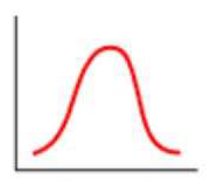
Normal
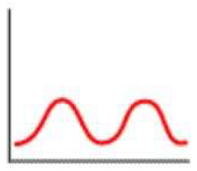
Bimodal
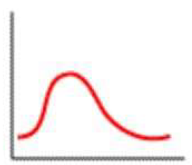
Positive (Right) Skew
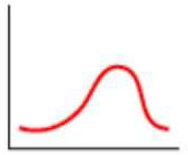
Negative (Left) Skew
Identification of Outliers
Erroneous values that deviate significantly from the proper reference values
Values near the furthest point on the long tail of a skewed distribution may be misinterpreted as outliers
Deviating values identified as possible outliers should not be discarded automatically
Include or exclude rationally after checking records of suspect values and correcting errors
Determination of Reference Limits
Reference Interval
A set of values usually defined by an upper and lower reference limit, representing a specified proportion of the values frequently the central 95%
Reference Limits
Describe the reference distribution and provide information about the observed variation of values in the selected set of reference individuals
Observed patient’s values are compared with the corresponding reference interval, which is bounded by a pair of reference limits
Clinical Decision Limits
Provide optimal separation among clinical categories; usually based on analysis of reference values from several groups and thus used for differential diagnosis
Nonparametric Analysis
Statistical approach to reference value analysis that requires no assumptions about the distribution; Gaussian or Non-Gaussian
Preferred method to establish reference intervals
Requires 120 reference values per partition
Parametric Analysis
Statistical approach to reference value analysis that requires the distribution of values to be Gaussian (or mathematically manipulated to become Gaussian)
Reference Values are used for interpretation of patient values
Appropriate reference interval presented with the patient value
Abnormal results often indicated
Low
Yellow (IM); down arrow (EPIC)
High
Purple (IM); up arrow (EPIC)
Critical
Red (IM); exclamation mark (EPIC)
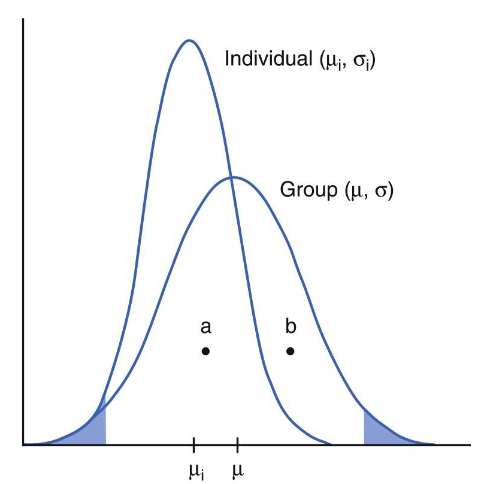
Subject-Based vs Population-Based Reference Values
Transferrability
Prerequisite
Comparable populations with no major ethnic, social, or environmental differences
Standardization protocols for qualifying reference individuals, preparing individuals for specimen collection and performing specimen collection
Other sources
Manufacturers’ (package inserts)
Peer-reviewed literature
Multicenter trials
Verify appropriateness of values
Clinical Sensitivity
The fraction of those subjects with a specific disease that the assay correctly detects
Clinical Specificity
The fraction of those individuals without the disease that the assay correctly detects
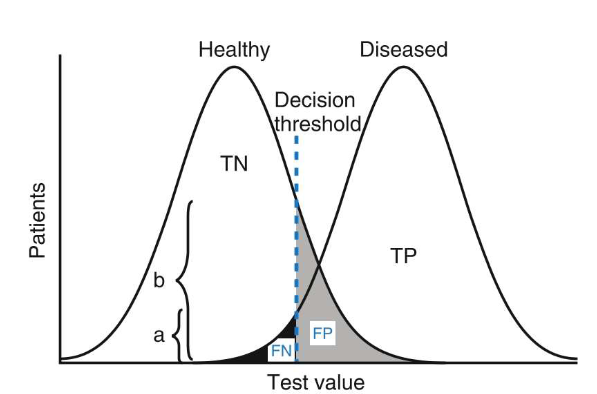
Changing the decision limit of an assay affects clinical sensitivity and specificity