Hemolytic Disease of the Fetus and Newborn
 Call Kai
 Learn
Learn Practice Test
 Spaced Repetition
 Match
Match Flashcards
 Knowt Play
1/25

There's no tags or description
Looks like no tags are added yet.
Name | Mastery | Learn | Test | Matching | Spaced | Call with Kai | Chat |
|---|
No analytics yet
Send a link to your students to track their progress
26 Terms
Define hemolytic disease of the newborn
A disorder of the fetus or newborn in which the fetal red blood cells are destroyed by maternal IgG antibodies
The time period before birth is called?
Prenatal/Antenatal
The time period within the first 28 days after birth is called?
Neonatal
Parity (Para) refers to what?
Number of live births
Gravidity (grava) refers to what?
Number of pregnancies
What is Hydrops fetalis?
In HDN, as fetal hemolysis occurs cardiac output increases leading to cardiac failure and fluid accumulation in abdomen
Discuss the role of the placenta during pregnancy
The placenta acts as the site of gas, nutrient, and waste exchange between mother and the fetus
ABO HDN happens when mother is ___ and baby is ___
O
A or B
State the three elements needed for HDN to occur
The mother must make an IgG antibody to a foreign RBC antigen
The fetus must possess the antigen the IgG antibody targets
The antigens must be well developed at birth
Which HDN is more severe: ABO or Rh?
Rh
State the 3 theories of why ABO HDN is less severe than Rh HDN
Presence of A or B substances in fetal tissues that neutralize maternal antibodies
Poor development of ABO antigens in prenatal period
Reduced number of ABO antigens in prenatal period
Describe the mechanism of action of RhIG
A recent theory involves the production of specific cytokines that work to suppress a primary immune response in the mother to positive fetal red blood cells.
List two antibodies commonly implicated in HDN that are not Anti-ABO or Anti-D
They must be in IgG class
Ex.
Anti-c
Anti-K
What testing during the initial prenatal visit?
ABO/D
Antibody screen (for IgG antibodies)
Antibody titer (if screen is positive)
What testing should be done 26-28 weeks gestations?
Confirm D-typing
Repeat antibody screen
If a clinically significant antibody was identified (in a pregnant person), how often should an antibody titer be performed?
every 4 weeks
An antibody titer of __ is considered significant enough to cause HDN
32
What maternal testing should be done postpartum?
ABO/D Typing
Antibody Screen
Antibody ID
Fetal screen (Rosette)
Kleihauer-Betke
What infant testing should be done postpartum?
ABO/D typing ( Only forward typing because babies don’t have antibodies)
DAT
Elution
What is the blocking phenomenon as it relates to the D-antigen in cord blood?
The infant is falsely typed as Rh negative BECAUSE the mothers anti-D is covering the infants antigens —>
this blocks reagent Anti-D from agglutinating cells
A sample experiencing the blocked D phenomenon will type as Rh ____ and essentially always have a ____ IgG DAT
Negative
Positive
One dose of RhIG covers ___mL of D-positive blood
30
<1 rosette per 3 hpf. how many doses of RhIG?
1 dose
Determine the number of RhIG units needed when provided a case study
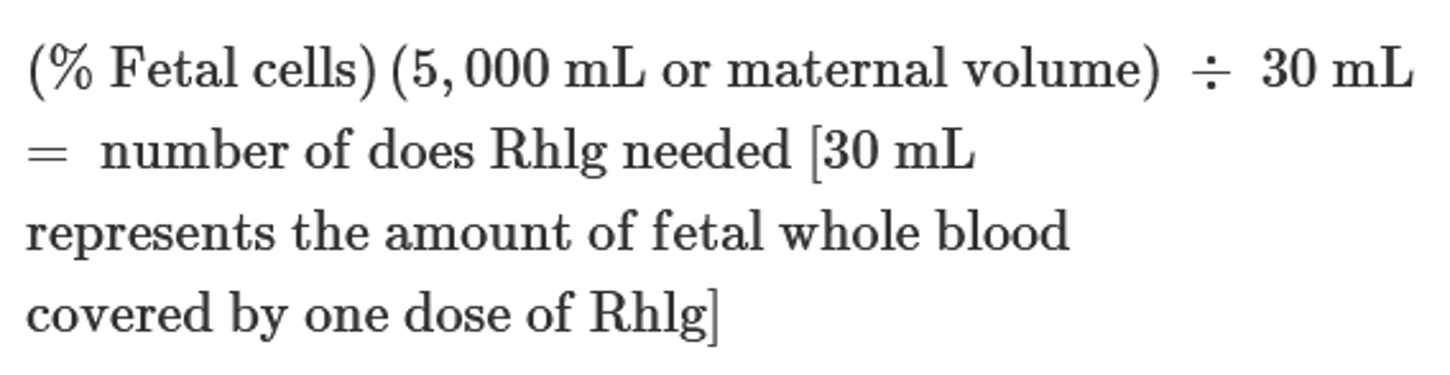
Always round up if at a 0.5 limit
Define exchange transfusion
Complete blood volume transfusion needed for severe cases of HDN
What are the requirements for blood products used in exchange transfusions?
Blood products must be:
Group O (or ABO compatible) D negative blood
RBC <7 days old suspended in fresh frozen plasma to HCT of 45-60%*
CMV-reduced products
Irradiated
Hemoglobin S negative
Blood must lack the antigen to maternal antibody
Compatible crossmatch with maternal serum