AHM Exam 1 (Biomechanics)
 Call Kai
 Learn
Learn Practice Test
 Spaced Repetition
 Match
Match Flashcards
 Knowt Play
1/99

There's no tags or description
Looks like no tags are added yet.
Name | Mastery | Learn | Test | Matching | Spaced | Call with Kai | Chat |
|---|
No analytics yet
Send a link to your students to track their progress
100 Terms
Biomechanics
the application of the broad term mechanics to the study of human movement
What are the two branches of biomechanics?
Kinematics & Kinetics
Kinematics
Branch of mechanics used to describe movement of the body. (Osteokinematics & Arthrokinematics)
Kinetics
Branch of movement used to describe how forces and torques affect the body. (Force of a muscle acting on a bone)
Anatomical Position
Eyes looking forward
Feel parallel/slightly apart
Arms at side
Palms facing forward
Upright, weight evenly distributed

Rotation/twisting
opposing forces applied on each articulating surface. (can result in spiral fracture or tissue injury)

Anterior(ventral)
The front of the body
Posterior(dorsal)
The back of the body
Medial
Towards midline
Lateral
Away from midline
Distal
farther from the origin of a body part or the point of attachment of a limb to the body trunk
Proximal
Closer to the origin of the body part or the point of attachment of a limb to the body trunk
Superior
Above
Inferior
Below
Ipsilateral
On the same side of the body
Superficial
At the surface

Deep
Way below the surface

Contraladeral
On the opposite side of the body
Supine
Laying face up

Prone
Laying face down

Right lateral recumbent position
Laying on right side
Left lateral recumbent position
Laying on left side
Movement occurs
WITHIN a plane
AROUND an axis
Saggital plane
Passes through body vertically from front to back. (divides body into right & left halves)
Frontal plane
Passes through the body vertically from side to side. (divides body into posterior & anterior)
Transverse plane
Passes through the body horizontally. (divides body into superior & inferior)
Center of gravity
Point where all planes intersect
Degrees of freedom
The number of planes in which the joint can move. (Uniaxial, Biaxial, & Triaxial joints)
Force
The amount of push/pull applied to objects or body segments
Push creates
compression
Pull creates
traction
What are the two types of force that cause the body to move?
Internal & External
Internal Force
muscle contractions
ligamentous restraint
External Force
gravity
external weight
friction
Gravitational Force
Force exerted on an object or person by gravity
Linear force
two forces acting on the same line. (can pull in the same or opposite directions)
Parallel force
two forces acting in the same plane but opposite directions
Concurrent force
Two+ forces acting on a common point but push/pull in different directions
Force Couple
Two+ forced acting on a common point but opposite directions, resulting in a turning effect 🔄
Five possible mechanical effects of force
1. Traction
2. Compression
3. Shear
4. Bending
5. Rotation(twisting)
Traction
joint surfaces pull apart from each other. (ex. carrying a heavy bag)

Compression
joint approximation. (ex. push ups)

Shear
gliding motion where joint surfaces move parallel to each other. (excessive shear forces cause soft tissue injury)

Bending
forces are not applied equally. (compression on one side & elongation on the other)

Linear motion
Occurs more or less in a straight line. (same direction, distance, and time)
Rectilinear motion example
straight line. (ex bowling ball or sled)
Curvilinear motion
curved line. (ex. path of a ball or diving)
What are the two types of movement?
1. Linear motion
2. Angular motion(rotary)
Joints are considered
axes
Muscles and weight can be considered as
force & resistance
Bones are considered
levers
What are the three different types of levers?
First, Second, & Third class levers
First Class Lever
axis is in the middle

Second Class Lever
resistance is in the middle

Third Class Lever
force is in the middle

Muscles
attach to bones by tendons
produce movement at joints
do not know direction, they only contract
What are the two parts of muscles?
Insertion and origin
Insertion
usually on more moveable bone
tends to be more distal
Origin
usually on more stable bone
tends to be more proximal
What determines the action of a muscle?
Line of Pull
What are four characteristics of a muscle fiber?
1. irritability
2. extensibility
3. contractility
4. elasticity
Irritability(excitability) of a muscle
reacts to a stimulus by generating an electrical impulse that leads to contraction
Extensibility of a muscle
stretch or lengthen when force is applied
Contractility of a muscle
contract & generate force
Elasticity of a muscle
recoil or return to its normal resting length when stretching/shortening force is removed
Agonist(prime movers)
Muscle(or group of muscles) most directly involved in causing the motion
Antagonist
Performs opposite motion of agonist ; has capability of slowing/opposing the movement of the prime mover
What is Co-contraction?
When the agonist and antagonist muscles work together to stabilize
Synergist
When two+ muscles work together to perform a motion that cannot be performed by a single muscle
Isometric Muscle Contraction
muscle contracts without changing length of muscle
Isotonic Muscle Contraction
muscle contracts and changes the joint angle
a.) concentric (muscle shortens)
b.) eccentric (muscle lengthens)

Isokinetic Muscle Contraction
occurs when the speed of the motion stays the same for the duration of contraction but resistance varies.
What is tension?
force built up in a muscle due to stretching and/or contracting
What is muscle excursion?
the length difference between a muscle that is fully shortened and the same muscle fully lengthened
What can cross one joint or multiple joints?
Muscles
Active Insufficiency
multi-joint muscle shortens over two joints simultaneously, creating so much slack that tension is completely lost.
(occurs to the agonist)
Passive Insufficiency
multi-joint muscle is lengthened to its fullest extent at both joints, which prevents full ROM of each joint it crosses
(occurs to the antagonist)
What does ROM stand for?
range of motion
What are kinetic chains?
interconnected system of muscles, joints, and tendons that work together to produce movement
What are the two types of kinetic chains?
closed & open kinetic chains
Closed kinetic chain
occurs when distal segment is fixed.
(provides stability distally)
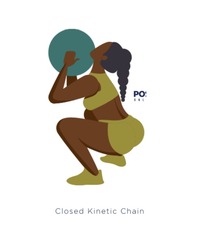
What are some examples of an open kinetic chain?
Reaching into cabinet
Kicking a ball
Brushing your teeth
Throwing a ball
What are some examples of a closed kinetic chain?
Squats
Wall push-up
Sit to stand
Going up stairs
Joint
connection between two bones
(allows movement
helps bear weight
provides stability
contains synovial fluid)
What is the purpose of synovial fluid?
lubricates joint
nourishes cartilage
Stability vs Movement
Increased Stability = decreased mobility
decreased stability = Increased mobility
What are two types of joints?
1. Synarthrodial
2. Diathrodial
Synarthrodial joints
provides shape and stability
allows little to no movement
Diathrodial joints (synovial)
provides mobility
cavity contains synovial joints
no direct union between bone ends
has a joint capsule
Joint capsule
outer layer - strong fibrous tissue(holds joint together & protects)
inner layer - lined with synovial membrane that secretes synovial fluid
Joint capsule also
Reduces friction
source of nutrition for tissues
Articular surface
smooth and covered in hyaline cartilage
more movement =
= less stability
What is the purpose of ligaments?
holds joints together
provides attachment for cartilage
flexible but not elastic
What contains fibrous connective tissue?
Cartilage
What are the three types of cartilage ?
1. Hyaline cartilage
2. Fibrocartilage
3. Elastic cartilage
Hyaline cartilage (articular)
covers ends of bone with a synovial joint.
cannot repair itself
no blood or nerve supply
Fibrocartilage
shock absorber
(ex. menisci of knee, vertebral discs, labrum)
elastic cartilage
helps to maintain shape
allows movement
(ex. ear)
Open kinetic chain
occurs when proximal segment is fixed.
(correcting muscle imbalances or rehab after injury)
