Superconducting magnet plate
 Call Kai
 Learn
Learn Practice Test
 Spaced Repetition
 Match
Match Flashcards
 Knowt Play
1/12

There's no tags or description
Looks like no tags are added yet.
Name | Mastery | Learn | Test | Matching | Spaced | Call with Kai | Chat |
|---|
No analytics yet
Send a link to your students to track their progress
13 Terms
for superconductivity
high current density
at certain temperatures and field density
at lower AC losses and power requirements
cryostat heat flow
via two stages cooling
efficiency expressed through Carnot efficiency
thin double shield and stiff motor fixation without significant heat flux are key
n_Carnot=T2/(T1-T2)
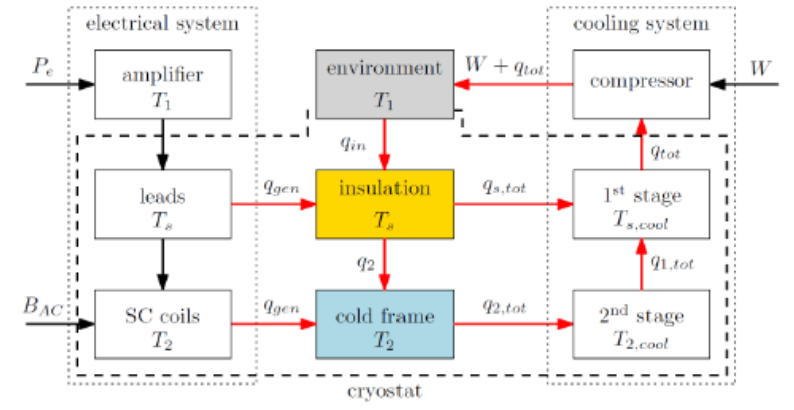
system architecture + challenges, problem
562 superconductor coils in vacuum
challenges: small footprint, high force density, stable temperature
high filling ratio with the risk of delamination
high stiffness coil support with minimum thermal conductivity
thin isolation layer in the magnetic gap of the superconducting motor
problem: how to desing a minimum superconductor volum, increase in magnetic field density with thin, flat, thermal isolation, accurate superconductiong coil fixation while transmitting high dynamic forces and minimal heat transfer
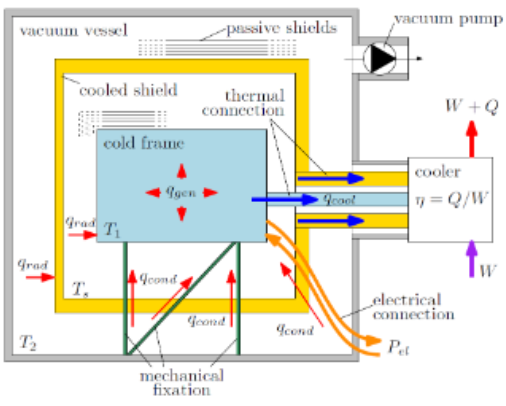
electromagnetic coil design
array of superconducting coils: maximum field per unit of volume
critical current density is a function of the magnetic field density, field angle and the absolute temperature - occurs at coil top and bottom surface
field density per unit of volume optimized via dimensionless parameter study
peak magnetic field density is increased compared to a high-end permanent magnet array
concept 1
attraction forces of edge coils cause very significant bending deformation
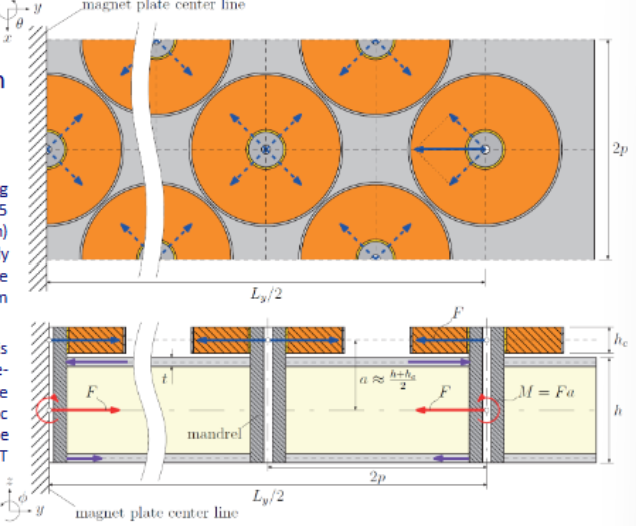
concept 2
minimum out-fof-plane stiffness
transmits half of the interaction force from left to right
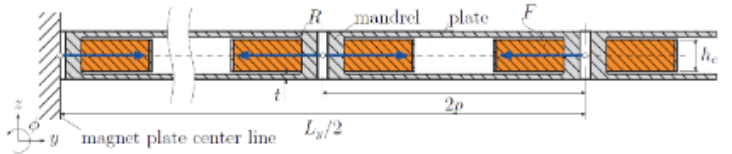
concept 3
half the original height
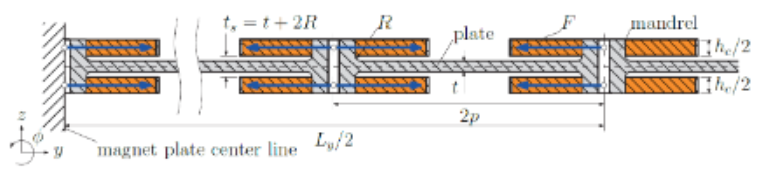
concept 4
interfaces to the outside of the coil based on elastic averaging (nest of springs) are not pursuit due to large diameter variation
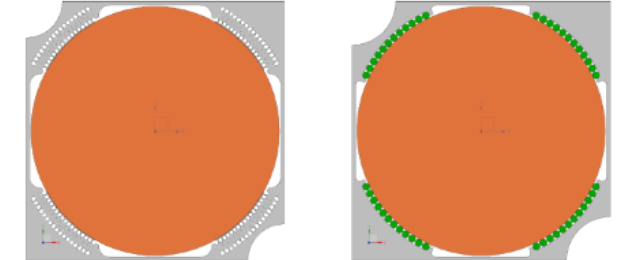
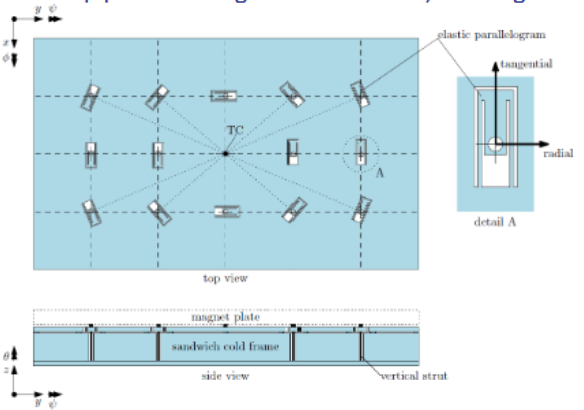
chosen concept
→ evolved from concept 3
elastic parallelograms with sandwich top plate creating a thermal center, allowing for a nm of deformation
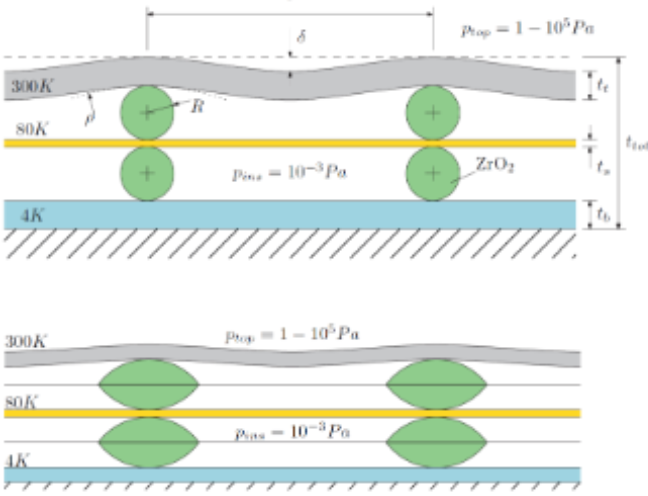
ceramic spheres
high load capacity
no atmospheric testing
limited path for heat transfer
→ lower thermal conductivity with hihger resistance
→ separation of insulation laters based on partial spheres and passive shield: sphere radius is decoupled from insulation thickness
struts
= non-contact solutions between top and bottom plate
outperform spheres regarding heat load and atmospheric pressure on the ouside of the insulation
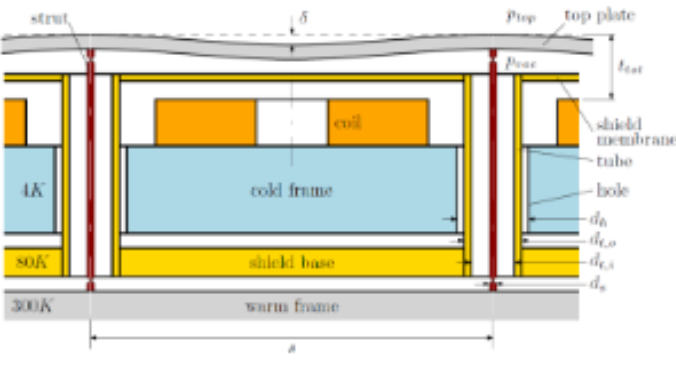
demonstrator components
separated via V-shaped frames
stiffness over thermal conductivity maximized, only dependent on material properties
mechanical model
radial stress is bigger than tangential stress= net radial stress
Lorent forces within coil generate tangential stress and strain
radial thermal stress delaminates wet-wound coil and separates dry-wound coil
rather uniform compressive stress, at inner radius sufficient to withstand axial load (via central madrel and aluminium ring)