KIN 1Y03 Lecture 26: Axial (Vertebrae & Ribs)

0.0(0)
studied byStudied by 0 people
0.0(0)
full-widthCall Kai
learnLearn
examPractice Test
spaced repetitionSpaced Repetition
heart puzzleMatch
flashcardsFlashcards
GameKnowt Play
Card Sorting

1/25

encourage image

There's no tags or description

Looks like no tags are added yet.

Study Analytics
Name
Mastery
Learn
Test
Matching
Spaced

No study sessions yet.

26 Terms

1
New cards

functions of the vertebral column

  • supports weight of head and trunk

  • protects spinal cord, vertebral canal that surrounds & protects the spinal cord → has openings (intervertebral foramen) that allow SC to go to periphery

  • allows spinal nerves to exit the SC

  • provides sites for muscle attachment ⇒ allows for movement

2
New cards

what are the 26 vertebrae

7 cervical, 12 thoracic, 5 lumbar, 1 sacral (5 fused tog), 1 coccygeal (4 fused)

3
New cards

compare the curves of the vertebral column in adults vs embryo/fetus

adult:

  • 4 curves

    • cervical curve (7 cervical vertebrae) — CONVEX

    • thoracic curve (12 thoracic vertebrae) — CONCAVE

    • lumbar (5 lumbar vertebae) — CONVEX

    • sacral curve (5 fused sacral vertebrae) — CONCAVE

embryo/fetus (has only 1 curve that’s concave)

  • 3 months = form cervical curve (when they hold head up)

  • 8-12 months = form lumbar curve (when they start to stand+walk upright)

  • 10 yo = fully development vertebral column

  • spinal curvature will decline w age (bone loss)

4
New cards

articular processes (uuu 4 total)

form joint w another bone — either above or below vertebrae

  • superior articular process (2)

  • inferior articular process (2)

5
New cards

vertebral arch

composed of 2 regions [lamina x2 + pedicle x2] => forming a pentagon ring shape

6
New cards

what happens when pedicles are stacked

will form intervertebral foramen

7
New cards

spinous process

(1) bony projection on the back of each vertebra in the spine that can be felt thru the skin

  • allows muscles and ligaments to attach

8
New cards

vertebral foramen

when stacked, all vertebrae will line up to form vertebral canal

9
New cards

superior and inferior demifacet

superior demifacet: half-facet on thoracic vertebra that articulates w the head of the rib thats directly above it

inferior demifacet: where ribs will articular w vertebrates
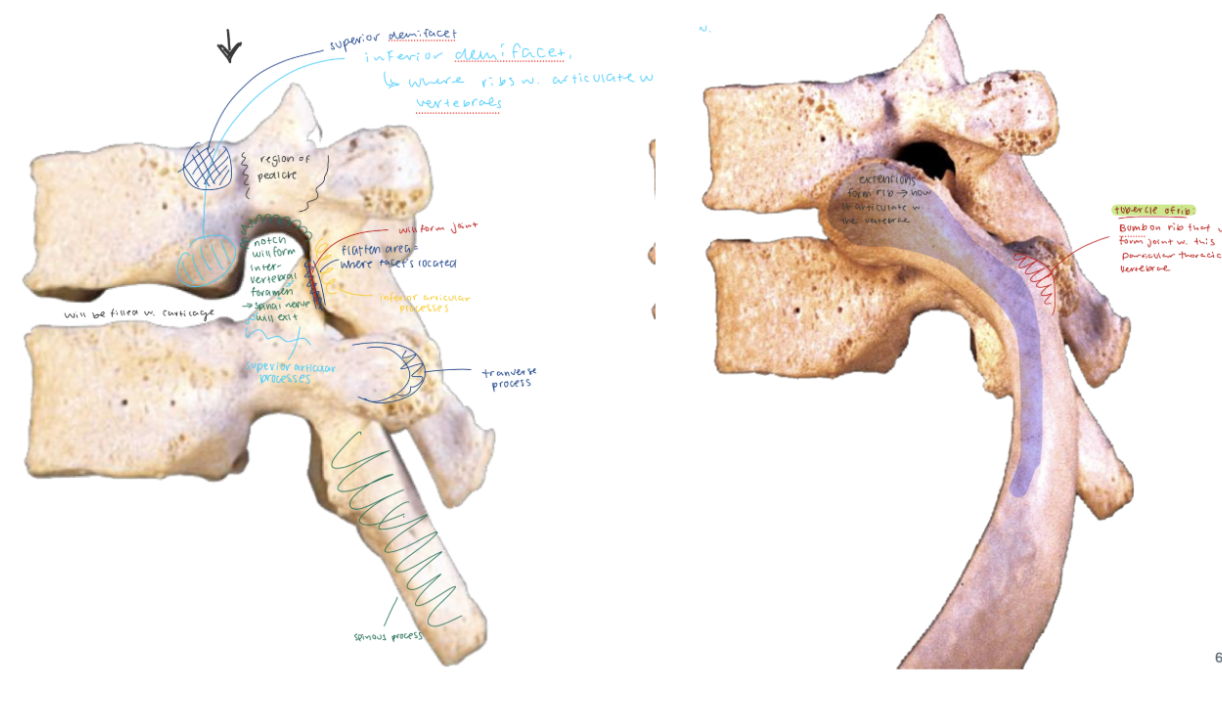
<p><u>superior demifacet</u>: half-facet on thoracic vertebra that articulates w the head of the rib thats directly above it </p><p><u>inferior demifacet</u>: where ribs will articular w vertebrates </p>
10
New cards

characteristics of atlas vertebra

Atlas: “yes” movement (and some lateral flexion – tilting ear to shoulder) 

  • No vertebral body 

  • No spinous process 

  • V. large vertebral foramen (matches with foramen magnum in occipital lobe) 

  • Small holes in transverse process → allows for blood vessels & nerves (from cranial cavity ⇔ body) 

  • Large articular surfaces (superior articular facets)

  • Facet for dens: will form joint with C2 vertebrae 
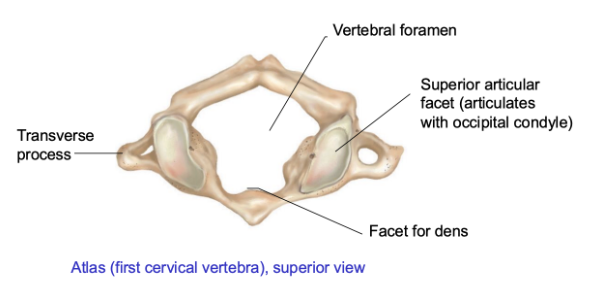
<p><span style="background-color: transparent;"><u><span>Atlas</span></u><span>: “yes” movement (and some </span><u><span>lateral flexion</span></u><span> – tilting ear to shoulder)&nbsp;</span></span></p><ul><li><p><span style="background-color: transparent;"><span>No vertebral body&nbsp;</span></span></p></li><li><p><span style="background-color: transparent;"><span>No spinous process&nbsp;</span></span></p></li><li><p><span style="background-color: transparent;"><span>V. large vertebral foramen (matches with foramen magnum in occipital lobe)&nbsp;</span></span></p></li><li><p><span style="background-color: transparent;"><span>Small holes in transverse process → allows for blood vessels &amp; nerves (from cranial cavity ⇔ body)&nbsp;</span></span></p></li><li><p><span style="background-color: transparent;"><span>Large articular surfaces (</span><em><span>superior articular facets</span></em><span>)</span></span></p></li><li><p><span style="background-color: transparent;"><u><span>Facet for dens</span></u><span>: will form joint with C2 vertebrae&nbsp;</span></span></p></li></ul><p></p>
11
New cards

characteristics of axis vertebra

Axis: “No” movement  

  • Slight vertebral body 

  • Dens: upward-facing long bony process that facilitates turning motions in C2 vertebra

  • Transverse process – looks like “trailer hitch”

  • Superior articular facet – is very flat and points up (to sky)

  • Inferior articular facet — also flat points down (ground) 

    • ⤷ both when tog = have flat articulating surface, allows for large degree of cervical vertebrae 

  • Slightly smaller vertebral foramen (compared to C1 atlas) 

  • Spinous process – has small projection
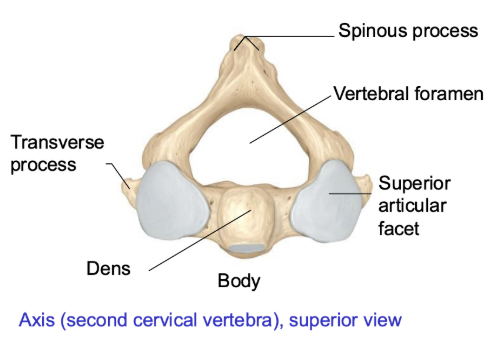
<p><span style="background-color: transparent;"><u><span>Axis</span></u><span>: “No” movement&nbsp;&nbsp;</span></span></p><ul><li><p><span style="background-color: transparent;"><span>Slight vertebral body&nbsp;</span></span></p></li><li><p><span style="background-color: transparent;"><u><span>Dens</span></u><span>: upward-facing long bony process that facilitates turning motions in C2 vertebra</span></span></p></li><li><p><span style="background-color: transparent;"><span>Transverse process – looks like “trailer hitch”</span></span></p></li><li><p><span style="background-color: transparent;"><span>Superior articular facet – is very flat and points up (to sky)</span></span></p></li><li><p><span style="background-color: transparent;"><span>Inferior articular facet — also flat points down (ground)&nbsp;</span></span></p><ul><li><p><span style="background-color: transparent;"><span>⤷ both when tog = have flat articulating surface, allows for large degree of cervical vertebrae&nbsp;</span></span></p></li></ul></li></ul><ul><li><p><span style="background-color: transparent;"><span>Slightly smaller vertebral foramen (compared to C1 atlas)&nbsp;</span></span></p></li><li><p><span style="background-color: transparent;"><span>Spinous process – has small projection</span></span></p></li></ul><p></p>
12
New cards

interaction between atlas and axis

  • The dens of the axis is on the facet for dens – on the anterior side 

    • Held in place via ligaments – allowing it to “swivel on axis” – move side to side to create “NO” movement)
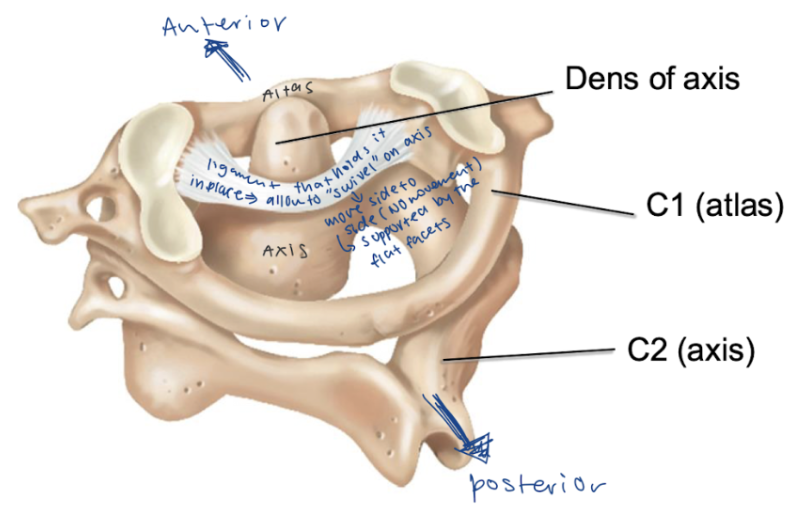
<ul><li><p><span style="background-color: transparent;"><span>The </span><em><span>dens of the axis</span></em><span> is on the </span><em><span>facet for dens </span></em><span>– on the anterior side&nbsp;</span></span></p><ul><li><p><span style="background-color: transparent;"><span>Held in place via </span><strong><span>ligaments</span></strong><span> – allowing it to “swivel on axis” – move side to side to create “NO” movement)</span></span></p></li></ul></li></ul><p></p>
13
New cards

characteristics of C5 vertebra

  • Rectangularly-larger-flat vertebral body 

  • Has lamina and pedicle development 

  • Transverse process – has holes that allow blood vessels + nerves to go thru 

  • Vertebral foramen – gets smaller compared to C2 

  • Bifid: spinous process that breaks apart and have 2 points (clefted) – only for C2-C6
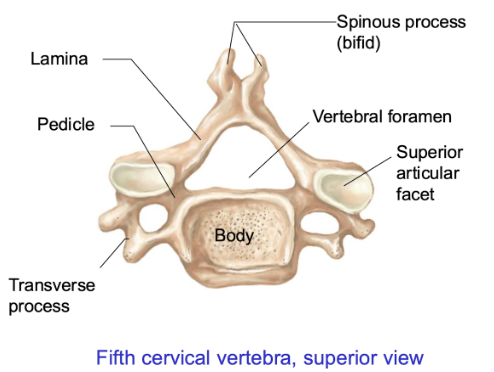
<ul><li><p><span style="background-color: transparent;"><span>Rectangularly-larger-flat vertebral body&nbsp;</span></span></p></li><li><p><span style="background-color: transparent;"><span>Has lamina and pedicle development&nbsp;</span></span></p></li><li><p><span style="background-color: transparent;"><span>Transverse process – has holes that allow blood vessels + nerves to go thru&nbsp;</span></span></p></li><li><p><span style="background-color: transparent;"><span>Vertebral foramen – gets smaller compared to C2&nbsp;</span></span></p></li><li><p><span style="background-color: transparent;"><u><span>Bifid</span></u><span>: spinous process that breaks apart and have 2 points (clefted) – only for </span><strong><span>C2-C6</span></strong></span></p></li></ul><p></p>
14
New cards

characteristics of thoracic vertebrae

  • Mid-sized vertebral body 

  • Spinous process – present, rounded tip

  • Vertebral foramen – more circularly rounded space

  • PRESENCE OF ARTICULAR FACET FOR TUBERCLE RIB 

  • Superior articular facet – present, facing the sky (from superior view), or slightly posted posteriorly and anteriorly (from lateral view) 

  • Superior demifacet – present, small flattened surface on side of body

  • Pedicle – relatively shorter bulge out, with superior articular facet on top
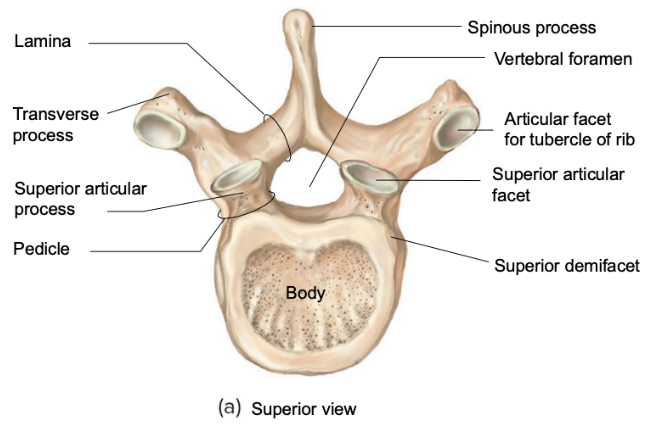
<ul><li><p><span style="background-color: transparent;"><span>Mid-sized vertebral </span><strong><span>body</span></strong><span>&nbsp;</span></span></p></li><li><p><span style="background-color: transparent;"><strong><span>Spinous process</span></strong><span> – present, rounded tip</span></span></p></li><li><p><span style="background-color: transparent;"><strong><span>Vertebral foramen</span></strong><span> – more circularly rounded space</span></span></p></li><li><p><span style="background-color: transparent;"><span>PRESENCE OF </span><strong><span>ARTICULAR FACET FOR TUBERCLE RIB&nbsp;</span></strong></span></p></li><li><p><span style="background-color: transparent;"><strong><span>Superior articular facet</span></strong><span> – present, facing the sky (from superior view), or slightly posted posteriorly and anteriorly (from lateral view)&nbsp;</span></span></p></li><li><p><span style="background-color: transparent;"><strong><span>Superior demifacet</span></strong><span> – present, small flattened surface on side of body</span></span></p></li><li><p><span style="background-color: transparent;"><strong><span>Pedicle</span></strong><span> – relatively shorter bulge out, with superior articular facet on top</span></span></p></li></ul><p></p>
15
New cards

characteristics of lumbar vertebrae

  • Body — LARGE, and longer (to hold up more body weight)  

  • Vertebral foramen – vertically flatten and smaller 

  • Superior articular facet – facing towards midline, no longer circularly flat (more oval-rectangular) 

    • Inferior articular facet points laterally 

  • Pedicle – THICKERER but short, one-direction, with no direct superior articular facet on top 

  • Transverse process – sticks out laterally, pointy 

  • Spinous process – shorter (thin), more rectangular
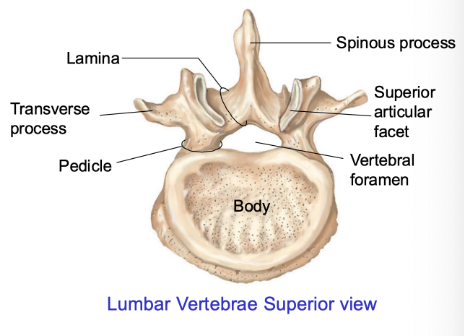
<ul><li><p><span style="background-color: transparent;"><strong><span>Body</span></strong><span> — LARGE, and longer (to hold up more body weight)&nbsp;&nbsp;</span></span></p></li><li><p><span style="background-color: transparent;"><strong><span>Vertebral foramen</span></strong><span> – vertically flatten and smaller&nbsp;</span></span></p></li><li><p><span style="background-color: transparent;"><strong><span>Superior articular facet</span></strong><span> – facing towards midline, no longer circularly flat (more oval-rectangular)&nbsp;</span></span></p><ul><li><p><span style="background-color: transparent;"><span>Inferior articular facet points laterally&nbsp;</span></span></p></li></ul></li><li><p><span style="background-color: transparent;"><strong><span>Pedicle</span></strong><span> – THICKERER but short, one-direction, with no direct superior articular facet on top&nbsp;</span></span></p></li><li><p><span style="background-color: transparent;"><strong><span>Transverse process</span></strong><span> – sticks out laterally, pointy&nbsp;</span></span></p></li><li><p><span style="background-color: transparent;"><strong><span>Spinous process</span></strong><span> – shorter (thin), more rectangular</span></span></p></li></ul><p></p>
16
New cards

sacrum

5 individual bones,  triangular bone @ base of spine

  • fused together @ age 16-18, not completely fused until 30 yo

17
New cards

posterior sacral foramen

openings (similar to intervertebral foramen) that allow spinal nerves to exit

18
New cards

median sacral crest

where spinous process wouldve been located on the og 5 vertebae that fused tog — attachment point for muscles

19
New cards

coccyx

attachment point for filum terminate (was composed of 4-5 bones and fused tog

  • no foramen

  • fusion ocurrs at age 20-30

20
New cards

intervertebral disks (job + composed of)

fibrocartilage “disks“ found in between vertebral bodies

  • job: provide support (connecting vertebral bodies in symphysis joint + hold body in upright position — cartilage = able to withstand a lot of force (movement and weight)

    • very resilient and able to absorb vertical shock and permit movement (bending of spine)

  • composed of:

    • annulus fibrosus: outer layer of fibrocartilage

    • nucleus pulposus: gelatinous pulp of fibrocartilage

21
New cards

herniated disk

herniated disk: when theres a tear in cartilage @ intervertebral disks, and the nucleus pulposus will squeeze out towards posterior side (bc of body mass on anterior side) and goes towards intervertebral foramen

  • Results in pressure on spinal nerve ⇒ cause dysfunction 

  • To fix: take pressure off and wait to heal (but will take a longer time bc its avascular)

22
New cards

thoracic cage

job: protect vital organs

movement: semi-rigid — moveable bc it forms joints w other bones + connect via cartilage, should be flexible to accommodate for inflation and deflation of lungs

composed of: thoracic vertebrae, ribs, costal cartilage, sternum

  • 12 pairs of ribs

    • 7 pairs vertebrosternal ribs (“true ribs“) — top half that touches sternum

    • 5 pairs vertebral ribs (“floating“) — only touch vertebral column, no sternum

23
New cards

vertebrosternal ribs vs vertebral ribs

makes up the ribs in the thoracic cage

  • 7 pairs vertebrosternal ribs (“true ribs“) — top half that touches sternum

  • 5 pairs vertebral ribs (“floating“) — only touch vertebral column, no sternum

  • total = 12 ribs

24
New cards

sternum + components of it

Sternum: composed of the manubrium, body, xiphoid process 

  • Manubrium: broad, uppermost part of the sternum, that connects to clavicles

  • Body of sternum: middle and longest part of the breastbone

  • Xiphoid process: cartilaginous section at the lower end of the sternum, which is not attached to any ribs, and gradually ossifies during adult life
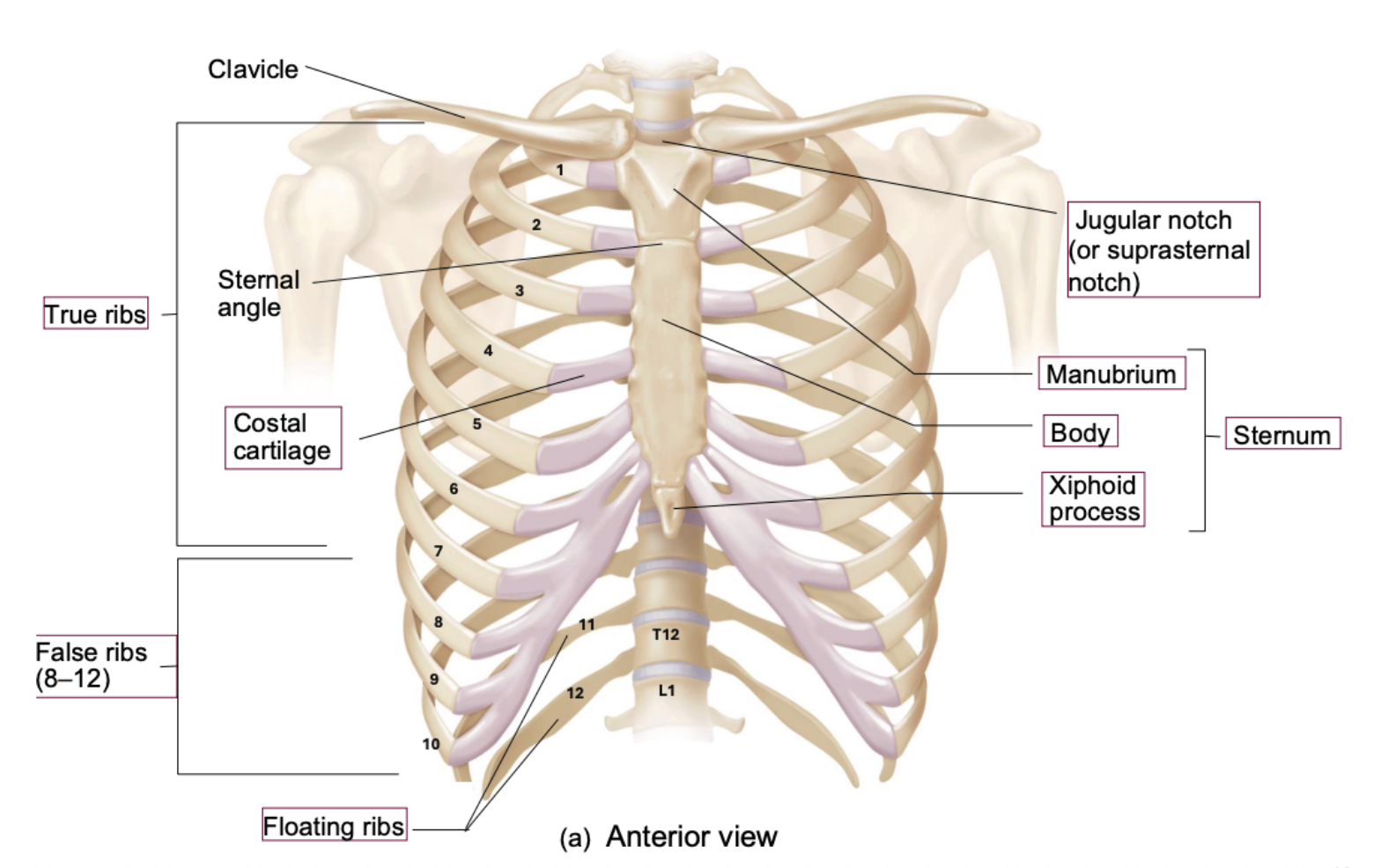
<p><span style="background-color: transparent;"><u><span>Sternum</span></u><span>: composed of the manubrium, body, xiphoid process&nbsp;</span></span></p><ul><li><p><span style="background-color: transparent;"><u><span>Manubrium</span></u><span>: broad, uppermost part of the sternum, that connects to clavicles</span></span></p></li><li><p><span style="background-color: transparent;"><u><span>Body of sternum</span></u><span>: middle and longest part of the breastbone</span></span></p></li><li><p><span style="background-color: transparent;"><u><span>Xiphoid process</span></u><span>: cartilaginous section at the lower end of the sternum, which is not attached to any ribs, and gradually ossifies during adult life</span></span></p></li></ul><p></p>
25
New cards

sternal angle

where the manubrium connects to body of sternum
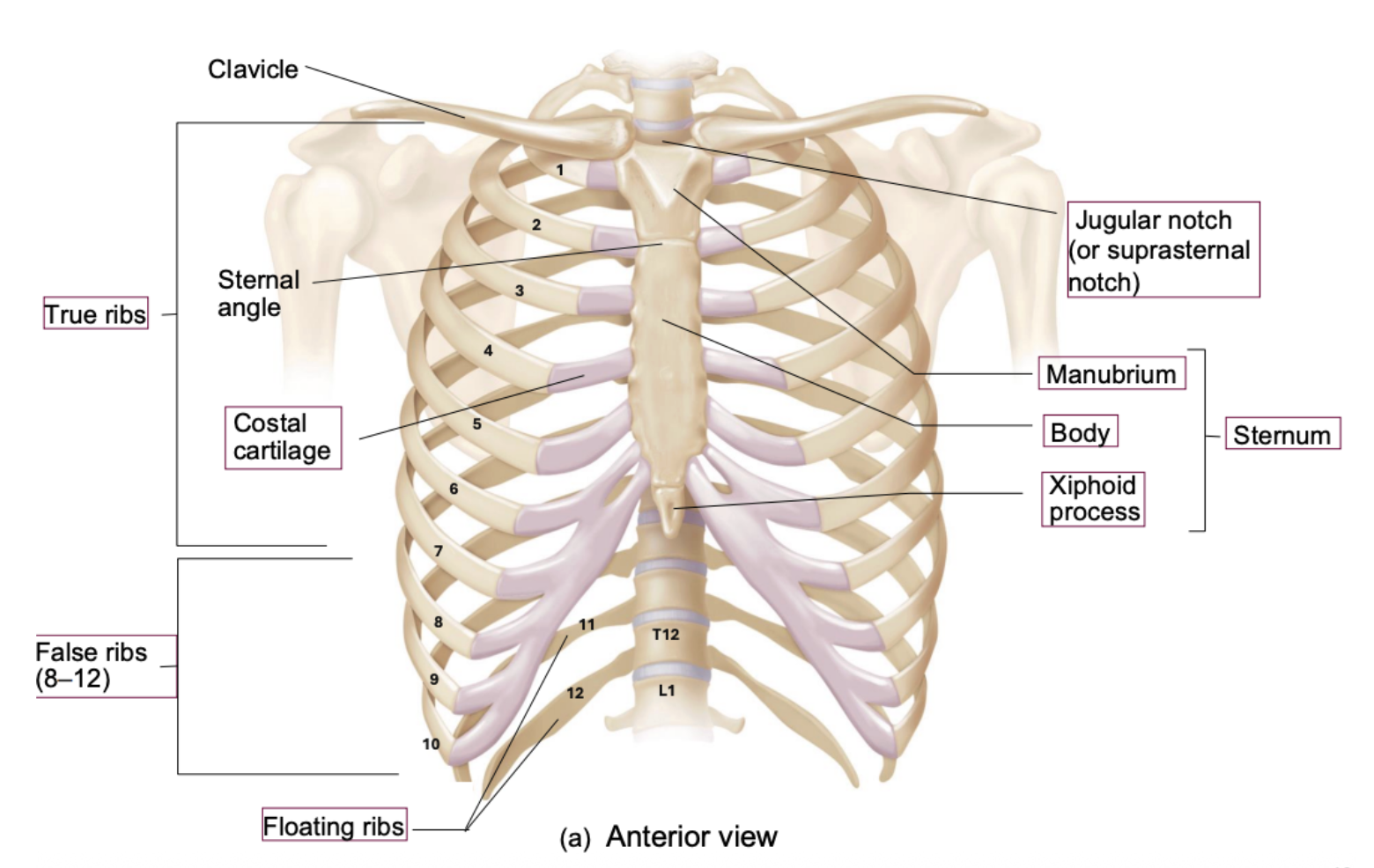
<p>where the manubrium connects to body of sternum </p>
26
New cards

costal cartilage

cartilage that acts as “middleman“ — connecting ribs to the sternum
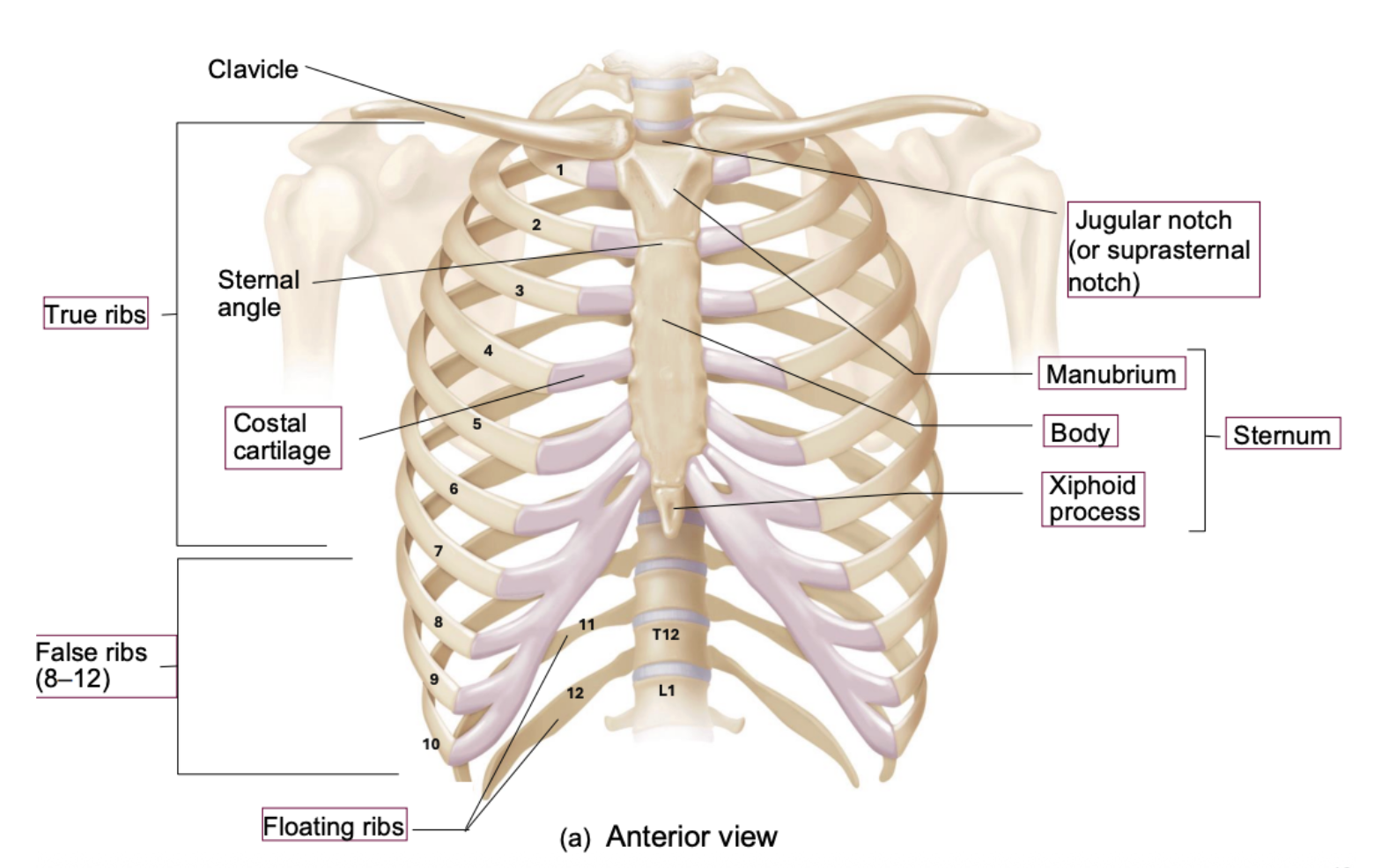
<p>cartilage that acts as “middleman“ — connecting ribs to the sternum </p>