Muscle Tissue Types, Contraction Mechanisms, and Physiology
 Call Kai
 Learn
Learn Practice Test
 Spaced Repetition
 Match
Match Flashcards
 Knowt Play
1/234

There's no tags or description
Looks like no tags are added yet.
Name | Mastery | Learn | Test | Matching | Spaced | Call with Kai | Chat |
|---|
No analytics yet
Send a link to your students to track their progress
235 Terms
What factors influence the force of muscle contractions?
1. Number of muscle fibers stimulated (recruitment) 2. Relative size of fibers 3. Frequency of stimulation 4. Degree of muscle stretch
How does the number of motor units recruited affect muscle contraction?
The more motor units recruited, the greater the force of contraction.
What happens to muscle fibers with regular exercise?
They can increase in size, a process known as hypertrophy.
What is the optimal sarcomere length for generating maximum force?
80% to 120% of resting length.
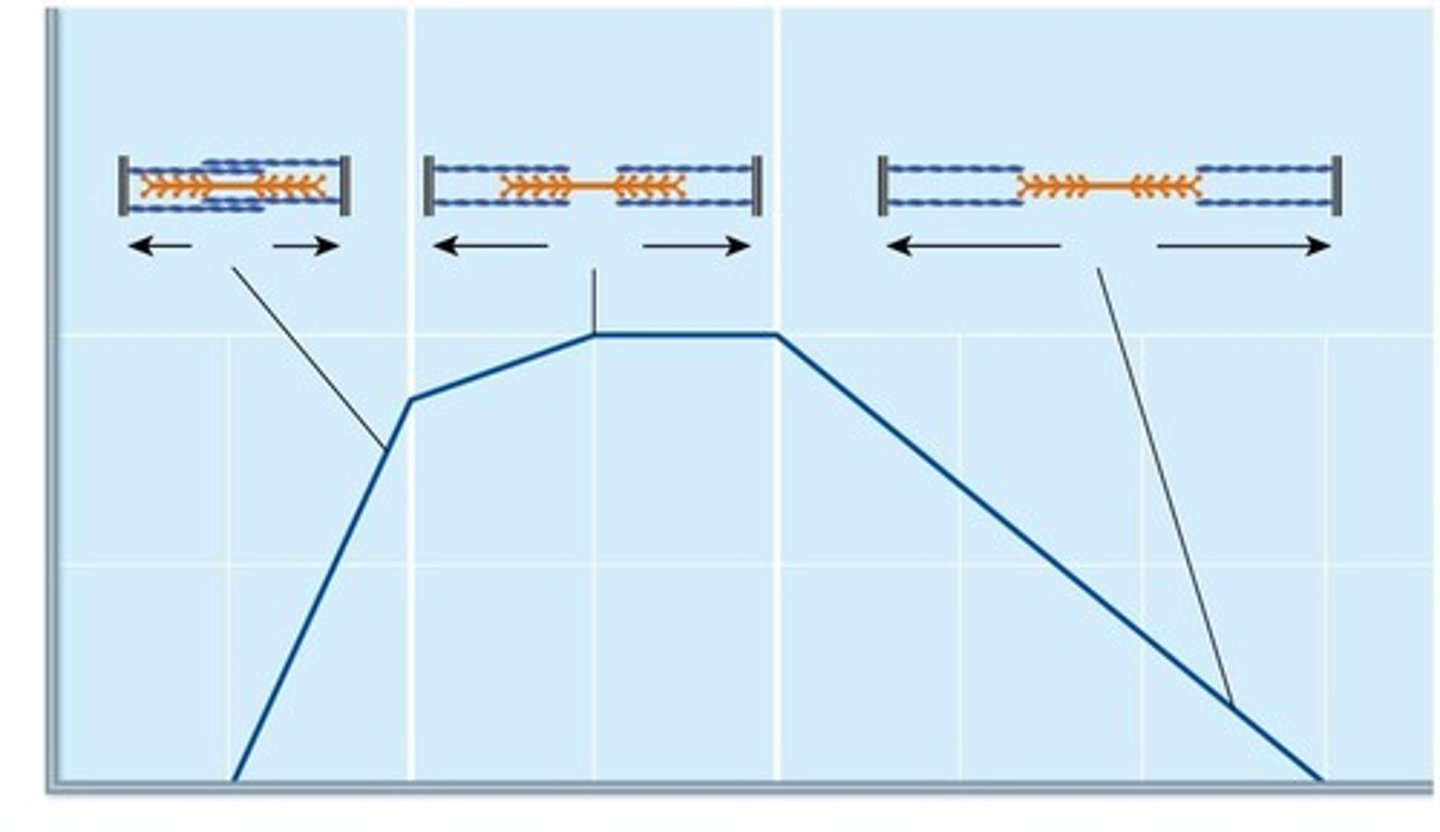
What occurs if a sarcomere is less than 80% of resting length?
Filaments overlap too much, resulting in decreased force.
What happens if a sarcomere is greater than 120% of resting length?
Filaments do not overlap enough, leading to decreased force.
What are the three types of skeletal muscle fibers?
1. Slow oxidative fibers 2. Fast oxidative fibers 3. Fast glycolytic fibers
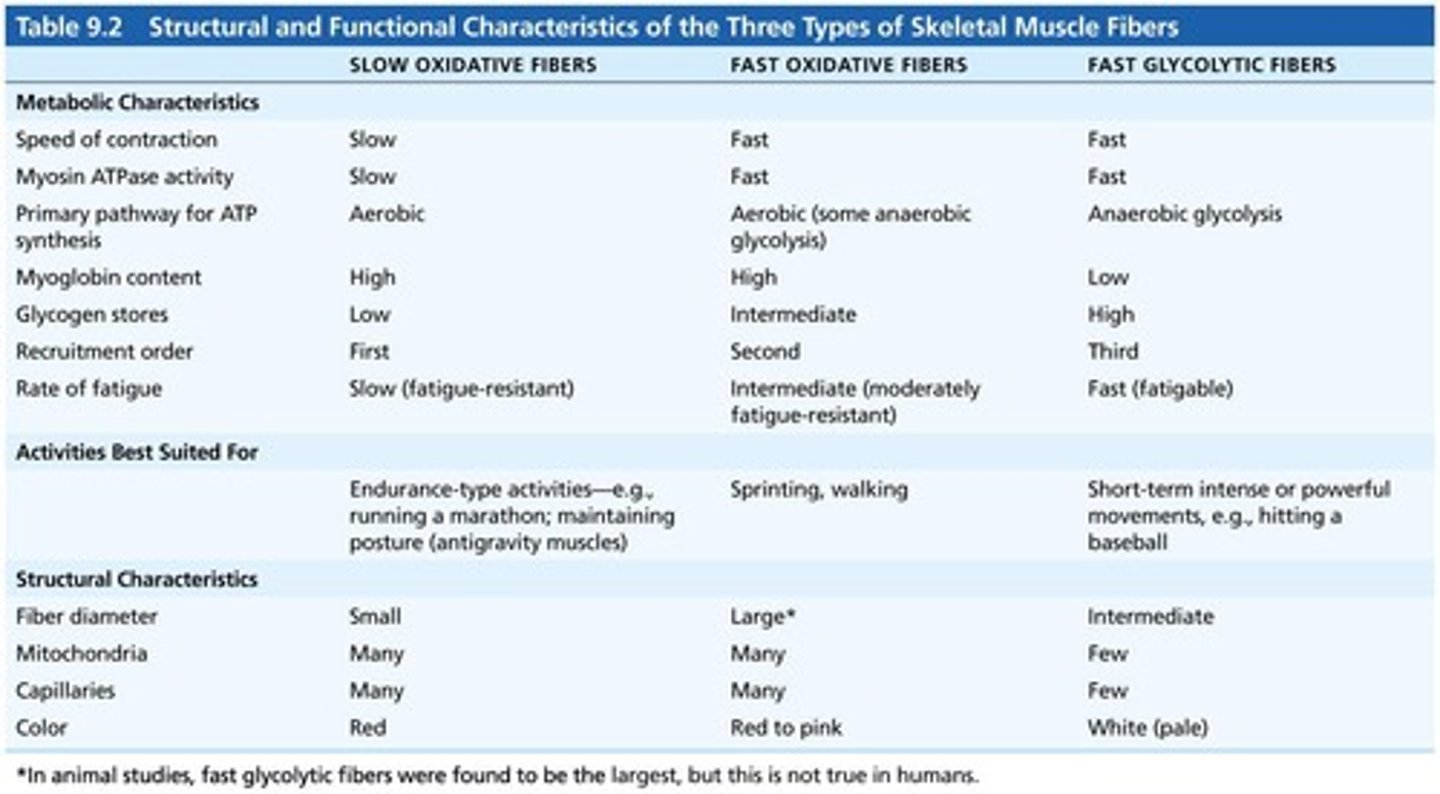
What type of activities are slow oxidative fibers best suited for?
Low-intensity, endurance activities, such as maintaining posture.
What type of activities do fast glycolytic fibers support?
Short-term intense or powerful movements, such as hitting a baseball.
How does load affect muscle contraction speed and duration?
Muscles contract fastest with no load; greater loads slow contraction and decrease duration.
What adaptations occur from aerobic (endurance) exercise?
Increased muscle capillaries, number of mitochondria, and myoglobin synthesis.
What is the result of resistance exercise on muscles?
Muscle hypertrophy, increased mitochondria, myofilaments, glycogen stores, and connective tissue.
What is disuse atrophy?
Degeneration and loss of muscle mass due to immobilization or loss of neural stimulation.
What can happen to paralyzed muscles over time?
They may atrophy to one-fourth of their initial size.
Where is smooth muscle found in the body?
In the walls of most hollow organs, excluding the heart.
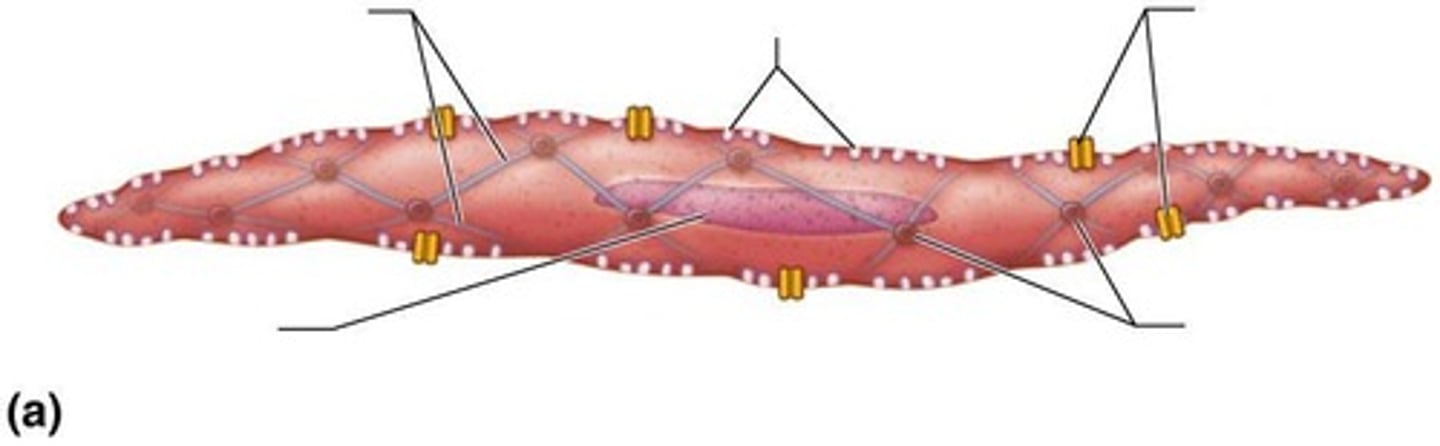
What is the primary organization of smooth muscle?
Most smooth muscle is organized into sheets of tightly packed fibers.
What is the relationship between muscle fiber type and contraction speed?
Muscle fibers are classified by the speed of contraction and metabolic pathways used for ATP synthesis.
What is the effect of high frequency of stimulation on muscle contraction?
It leads to greater force through temporal summation and tetanus.
What is the role of myosin ATPases in muscle contraction?
They split ATP and influence the speed of contraction.
What is the impact of genetics on muscle fiber composition?
Genetics dictate an individual's percentage of each muscle fiber type.
What is the significance of myoglobin in muscle fibers?
Myoglobin facilitates oxygen storage, enhancing endurance.
What happens to fast glycolytic fibers with endurance training?
They may convert into fast oxidative fibers.
What is the effect of increased recruitment on muscle contraction?
It results in faster and more prolonged contractions.
How does muscle hypertrophy affect muscle strength?
It leads to increased muscle strength and size.
What is the consequence of immobilization on muscle health?
It can lead to rapid muscle atrophy and loss of strength.
What is the primary function of smooth muscle?
To facilitate involuntary movements in hollow organs.
What is the difference between oxidative and glycolytic fibers?
Oxidative fibers use aerobic pathways, while glycolytic fibers use anaerobic glycolysis.
Where is smooth muscle primarily found?
In the walls of most hollow organs, including respiratory, digestive, urinary, reproductive, and circulatory systems (except in the smallest blood vessels).
What type of muscle is not found in the heart?
Smooth muscle; the heart contains cardiac muscle.
How are smooth muscle fibers organized?
Most smooth muscle is organized into sheets of tightly packed fibers.
What are the two layers of smooth muscle fibers in most organs?
Longitudinal layer (fibers run parallel to the organ's long axis) and circular layer (fibers run around the organ's circumference).
What happens during contraction of the longitudinal layer of smooth muscle?
The organ shortens.
What happens during contraction of the circular layer of smooth muscle?
The lumen of the organ constricts.
What is a key difference between smooth muscle fibers and skeletal muscle fibers?
Smooth muscle fibers are spindle-shaped, thin, and short, while skeletal muscle fibers are wider and much longer.
How many nuclei do smooth muscle fibers have?
Smooth muscle fibers have only one nucleus.
What connective tissue sheath is present in smooth muscle?
Smooth muscle contains only endomysium.
What are varicosities in smooth muscle?
Bulbous swellings of nerve fibers that store and release neurotransmitters into a wide synaptic cleft called a diffuse junction.
Which nervous system innervates smooth muscle?
The autonomic nervous system.
What is the role of caveolae in smooth muscle?
Caveolae are pouch-like infoldings in the sarcolemma that contain Ca2+ channels for rapid influx of extracellular calcium.
How does smooth muscle obtain calcium for contraction?
Calcium is primarily obtained from extracellular fluid, with some from the sarcoplasmic reticulum (SR).
What is the function of gap junctions in smooth muscle?
Gap junctions allow electrical coupling and depolarization to spread from cell to cell.
What structural feature differentiates smooth muscle from skeletal muscle regarding thick and thin filaments?
Smooth muscle has fewer thick filaments with myosin heads along their entire length.
What protein binds calcium in smooth muscle instead of troponin?
Calmodulin binds calcium in smooth muscle.
What initiates the contraction process in smooth muscle?
Increased intracellular calcium levels trigger contraction.
What is the role of myosin light chain kinase in smooth muscle contraction?
Myosin light chain kinase phosphorylates the myosin head, activating it for crossbridge formation with actin.
How do smooth muscle contractions differ from skeletal muscle contractions?
Smooth muscle contractions are slower, synchronized, and can be self-excitatory, while skeletal muscle contractions are faster and require external stimulation.
What is the arrangement of thick and thin filaments in smooth muscle?
Thick and thin filaments are arranged diagonally, causing smooth muscle to contract in a corkscrew manner.
What are dense bodies in smooth muscle?
Proteins that anchor filaments to the sarcolemma at regular intervals, corresponding to Z discs in skeletal muscle.
What happens to the sarcolemma during contraction of smooth muscle?
Areas of the sarcolemma between dense bodies bulge outward, making the muscle cell appear puffy.
What is the primary mechanism of contraction in smooth muscle?
The sliding filament mechanism, where actin and myosin interact.
What is the significance of the lower ratio of thick to thin filaments in smooth muscle?
It allows smooth muscle to be as powerful as skeletal muscle despite having fewer thick filaments.
How does the contraction of smooth muscle cells affect the lumen of hollow organs?
Contraction of the circular layer constricts the lumen, helping to mix and squeeze substances through.
What is required for smooth muscle relaxation?
Ca2+ detachment from calmodulin, active transport of Ca2+ into SR and extracellularly, and dephosphorylation of myosin.
How do calcium ions enter the cytosol in smooth muscle?
Via voltage-gated or non-voltage-gated Ca2+ channels, or from the scant sarcoplasmic reticulum (SR).
What activates calmodulin in smooth muscle contraction?
Calcium ions (Ca2+) binding to calmodulin.
What is the role of activated calmodulin in smooth muscle contraction?
It activates myosin light chain kinase enzymes.
What do activated kinase enzymes do in smooth muscle contraction?
They catalyze the transfer of phosphate to myosin, activating myosin ATPases.
What occurs after activated myosin forms cross bridges with actin?
Shortening of the muscle begins.
What is a key feature of smooth muscle contraction regarding energy efficiency?
Smooth muscle is slower to contract and relax but maintains contraction for prolonged periods with little energy cost.
What is smooth muscle tone?
A moderate degree of contraction maintained constantly without fatiguing.
What regulates smooth muscle contraction?
Nerves, hormones, or local chemical changes.
What effect can one neurotransmitter have on smooth muscle in different organs?
It can have a stimulatory effect in one organ and an inhibitory effect in another.
What are some chemical factors that can affect smooth muscle contraction?
Hormones, high CO2, pH, and low oxygen.
What is the stress-relaxation response in smooth muscle?
It is the ability to respond to stretch briefly and then adapt to a new length.
What types of smooth muscle exist?
Unitary and multiunit smooth muscle.
Where is unitary smooth muscle commonly found?
In all hollow organs except the heart.
What are the characteristics of unitary smooth muscle?
Arranged in opposing sheets, innervated by varicosities, often exhibit spontaneous action potentials, electrically coupled by gap junctions.
Where is multiunit smooth muscle located?
In large airways in lungs, large arteries, arrector pili muscles, and the iris of the eye.
How does multiunit smooth muscle differ from unitary smooth muscle?
It has very few gap junctions, and spontaneous depolarization is rare.
What is the developmental origin of all muscle tissues?
All muscle tissues develop from embryonic myoblasts.
How do multinucleated skeletal muscle cells form?
By the fusion of many myoblasts.
When do cardiac muscle cells start pumping during development?
When the embryo is 3 weeks old.
What is the role of growth factors in muscle development?
They stimulate clustering of ACh receptors at neuromuscular junctions.
What is a unique feature of cardiac and smooth muscle myoblasts?
They do not fuse but develop gap junctions.
What allows smooth muscle to have huge volume changes without becoming flabby?
It can contract when between half and twice its resting length.
What is the significance of slower ATPases in smooth muscle?
They contribute to the energy efficiency of smooth muscle contraction.
What happens to myofilaments during smooth muscle contraction?
They may latch together to save energy.
What cells fuse to form a multinucleate skeletal muscle fiber?
Myoblasts
What is the immature form of a multinucleate muscle fiber called?
Myotube
What is the primary function of myoblasts during muscle development?
To undergo cell division and enlarge
What limits the regenerative ability of skeletal muscle?
Myoblast-like skeletal muscle satellite cells
How do cardiomyocytes regenerate after injury?
They can divide at a modest rate, but injured heart muscle is mostly replaced by connective tissue.
Which type of muscle regenerates throughout life?
Smooth muscle
What is the peak natural neural control development stage?
Midadolescence
What is the difference in skeletal muscle mass between females and males?
Female skeletal muscle makes up 36% of body mass, while male skeletal muscle makes up 42% due to testosterone.
What begins to happen to muscle mass by age 30?
Loss of muscle mass (sarcopenia) begins.
What is muscle tone?
A constant, slightly contracted state of all muscles.
What are isotonic contractions?
Muscle contractions where the muscle changes in length and moves a load.
What are the two types of isotonic contractions?
Concentric and eccentric contractions.
What occurs during a concentric contraction?
The muscle shortens and does work.
What occurs during an eccentric contraction?
The muscle lengthens while generating force.
What are isometric contractions?
Muscle contractions where the load is greater than the maximum tension the muscle can generate, so the muscle neither shortens nor lengthens.
What is the primary energy source for muscle contraction?
ATP (adenosine triphosphate)
How quickly are available stores of ATP depleted during muscle activity?
In 4-6 seconds.
What are the three mechanisms for regenerating ATP during muscle activity?
Direct phosphorylation of ADP by creatine phosphate, anaerobic pathway (glycolysis and lactic acid formation), and aerobic pathway.
What is creatine phosphate's role in ATP regeneration?
It donates a phosphate to ADP to instantly form ATP.
What enzyme carries out the transfer of phosphate from creatine phosphate to ADP?
Creatine kinase.
How long can muscle fibers power themselves using ATP and creatine phosphate reserves?
About 15 seconds.
What happens to muscle fibers as a person ages?
Connective tissue increases and muscle fibers decrease.
What is the condition called that leads to muscle mass loss with age?
Sarcopenia.