5 - Organization of the Nervous System
 Call Kai
 Learn
Learn Practice Test
 Spaced Repetition
 Match
Match Flashcards
 Knowt Play
1/33

There's no tags or description
Looks like no tags are added yet.
Name | Mastery | Learn | Test | Matching | Spaced | Call with Kai | Chat |
|---|
No analytics yet
Send a link to your students to track their progress
34 Terms
-receive sensory information
-integrate and process information
-decide if a motor response will occur
What are the primary functions of the nervous system? [3]
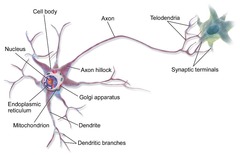
neuron
What is the major functional unit of the nervous system?
dendrite (information-receiving area)
cell body/soma (contains organelles for cell metabolism)
axon (information-carrying extension of cell membrane)
pre-synaptic terminal (end of axon to transmits information to other cells)
Match the basic structures of a neuron to its function:
dendrite (transmits information to other cells)
cell body/soma (information-carrying extension)
axon (contains organelles for cell metabolism)
pre-synaptic terminal (information-receiving area)
-produce myelin sheath
-modulate growth of neurons
-buffer extracellular concentrations of K+ and neurotransmitters
-form synapses between neurons
-participate in immune responses.
What role do glial cells play in the nervous system? [5]
the brain and spinal cord
What components make up the CNS?
-autonomic nervous system (sympathetic and parasympathetic)
-somatic nervous system (sensory and motor)
What are the components of the PNS?
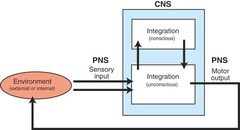
-peripheral->CNS (afferent)
-CNS->synapses (efferent)
Which way to afferent and efferent neurons carry signals?
-skin
-retina
Where does somatic afferent (part of somatic) carry signals from?
-thoracic and abdominal organs
-olfactory
-epithelium
-taste buds
Where does visceral afferent (part of autonomic) carry signals from? [4]
skeletal muscles
Where does somatic efferent (part of somatic) carry signals to?
-cardiac muscles
-smooth muscle
-exocrine glands
Where does visceral efferent (part of autonomic) carry signals to? [3]
enter via dorsal roots
How do afferent sensory axons enter the spinal cord?
exit via ventral roots
How do efferent motor axons exit the spinal cord?
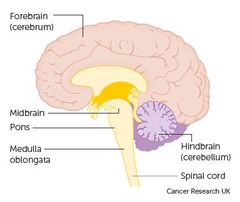
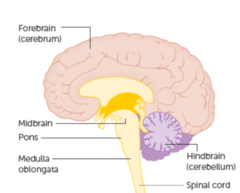
-medulla
-pons
-midbrain
-diencephalon
-telencephalon
What are the five major brain regions from caudal to rostral?
-receives sensory input and supplies motor output to trunk and limbs
-sensory input relayed to forebrain via brainstem
What is the function of the spinal cord?
-medulla
-pons
-midbrain
What are the parts of the brainstem? [3]
-sensory input and motor output face/head
What is the function of the brainstem?
-diencephalon
-telencephalon
What are the parts of the forebrain?
-most sophisticated information processing as well as motor output
-capable of sending motor output directly to spinal cord(by-passing brain-stem)
What is the function of the forebrain?
-sensory for skin, muscles, tendons, joints, visceral organs
-motor neurons to smooth or skeletal muscle
-sensory info to brain AND motor commands from brain to motor neurons
-control muscle stretch reflexes and limb withdrawal from painful stimuli
Function of 6 CNS regions- spinal cord [4]
-receives info from external and internal sensory receptors
-sends motor commands to skeletal and smooth muscle
Function of 6 CNS regions- medulla [2]
-sensory info about facial touch and have role in motor control of chewing
-relays info from the cerebral cortex to cerebellum
Function of 6 CNS regions- pons [2]
-contains superior and inferior colliculi (for processing and relaying visual and auditory information)
-cranial nerve nuclei to control eye movement and induce pupillary
constriction
-each brainstem region contains a portion of the reticular formation, a netlike complex of small clusters of cell bodies and axonal projections located near the midline
Function of 6 CNS regions- midbrain [3]
thalamus:
-relay station for and modulator of info being passed to cerebral cortex from sensory systems and other brain regions
hypothalamus:
-regulates the autonomic nervous system
-controls hormone secretion from pituitary
-major role in physiological and behavioral aspects of homeostasis
Function of 6 CNS regions- diencephalon [4]
cerebral cortex:
-mediates complex sensory integration (somatic senses, vision, olfactory, taste, hearing) and conscious sensory perception
-formulates and execute sequences of voluntary movement
basal ganglia:
-modulates motor functions
hippocampus:
-memory and spatial learning
Function of 6 CNS regions- telencephalon [4]
The meninges: pia mater (innermost), arachnoid (middle), and dura mater (outermost)
What protective layers surround the CNS? [3]
![<p>What protective layers surround the CNS? [3]</p>](https://assets.knowt.com/user-attachments/b5cd4cf2-b79f-4e13-a5f1-97dda7d0ead3.jpg)
a clear, colorless fluid(ultrafiltrate of plasma) found in the subarachnoid space, central canal of the spinal cord, and ventricular system of the brain
What is cerebrospinal fluid and where is it found?
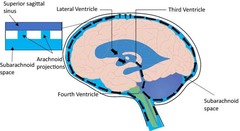
modified ependymal cells surrounding capillaries that serves as a barrier between blood and CSF
What is the choroid plexus?
-line the ventricles of the brain and spinal cord
-barrier with brains interstitial fluid
-secrete Na
Role of epidydimal cells? [3]
-produced in ventricles of brains and flows down to subarachnoid space to bathe surface of CNS → eventually passes to venous system
-replaced several times a day
What is the life cycle of the CSF?
-cushions the brain and spinal cord, equalizes pressure changes
-maintains a stable microenvironment for neurons and glia
• serves as a chemical buffer
-aids in waste excretion and toxin removal
What are the functions of cerebrospinal fluid (CSF)? [4]
![<p>What are the functions of cerebrospinal fluid (CSF)? [4]</p>](https://assets.knowt.com/user-attachments/44087a0a-0064-4e24-b467-75a0d17927aa.jpg)
-capillaries in brain and spinal cord that have tight junctions to prevent many molecules from leaving blood and entering brain
-tight junctions formed and maintained by astrocytes
What is the blood-brain barrier (BBB)?
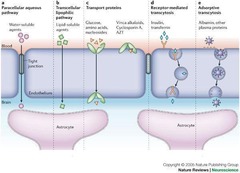
-interact with brain endothelial cells and regulate their permeability
-help repair blood brain barrier if damaged
What do astrocytes do?
-small, uncharged
-lipid-soluble
-non-protein bound
-ex. O2 and CO2.
-glucose and AA require transport
What characteristics do molecules need to cross the blood-brain barrier? [5]