B4 : Bioenergenetics
 Call Kai
 Learn
Learn Practice Test
 Spaced Repetition
 Match
Match Flashcards
 Knowt Play
1/46

Earn XP
Description and Tags
Name | Mastery | Learn | Test | Matching | Spaced | Call with Kai |
|---|
No analytics yet
Send a link to your students to track their progress
47 Terms
Where does photosynthesis take place?
In the chloroplast, which has a green pigment called chlorophyll which absorbs light
What type of reaction is photosynthesis?
Endothermic reaction
What is the word equation for photosynthesis?

What is the balanced symbol equation for photosynthesis?

What is a limiting factor?
A limiting factor is any factor that slows down the rate of photosynthesis if there is not enough of it
What are the 4 factors that affect photosynthesis?
Temperature
Light intensity
Carbon dioxide
Chlorophyll
When is temperature a limiting factor + how does temperature affect the rate of photosynthesis?
In winter temperature is a limiting factor but in summer photosynthesis increases because particles gain more energy in warmer temperatures
When is light intensity a limiting factor + how does light intensity affect the rate of photosynthesis?
At night light intensity is a limiting factor but in the day photosynthesis increases because there is light which is absorbed by chlorophyll
When is carbon dioxide the limiting factor for the rate of photosynthesis?
If its warm and bright enough carbon dioxide is the limiting factor
How does chlorophyll affect the rate of photosynthesis?
Chlorophyll absorbs light and if there is not enough chlorophyll the rate of photosynthesis will decrease
What effects the amount of chlorophyll? (3)
diseases (such as tobacco mosaic virus)
lack of nutrients (such as magnesium)
loss of leaves (fewer leaves means fewer chloroplasts)
What are the 5 uses of glucose in plants? + explain the uses.
Amino Acids → glucose combined with nitrate ions to form amino acids which are the building blocks for protein
Cellulose → glucose converted into cellulose which is used to strengthen the plant cell wall
Respiration → energy transferred from glucose
Oils and fats → glucose converted into oils and fats for seeds
Starch → glucose (soluble) stored as starch (insoluble) for food for plants for when photosynthesis isn’t happening
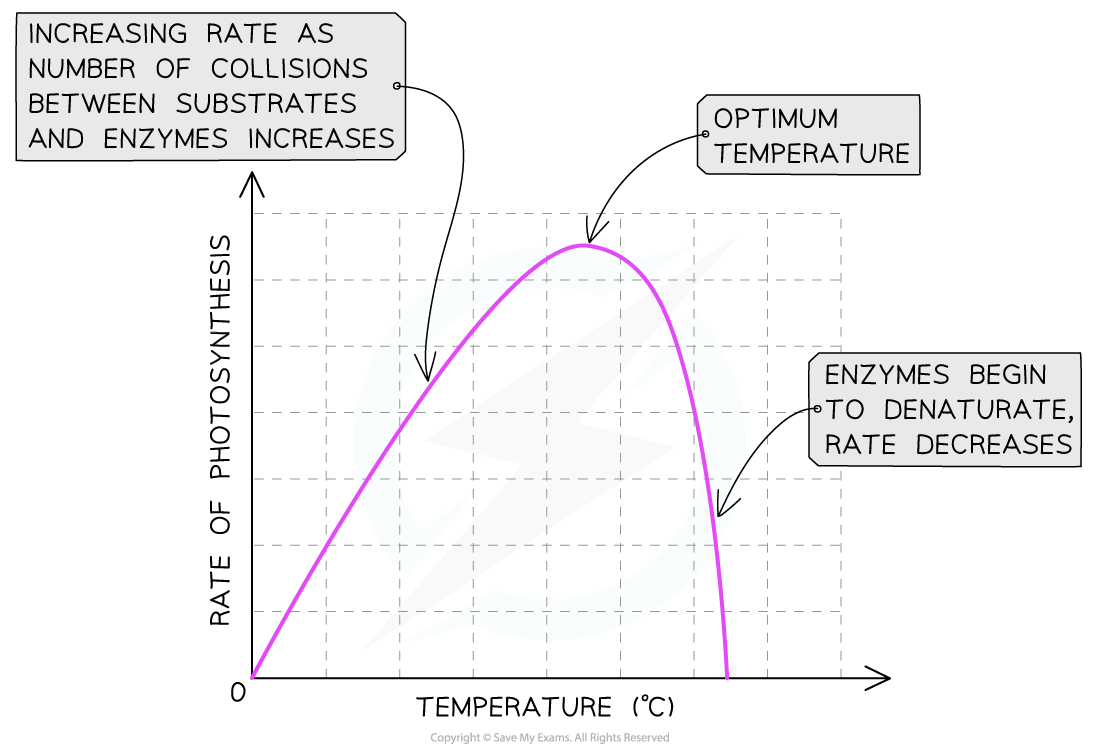
Describe the temperature limiting factor graph (3)
The temperature of the environment affects how much kinetic energy all particles have – so temperature affects the speed at which carbon dioxide and water move through a plant
The lower the temperature, the less kinetic energy particles have, resulting in fewer successful collisions occurring over a period of time
At higher temperatures (45°C), however, enzymes that control the processes of photosynthesis can be denatured (where the active site changes shape and is no longer complementary to its substrate) – this reduces the overall rate
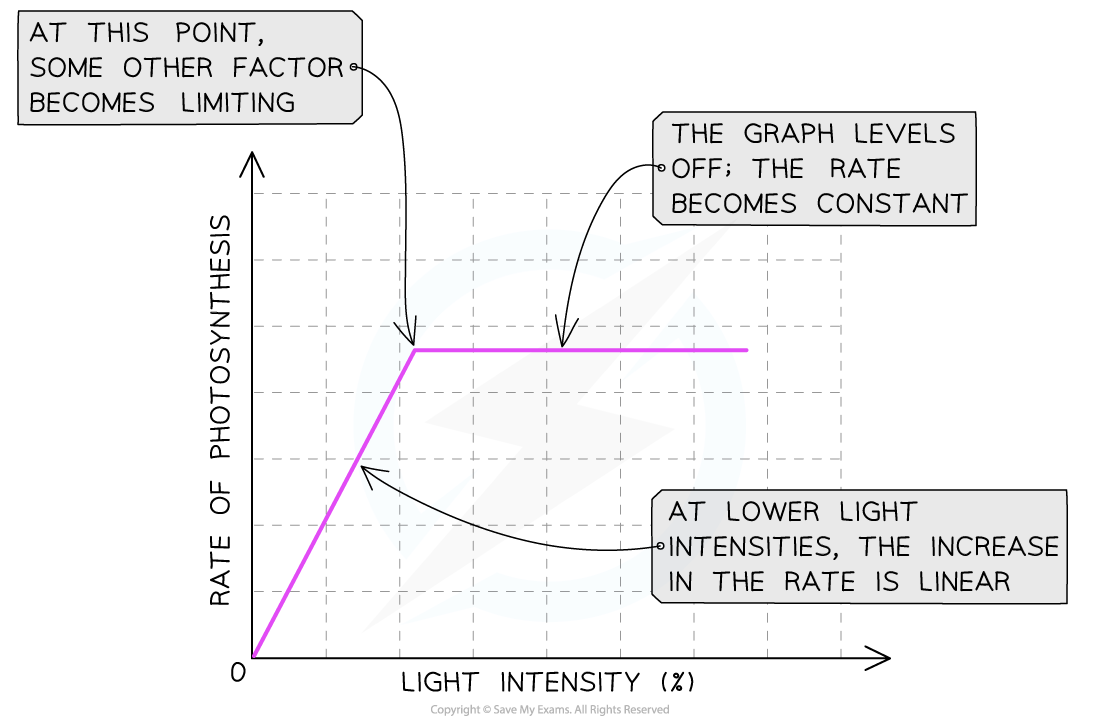
Describe the light intensity limiting factor graph (3)
The intensity of the light available to the plant will depend on the amount of energy that it has to carry out photosynthesis
The more light a plant receives, the faster the rate of photosynthesis
This trend will stop if either temperature or carbon dioxide are limiting factors
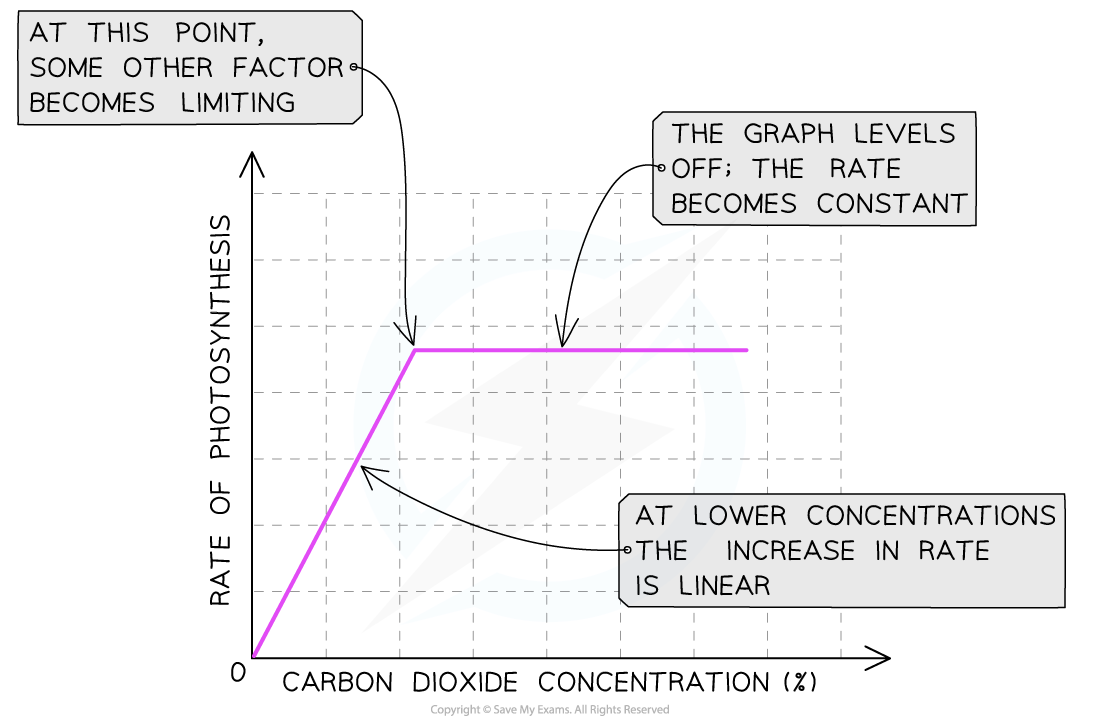
Describe the carbon dioxide limiting factor graph (3)
Carbon dioxide is one of the raw materials required for photosynthesis
This means the more carbon dioxide that is present, the faster the reaction can occur
This trend will stop if either temperature or light intensity are limiting factors
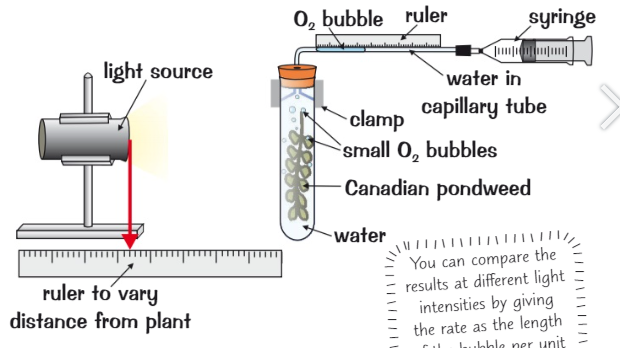
Describe how oxygen production shows the rate of photosynthesis. (5)
Source of white light placed at a specific distance from pondweed
Pondweed is left to photosynthesise for a set amount of time
As pondweed photosynthesises, O2 collected in capillary tube
A syringe is used to draw gas bubbles in a tube up alongside a ruler, so the length of the gas bubble can be measured. This is proportional to the volume of O2 produced
Experiment repeated with a light source at different distances from pondweed
How can the apparatus be altered to find and measure the effect of temperature or CO2?
Temperature
The test tube of pondweed can be put into a water bath at a set temperature.
The experiment can then be repeated with different temperatures of water
CO2
A measured amount of sodium hydrogen carbonate can be dissolved in the water - this gives off CO2.
The experiment can be repeated with different concentrations of sodium hydrogen carbonate
What is the light intensity formula?
light intensity ⍺ 1/distance²
(⍺ → proportional to)

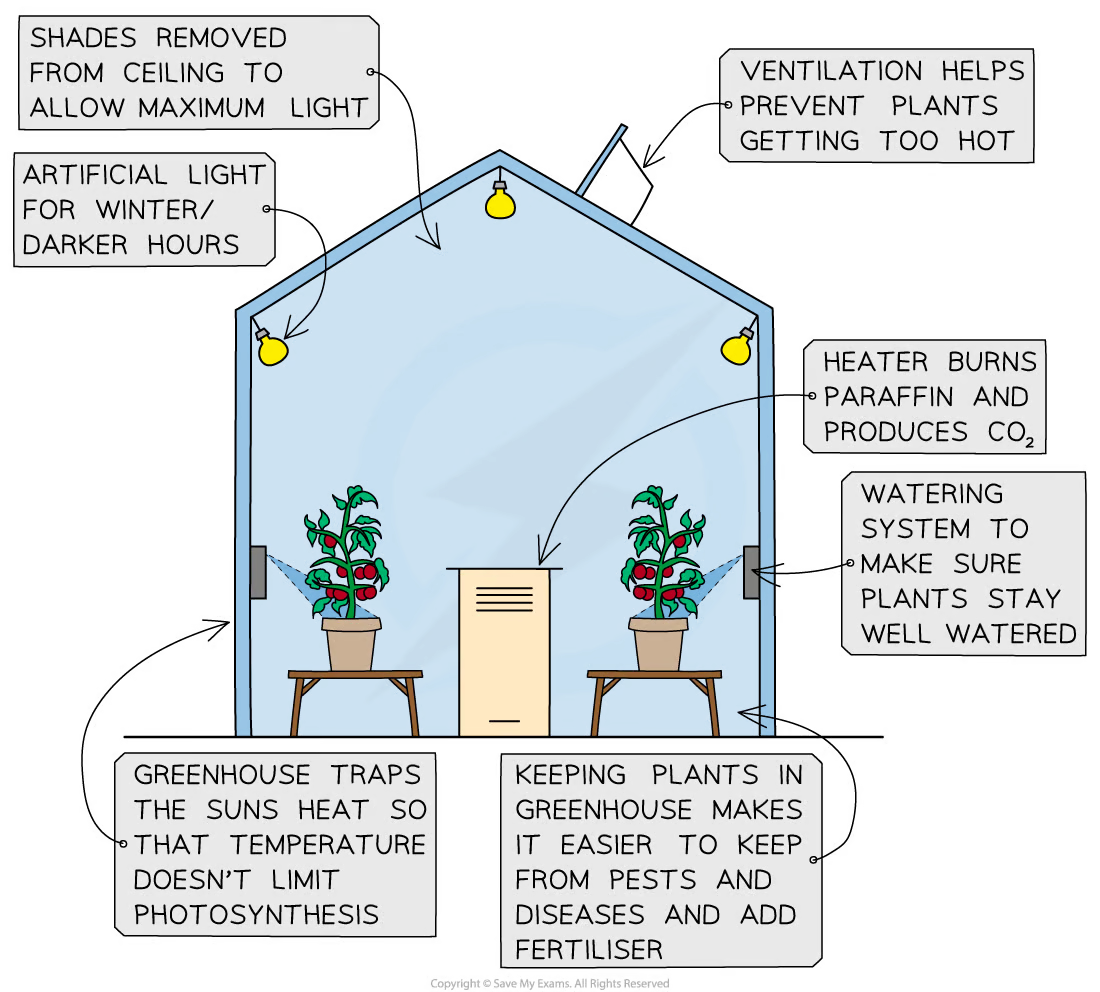
How is a green house adapted for ideal farming? (7)
Greenhouses trap the sun’s heat+ make sure the temperature doesn’t become limiting
In winter a heater is used
In summer if it’s too hot a ventilator is used
Artificial light is used if it is dark
To increase CO2 a paraffin heater is used
Plants enclosed in a greenhouse keep pests away
Fertilisers are used to provide minerals
Why is it important that farmers make sure their greenhouse conditions are effective? (2)
To much off light,CO2 or temperature will lead to the conditions being ineffective and waste money.
Keep a greenhouse supplied costs a lot of money and if crop is not being produced then money is being wasted as no revenue will be collected
What is a metabolism?
The sum of all of the chemical reactions in a cell or the body
What are chemical reactions controlled by?
Enzymes
What are the 5 larger molecules that are made from small molecules during chemical reactions?
glucose forms starch (glucose stored in a plant)
glucose forms glycogen (glucose stored in a human)
glucose forms cellulose (for the cell wall)
glucose combines with nitrate ion to form amino acids which form protein
Lipid molecules are made from 1 molecule of glycerol and 3 molecules of fatty acids
What are the 2 larger molecules that are broken down from large molecules to smaller molecules during chemical reactions?
Glucose is broken down in respiration to release energy for the body
Excess protein is broken down to produce urea which is removed from the body via urine
What is respiration?
Respiration is the process of transferring energy from glucose which happens in every cell (transference of energy from food)
What type of reaction is respiration?
Exothermic
What are 3 ways the organisms use energy from respiration?
Build up larger molecules from smaller molecules
In animals it allows muscles to contract
In mammals and birds the energy is used to keep their body temperature to stay warm in colder settings
What are the two types of respiration?
Aerobic respiration + anaerobic respiration
Where does aerobic respiration take place?
It happens in the mitochondria
What is the formula for respiration?

What is the symbol equation for respiration?

Why does aerobic respiration release large amounts of energy?
The glucose has been fully oxidised
Why does anaerobic respiration take place?
There is not enough oxygen supplied to the cells
What is anaerobic respiration in terms of glucose?
The incomplete oxidation of glucose
What is the word equation for anaerobic respiration in muscle cells?

How much energy does anaerobic respiration release?
Not a lot compared to aerobic respiration
When is anaerobic respiration used?
In emergencies such as during exercise
Explain respiration in terms of exercise (4)
Muscles need energy to contract and during exercise, muscles contract more frequently leading to increased respiration
An increase in respiration in cells means more oxygen is needed in them
Your breathing rate and breath volume increase to get more oxygen into the blood and your heart rate increases to get oxygenated blood around the body
This removes CO2 at the same time
Explain anaerobic respiration in terms of exercise (3)
When you do vigorous exercise like sprinting your body can’t supply oxygen to the body fast enough so it starts respiring anaerobically
This is bad because it causes a build up of lactic acid which gets painful
Long periods of exercise cause muscle fatigue and muscles get tired leading to inefficient contraction
What is oxygen debt?
Oxygen that needs to be paid back after anaerobic respiration
Explain oxygen debt (4)
After anaerobic respiration you body will need to make up all the oxygen that was lost
This is because it needs to react with the build up of lactic acid and remove it from cells
As a result after exercise you need to breathe hard to get oxygen back into your body
The pulse and breathing levels stay high whilst removing lactic acid and carbon dioxide
How else apart from breathing can lactic acid be removed?
The blood that enters the muscles transports the lactic acid to the liver where it is converted back to glucose
What is the word equation for anaerobic respiration in plants and yeast?

What is anaerobic respiration called in yeast cells?
Fermentation
What is fermentation used to make?
Bread + alcoholic drinks
How is fermentation used in bread + alcoholic drinks?
Bread
Carbon dioxide from fermentation is used to make bread rise
Alcoholic drinks
The fermentation process produces alcohol (ethanol) for alcoholic drinks
How can you measure the effects of exercise on the body? (2)
Measure breathing rate by counting breaths
Measure heart rate by taking your pulse