Lecture 4 - The Brain
0.0(0)
Studied by 6 people Call Kai
 Learn
Learn Practice Test
 Spaced Repetition
 Match
Match Flashcards
 Knowt Play
Card Sorting
1/29

Last updated 2:07 PM on 12/7/22
Name | Mastery | Learn | Test | Matching | Spaced | Call with Kai | Chat |
|---|
No analytics yet
Send a link to your students to track their progress
30 Terms
1
New cards
What is the brain protected by?
- Cranial bones
- Cranial meninges
- Cranial meninges
2
New cards
What is the function of the meninges?
- To protect and support the brain
- Prevent the spread of infection
- Hold the cerebrospinal fluid
- Prevent the spread of infection
- Hold the cerebrospinal fluid
3
New cards
Name the three cranial meninges
1. Dura mater
2. Arachnoid mater
3. Pia mater
2. Arachnoid mater
3. Pia mater
4
New cards
Describe the function of the dura mater
Helps hold the brain in place
Outermost layer
Outermost layer
5
New cards
Describe the arachnoid mater
Middle layer
Spider web like appearance
Spider web like appearance
6
New cards
Describe the pia mater
Innermost layer
Thin and transparent
Lies directly on the surface of the brain
Thin and transparent
Lies directly on the surface of the brain
7
New cards
Name the space in between the pia mater and the arachnoid mater where the cerebrospinal fluid circulates
Subarachnoid space
8
New cards
How does blood flow to and from in the brain?
To the brain via blood vessels that branch from the cerebral arterial circle at the base of the brain
Return blood from the head to the heart via veins
Return blood from the head to the heart via veins
9
New cards
What can a lack of oxygen to the brain result in?
Weakening, permanent damage or death of brain cells
10
New cards
What % of the body's oxygen supply is used by the brain?
20%
11
New cards
What can glucose deficiency cause?
- Mental confusion
- Dizziness
- Convulsions
- Unconsciousness
- Dizziness
- Convulsions
- Unconsciousness
12
New cards
Describe the function of the blood brain barrier
- Protects brain cells from harmful substances and pathogens
- Serves as a selective barrier to prevent passage of many substances from the blood into the brain
- May prevent entry of drugs as therapy for brain cancer or other CNS disorders
- Serves as a selective barrier to prevent passage of many substances from the blood into the brain
- May prevent entry of drugs as therapy for brain cancer or other CNS disorders
13
New cards
What cannot reach the CSF?
Metabolic waste - urea, creatinine
Toxins
Toxins
14
New cards
What is pumped into the CSF?
- Nutrients
- Some amino acids
- Electrolytes
- Some amino acids
- Electrolytes
15
New cards
What can an injury to the brain due to trauma, inflammation or toxins cause?
Breakdown of the blood brain barrier permitting the passage of normally restricted substances into the brain tissue
16
New cards
What is the cerebrospinal fluid formed by?
Filtration from networks of capillaries called choroid plexuses located in the ventricle walls
17
New cards
What do the ependymal cells form and control?
- Form a blood-CSF barrier
- Controlling substances passing from the blood to CSF
- Controlling substances passing from the blood to CSF
18
New cards
State the function of the cerebrospinal fluid
- Provided mechanical and chemical protection
- Circulates essential nutrients
- Circulates essential nutrients
19
New cards
Describe the cerebrospinal fluid flow
20
New cards
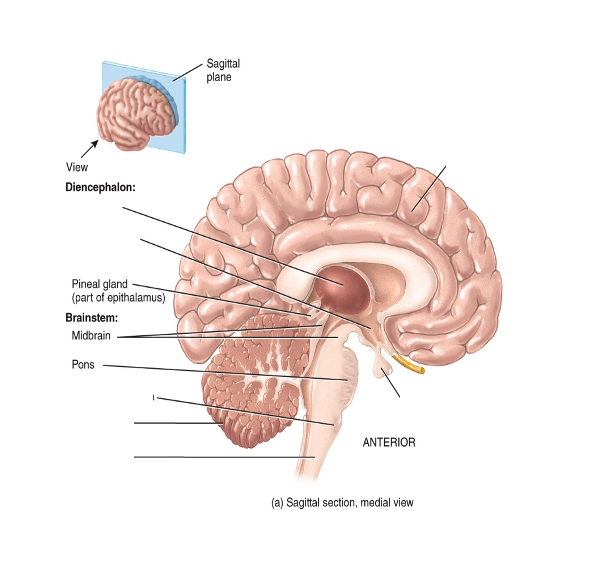
Label the diagram
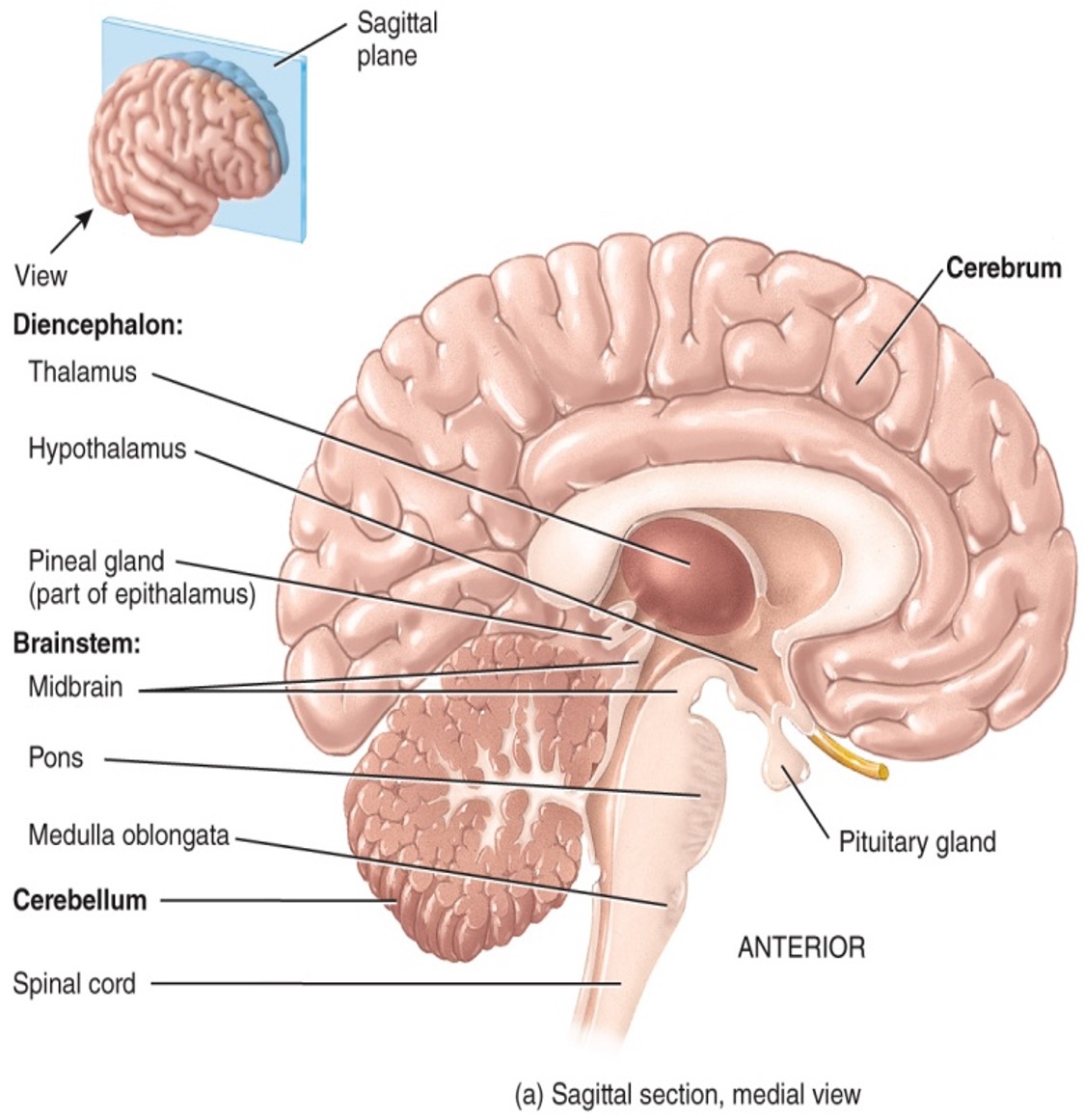
21
New cards
Describe the cerebrum
- Largest part of brain 83%
- Longitudinal fissure split into left and right cerebral hemispheres
- Each cerebral hemisphere divided into lobes
- Surface is grey matter, deeper is white matter
- Surface is convoluted to increase surface area
- Conscious brain
- Gyri and sulci - big sulci distinguishes between different lobes
- Longitudinal fissure split into left and right cerebral hemispheres
- Each cerebral hemisphere divided into lobes
- Surface is grey matter, deeper is white matter
- Surface is convoluted to increase surface area
- Conscious brain
- Gyri and sulci - big sulci distinguishes between different lobes
22
New cards
Name the four lobes of the cerebrum
1. Frontal
2. Parietal
3. Occipital
4. Temporal
2. Parietal
3. Occipital
4. Temporal
23
New cards
Describe the frontal lobe
- Largest lobe
- Found at the front of the brain
- Separated from the parietal lobe by central sulcus
- Separated from the temporal lobe by the lateral sulcus
- Includes the primary motor cortex, premotor cortex, primary olfactory cortex and Broca's area
- Found at the front of the brain
- Separated from the parietal lobe by central sulcus
- Separated from the temporal lobe by the lateral sulcus
- Includes the primary motor cortex, premotor cortex, primary olfactory cortex and Broca's area
24
New cards
What is the function of the frontal lobe?
The 'mind' with higher order functioning and memory and control of voluntary movements
25
New cards
Describe the parietal lobe
- Separated from the occipital lobe by the parietal-occipital lobe
- Main somatic sensory area
- Taste sensation
- Includes Wernicke's area
- Main somatic sensory area
- Taste sensation
- Includes Wernicke's area
26
New cards
What is the function of the parietal lobe?
Integrated sensations necessary to cary out complex maths, reading, writing and visual skills
27
New cards
What is the hypothalamus responsible for?
- Controls the sleep-wake cycle
- Maintains body temperature at 37C
- Monitors satiation, hunger and thirst
- Regulated the autonomic nervous system
- Influences emotions and sexual activity
- Controls hormonal output of pituitary gland
- Maintains body temperature at 37C
- Monitors satiation, hunger and thirst
- Regulated the autonomic nervous system
- Influences emotions and sexual activity
- Controls hormonal output of pituitary gland
28
New cards
What does the pineal gland do?
Regulates body clock through release of melatonin
29
New cards
Why are the basal ganglia important?
- Coordinate muscle movement and posture
- Suppress unwanted movements
- Control muscle tone
- Suppress unwanted movements
- Control muscle tone
30
New cards
Describe the limbic system
- Positioned deep in the brain
- Series of nuclei that affect emotion, memory and the learning process
- Includes cerebrum, brainstem and diencephalon
- Series of nuclei that affect emotion, memory and the learning process
- Includes cerebrum, brainstem and diencephalon