Basic Biomechanics: Forces, Levers, and Newton's Laws
 Call Kai
 Learn
Learn Practice Test
 Spaced Repetition
 Match
Match Flashcards
 Knowt Play
1/34

There's no tags or description
Looks like no tags are added yet.
Name | Mastery | Learn | Test | Matching | Spaced | Call with Kai | Chat |
|---|
No analytics yet
Send a link to your students to track their progress
35 Terms
muskuloskeletal
The major system producing human movement.
Biomechanics
Principles and methods of mechanics and apply them to the structure and function of the human body creating movement and stability.
Mechanics
Branch of physics associated with forces and the effect.
Scalar
Quantity describes magnitude only; does not have a direction, e.g., speed, length, area, volume, mass.
Mass
Amount of matter in an object.
Vector
Magnitude and direction, e.g., force, velocity, and acceleration.
Force
Amount and Direction of push or pull action; creates compression and traction.
Internal or External forces
Forces that can either act within an object or from outside it.
Concurrent
Two or more forces pushing or pulling in different directions.
Resultant force
Sum of magnitude and direction of each individual force vector
Torque
Ability of force to produce rotation about an axis
Amount of torque
Amount of force exerted and the distance it is from the axis
Moment arm
Perpendicular distance between the muscle line of pull and the center of the joint
Force arm
Linear distance from the application of force to the axis of rotation
Angle of application
Angle at which force is applied
Rotary
Perpendicular to an object
Torque is greatest
When the angle of pull is at 90 degrees and decreases if the angle decreases or increases
Angular Force
When the perpendicular distance between the joint axis and line of pull is larger
Stabilizing force
When the perpendicular distance between the joint axis and line of pull is very small
Newton's First Law
An object at rest tends to stay at rest and an object in motion tends to stay in motion
Newton's Second Law
The amount of acceleration depends on the strength of the force applied to an object

Acceleration
Any change in velocity of an object
Newton's Third Law
For every action, there is an equal and opposite reaction
State of equilibrium
Sum of all forces acting on an object = 0
Static equilibrium
Remain fixed or steady in one position
Dynamic equilibrium
Remain steady while changing positions
Simple Machines
Allow a person to exert a force greater than could be exerted by using muscle power alone
Lever System
Force arm (FA): Distance between the force and the axis
Class I Lever
The axis is located between the force and resistance

Class II Lever
Resistance between the force point and fulcrum
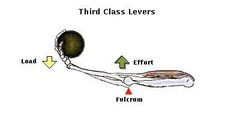
Class III Lever
Force is between resistance point & axis
Pulley
Consists of a grooved wheel that turns on an axle with a rope or cable riding in the groove

Fixed pulley
Simple pulley attached to a beam, used only to change direction
Movable pulley
One end of the rope attached to a beam, providing a mechanical advantage of 2.
Inclined plane
Flat surface that slants, exchanges increased distance for less effort.