Geochem exam 2
 Call Kai
 Learn
Learn Practice Test
 Spaced Repetition
 Match
Match Flashcards
 Knowt Play
1/36

There's no tags or description
Looks like no tags are added yet.
Name | Mastery | Learn | Test | Matching | Spaced | Call with Kai | Chat |
|---|
No analytics yet
Send a link to your students to track their progress
37 Terms
What elements and key mineral is involved in the long-term, geologic cycling of oxygen?
The primary elements involved are carbon, sulfur, iron, and silicon. The most critical mineral family in this cycle is silicates.
What do the Urey Equations represent?
The Urey Equations represent the chemical process of silicate weathering and its role in controlling Earth’s climate over millions of years
Which Earth process is associated with each of the following reactions?
o CO2 + H2O → CH2O + O2
o CH2O + O2 → CO2 + H2O
o SiO2 + CaCO3 + H2O → CaSiO3 + CO2 + H2O
o CO2 + H2O + CaSiO3 → SiO2 + CaCO3 + H2O
o 3O2 + uv → 2O3
o 2H2O + uv → 4H+ + O2
CO2 + H2O → CH2O + O2 = Photosynthesis, CH2O + O2 → CO2 + H2O = Respiration, SiO2 + CaCO3 + H2O → CaSiO3 + CO2 + H2O =Metamorphic Outgassing (volicanism), CO2 + H2O + CaSiO3 → SiO2 + CaCO3 + H2O = Chemical weathering, 3O2 + uv → 2O3 = Ozone formation, 2H2O + uv → 4H+ + O2 = dissolution
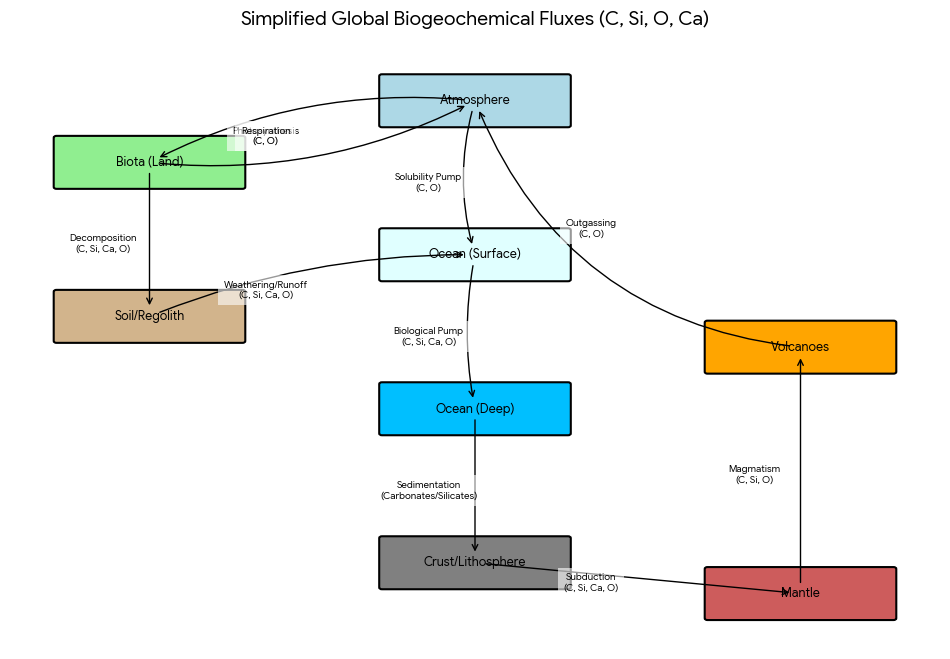
Draw a flow chart that represents the pools and fluxes of C, Si, O, and Ca through the Earth system
Why is water important in subduction zones?
In subduction zones, water acts as a chemical catalyst that lowers the melting point of the mantle.
What is the relationship between Bowen’s Reaction series and weathering?
The relationship is an inverse one: the order in which minerals crystallize from magma (Bowen’s) is the opposite of how they resist weathering.
What are the three main products of continental weathering of granite?
Quartz Sand, Clay Minerals, and Dissolved Ions
Draw a diagram that shows the history of atmospheric CO2 during the Phanerozoic.
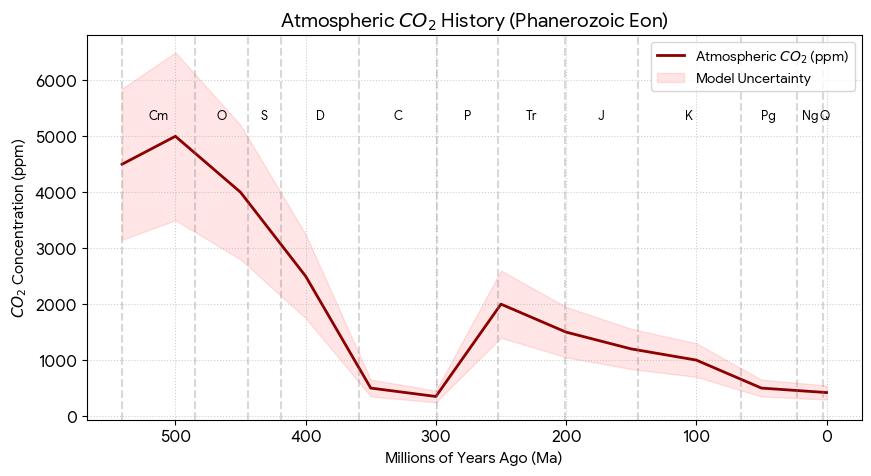
Label three major tectonic events that contributed to the Phanerozoic history of CO2.
The Breakup of Pangea, The Himalayan uplift, and The Caledonian and Hercynian (Variscan) uplifts
What makes the Permian period and the Pleistocene epoch of the Quaternary period similar?
The Permian period and the Pleistocene epoch are similar because they both represent "Icehouse" worlds characterized by massive continental glaciations and low atmospheric carbon dioxide levels
How does water temperature affect the solubility of CO2 in the ocean?
Water temperature and solubility have an inverse relationship: as water temperature rises, the solubility of decreases (Cold water holds more CO2)
How does the amount of dissolved CO2 in the ocean affect ocean acidity?
When CO2 dissolves in the ocean, it increases ocean acidity (lowering the pH) through a chemical reaction that creates carbonic acid
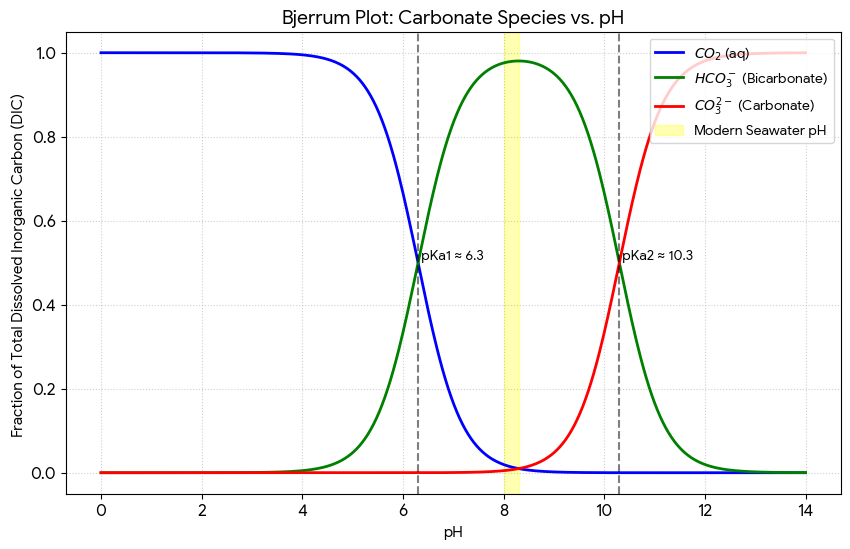
Draw a diagram relating the abundance of CO2, CO32-, and HCO3- in water to pH. Why does this matter for carbonate formation?
This "loss" of carbonate ions makes it harder for marine organisms (corals, mollusks, coccolithophores) to build their shells and skeletons, even if the total amount of carbon in the water is actually increasing.
What is the carbonate compensation depth?
The Carbonate Compensation Depth (CCD) is the specific depth in the ocean below which calcite (calcium carbonate) dissolves faster than it can accumulate
What processes contribute to ocean salinity, alkalinity, and conductivity?
Salinity (Total Dissolved Salts)= Continental Weathering, Alkalinity (Buffering Capacity)= Silicate and Carbonate Weathering, Anaerobic Decomposition, and Carbonate Dissolution, Conductivity (Electrical Flow) = Total Dissolved Solids and Temp
Aside from enhancing the greenhouse effect, how are human emissions of CO2 changing the oceans?
Beyond warming the water, human emissions are fundamentally changing ocean chemistry through Ocean Acidification
Describe a major feature of the Great Unconformity.
The most famous feature of the Great Unconformity is a massive "gap in time" in the rock record.
Why might the Great Unconformity be related to the Cambrian Explosion?
The Great Unconformity is basically a giant pile of "missing time" in our planet's history. When those hundreds of millions of years of rock were washed away, all the minerals from that rock ended up in the ocean. This made the seawater very rich in things like calcium. This "mineral soup" gave tiny sea creatures the perfect building blocks to grow hard shells and skeletons for the first time. Once they had armor and bones, they could grow bigger and evolve into many new species, leading to the massive burst of life we call the Cambrian Explosion.
What is different about fossils from the Cryogenian, Ediacaran, and Cambrian Periods?
The main difference is the complexity and hardness of the life forms
What are three types of evidence for Snowball Earth? Given a brief description of each that would help someone recognize that evidence in the field.
dropstones. These look like big, heavy rocks that were dropped into thin layers of mud, squishing the layers underneath them like a heavy footstep in soft dirt.
Diamictite, which looks like a "messy concrete." While most rocks found in layers are sorted by size, this one is a random jumble of giant boulders and tiny sand, all mixed. This happens when a giant glacier acts like a bulldozer, shoving everything together into one big pile.
Caps carbonates. These are bright, clean layers of limestone that sit right on top of those messy glacial rocks. They are easy to see because they look like a neat white cap on a dark, dirty base. They formed when the "Snowball" finally melted, and the ocean was suddenly filled with minerals
Describe the two zones of a glacier. How do they contribute to forming glacial moraines?
A glacier is divided into two main parts: the zone of accumulation and the zone of ablation. The zone of accumulation is the higher part of the glacier where it snows more than it melts. These zones form glacial moraines by acting like a giant conveyor belt. The heavy ice in the accumulation zone grinds up rocks and dirt as it moves.
What about the glacial evidence from the Cryogenian Period indicates that Earth was in a Snowball state (basically completely frozen)?
The most telling clue from the Cryogenian is that those glacial rocks, like dropstones and diamictites, are found at the equator.
What are two key (positive) feedbacks that intensified Snowball Earth events?
The two key feedbacks that made the "Snowball" freeze so intense were the ice-albedo feedback and the reduction in silicate weathering
What is a key (negative) feedback that helped Earth eventually escape from Snowball periods?
The key negative feedback is the volcanic CO2-weathering feedback.
What are two lines of evidence to indicate that changes in the carbon cycle were important during Snowball Earth episodes? What are the types of evidence and what do they indicate?
The two main lines of evidence are carbon isotope excursions and cap carbonates. For carbon isotope excursions, scientists measure the ratio of Carbon-13 to Carbon-12 in limestone layers from that time. During Snowball Earth, the amount of Carbon-13 drops significantly. This indicates a massive collapse of life. While for cap carbonates, as mentioned earlier, these are thick layers of limestone sitting directly on top of glacial debris. This indicates a massive surge in chemical weathering.
Define the characteristics of reduction.
Reduction is the process where an atom or molecule gains electrons
Define the characteristics of oxidation.
Oxidation is the process where an atom or molecule loses electrons
What are the four main pools (storage locations) of S in the Earth system?
The four main pools, or storage locations, of sulfur (S) in the Earth system are the lithosphere, hydrosphere, biosphere, and atmosphere
What is CaSO4? How does it typically form?
CaSO4 is calcium sulfate and is typically formed from evaporation
What is FeS2? How does it typically form?
FeS2 is Pyrite and is typically formed in no oxygen enivroments.
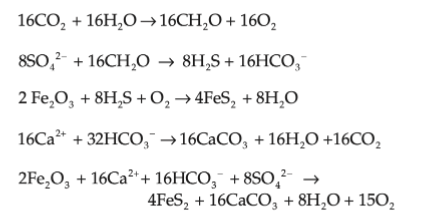
Label each of the following reactions and explain why it is important for contributing O2 to the atmosphere.
Photosynthesis = main source of oxygen, Sulfate Reduction - this is crucial because it breaks down the organic matter without using up the produced in the first step. Pyrite Formation: By locking sulfur into a solid mineral that gets buried, it prevents that sulfur from reacting with oxygen later, helping maintain levels. Carbonate Precipitation = the carbon that was originally pulled from the atmosphere, prevents it from turning back into carbon dioxide, and ensures the oxygen cycle remains balanced. Net Burial Reaction = This summarizes the entire geologic process.
What is the difference between sulfate and sulfide? Which is reduced? Which is oxidized?
The primary difference between sulfate and sulfide is the amount of oxygen they contain and their chemical charge. Sulfate — The Oxidized Form. Sulfide is the reduced form.
What is the difference between ferrous and ferric iron? Which is reduced? Which is oxidized?
The difference between ferrous and ferric iron comes down to their electrical charge and how much oxygen they have reacted with. Ferrous Iron (Fe2+) — The Reduced Form. Ferric Iron (Fe3+) — The Oxidized Form
What the three major mineral classes that contain oxidized Fe(III)?
Oxides, Hydroxides, and Silicates
Label each of the following minerals as ferrous or ferric: pyrite, magnetite, hematite, and goethite.
Pyrite: Ferrous, Magnetite: Both Ferrous and Ferric, Hematite: Ferric, Goethite: Ferric
Five major elements play important roles in “redox towers” in marine sediments. What are they and in what depth order would you expect to find them?
Oxygen (O): Found at the very surface (Oxic zone). Microbes use dissolved O2 first because it provides the most energy. Nitrogen (N): Found just below the oxygen layer (Suboxic zone). Once oxygen is gone, bacteria use nitrates in a process called denitrification. Manganese (Mn): Located slightly deeper. Microbes reduce manganese oxides. Iron (Fe): Found deeper still. Microbes reduce ferric iron (solid oxides) into ferrous iron. Sulfur (S): Found in the deep, oxygen-free mud (Anoxic zone). This is where sulfate-reducing bacteria turn sulfate into hydrogen sulfide, often creating the "rotten egg" smell.
Describe what changes with depth in a redox tower other than the elements involved.
Oxidation State (The environment shifts from Oxidizing (at the surface) to reducing (at depth), Color, Smell, and Energy Yield: The most important change is a steady drop in energy.