CFB 3: Biochemistry Proteins and Enzymes
 Call Kai
 Learn
Learn Practice Test
 Spaced Repetition
 Match
Match Flashcards
 Knowt Play
1/92

There's no tags or description
Looks like no tags are added yet.
Name | Mastery | Learn | Test | Matching | Spaced | Call with Kai | Chat |
|---|
No analytics yet
Send a link to your students to track their progress
93 Terms
The pH in the mouth is slightly _____.
Basic
Mixtures of weak acids and their conjugate bases
Buffers
A simple expression that relates pH, pKa, and buffer concentration
Henderson-Hasselbalch equation
Weak acids and bases have characteristic equilibrium constants (K__) also called acid dissociation constants (K_)
Keq
Ka
pH = pKa + log (conjugate base / weak acid)
Henderson-Hasselbalch equation
At the midpoint of the titration, at which exactly 0.5 equivalent of NaOH has been added, [HA] = ?
[HA] = [A-]
pH = pKa
Proteins are composed of a linear sequence of...
Amino acid residues
There are __ amino acid residues found in proteins
20
Proteins are polymers of what?
Amino acids
Glycine
Nonpolar, aliphatic

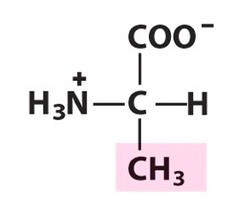
Alanine
Nonpolar, aliphatic
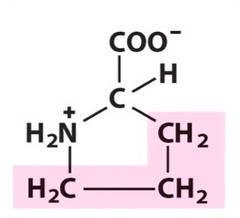
Proline
Nonpolar, aliphatic
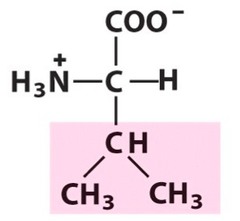
Valine
Nonpolar, aliphatic
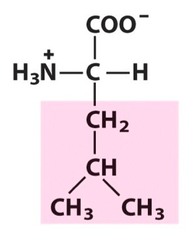
Leucine
Nonpolar, aliphatic
Isoleucine
Nonpolar, aliphatic
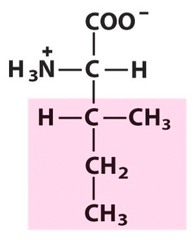
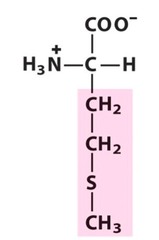
Methionine
Nonpolar, aliphatic
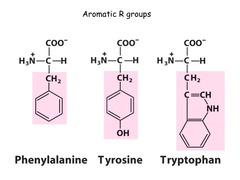
Phenylalanine
Aromatic

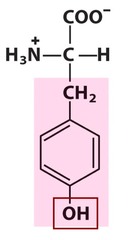
Tyrosine
Aromatic
Tryptophan
Aromatic
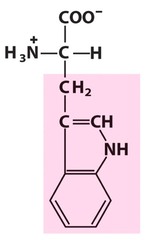
What are the aromatic R groups that absorb UV light?
Phenylalanine
Tyrosine
Tryptophan
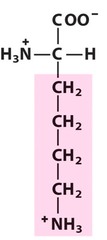
Lysine
Positively charged
Arginine
Positively charged

Histidine
Positively charged

Serine
Polar, uncharged
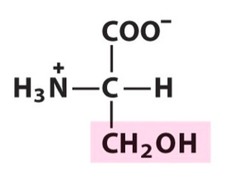
Threonine
Polar, uncharged

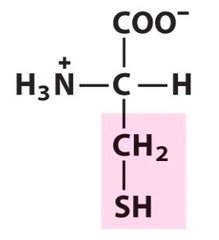
Cysteine
Polar, uncharged
Asparagine
Polar, uncharged

Aspartate
Negatively charged
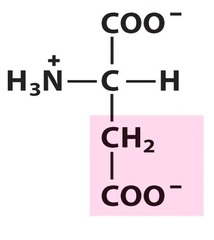
Glutamate
Negatively charged

Proteins are composed of amino acids linked together in a chain via _______ _____.
Peptide bonds
Primary structure
Sequence of amino acids
What must a polypeptide do to be functional?
Fold into the correct structure
How can proteins be unraveled?
Heat or mutation
The hydrogen acceptor is usually:
The hydrogen donor is:
Acceptor: oxygen or nitrogen
Donor: another electronegative atom
Secondary structure
Alpha helix
Beta pleated sheet
What AA is the helix breaker?
Proline
Tertiary structure
The fold
What is the oxygen binder of muscle?
Myoglobin
Quaternary structure
>1 polypeptide
Globular protein can non-covalently associate to form multimeric structures:
Dimers, trimers, tetramers, and greater
What is the classic example of quaternary structure?
Hemoglobin
2 alpha chains, 2 beta chains
What has the smallest AA side chain that allows proteins to form sharp bends and for polypeptide chains to come in close contact to one another?
Glycine
Water-soluble proteins are ____ inside.
Oily
Which AA can oxidize to form a covalently linked dimeric amino acid?
Cysteine
Cysteine and disulfide bonds gives extra _________ for "outside" proteins.
Stability
The cytoplasm of cells is ________.
The outside of cells, including ER lumen and blood plasma, is _________.
Cytoplasm: reducing
Outside: oxidizing
Proteins are sensitive to what?
Temperature and pH
Compounds have intrinsic energy called what?
"Free" energy (G)
A drop in free energy (ΔG) indicates a more ______ situation.
More stable
Spontaneous reactions have a _________ ΔG.
Negative
Reactions that flow in the opposite direction have a ________ ΔG.
Positive
ΔG is sensitive to what?
Concentration of reactants and products
T/F: Enzymes alter equilibrium constant.
False
Enzymes typically show maximal activity at a characteristic pH, the pH ______.
pH optima
Amount of product formed per unit time
Velocity
Initial velocity is where on the curve?
Linear part
What do Km values reflect?
Affinity of th eenzyme for the substrate
Double-reciprocal plot
Plot of 1/V vs 1/[S]
Lineweaver-Burke plot
![<p>Plot of 1/V vs 1/[S]</p><p>Lineweaver-Burke plot</p>](https://assets.knowt.com/user-attachments/f14d3bea-4137-4539-9c53-4d915786e8d0.png)
The action of fast-acting enzyme inhibitors depends on what?
How the interact with the enzyme
Competitive inhibitors affect only the what?
Binding site only
Noncompetitive inhibitors affect only the what?
Catalytic machinery
Competitive inhibitors resemble the __________.
Substrate
Example of competitive inhibition
Ethylene glycol for ethanol
What happens to Vmax and Km in the presence of a competitive inhibitor?
Vmax: same
Km: increases
Do non-competitive inhibitors compete with substrate binding?
No
T/F: Inhibitors showing non-competitive kinetics can be reversible or irreversible.
True
What happens to Vmax and Km in the presence of a non-competitive inhibitor?
Vmax: decreases
Km: same
Mechanism of serine proteases
Chymotrypsin, a digestive enzyme, catalyses peptide bond hydrolysis
Enzymes contain an active site, which is usually a crevice on the surface of the enzyme
Do allosteric enzymes contain multiple subunits?
Usually yes
Do allosteric enzymes usually follow Michaelis-Menten kinetics?
No
Allosteric enzymes usually have binding sites for what?
Effector molecules (bind somewhere else that speed things up, or slows them down)
Why are enzymes remarkable catalysts?
Activation energy lowering by transition state stabilization
What is Km and Vmax?
Km: measures substrate affinity
Vmax: speed of enzyme preparation
What is meant by allosteric enzymes?
Activity controlled by effectors
How does a serine protease cleave a substrate?
Specific binding, reactive serine, hydrolysis by water
Consider lidocaine, which is used as a local anesthetic to numb the oral cavity during certain dental procedures. It has a pKa of 7.8. What is the net charge on the molecule at pKa 7.8?
+0.5 (half charged base, half uncharged)
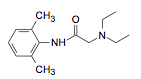
Consider lidocaine, which is used as a local anesthetic to numb the oral cavity during certain dental procedures. It has a pKa of 7.8. What is the ratio of the uncharged form to the charged form at pH 5.8?
0.01
The acid form has a charge of +1, the base form is neutral. You have 100x more acid form than base form, or 0.01 more base form than acid form
What is the least important buffering component of saliva?
Amino acids
Very little "free" AA in the oral cavity; they are polymerized in the form of proteins
Given that the [H+] concentration of an aqueous solution is 10^-4 M, which pH is correct?
4
The pKa of the bicarbonate buffer system (conjugate acid is H2CO3 and base is HCO3-) is 6.1. The pH of a sample of saliva was found to be 7.1. What is the ratio of HCO3- to H2CO3?
10:1
More base than acid because above the pKa
Phosphoric acid has three pKas (pK1: 2.1, pK2: 7.1, pK3: 12.3). The buffering capacity is least at pH:
4
Which ever is furthest from a pKa
Myoglobin is a monomeric protein present in muscle that binds oxygen. It has all of the following elements of protein structure except which?
Quaternary
Which of the following AAs has a side chain that can participate in hydrogen bonding in proteins?
Asparagine (contains electronegative atoms)
Presence of which AA would break an alpha helix?
Proline
Which polypeptide chain has AA side chains that are capable of hydrophobic interactions?
Leucine-valine-phenylalanine
Which polypeptide chain has AA side chains that are capable of forming hydrogen bonds?
Aspartate-lysine-serine
An individual has a mutation in the binding site of an enzyme such that the substrate binds weakly. What is the most likely change in the enzyme parameters?
Km increases
An individual has a mutation in the non-coding part of DNA such that the enzyme is produced with any change in the primary structure, but only 10% is present. What is the most likely change in the enzyme parameters?
Vmax decreases (because there's less enzyme)
The kinetics of most reactions catalyzed by enzymes can be described in terms of Km and Vmax. Which describes Km?
Concentration of substrate required to give half-maximal velocity
The addition of a noncompetitive inhibitor to an enzyme-catalyzed reaction leads to
Decrease in observed Vmax
The addition of a competitive inhibitor to an enzyme-catalyzed reaction leads to
Increased Km but no change in Vmax
Km is generally considered to be a measure of the
Affinity of enzyme for substrate
The effect of a competitive inhibitor on a Lineweaver-Burke (double-reciprocal) of an enzyme would be to
Decrease the magnitude of the X-intercept
(1/Km gets smaller because Km gets larger)
(The Y intercept is unchanged and the slope gets steeper)