309 Cognitive Processes Final
 Call Kai
 Learn
Learn Practice Test
 Spaced Repetition
 Match
Match Flashcards
 Knowt Play
1/69

There's no tags or description
Looks like no tags are added yet.
Name | Mastery | Learn | Test | Matching | Spaced | Call with Kai | Chat |
|---|
No analytics yet
Send a link to your students to track their progress
70 Terms
LO: Begin understanding the signals we read in others’ faces that inform our thinking and reasoning about their thoughts and emotions. L16
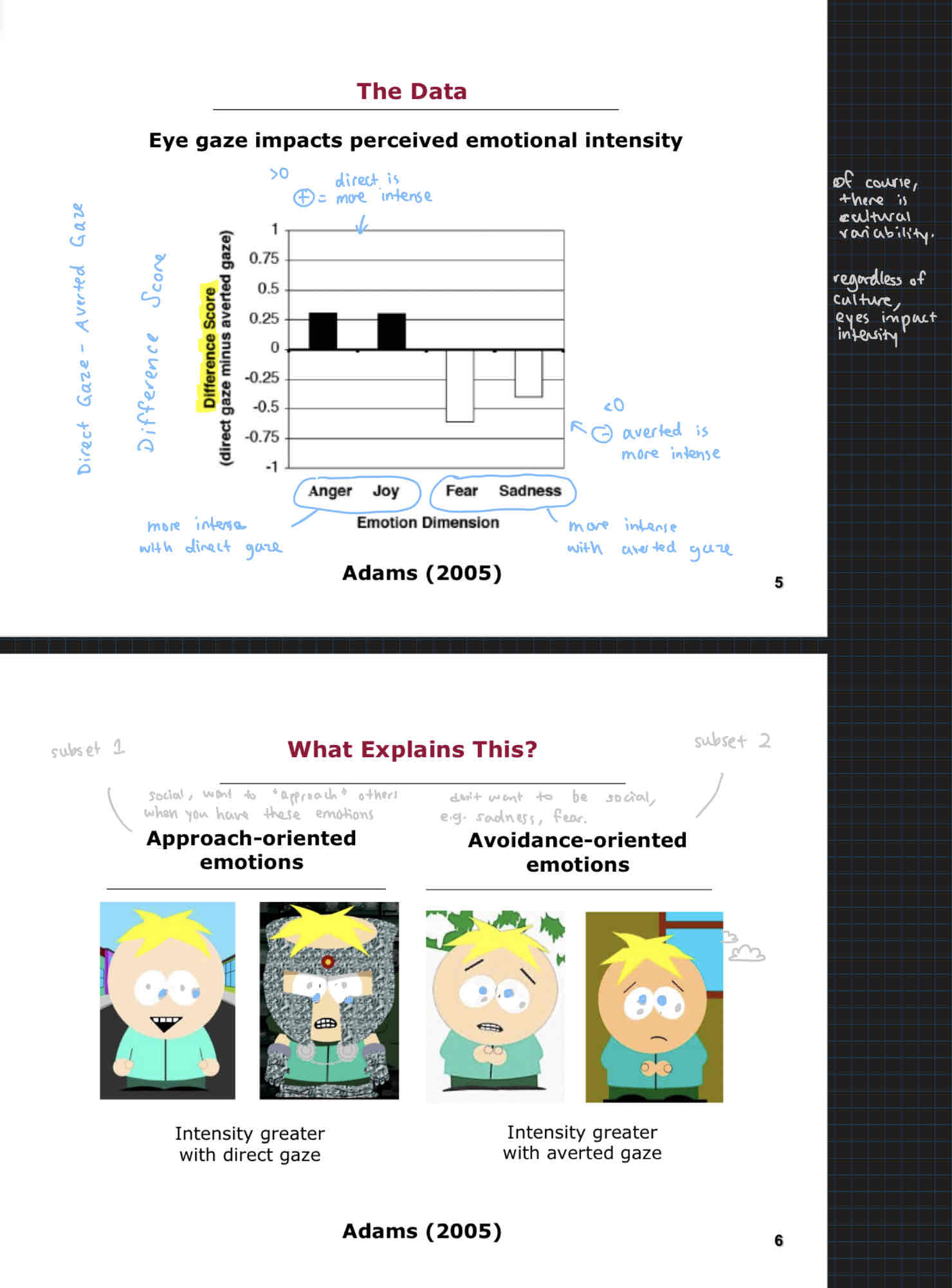
In an experiment by Adams (2005), participants rated pictures of faces based on the percieved emotional intensity. For each face, they manipulated the eye gaze - where the eye was looking.
What did they find in the data?
What explains this?
L16 S4-6
The data:
Anger and joy were rated as more intense with direct gaze.
Fear and sadness were rated as more intense with averted gaze.
Explained by:
Anger and joy are approach-oriented emotions; in social settings you ant to “approach” others when you have these emotions. Intensity is greater with direct gaze.
Fear and sadness are avoidance-oriented emotions; you don’t want to be social when you have these emotions. Intensity is greater with averted gaze.
What is the shared signal hypothesis? L16 S7
“Gaze behaviour and emotion have both been linked to approach and avoidance motivational orientations. Direct gaze, anger and joy, share an approach orientation, whereas averted gaze, fear, and sadness, hare and avoidance orientation.
Thus, it is predicted that when gaze direction matches the underlying behavioural intent communication by a specific emotion expression, it will enhance the perception of that emotion (referred to here as the shared signal hypothesis.”
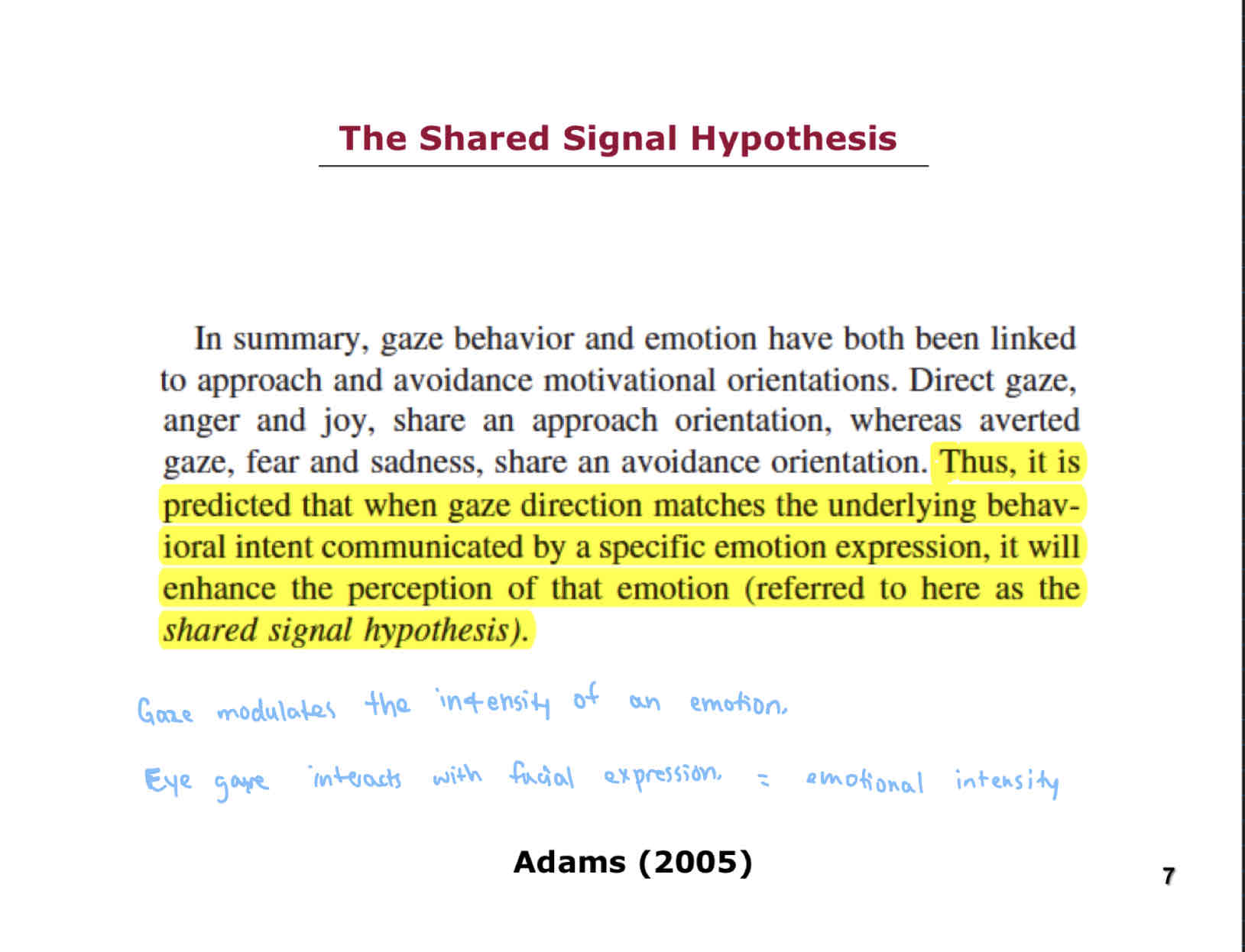
In a study by Adams (2005), they asked participants to label the emotions of a direct-gaze face that had two expressions digitally blended together: anger+fear. They manipulated the direction of the eye gaze. What did they find?
Why did they find this?
L16 S8-10
They found that people were equally likely to say the face showed anger or fear.
They think they found this because the fear intensity rating is the same as the anger intensity rating when the expressions were seperate. That is why the rating was the same.
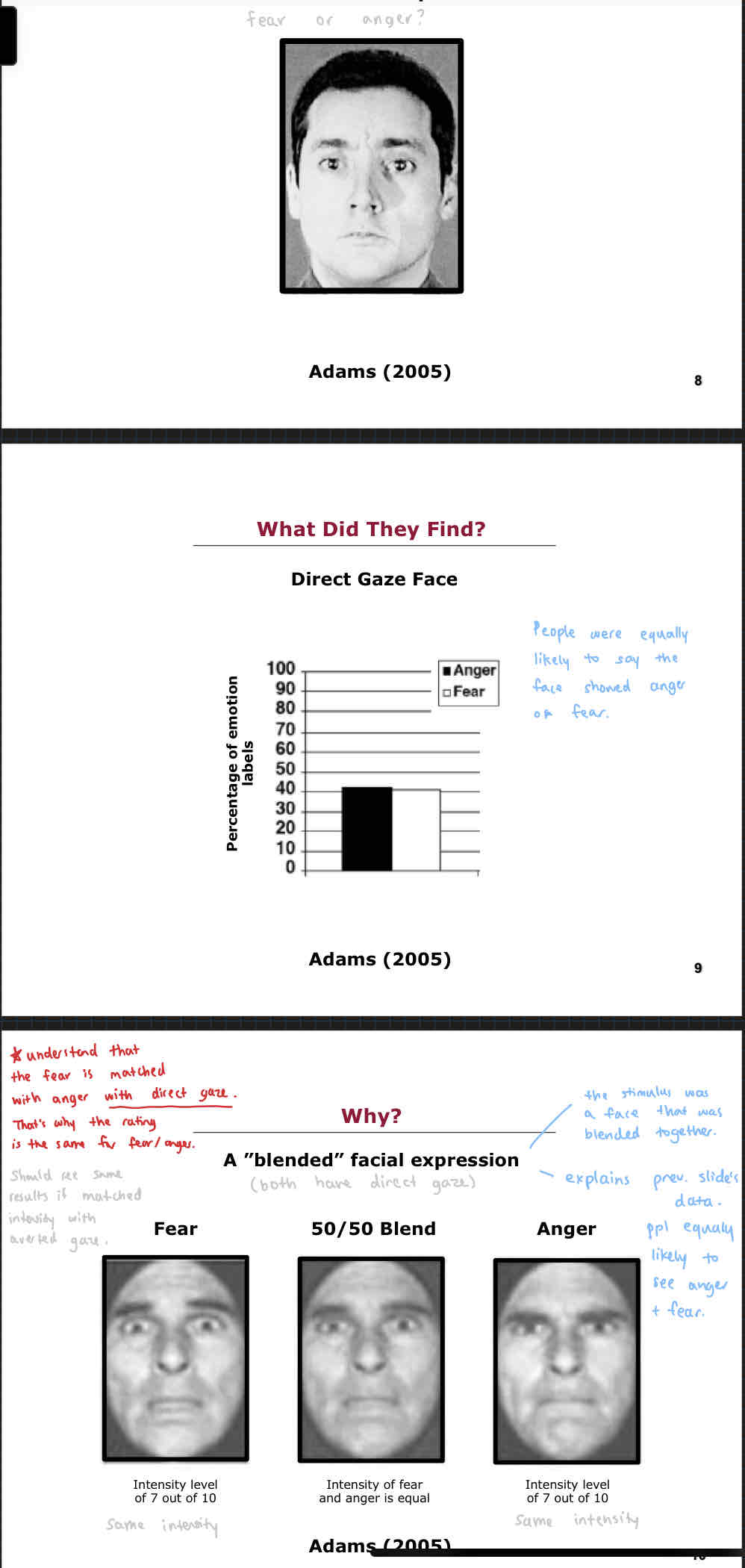
Continuing the previous study: Adams (20025) manipulated the direction of the eye gaze for the same anger-fear face. This time the eye gaze was averted. What did they find? L16 S11-12
In the next study with the averted eye gaze image, people were much more likely to rate the face as fearful.
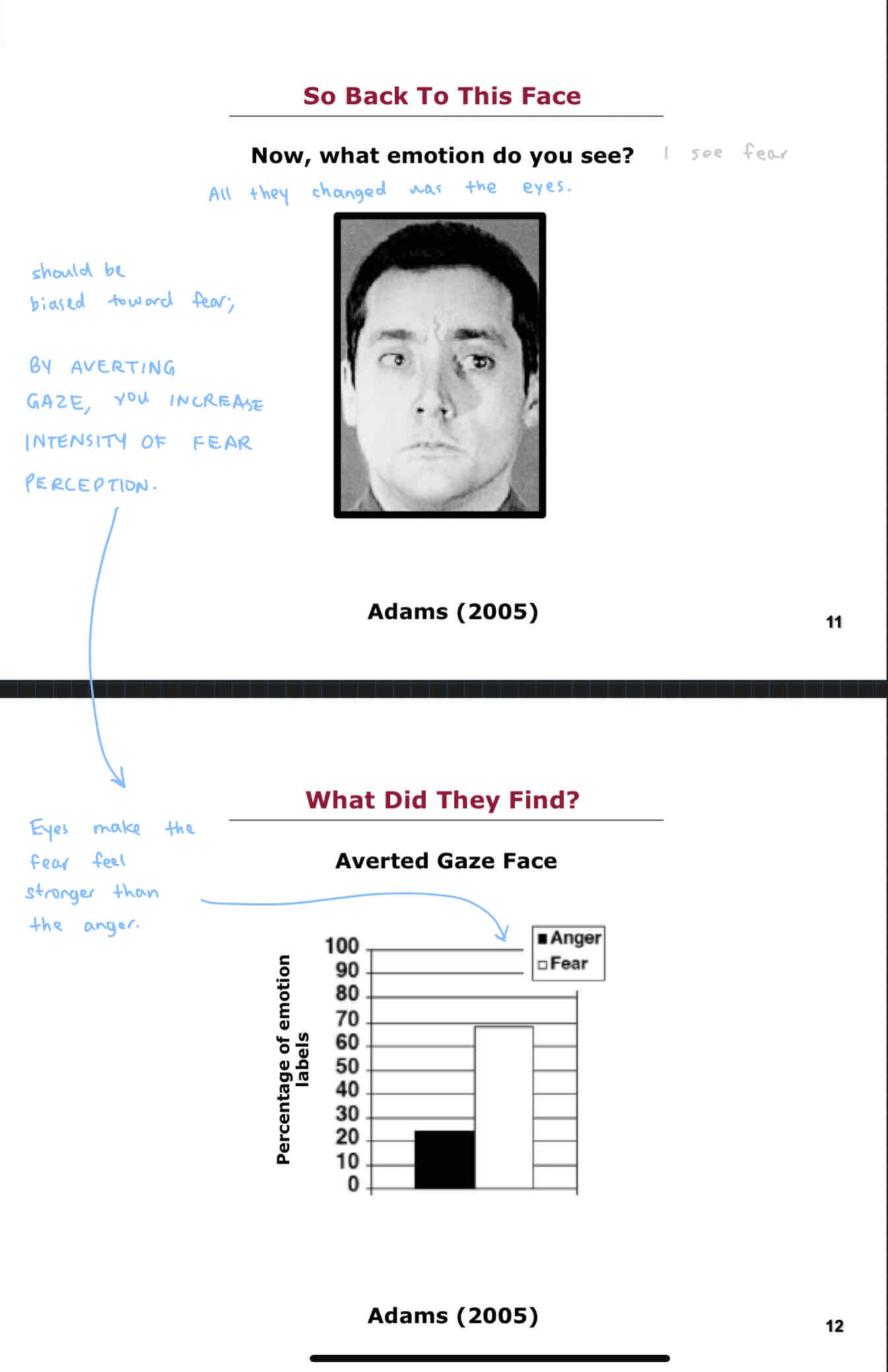
Why does eye gaze modulate the intensity of perceived fear and anger? L16 S13-14
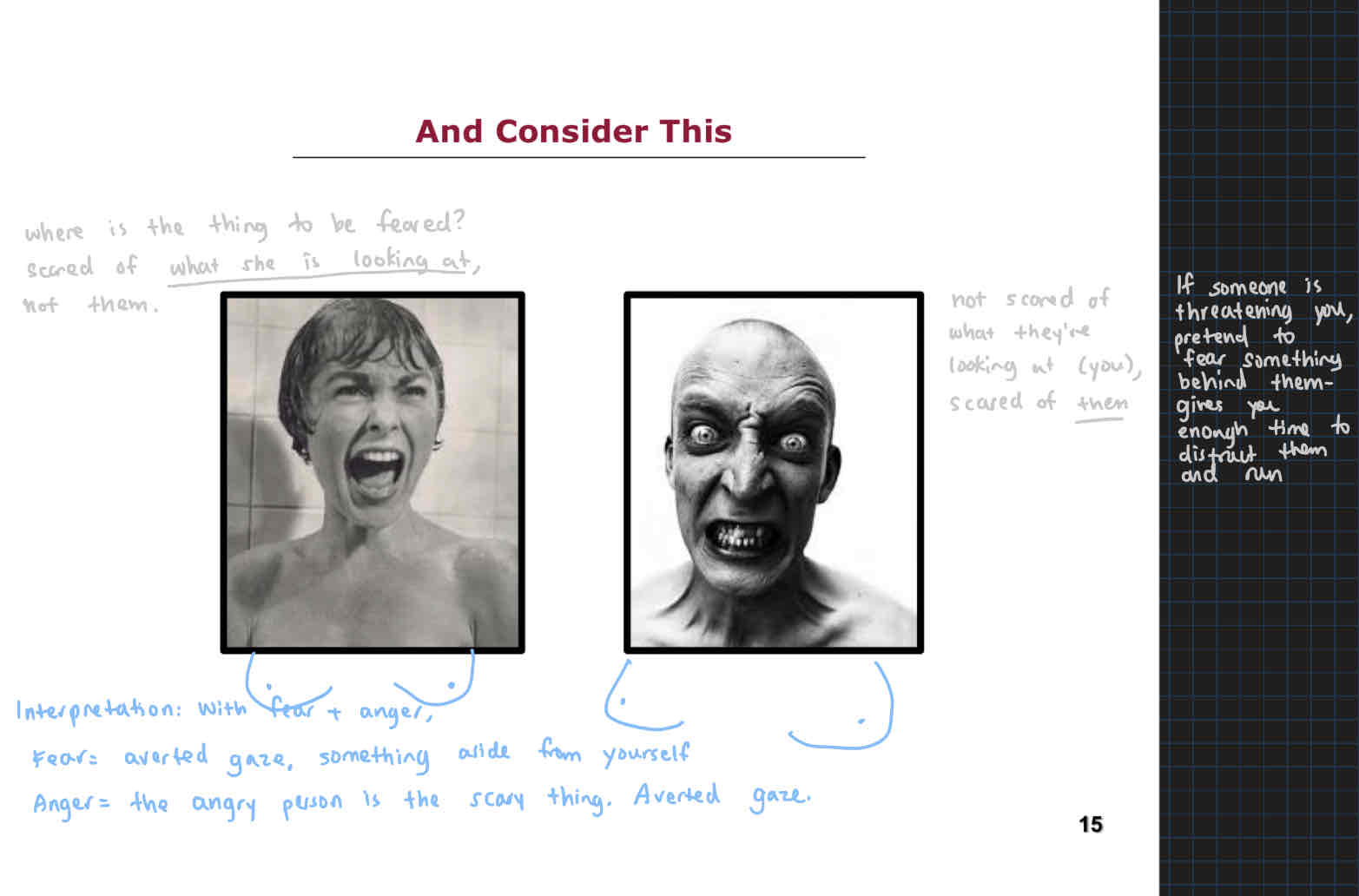
Eye gaze tells us what is the thing to be feared (remember kung fu panda clip)
Looking away from you: The thing to be feared is something else.
Looking at you: The thing to be feared is me!
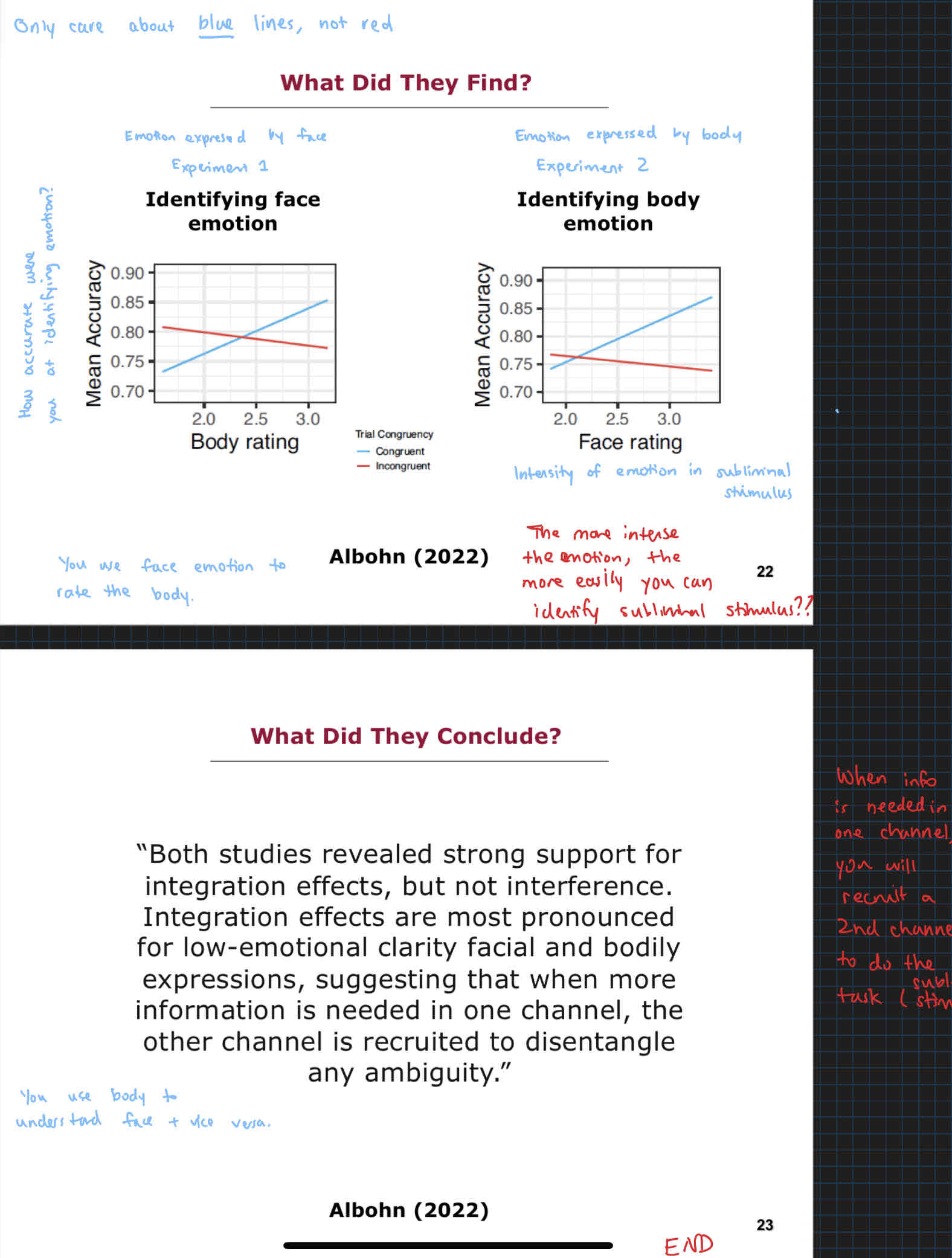
In a study by Albohn (2022), the researchers had two questions:
Do faces facilitate the recognition of bodily emotion?
Do bodies faciliate the recognition of facial emotion?
They studied with the following methods:
Experiment 1: Asked perticipants to identify a face as fearful or angry with subliminal image of a body pose.
Experiment 2: Identify a body as fearful or angry with subliminal image of a face.
They varied the intensity of the emotion in the emotional stimulus, and whether the two the stimuli had the same or different emotion.
What did the researchers find?
I think: THe more intense the emotion in the subliminal stimulus, the more accurate people were with their emotion identification for both face and body stimuli.
They concluded:
“Both studies reveled strong support for integration effects, but not interference. Integration effects are most pronounced for low-emotional calrity facial and bodily expressions, suggesting that when more information is needed in one channel, the other channel is recruited to disentangle any ambiguity.”
AKA you use the body subliminal stimuli to understand the face and vice versa. WHen info is needed in one channel, you will recuit a second channgel to help with the task.
Be able to answer:
How does eye gaze impact our perceive intensity of approach-oriented facial emotions?
How does eye gaze impact our perceived intensity of avoidance-oriented emotions?
What is the Shared Signal Hypothesis, and what three “signals” or “channels” have we considered in lecture?
How does eye gaze in anger and fear expression relate to threats?
When do we tend to “integrate” channels of emotional information?
LO: TO understand social mimcry, its neural basis, and the different ways in which it impacts pro-social behaviour. L17
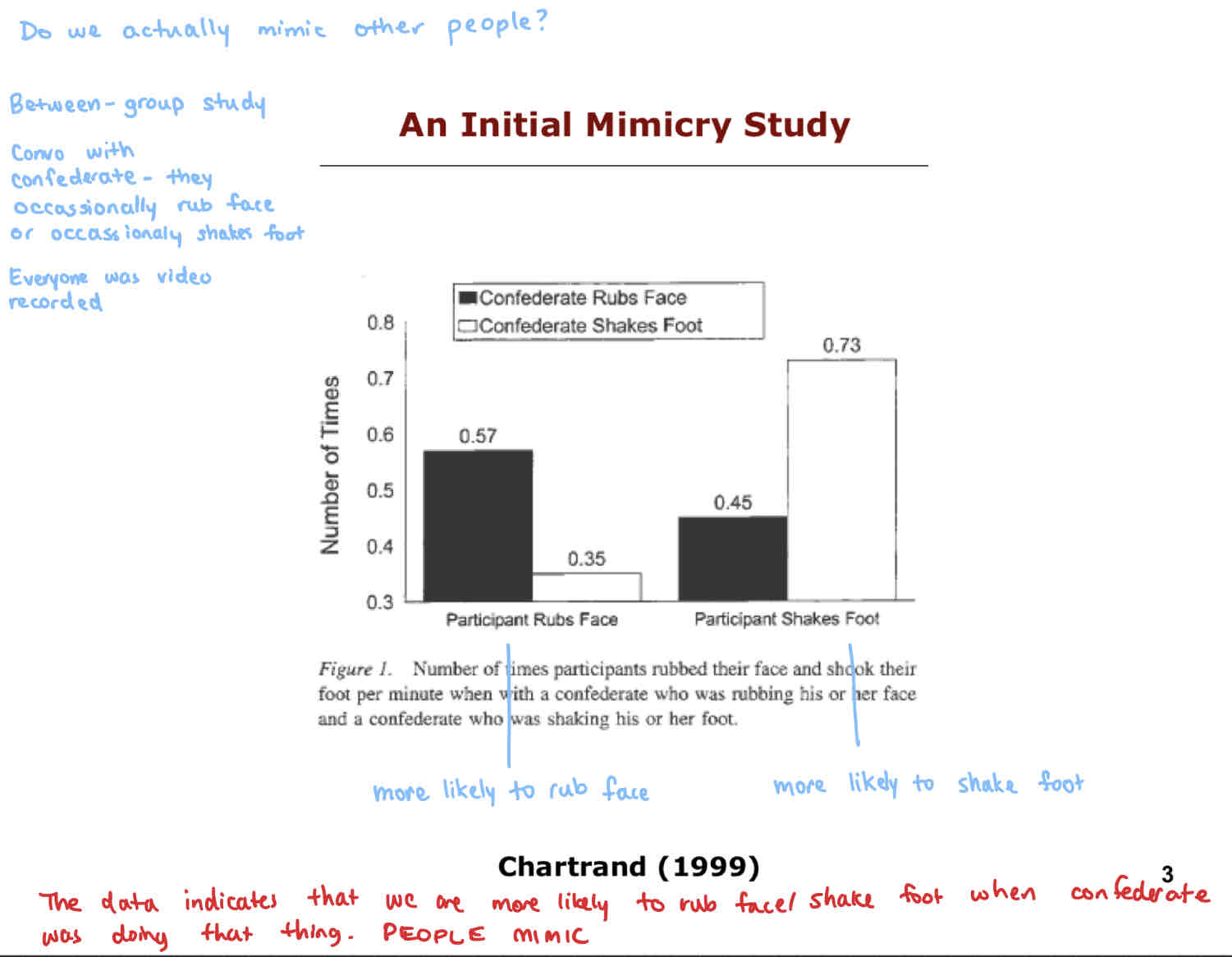
In a study by Chartrand (1999), participants had a conversation with a confederate who either occasionally rubbed their face or shook their foot.
What did they find?
L17 S3
Participants were more likely to rub their face when the confederate rubbed their face, and more likely to shake their foot when the confederate shook their foot.
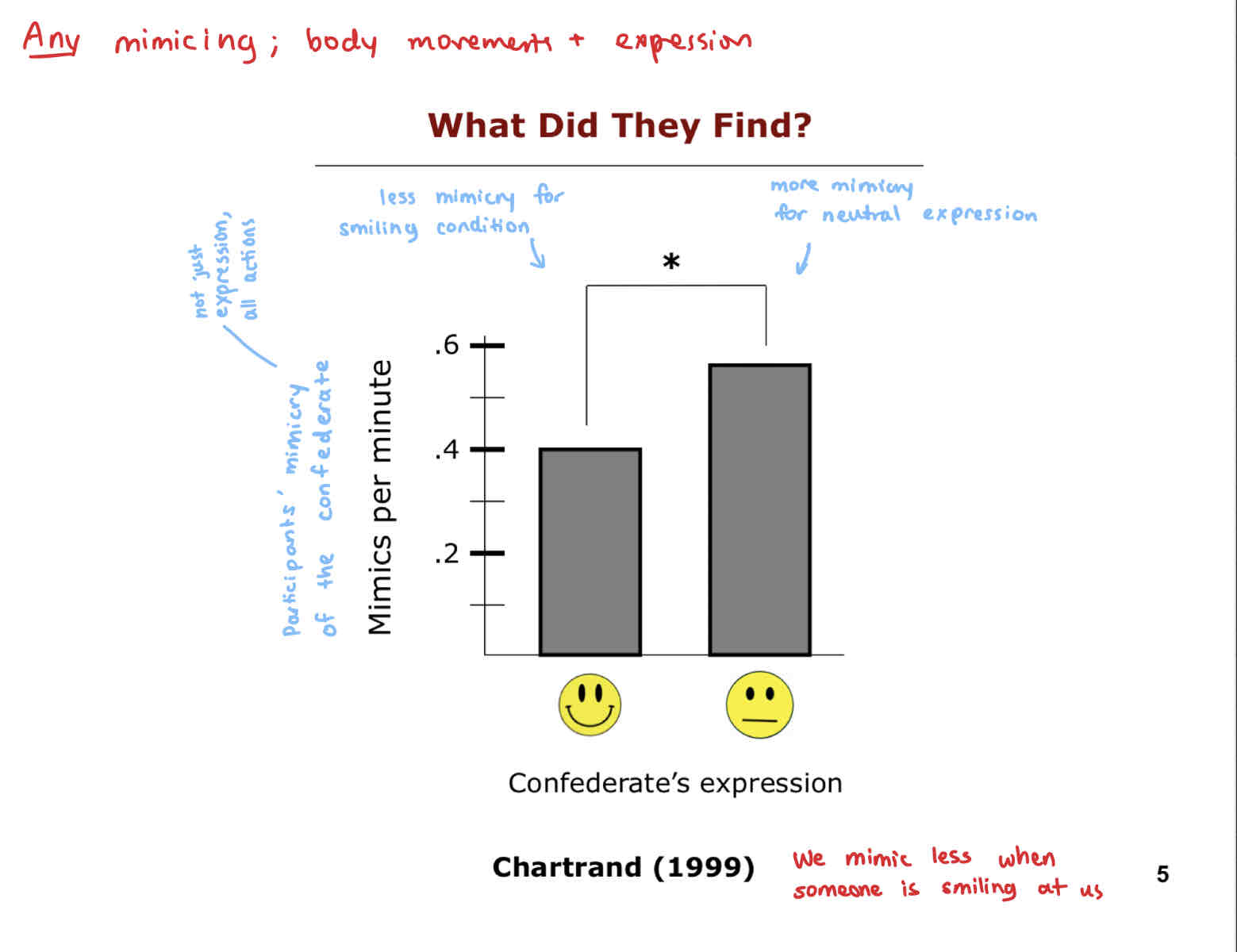
IN another study by Chartrand (1999), a confederate frequently smiled during an interaction or maintained a neutral expression during an interaction. What did they find? L17 S4
We mimic LESS when someone is smiling at us. Interesting!
Why do we see the data pattern in Chartrand’s study: WE mimic less when people are smiling, and we mimic more when people aren’t smiling? What does this tell us about the role of mimicry in social interactions? L17 S6
According to class: (Recall clip of Andy from the office) We could be mimicing more when someone is neutral because we are trying to see if the other person likes us.
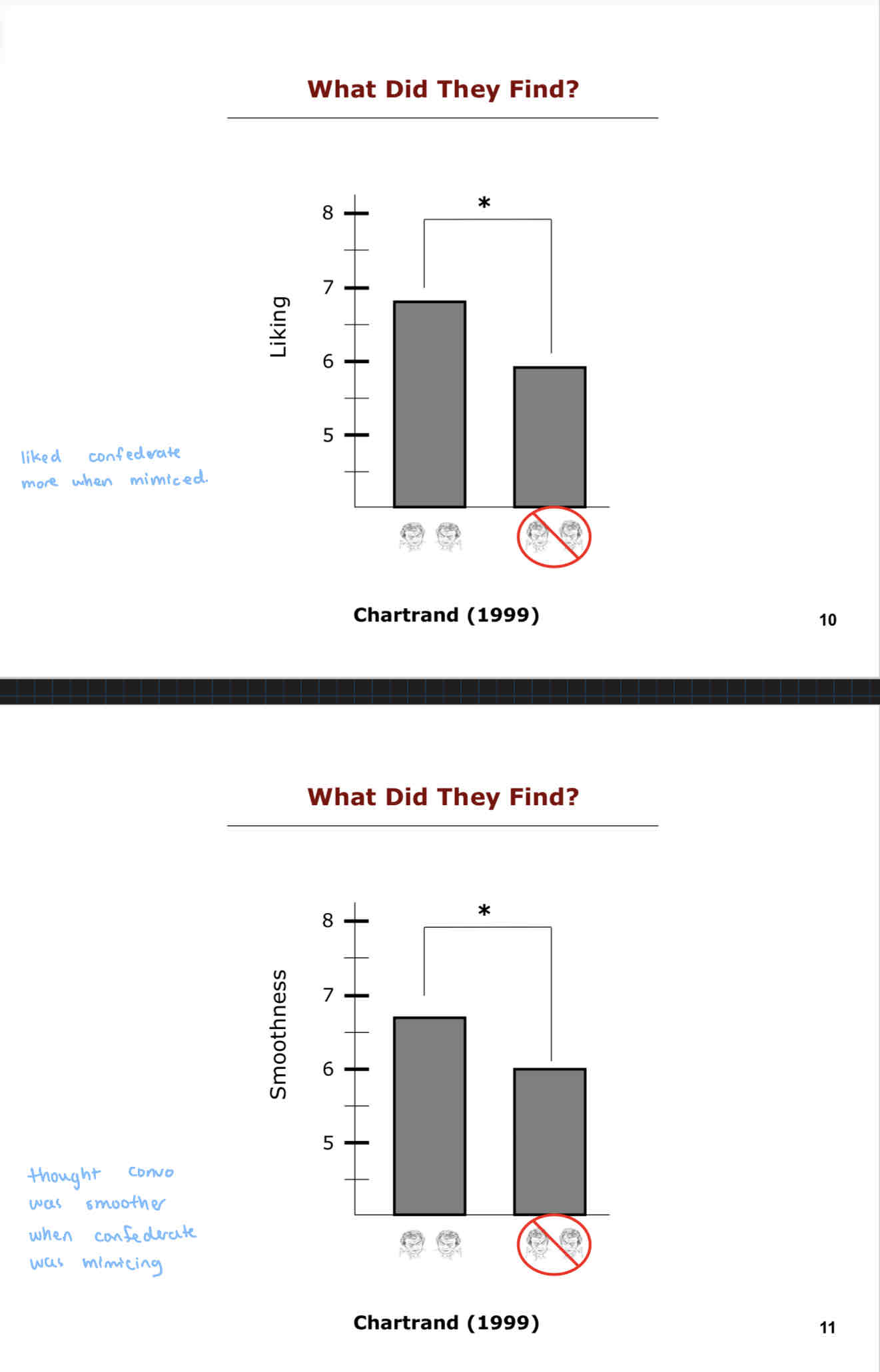
In another study by Chartrand (1999), participants were in one of two conditions: A) The confederate mimicked you, or B), the confederate did not mimic you.
Participants rated: 1) How much they liked the confederate, and 2) How smooth the interaction felt
What did they find?
L17 S8-10
The study found that participants liked the confederate more when they mimicked the participant.
They also found that participants thought the conversation was smoother when the confederate was mimicking.
Do the positive social impacts of mimicry extend beyond just the person who mimics us - AKA, does mimicry promote prosocial behaviour?
This was investigated in a study by Van Baaren (2004), who had participants in a condition where a confederate mimicked them, and a condition where the confederate did not mimic them.
The experimenters spilled a cup of pencils, either by:
The interactor who mimicked you
THe interactor who did not mimic you
A new person who did not mimic you (but you interacted with a mimicor)
A new person who did not mimic you (and you interacted with a non-mimicor.
What did they find?
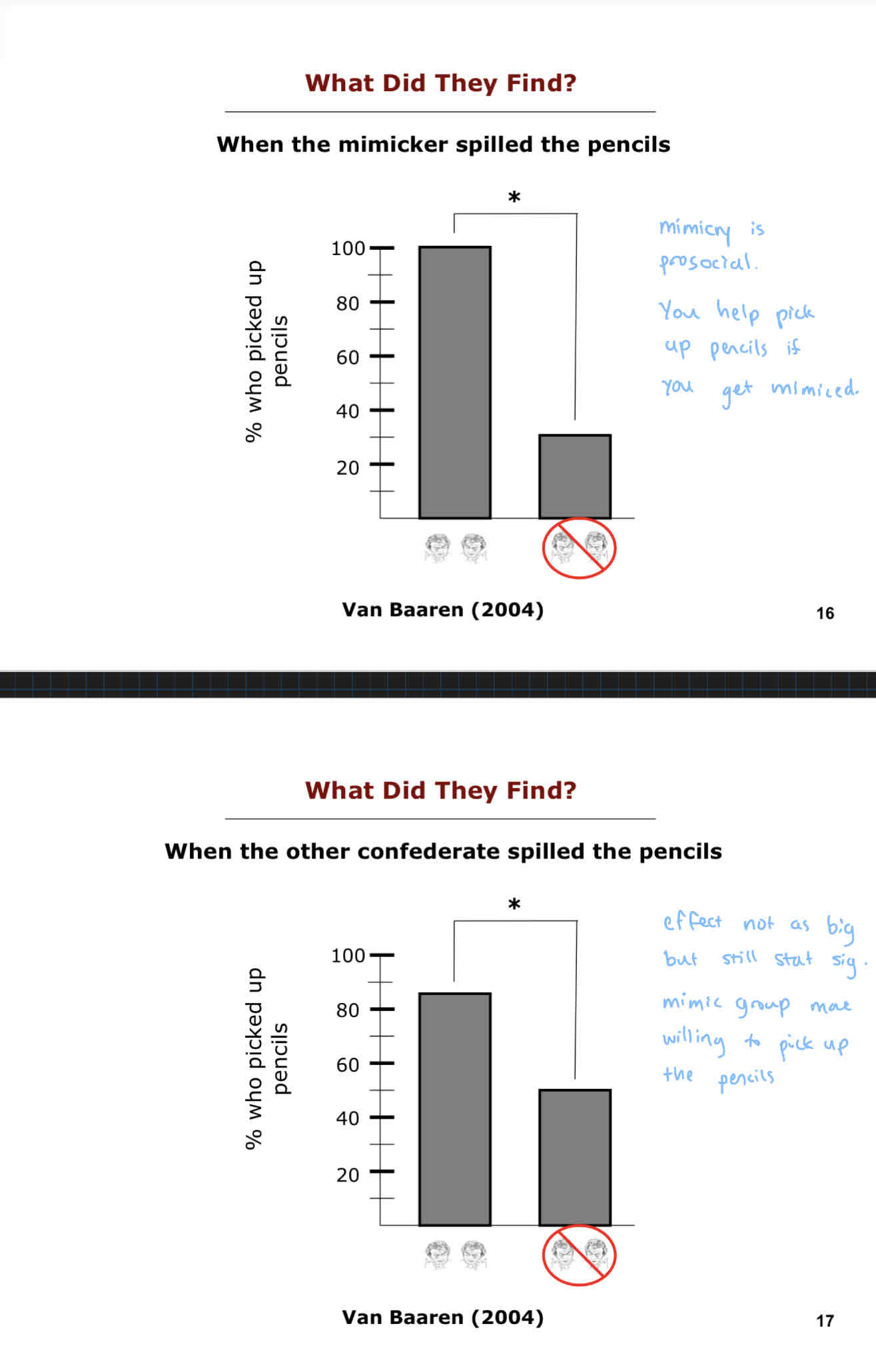
When the mimicker spilled the pencils
Mimicry is prosocial; you help pick up pencils if you get mimiced
When the other confederate spilled the pencils
You also help pick up pencils if you got mimicked, even if a new person spilled the pencils who you had not interacted with.
In another study by Van Baaren (2004), they once again put participants in a condition where they were mimicked, or a condition where they were not mimicked.
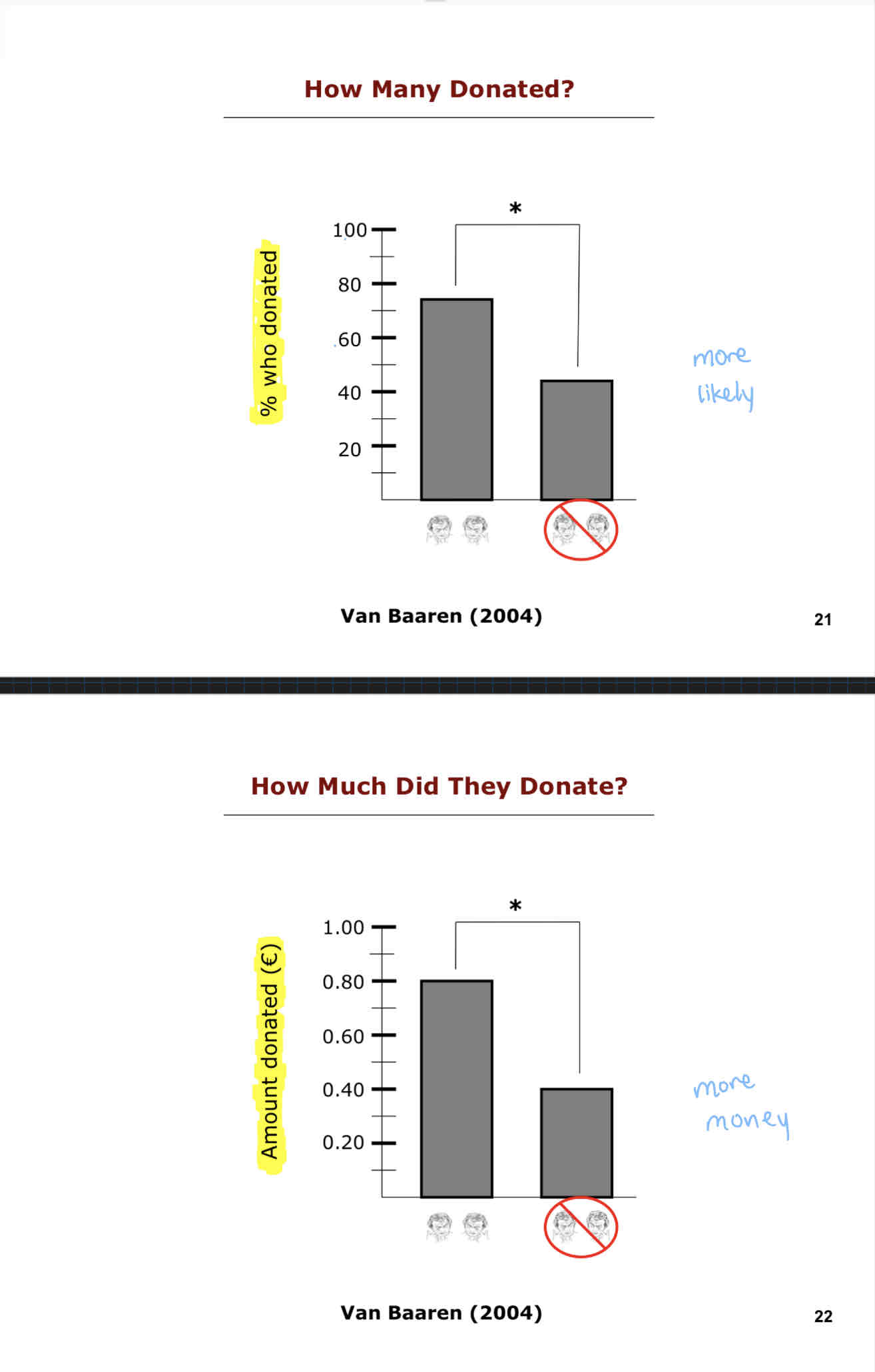
They then asked the participants for a donation.
What did they find?
In the mimicry condition, more participants were likely to donate.
In the mimicry condition, participants donated more.
What is the basis for mimicry? L17 S23
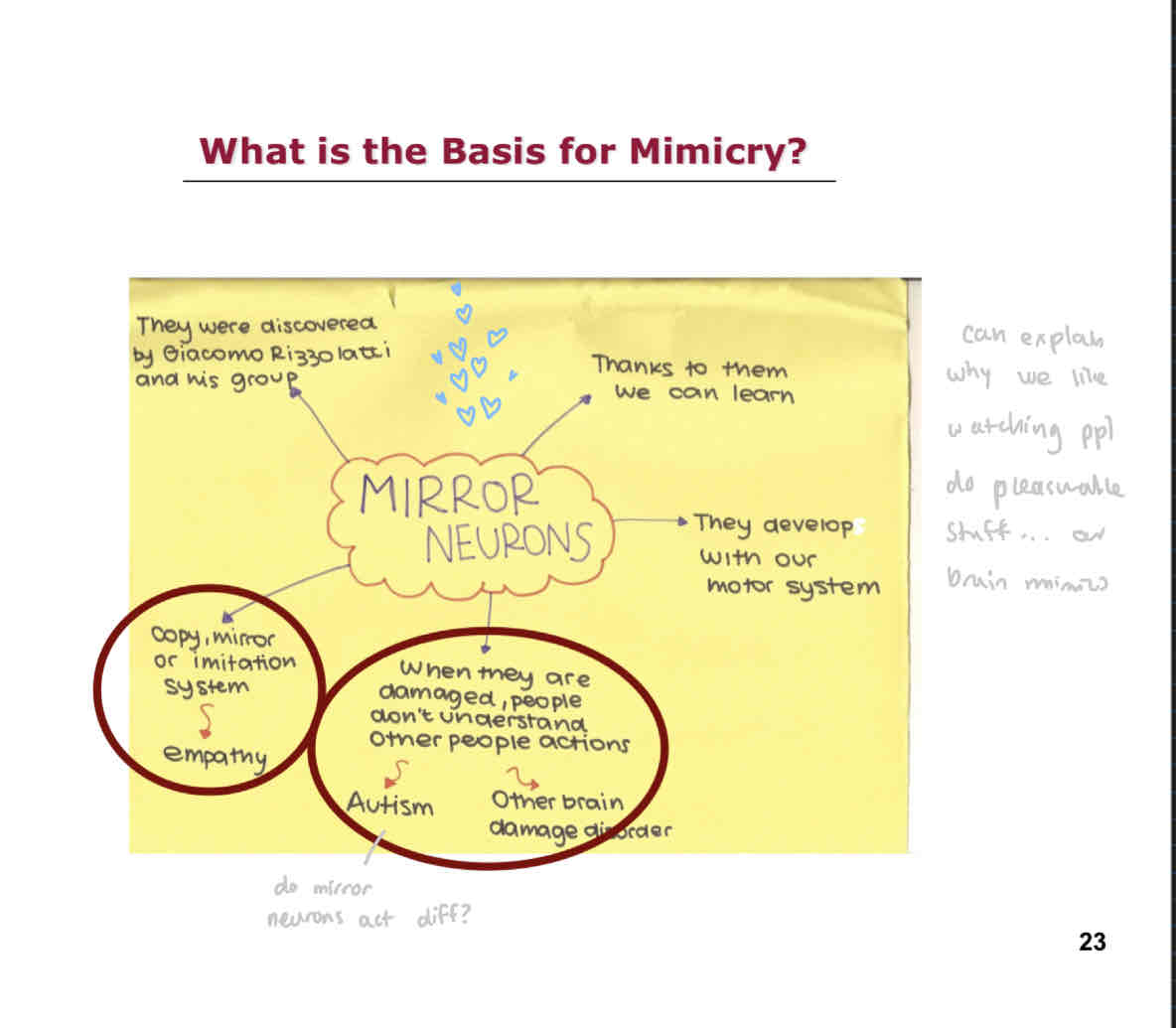
Mirror neurons:
Discovered by Biacomo Rizzolatti
Thanks to them we can learn
They develop with out motor system
When they are damaged, people don’t understand other people’s actions: Related to autism and other brain damage disorders
Copy, mirror, imitation system: Related to empathy
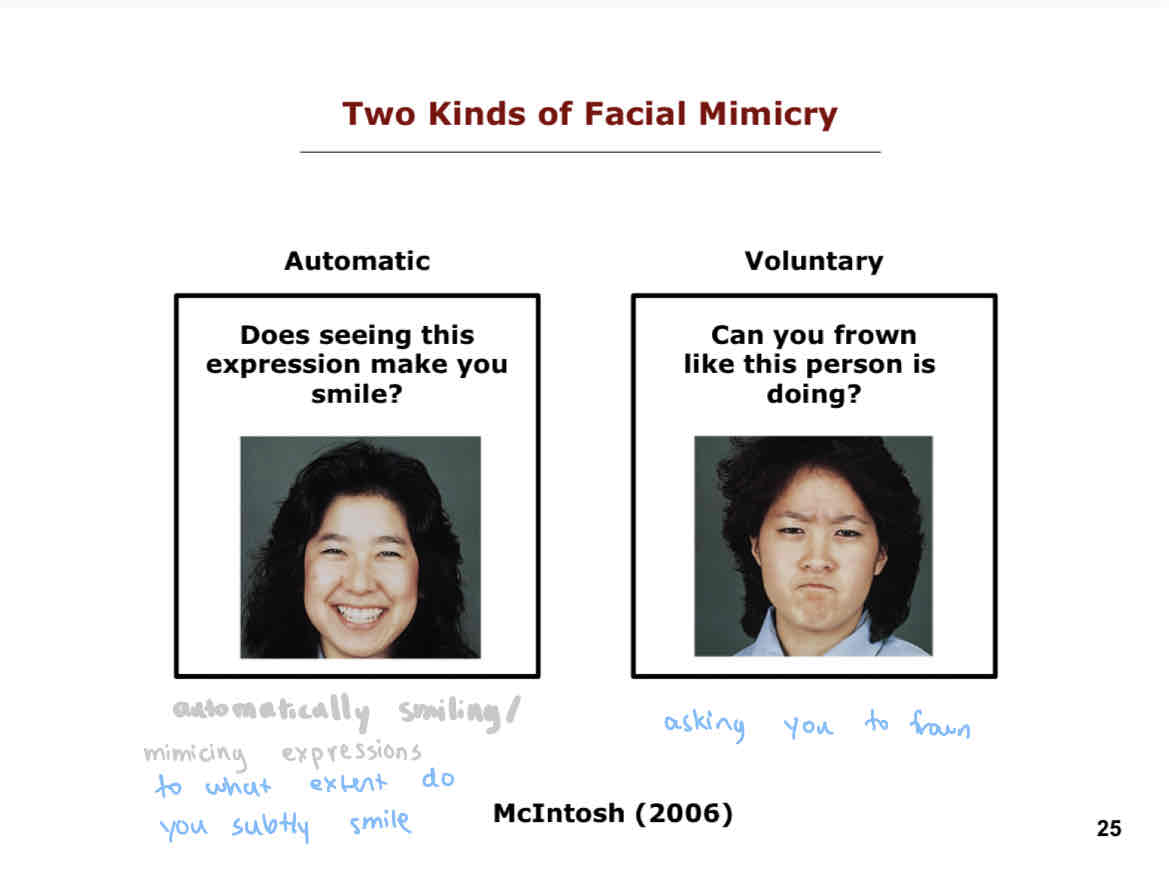
What’s the difference between automatic and voluntary facial mimicry? L17 S25
Automatic: E.g. automatically smiling/mimicking an expression
Voluntary: Being asked to mimick a frown
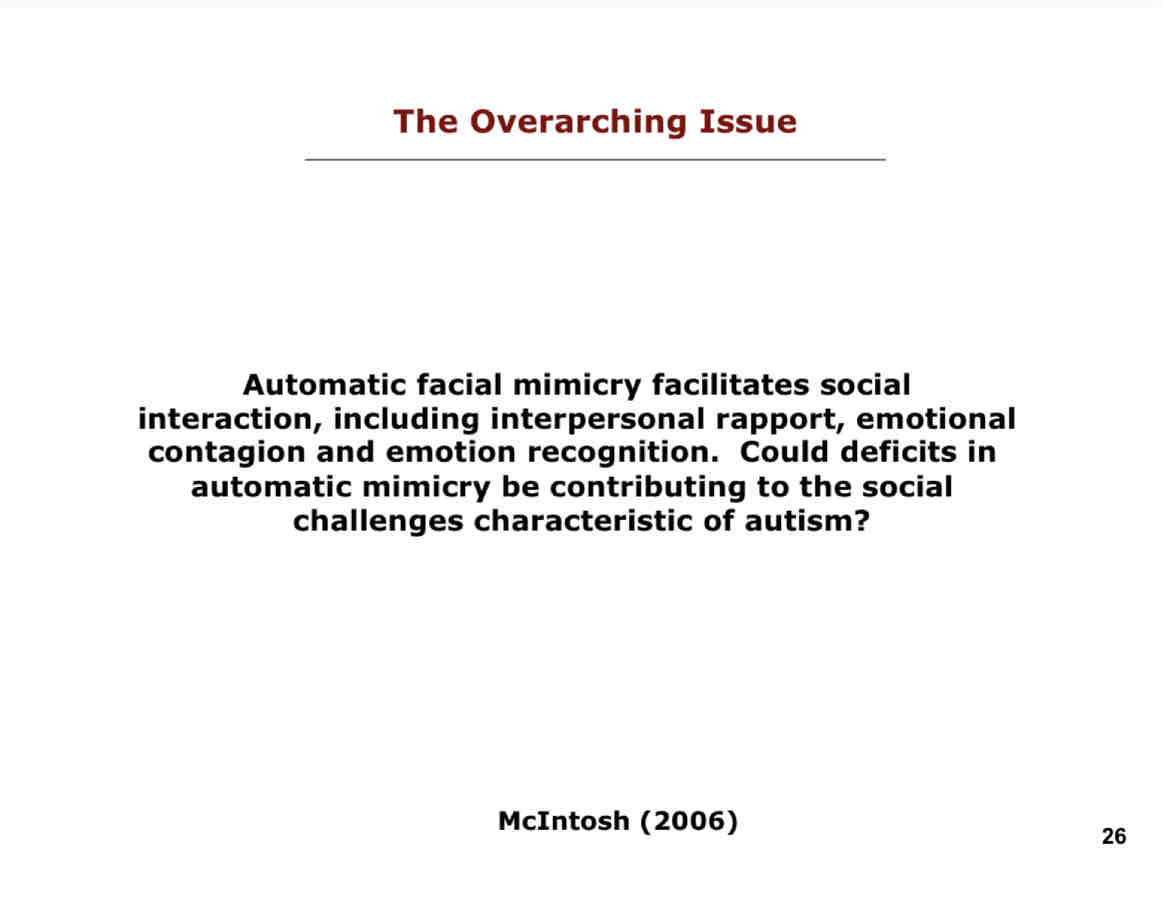
Describe the overarching issue regarding facial mimicry with people with autism. L17 S26
Automatic facial mimicry facilitates social interaction, including interpersonal rapport, emotional contagion and emotion recognition. Could deficits in automatic mimicry be contributing to the social challenges characteristic of autism?
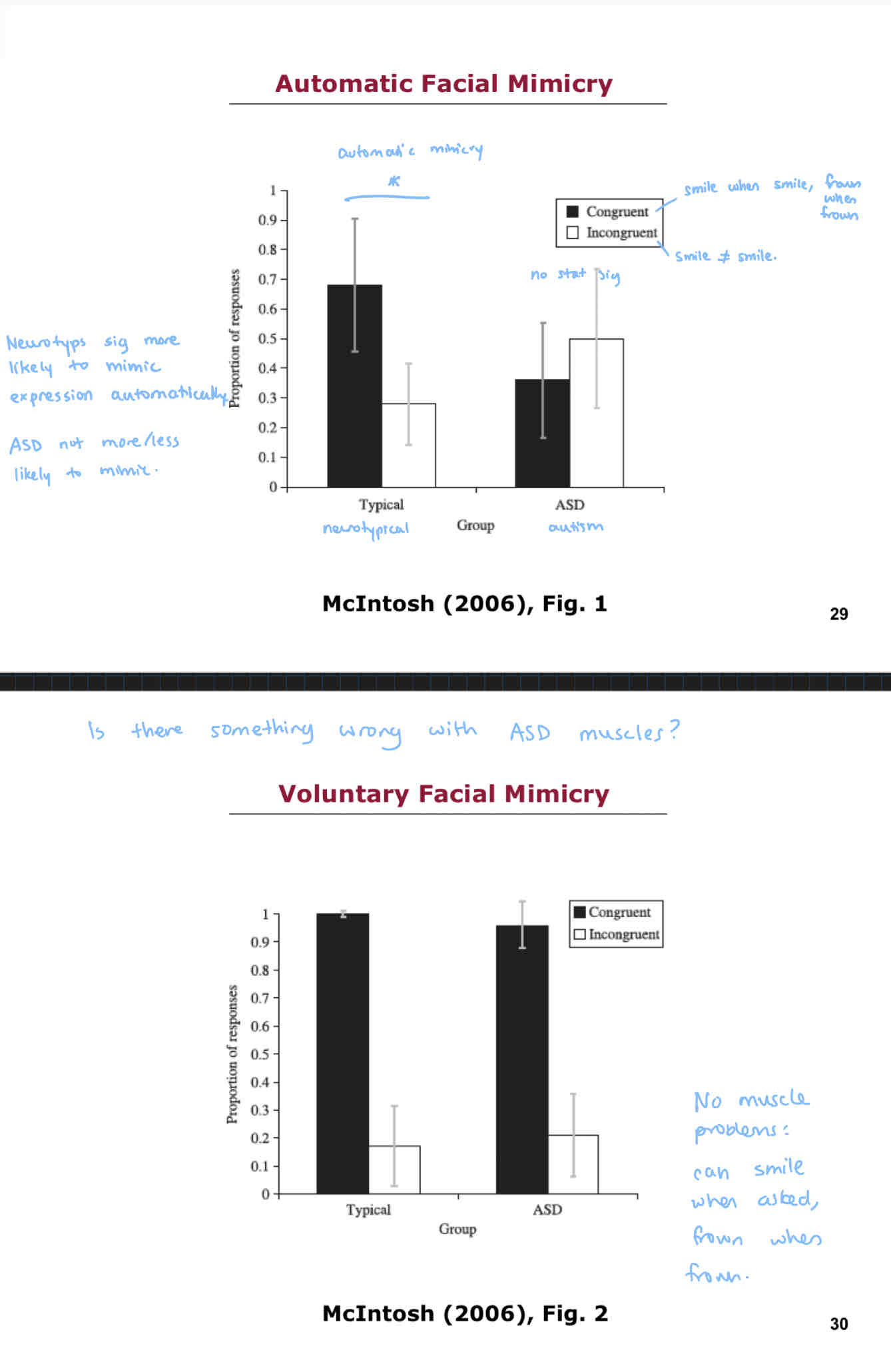
In a study by McIntosh (2006) studied one group that was neurotypical, and one group that had a diagnosis of autism. They looked at automatic and voluntary facial mimicry.
They placed electrodes on their faces to measure electrical activity in their muscles. Anger and happiness have unique EMG patterns.
What did they find?
L17 S28
For automatic facial mimicry, they found that:
Neurotypicals were significantly more likely automatically mimic expressions.
People with ASD were not any more or less likely to mimic the expressions.
For voluntary facial mimicry, they found that:
Both groups were able to voluntarily mimic a facial expression.
This rules out the possibility that there are muscle problems in people with ASD.
What you should be able answer:
What did Chatrand (1999) study reveal about mimicry?
What is meant by prosociality, and what did the study by Van Baaren (2004) reveal about the impacts of mimicry on prosociality?
What do mirror neurons support with respect to human behaviour and cognition?
What does the study by McIntosh (2006) help us to understand about the social challenges of autism?
LO: Understand the idea of mentalizing, how it build on emotional recognition, and how it explains one’s ability to understand thoughts and intentions of others. L18 S1
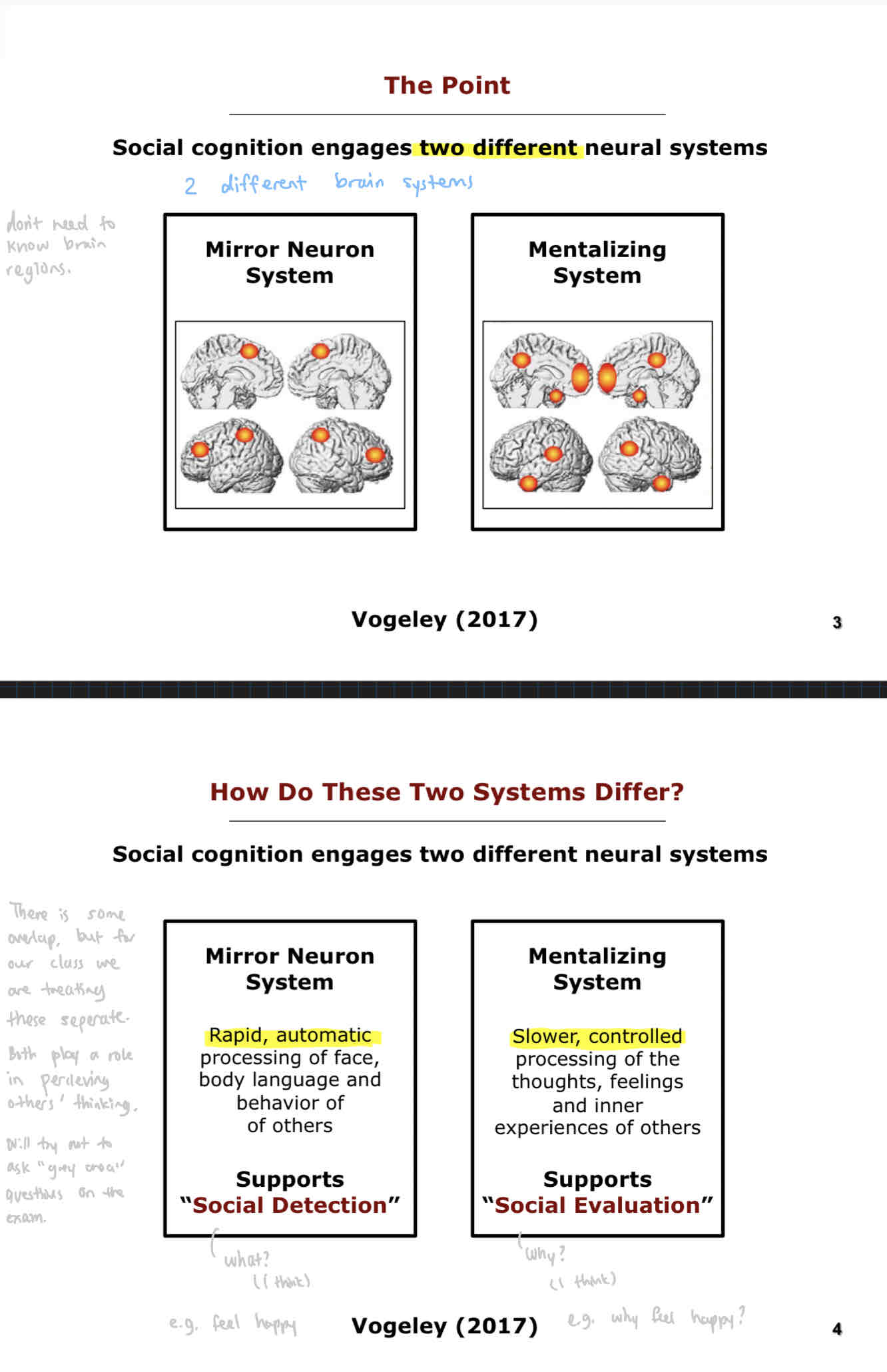
What are the two different neural systems that social cognition engages? How do these two systems differ? L18 S3-4
Mirror Neuron system
Mentalizing system
How these two systems differ:
Mirror neuron system: Rapid, automatic processing of face, body language and behaviour of others. Supports “Social Detection”
Mentalizing system: Slower, controlled processing of the thoughts, feelings, and inner experiences of others. Support “Social Evalution”
(There is some overlap but in our class we are treating them as separate.)
What is Huntington’s disease? L18 S6
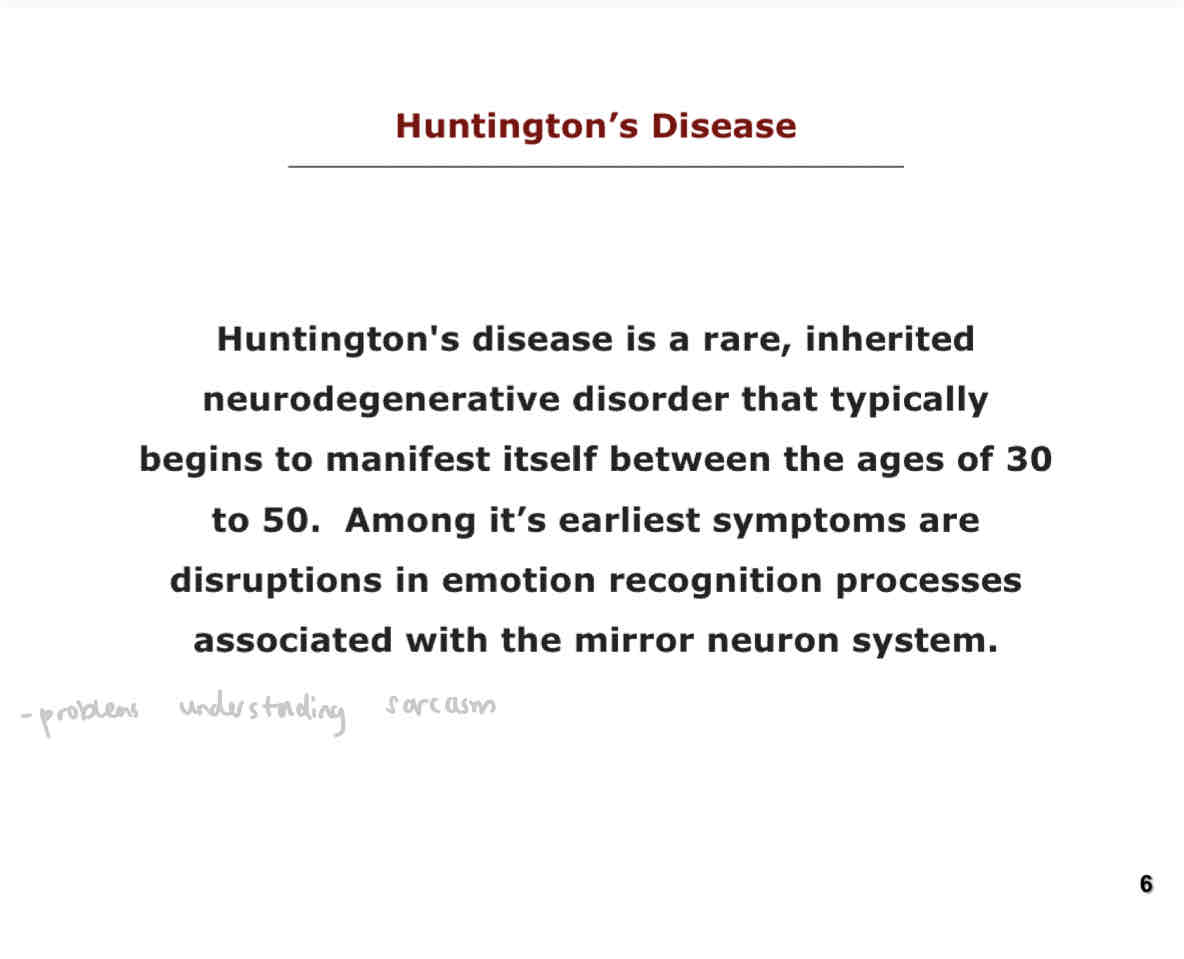
Huntington’s disease is a rare, inherited neurodegenerative disorder that typically begins to manifest itself between the ages of 30 to 50. Among it’s earliest symptoms are disruptions in emotion recognition processes associated with the mirror neuron system. E.g. ability to understand sarcasm.
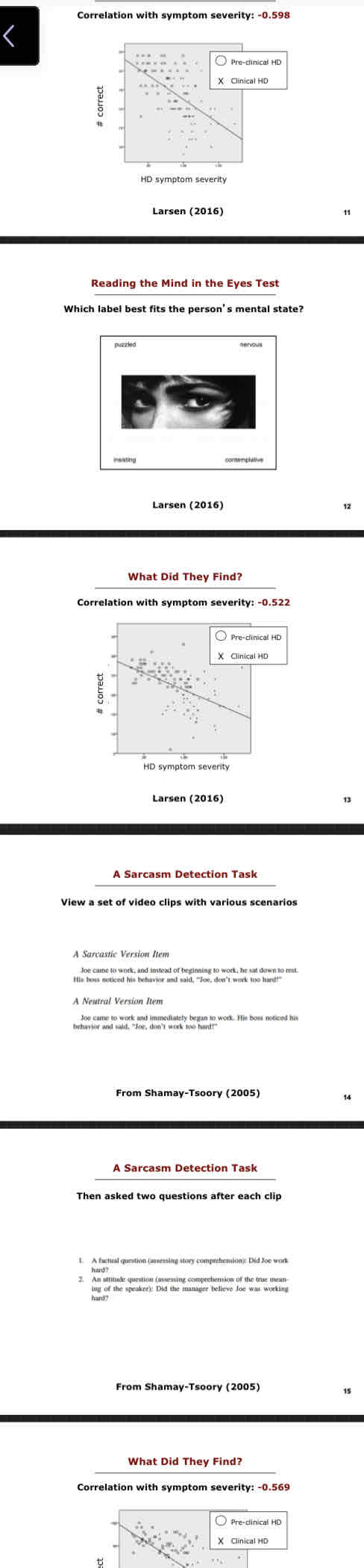
In Larsen’s (2016) study, there were three participant groups:
Individuals with the Huntington’s gene and manifesting clinical symptoms
Individuals with the Huntington’s gene and not manifesting clinical systems - no symptoms yet
Individuals with the Huntington’s gene in their family, but not carrying the gene themselves.
They were asked to do an emotional recognition test (i.e. “Which emotion best describes this facial expression?”)
What did they find?
L18 S9-11
They were also asked to do a “reading the mind in the eyes” test - trying to read an expression from only my eyes. What did they find?
L18 S12-13
They were also asked to do a sarcasm detection task: They viewed a set of video clips with various scenarios. They were asked questions to assess their story comprehension and their sarcasm comprehension. What did they find?
Emotional recognition test:
The correlation with symptom severity: -0.598
The higher Huntington’s Disease symptom severity, the fewer emotions the person got correct.
Reading the mind in the eyes test:
Correlation with symptom severity:
The higher the HD symptom severity, the fewer emotions the person got correct.
Sarcasm video test:
Correlation with symptom severity: -0.569
The higher the HD symptom severity, thefewer items they got correct.
What was the attendance question for L18?
Sasquatch/Bigfoot
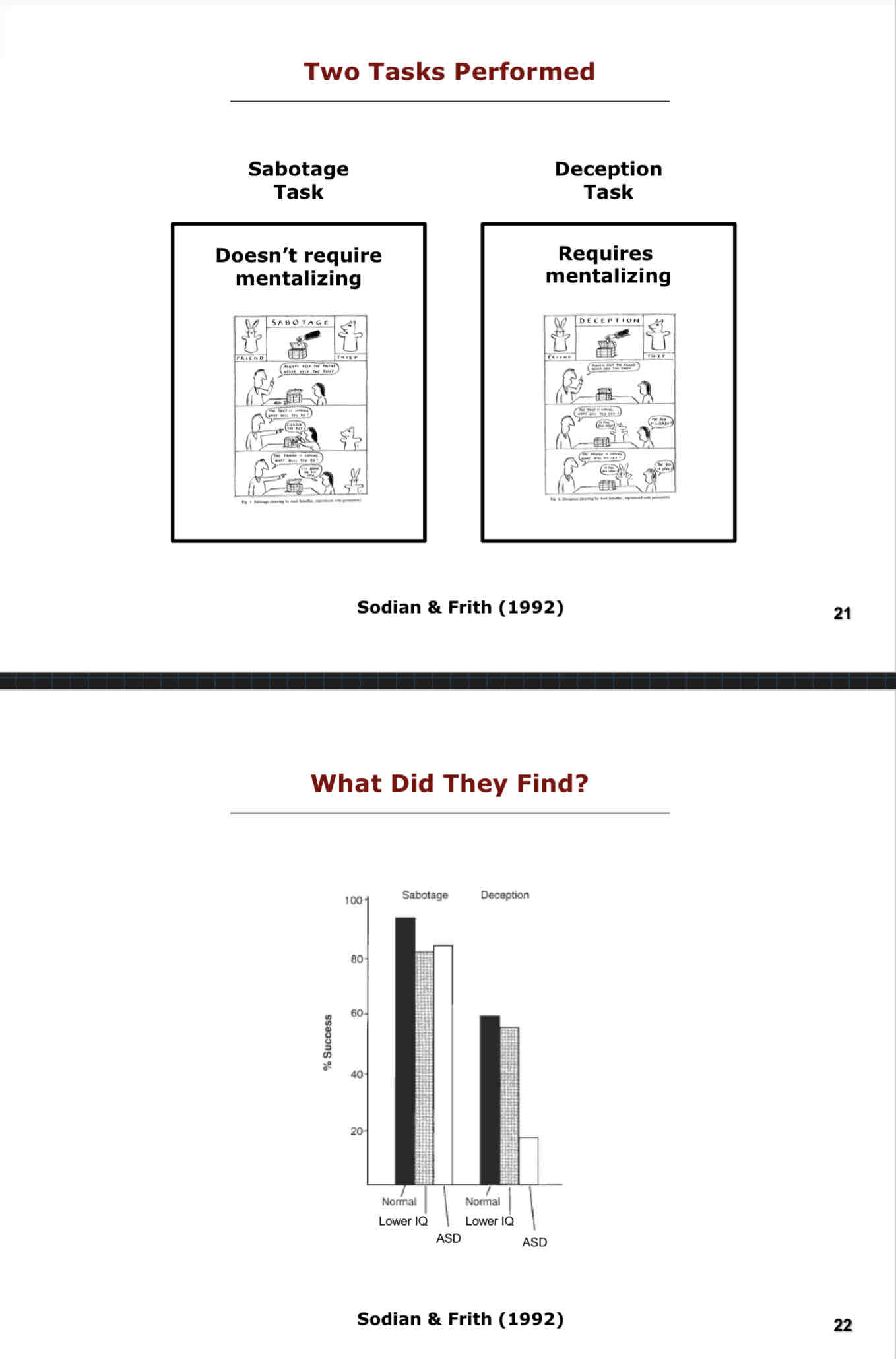
CHECK UNDERSTANDING: Sodian & Frith (1992) investigated the question: Is Autism Spectrum Disorder (ASD) associated with altered mentalizing system function?
They tested 3 groups of children:
An IQ score in the “normal” range
An IQ score below the “normal” range
Individuals with a diagnosis of ASD
The children performed two tasks:
Sabotage task: Watching a situation in which there is explicit sabotage that does not require mentalizing.
Deception task: Watching a situation in which there is deception that requires mentalizing
What did they find?
L18 S19-22
Children with ASD performed significantly worse in the deception (mentalizing) task. They performed about equal in the sabotage (non-mentalizing) task.
In a study by Senju (2009), they looked at how individuals with ASD pass “false belief” tasks despite “mind blind.”
(False belief task: An item is moved when Person A is out of them room. Where does Person A look?)
What did Senju find?
L18 S23-25
Senju found that those with ASD don’t spontaneously mentalize like allistic individuals. Rather, they reason about false beliefs (using System 2 thinking)
What you should be able to answer from L18:
What are the mirror neuron and mentalizing systems?
How do they differ, in terms of supporting our social cognition?
How does Huntington’s disease impact social cognition, in terms of what Larsen (2016) found?
What does sarcasm reveal about social cognition?
What does the study by Sodian & Firth (1992) reveal about ASD?
How do those with ASD solve false belief tasks?
LO: Understand the “liking gap” and the “thought gap”, and how our own self-knowledge can bias our mentalizing. L19 S1
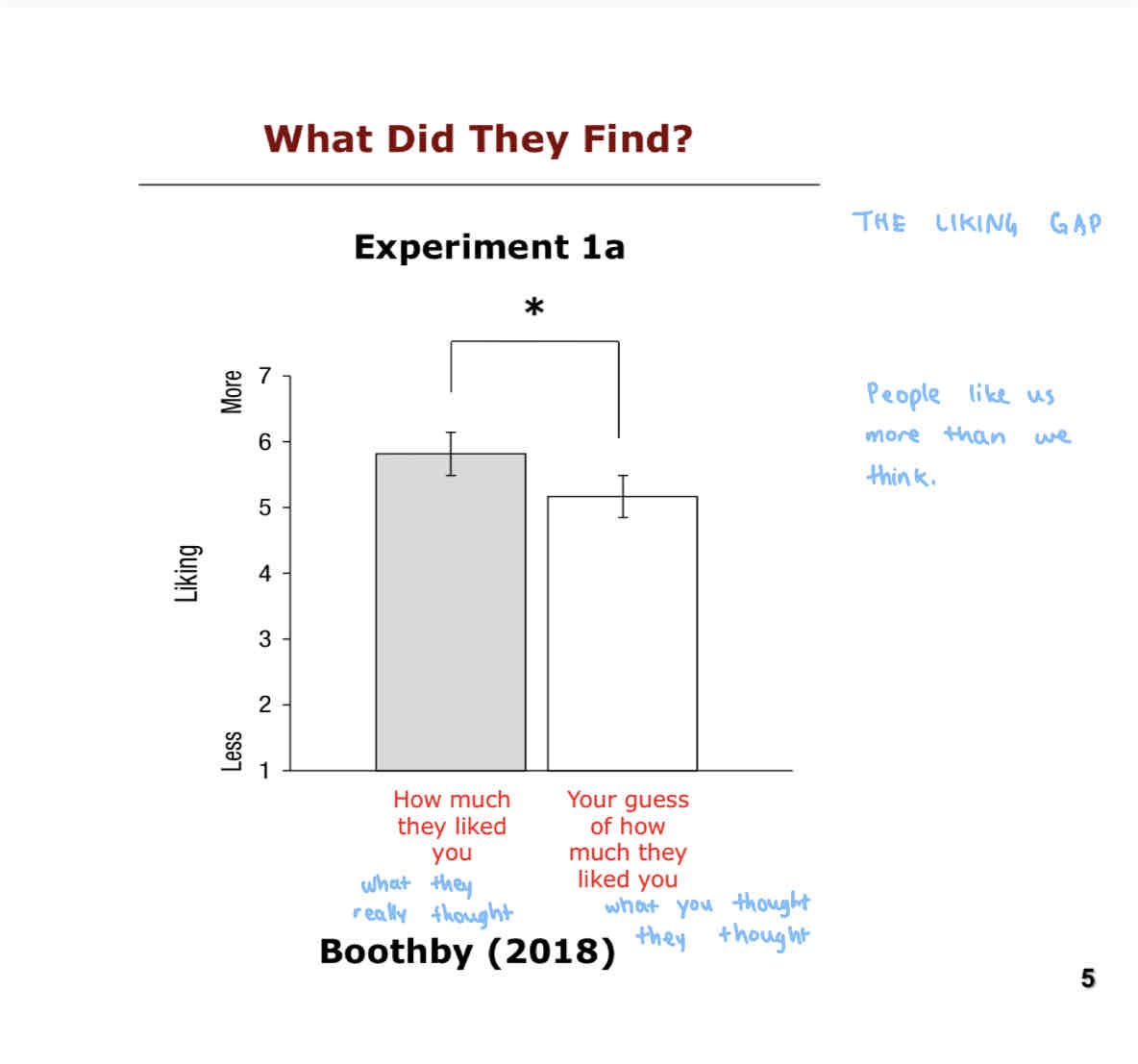
In a study by Boothby (2018), participants had a 5-minute conversation with a same-sex partner.
They rated how much they liked their partner and how much they think their partner liked them.
What did they find? What phenomenon does this reflect? L19 S2-5
They found that people like us more than we think.
Our guess of how much people like us is lower than their rating of how much they actually like us.
This reflects “The Liking Gap”.
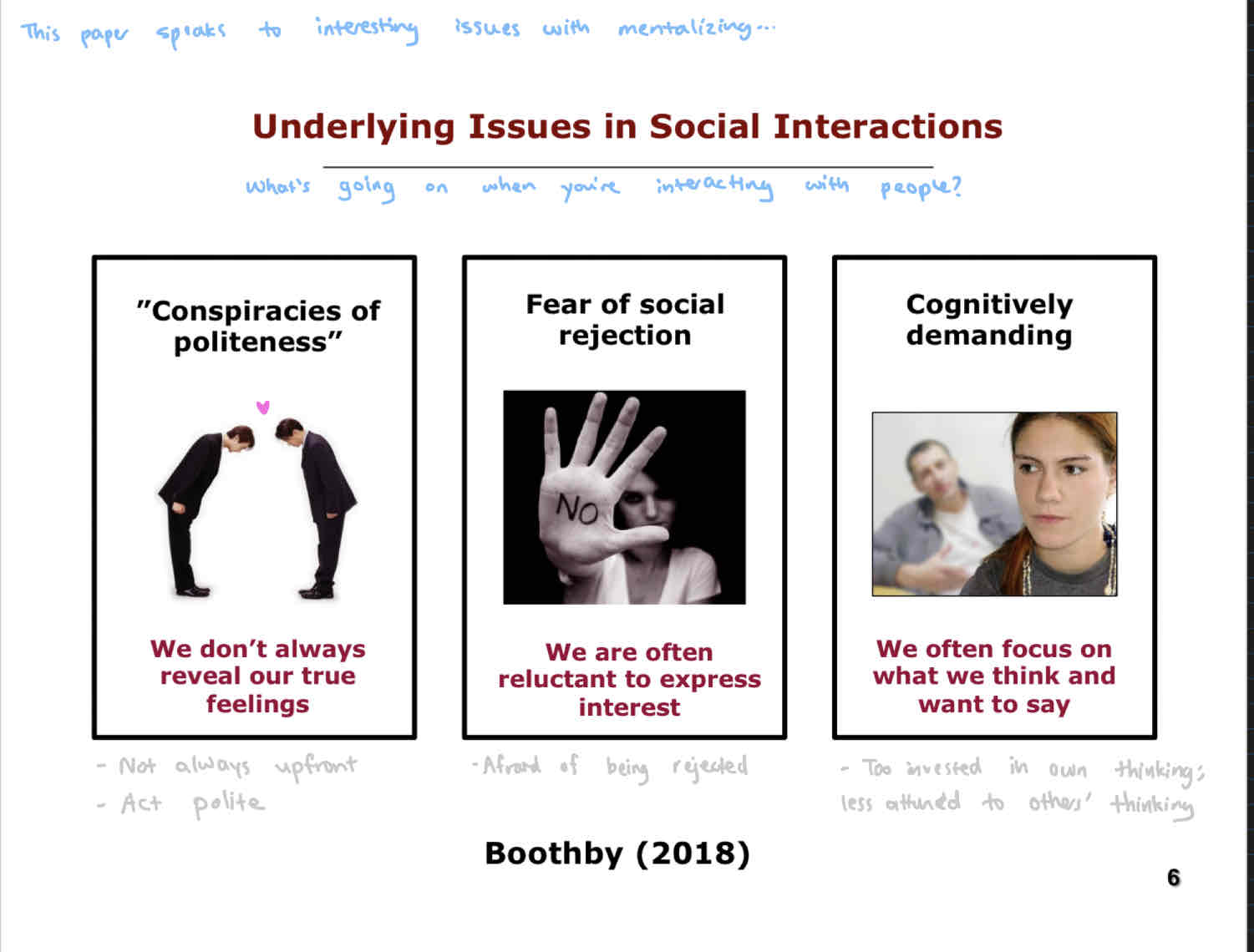
What are the 3 underlying issues in social interactions, according to the Boothby study? L19 S6
Conspiracies of “politeness”
We don’t always
Fear of social rejection
We are often reluctant to express interest
Cognitively demanding
We often focus on what we think and want to say
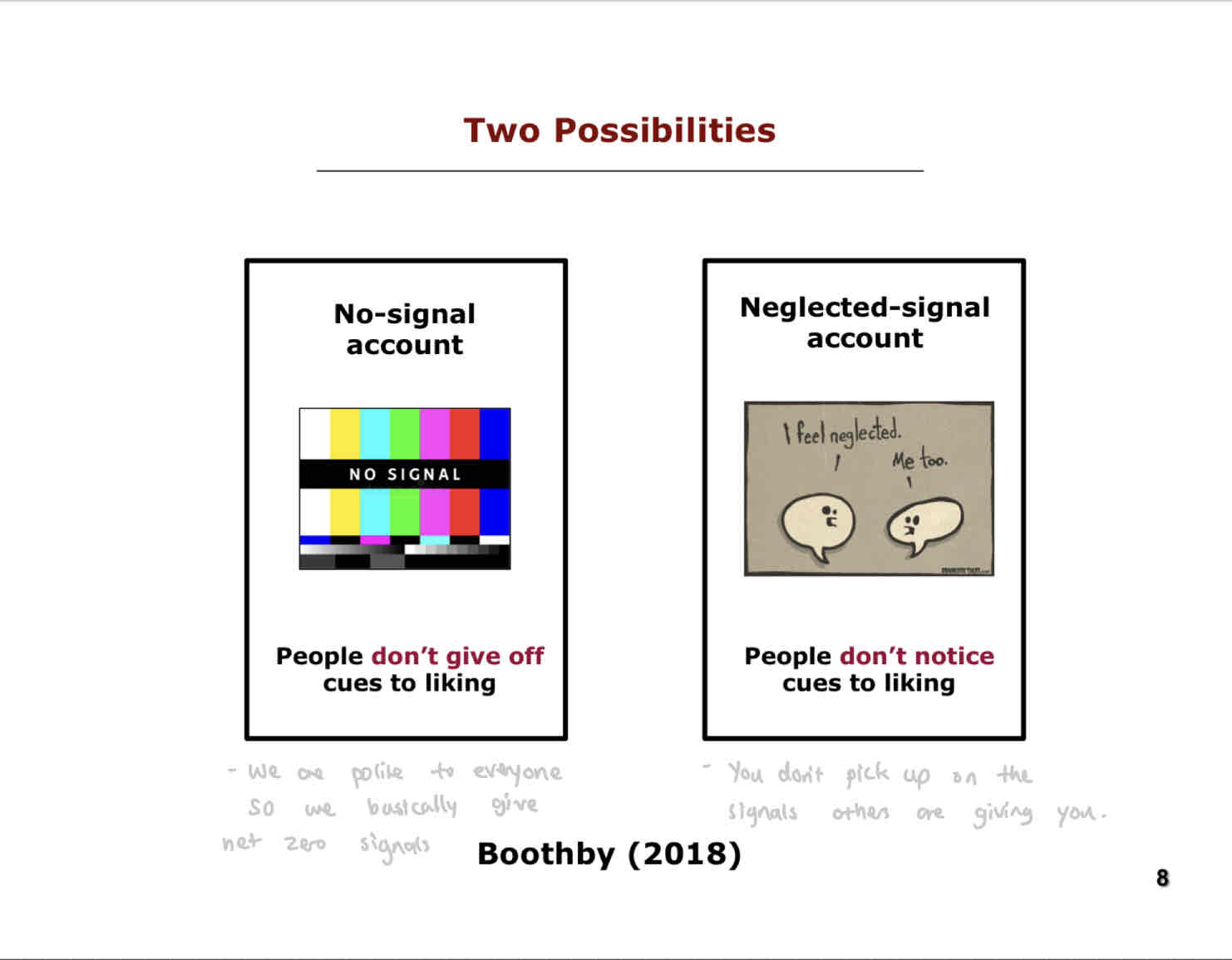
Boothby investigated two possibilities of the “liking gap”. What are they? L19 S8
No signal account: People don’t give signals/cues that they like you
Neglected-signal: People don’t notice cues to liking; you don’t pick up on the signals
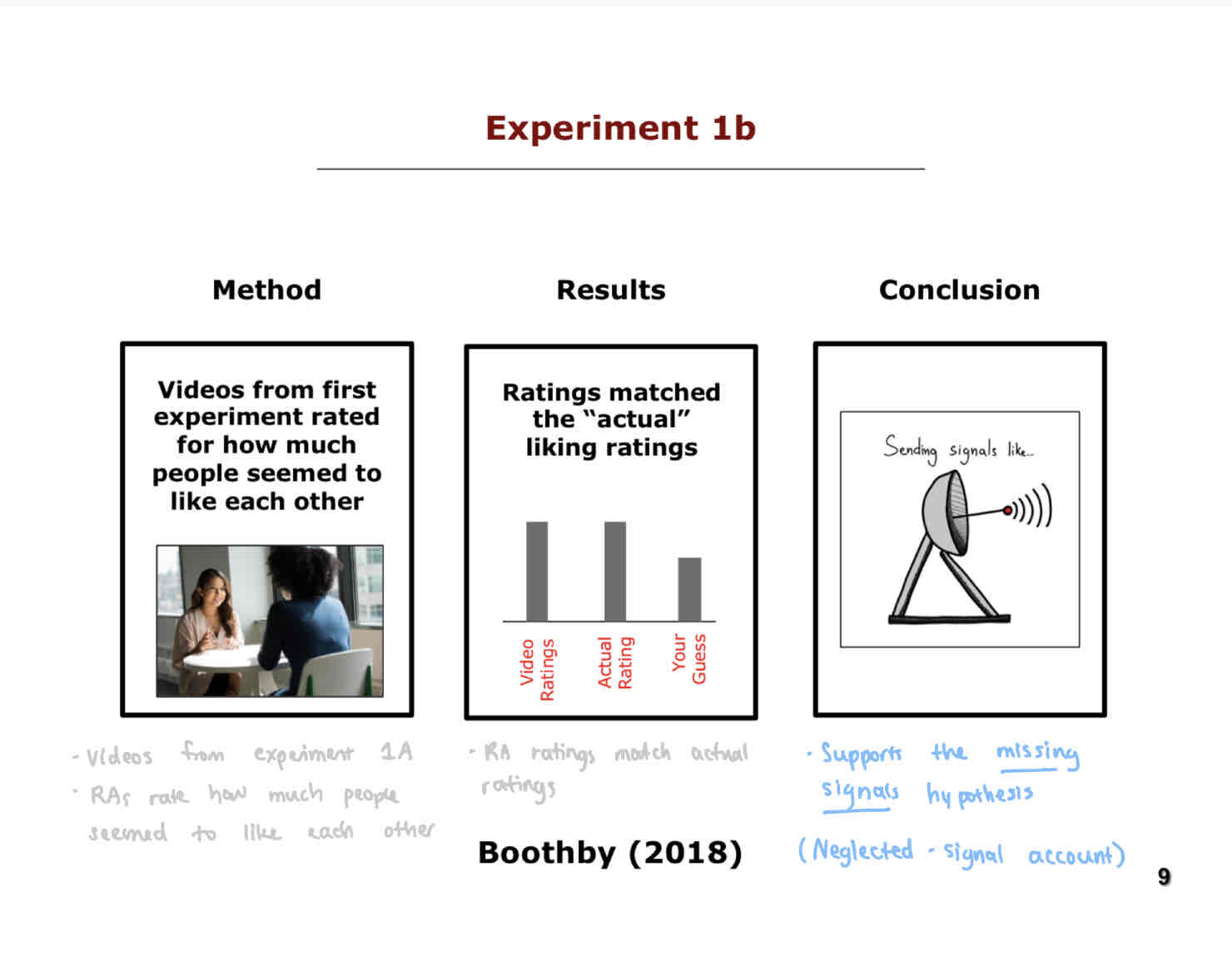
In a study by Boothby (2018), raters rated the videos from the experiment where participants talked to a same-sex partner.
What did they find and what did they conclude?
L19 S9
The ratings by the raters matched the actual ratings of liking.
They concluded that this supports the “Neglected Signal” account
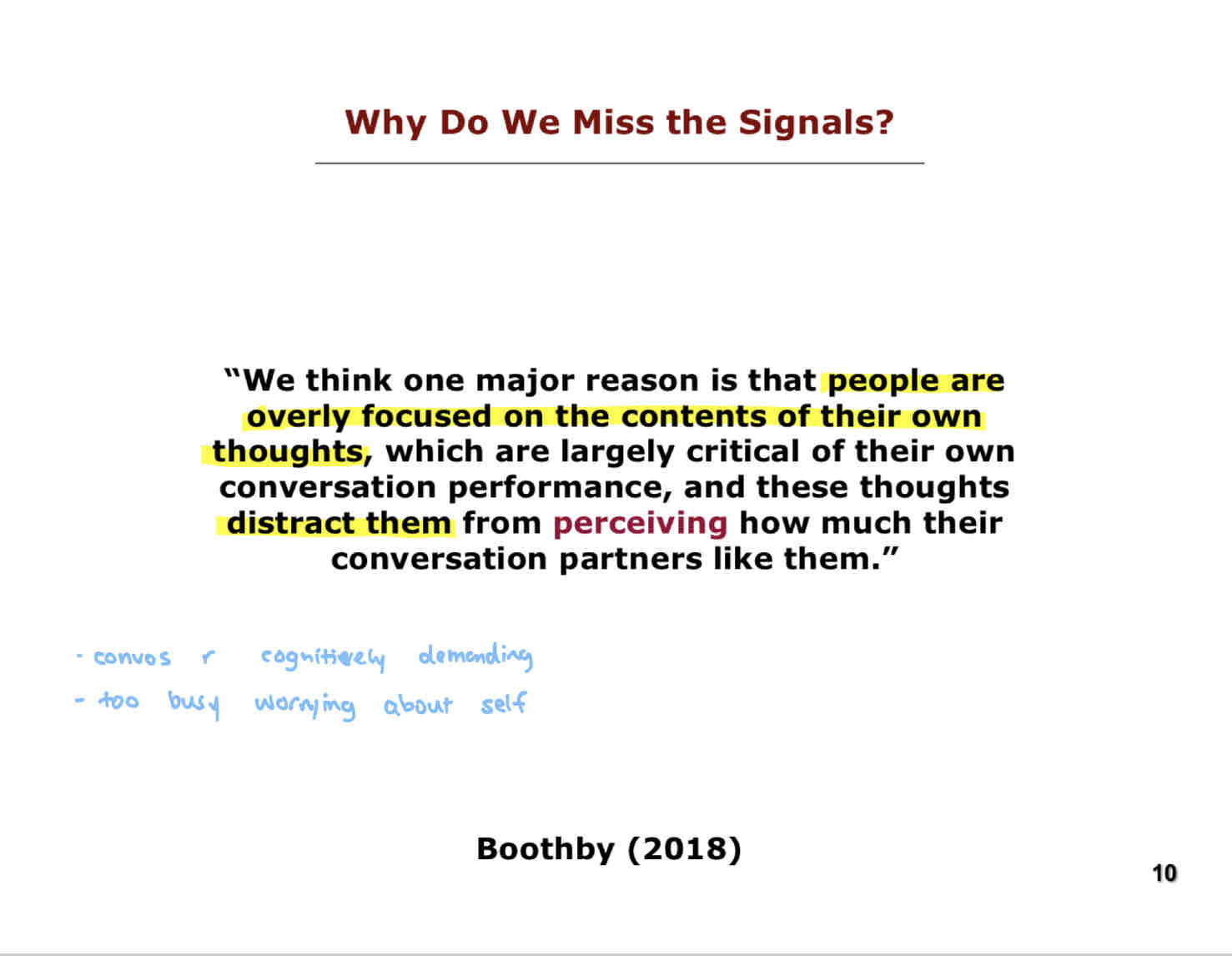
According to Boothby, why do we miss neglected signals? L19 S10
“We think one major reason that people are overly focused on the contents of their own thoughts, which are largely critical of their own conversation performance, and these thoughts distract them from perceiving how much their conversation partners like them.”
We are constantly worrying about our own self, which is too cognitively demanding to pick up on liking cues.
Boothby (2018) conducted another study on the liking gap.
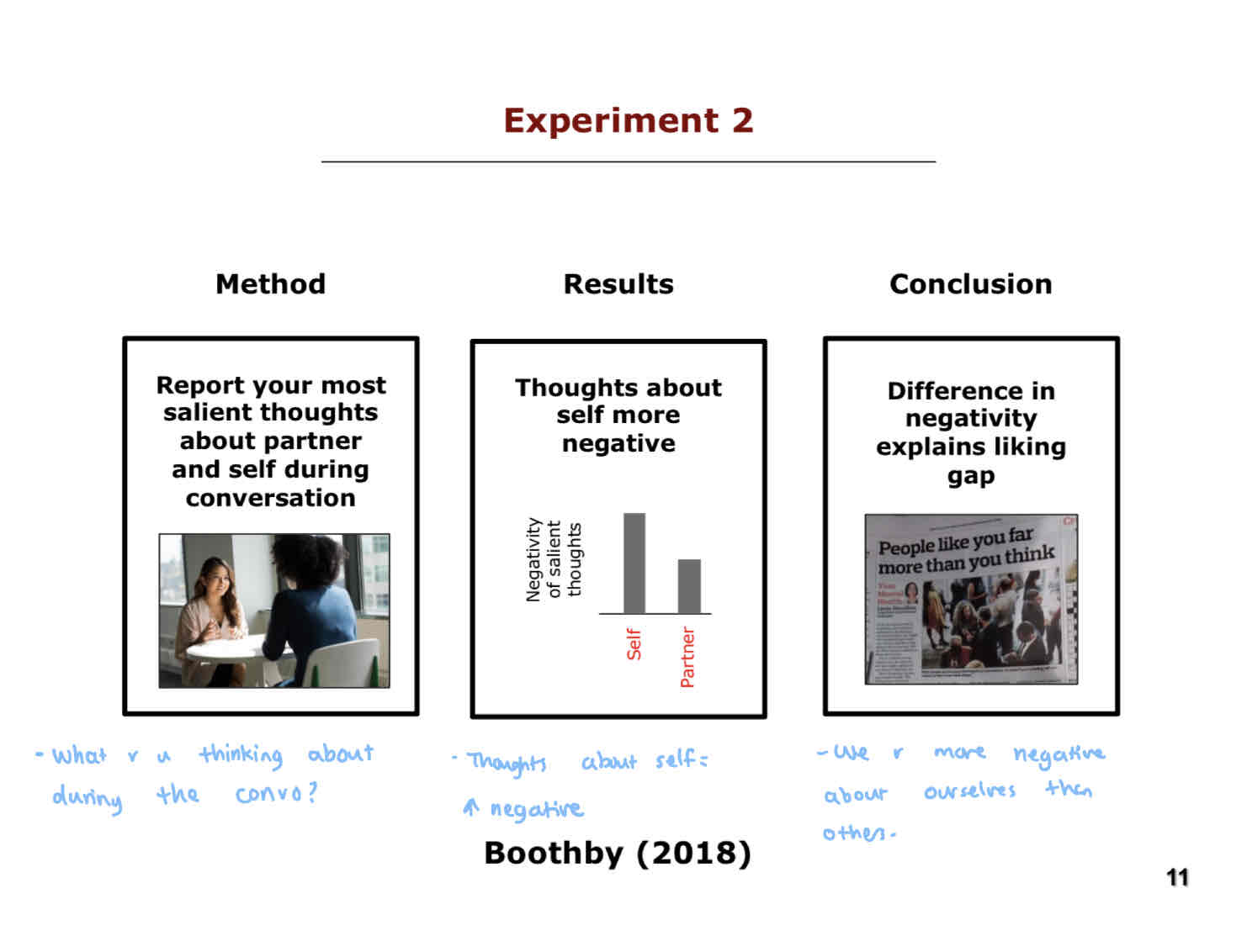
Participants were asked to report their most salient thoughts about partner and self during conversation.
What were the results and conclusion?
L19 S11
They found that participants’s thoughts about their self were more negative than their partner’s thought about them.
They concluded that the difference in negativity explains the liking gap.
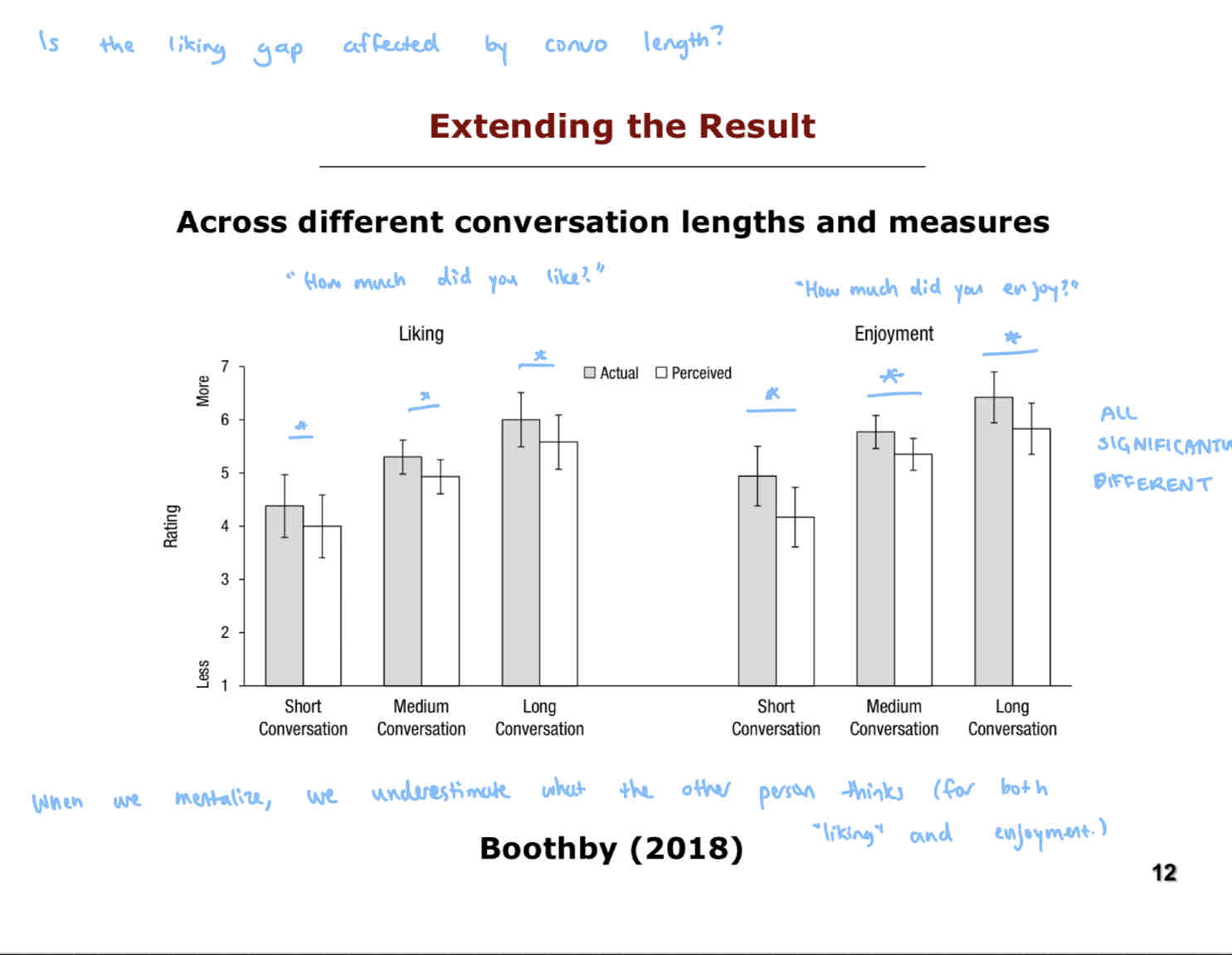
What did Boothby (2018) find when they investigated the liking gap’s relationship to conversation length? L19 S12
In all conversation lengths (short, medium, long), the other person’s ratings of both “liking” and “enjoyment” were significantly higher than the person’s self-perception.
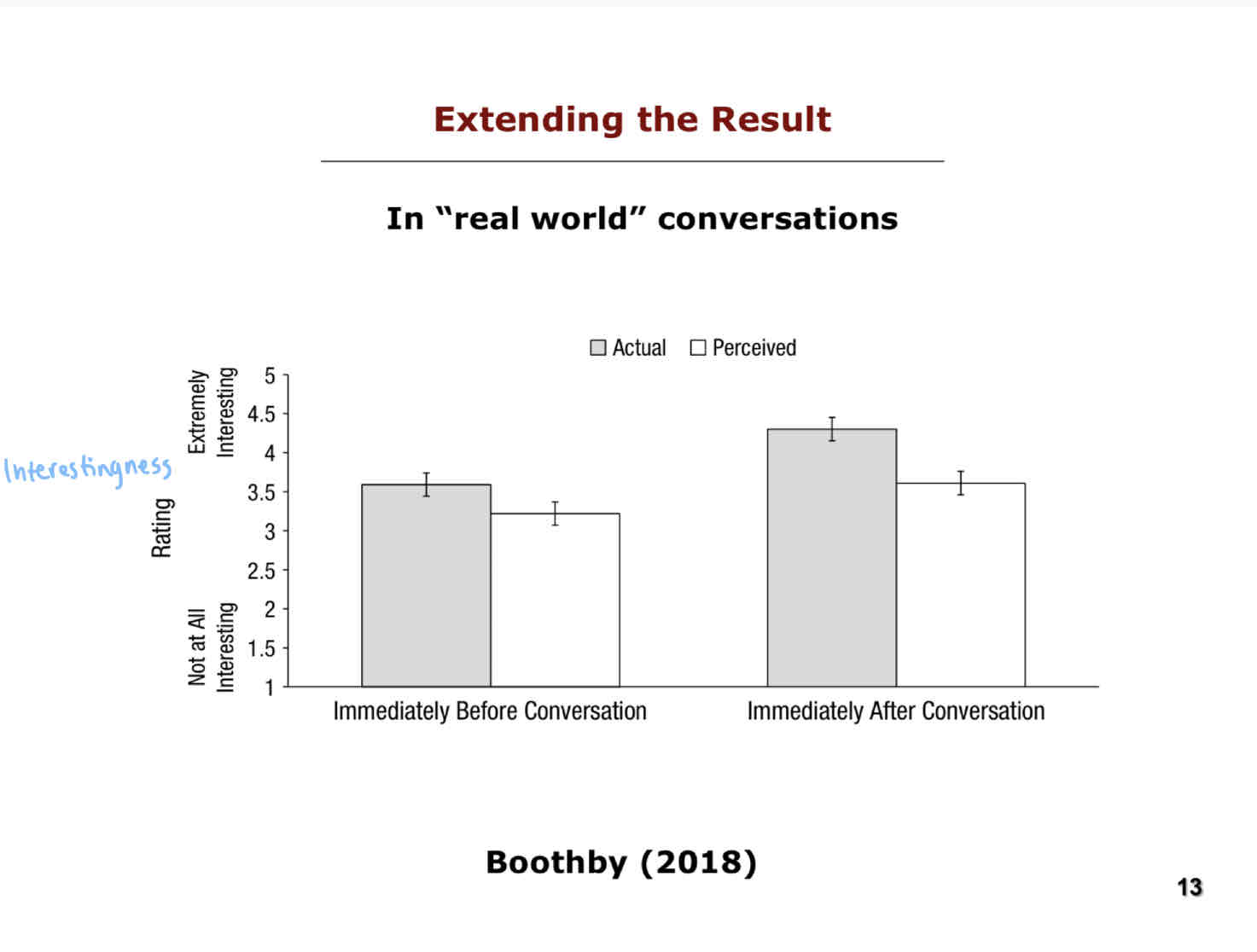
Boothby (2018) extended the results to “real world” conversations and percieved levels of interestingness. What did they find? L19 S13
They found that in ‘real world’ conversations, the actual interestingness rated by the partner was significantly higher than the perceived interestingness from the self.
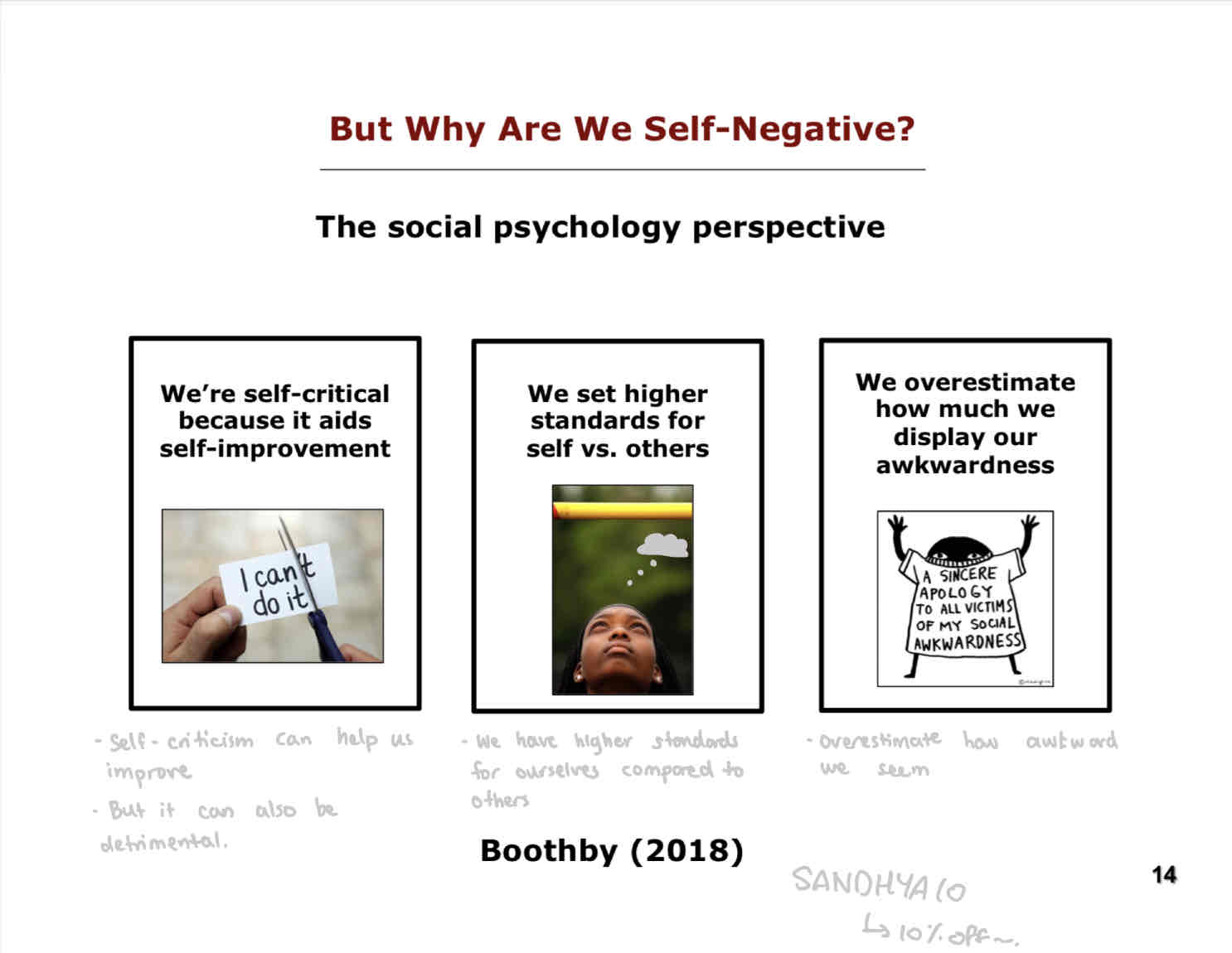
What are the 3 possible reasons we are self-negative, according to social psychology? L19 S14
We’re self-critical because it aids self-improvement.
We set higher standards for ourselves vs others.
We overestimate how much we display our awkwardness.
What was the participation mark from L19?
Bison - A man was arrested at Yellowstone for kicking a bison while drunk.
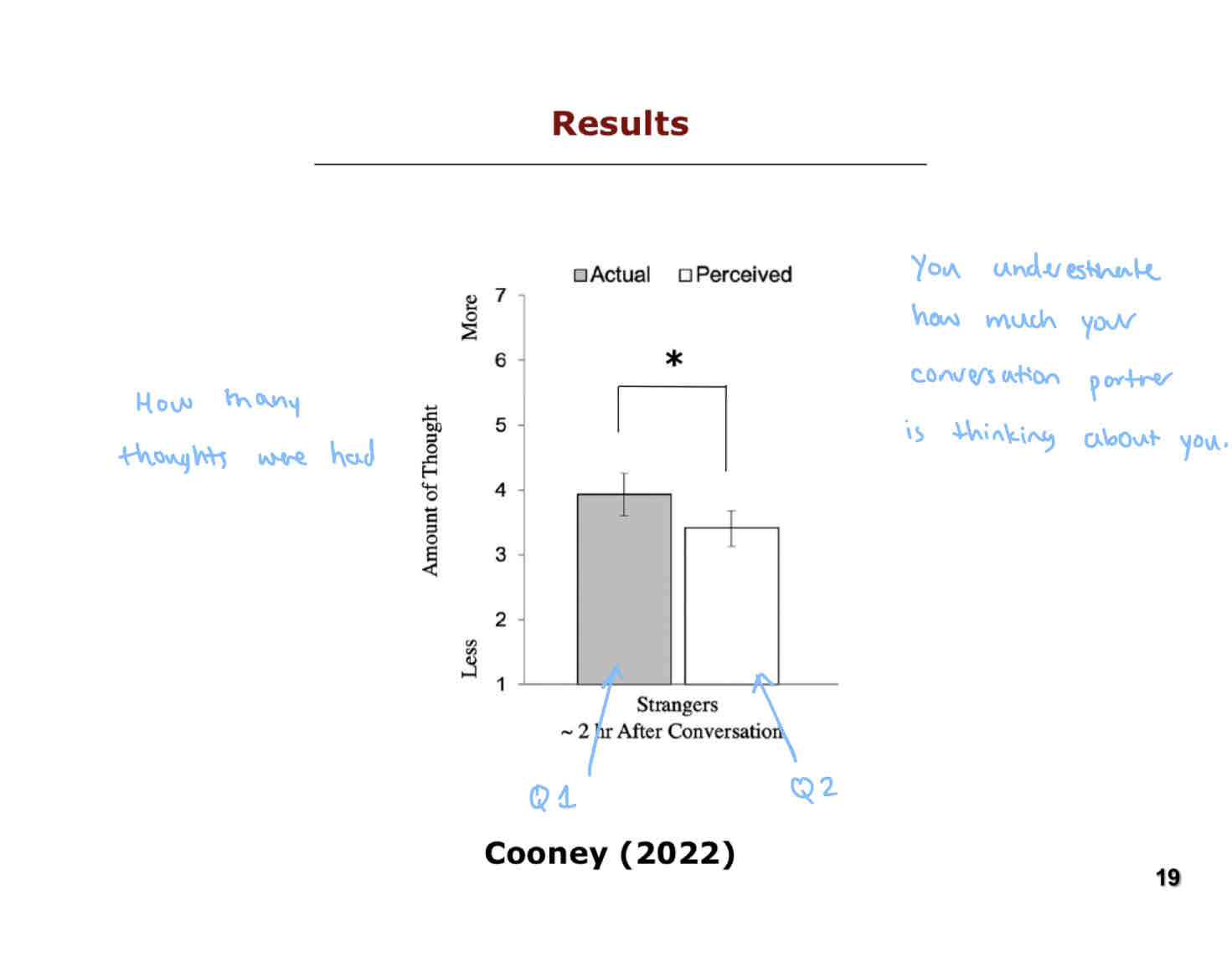
Cooney (2022) investigates how we estimate how much our conversation partners think about us after a conversation. Within-subjects design.
They had participants first have a 45-minute in-lab conversation with a stranger. Then, 2 hours later, they sent an online survey.
They were asked:
How much was your conversation partner on your mind after you talked?
How much do you think you were on your conversation partner’s mind after you talked?
What did they find? L19 S19
People underestimate how much their conversation partner is thinking about them - People are thinking more about you after you talk then you think.
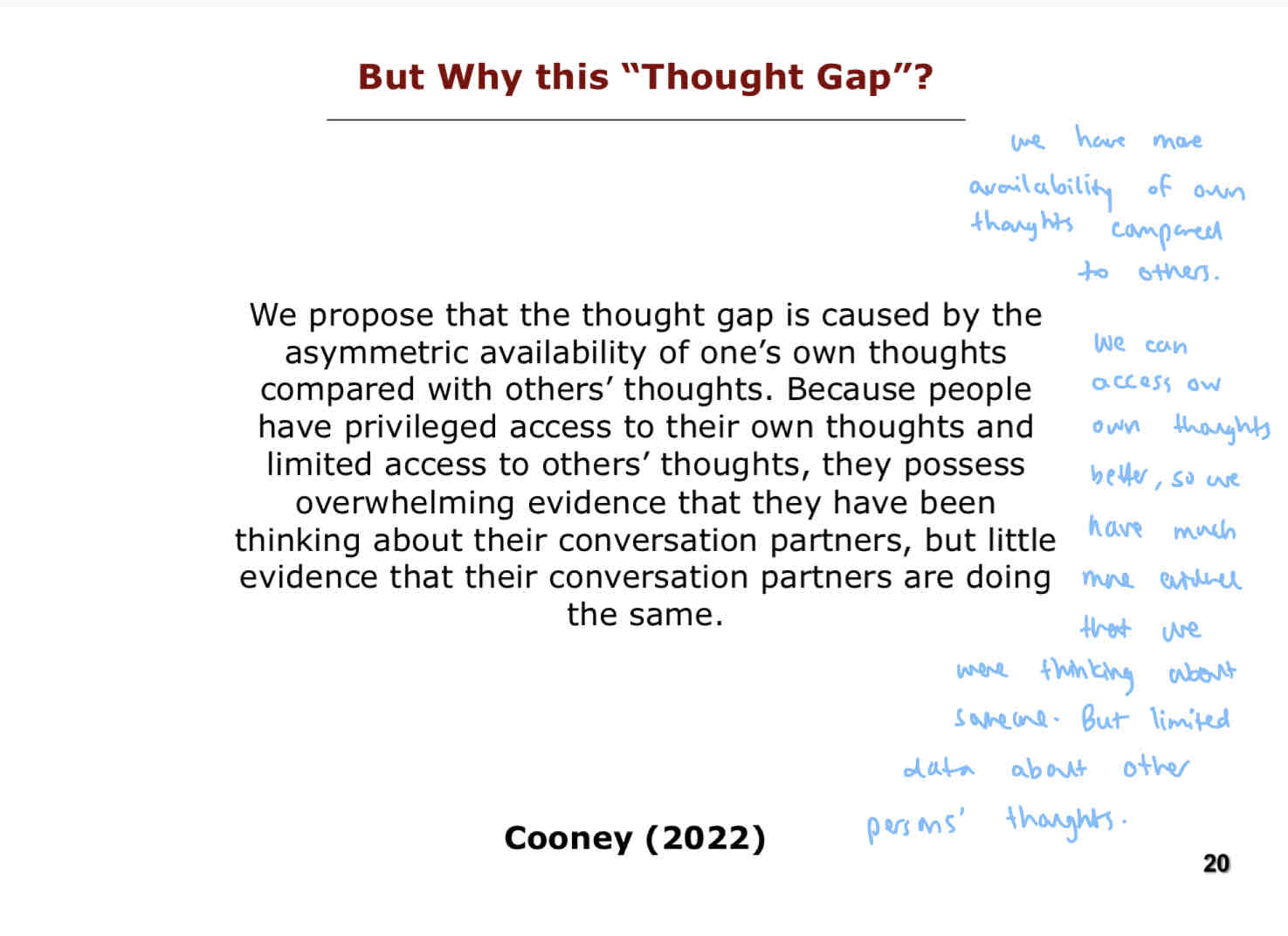
According to Cooney, why does this “Thought Gap” Exist? L19 S20
Asymmetric availability of your own thoughts compared with others’.
We can access own thoughts, but not others.
We have a lot of evidence that we have been thinking about our conversation partners, but little evidence they were thinking about us.
What were Cooney’s two predictions about the thought gap? L19 S21
Increase availability of others’ thoughts will decrease the thought gap. (By making someone think about someone else’s thoughts)
The thought gap will be moderated by how readily available one’s own thoughts are at a trait level. (Traits: Tendency to ruminate - this has individual variability.)
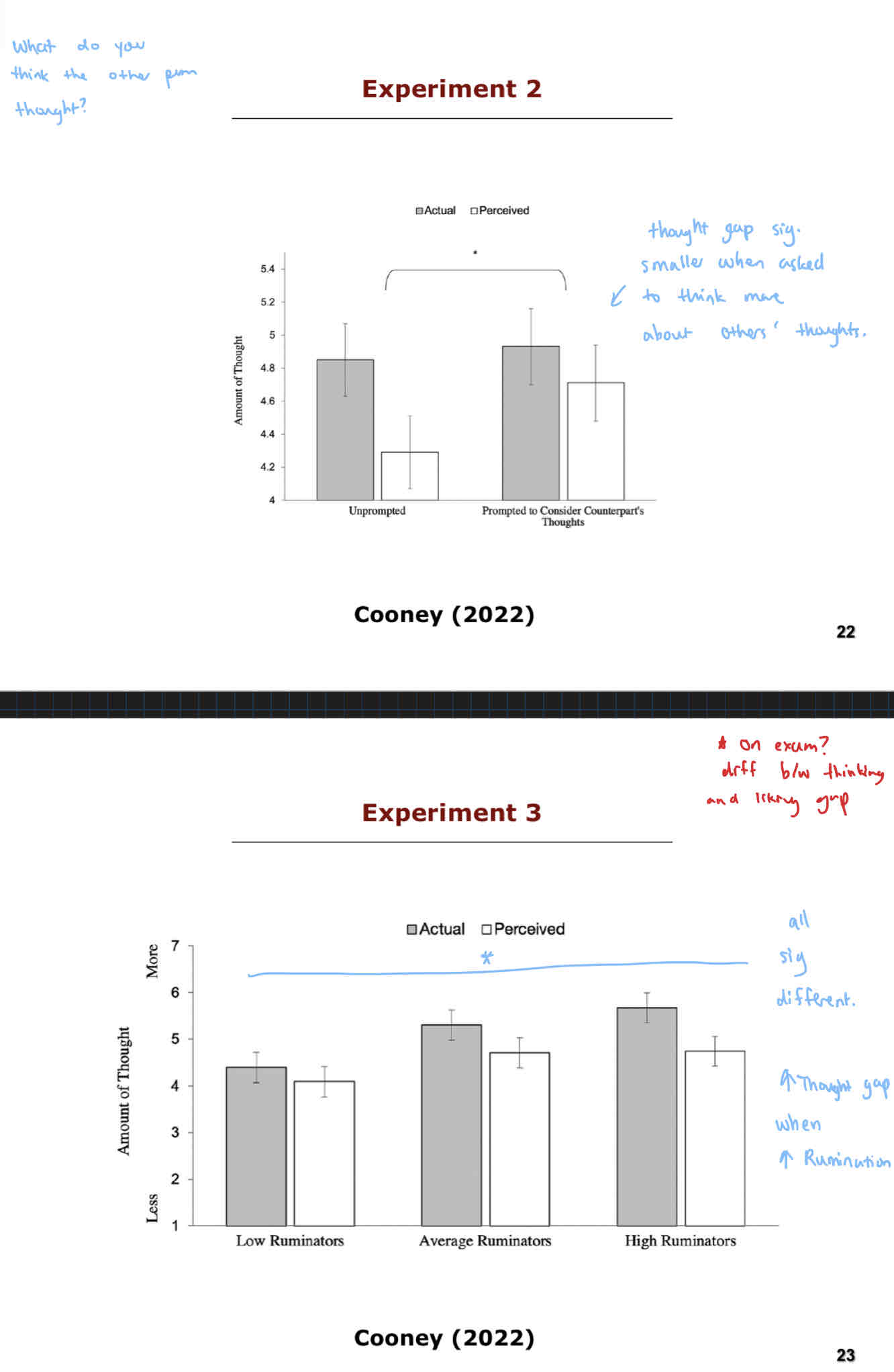
In a thought gap experiment by Cooney, they put one person in two conditions (within-subjects design):
Prompted to think about others’ thoughts
Not prompted
What did they find? L19 S22
In another experiment, they looked at the trait of rumination (low, average, high) in participants.
What did they find? L19 S23
When prompted to think about other person’s thoughts after having a conversation, participants showed a significantly smaller thought gap than when they were unprompted. (The gap between how much they thought about the other person, and how much they thought the other person thought about them, was smaller. Thought gap was in their own perceptions, not between 1 person and another.)
Low ruminators’ thought gaps were the smallest. Average ruminators’ thought gaps were significantly higher. High ruminators had the highest thought gap.
THe difference between all their thought gaps were statistically significant.
What you should be able to answer from L19:
What is the “liking gap”?
How do the “no-signal” and “neglected signal” accounts for the “liking gap” differ?
Why do we “miss” signals?
What is the “thought gap?”
How does availability of others’ thoughts moderate the “thought gap”? How does rumination tendency to moderate the “thought gap”?
LO 20: What is psychological distance and the predictions that construal-level theory makes about how it can bias our thinking, including how we think about others. L 20
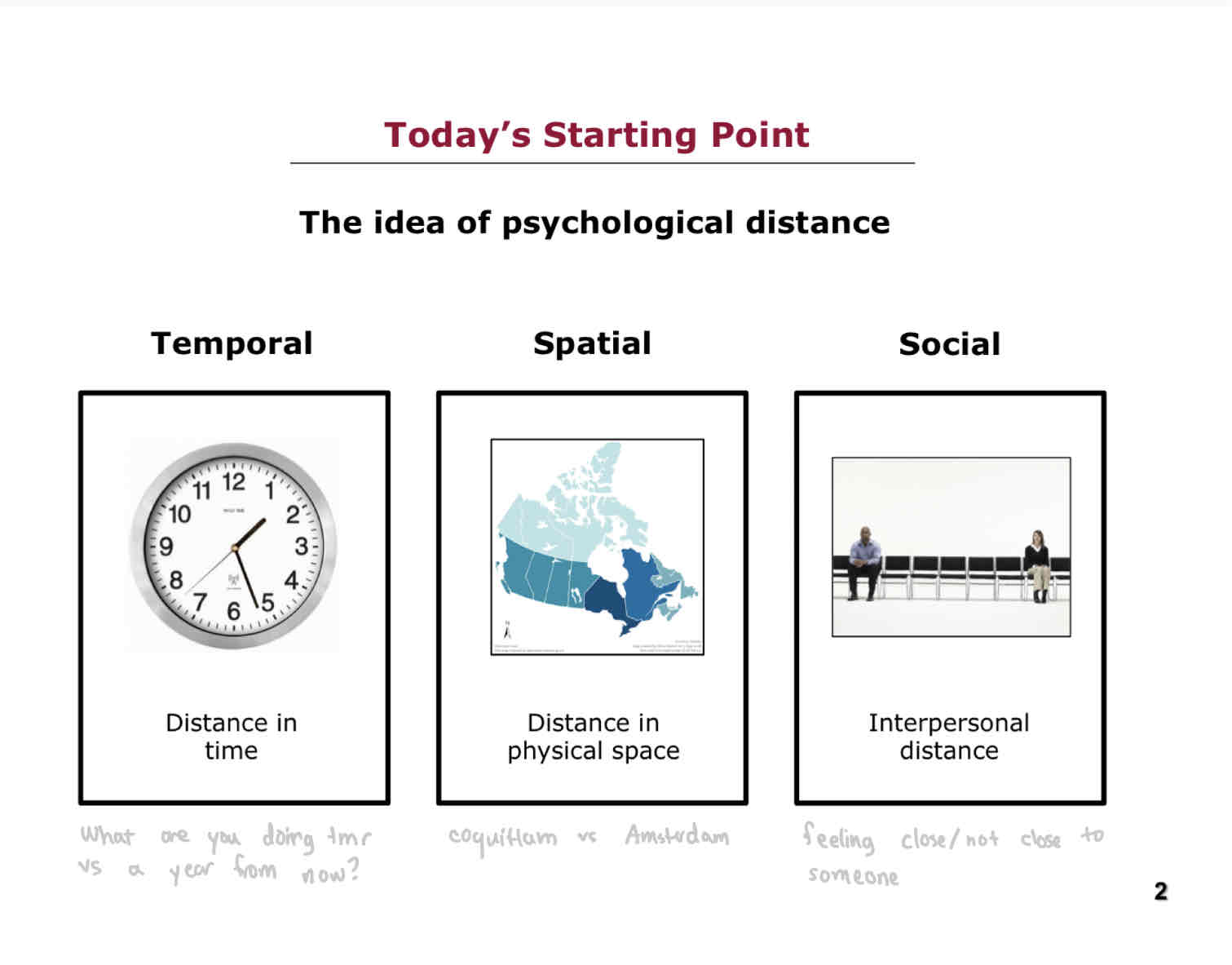
What are the 3 types of psychological distance? L20 S2
Temporal: Distance in time
Spatial: Distance in physical space
Social: Interpersonal distance; feeling socially close/not close to someone
What is construal level theory? L20 S3
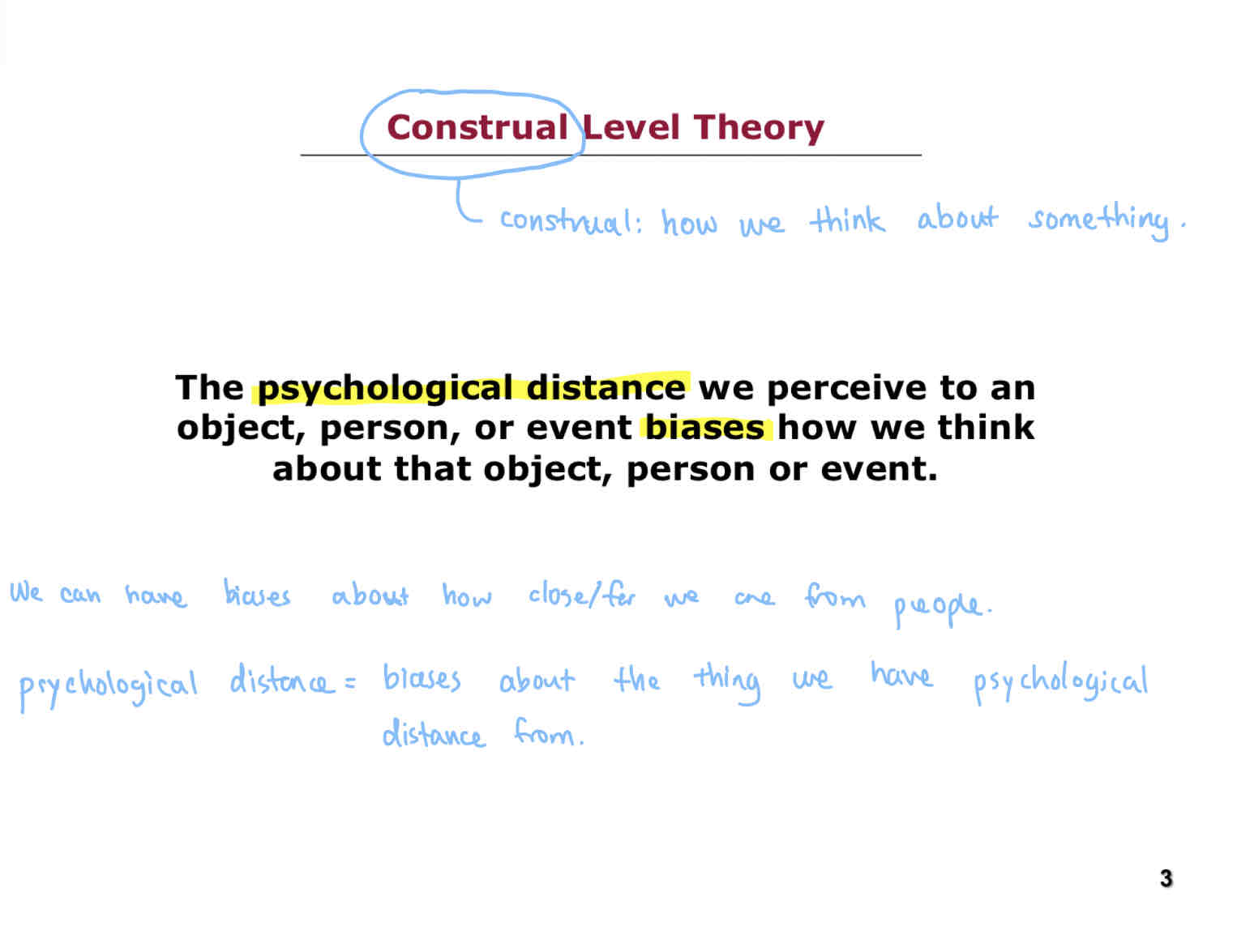
The psychological distance we perceive to an object, person, or event biases how we think about that object, person, or event.
Construal = How we think about something.
We have biases about how close/far we are from people.
Psychological distance = biases about the thing we have psychological distance from.
How do we think about events when they are close vs far? L20 S4
When close: a concrete issue
When distant: an abstract issue
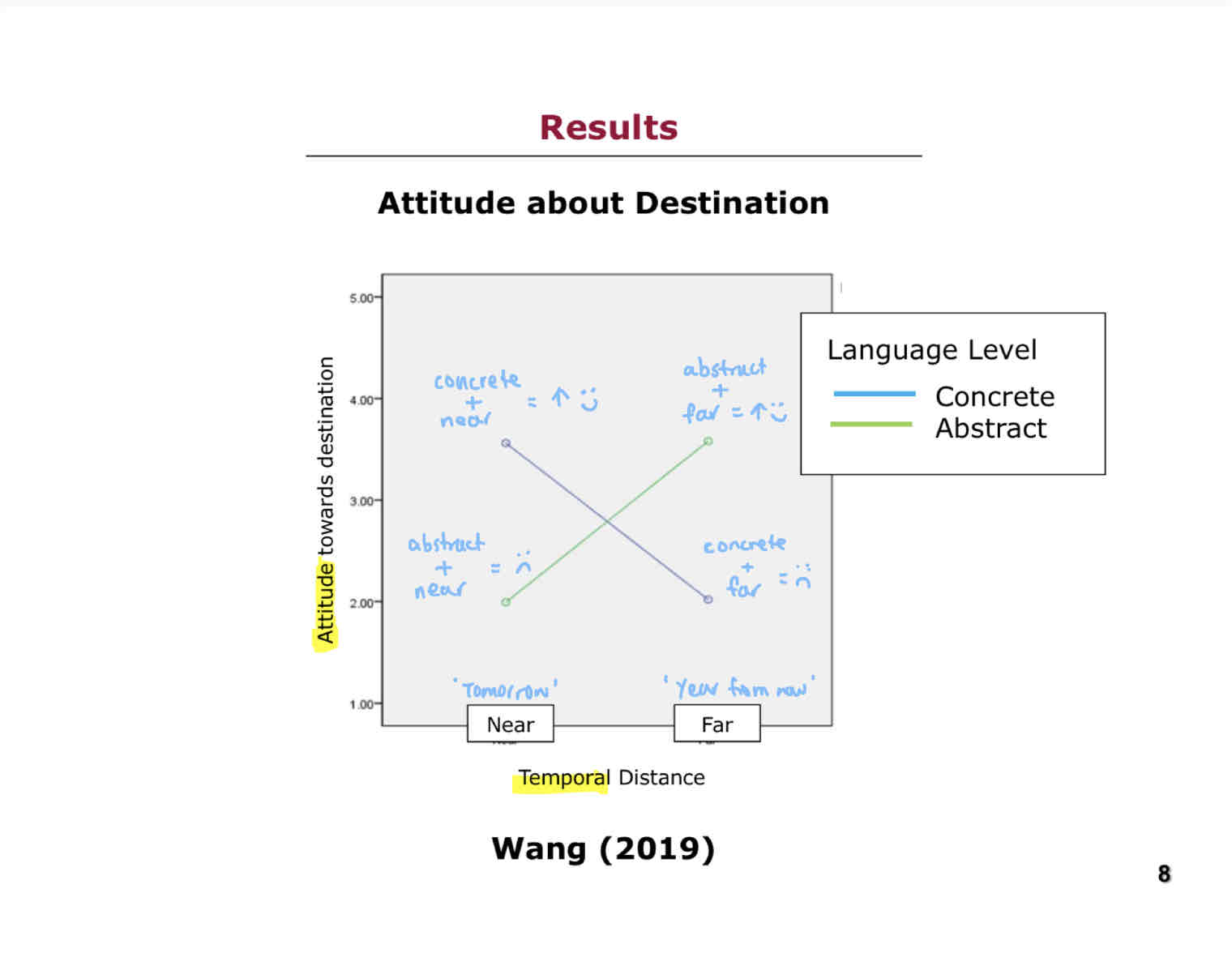
In a study by Wang (2019), participants were asked to imagine taking a vacation. Then, they were showed a facebook ad for a travel destination. Finally, they were asked about their attitude toward the ad and the travel destination.
In experiment 1, they manipulated the temporal distance: Near condition: Asked to imagine you will be travelling tomorrow, Far condition: Asked to imagine you will be travelling a year from now.
The ad message was manipulated for its language abstraction level: It was either concrete (“Calgary provides various water sports activities”) or abstract (“Calgary is a fun and exciting water sports destination”).
What were the results?
There was an interaction(?) effect between the temporal distance and the language abstraction level.
Near + abstract = lower attitude towards destination
Near + concrete = higher attitude towards destination
Far + abstract = higher attitude towards destination
Far =+ concrete = lower attitude towards destination.
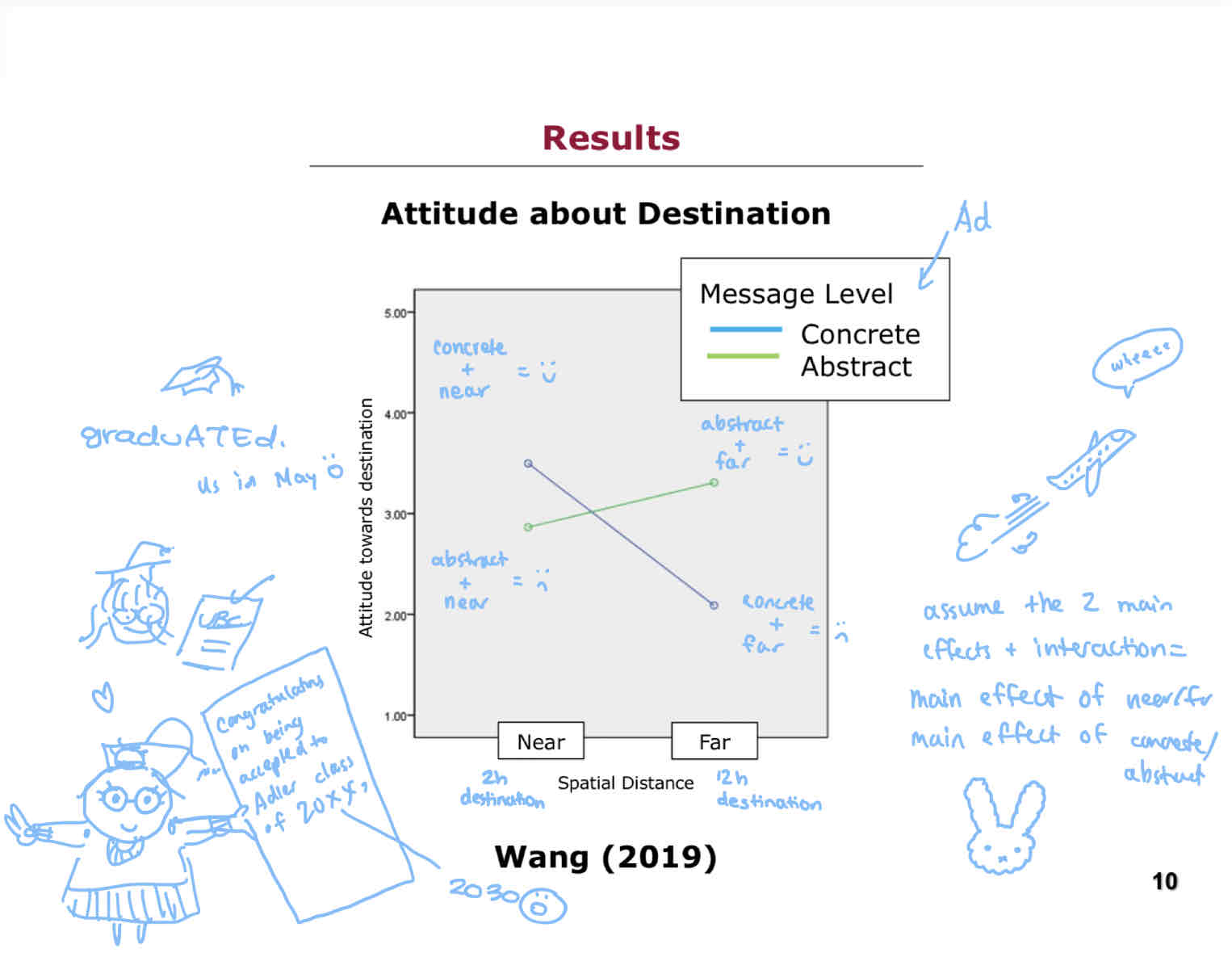
In experiment 2 by Wang (2018), where they studied travel destination attitudes, they manipulated the spatial distance instead.
Near: Asked to imagine you will be going on a trip to a nearby location where you could drive within 2 hours
Far: Asked to imagine that you will be going on a vacation to an international location where you have to take an airplane for 12 hours.
They showed concrete and abstract ads again.
What were the results?
L20 S9-10
There was a main effect of near/far and a main effect of concrete/abstract, as well as an interaction.
Near location + abstract = lower attitude rating
Near location + concrete = higher attitude rating
Far location + abstract = higher attitude rating
Far location + concrete = lower attitude rating
In a 2019 study by Rim, they explored in the ideas of construal-level theory help explain how gift-giving impacts our sense of interpersonal distance.
Participants were asked to imagine getting a gift:
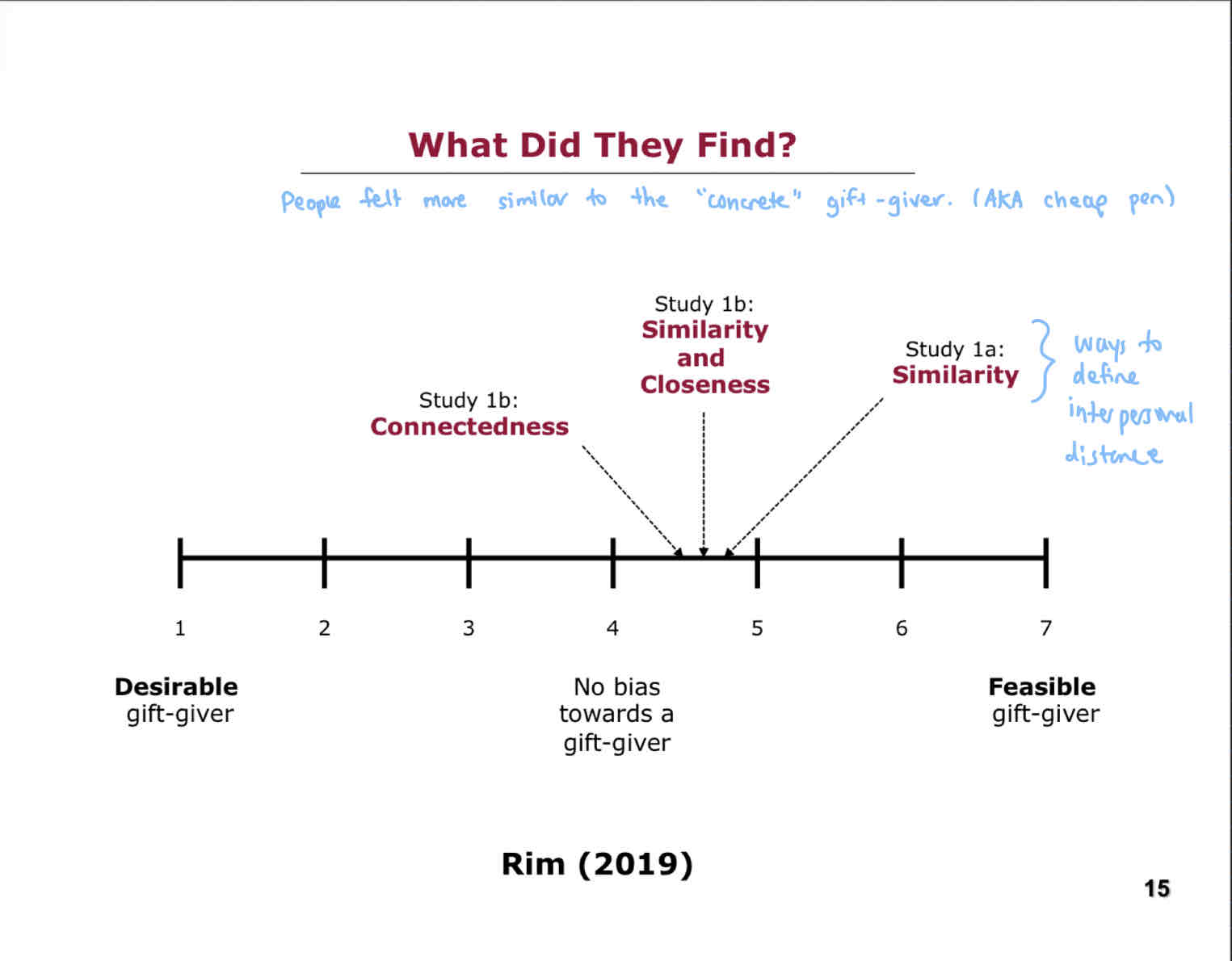
Study 1a: Asked to imagine getting a “feasible” gift (a practical and portable but unaesthetic pen) or a “desirable” gift (a fancy and attractive but heavy pen).
Participants were asked to answer which gift-giver is more similar to you, in terms of background, attitudes, and personal dispositions.
Study 1b: Asked to imagine getting a “feasible” gift (an ordinary Italian meal located 5 minutes away) or a “desirable” gift (an upscale Italian meal located 1 hour away).
Participants were asked which gift-giver is more similar to you, which you felt closer to, and which made ou feel more connected to.
What did they find?
Feasible = Concrete
Desirable = Abstract
L20 S11-15
They found that on a 7-point scale, people felt more similar, close, and connected to the “feasible” (concrete) gift-giver.
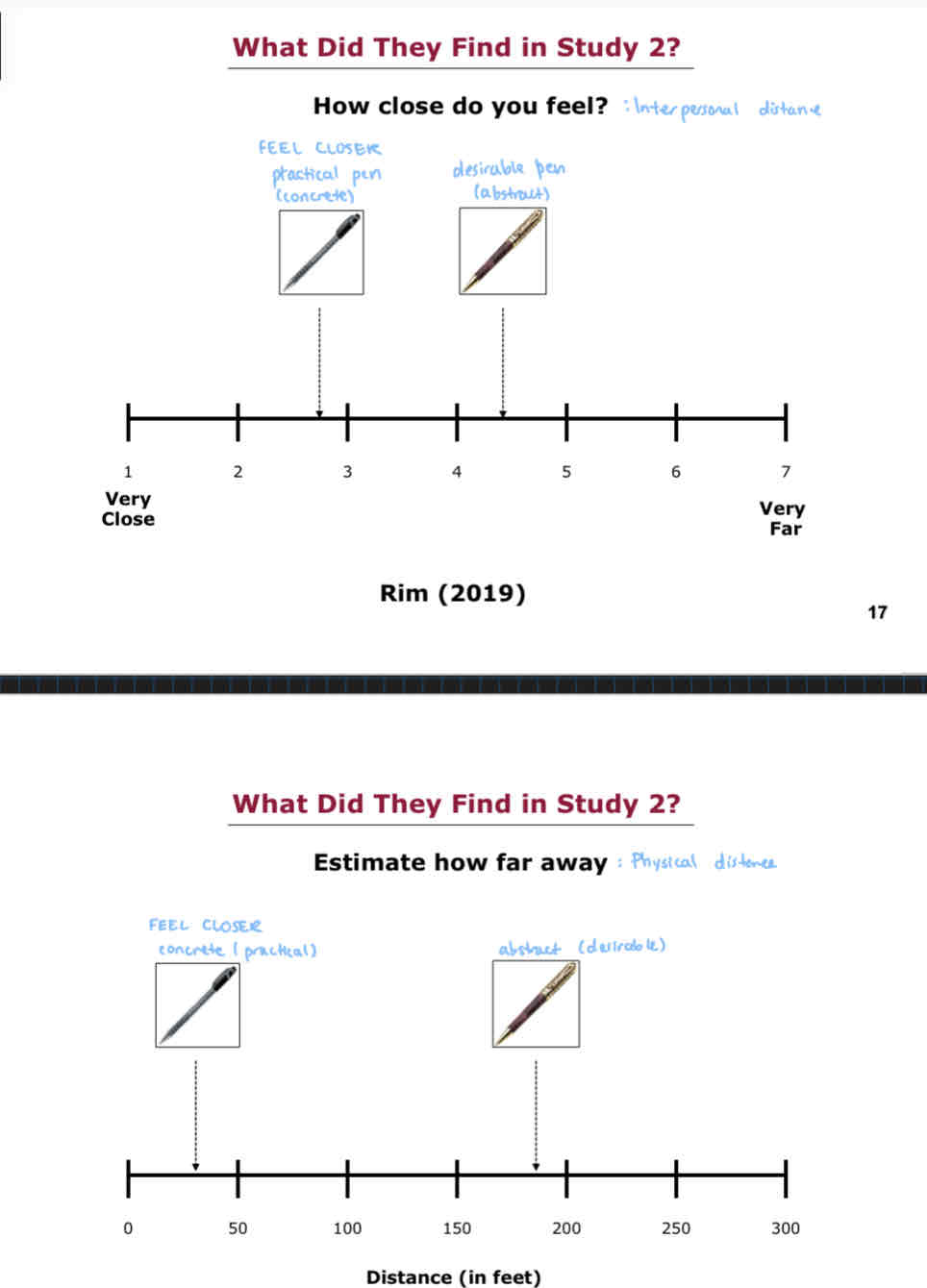
In a second study by Rim (2019), they separated pairs of people walking together on a university campus and took them to opposite ends of a campus store. Then, each person was told their partner/friend would choose a pen to give them as a giift. Their friend was informed of the pen that they chose.
Each person then rates how close they felt to their friend/partner, and estimate how physically far away they were. (DId not measure similarity.)
What did they find?
L20 S16-18
Participants felt socially (interpersonally) closer to their friend when they were told that their friend chose the practical (concrete) pen, instead of the desirable (abstract) pen.
Participants felt physically closer 9in distance) to their friend when they were told the friend chose the practical (concrete) pen) than when they chose the desirable (abstract) pen.
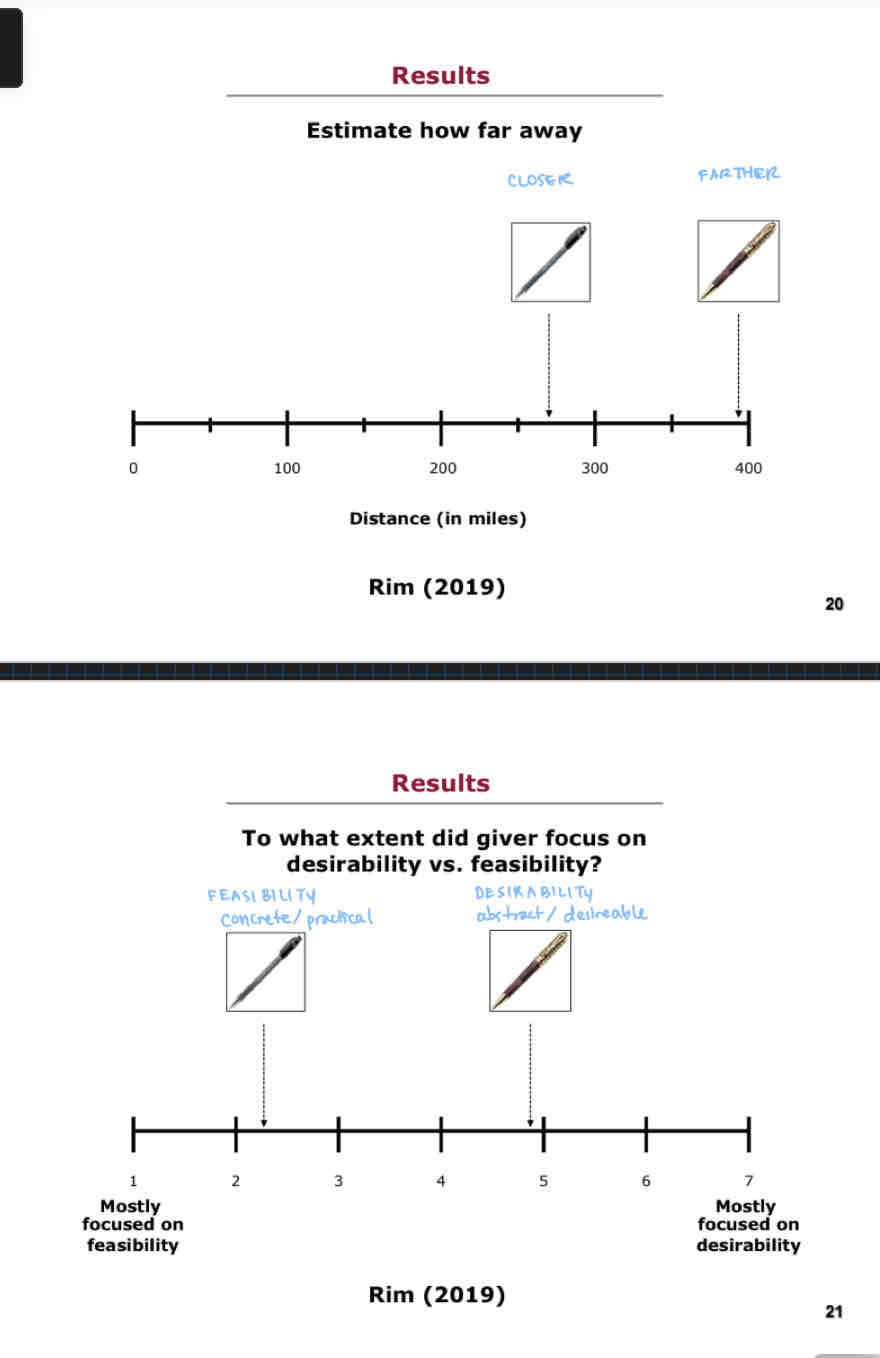
In study 3 by Rim (2019), participants were asked to first imagine receiving a pen as a gift. Then, they were was to estimate a) how physically far away the gift giver is from you, and b) the extent to which you think they focused on feasibility vs desirability when selecting the gift.
This was meant to measure if the effects from study 2 were about mentalizing about what the gift-giver was thinking. In simpler terms: How much do you think the gift giver was thinking about the gift?
What did they find?
L20 S19-21
Physical distance: Participants thought that the gift giver who gave the practical/concrete pen was physically closer than the desirable/abstract pen.
Mentalizing: Participants thought that the gift giver who gave the practical/concrete pen was more focused on feasibility. They thought that the gift-giver who gave the abstract/desirable pen was more focused on desirability.
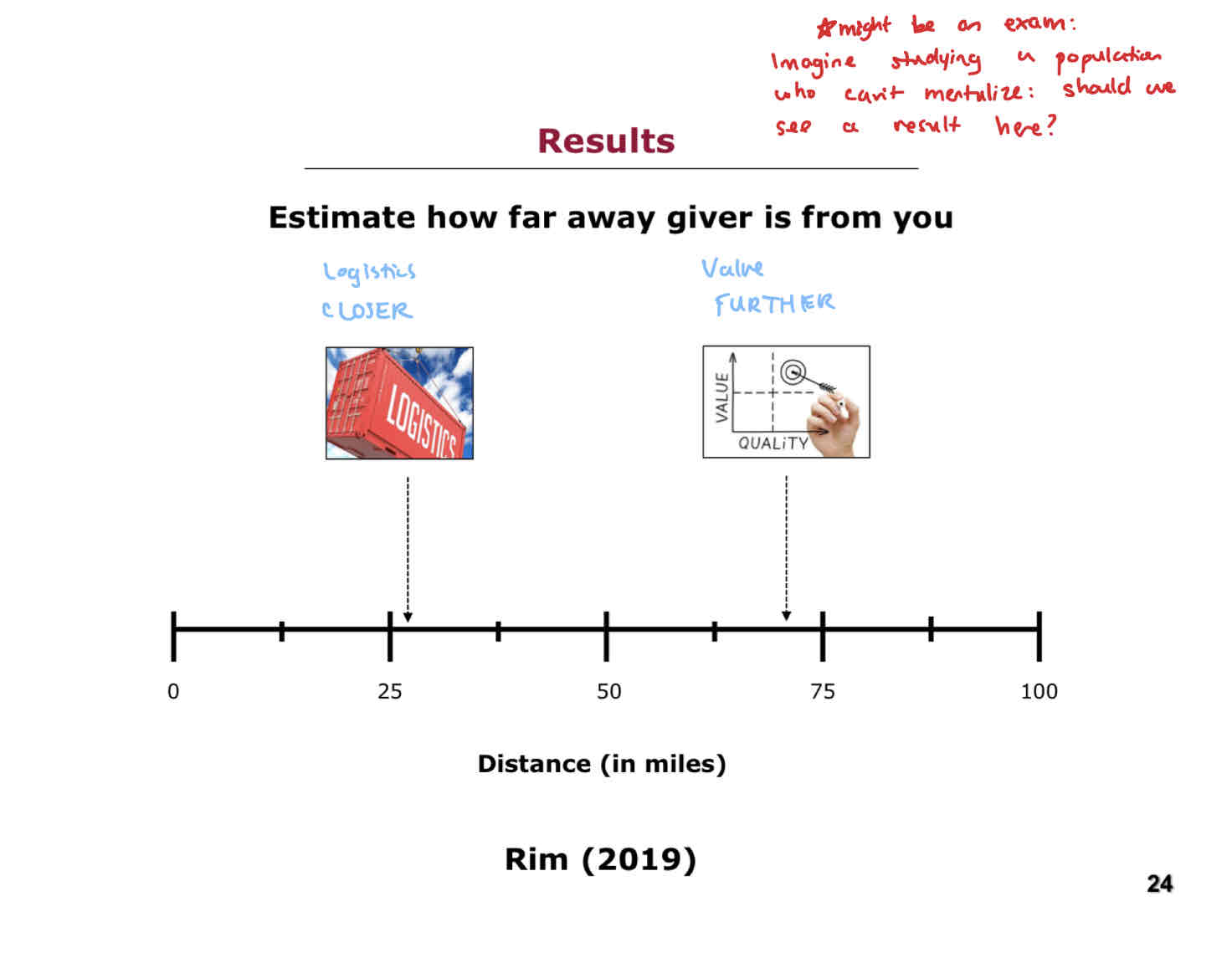
In another fucking study by Rim (2019), they fully leaned into manipulating the mentalizing.
Participants were in one of two conditions:
High-level focus (abstract): Asked to imagine being given a gift certificate to an Italian restaurant, and told the gift-giver focused on the value and quality of the gift.
Low-level focus (concrete): Asked to imagine being given a gift certificate to an Italian restaurant, and told the gift-giver focused on the logistics of using the gift.
They were asked to estimate how far away the gift giver is from you.
What were the results?
Hint for exam: What might we expect if we were studying a population who could not mentalize?
L20 S23-24
Participants estimated the gift-giver to be physically closer in the logistical/concrete/low-level focus condition than the abstract/value/high-level focus.
What you should be able to answer from L20:
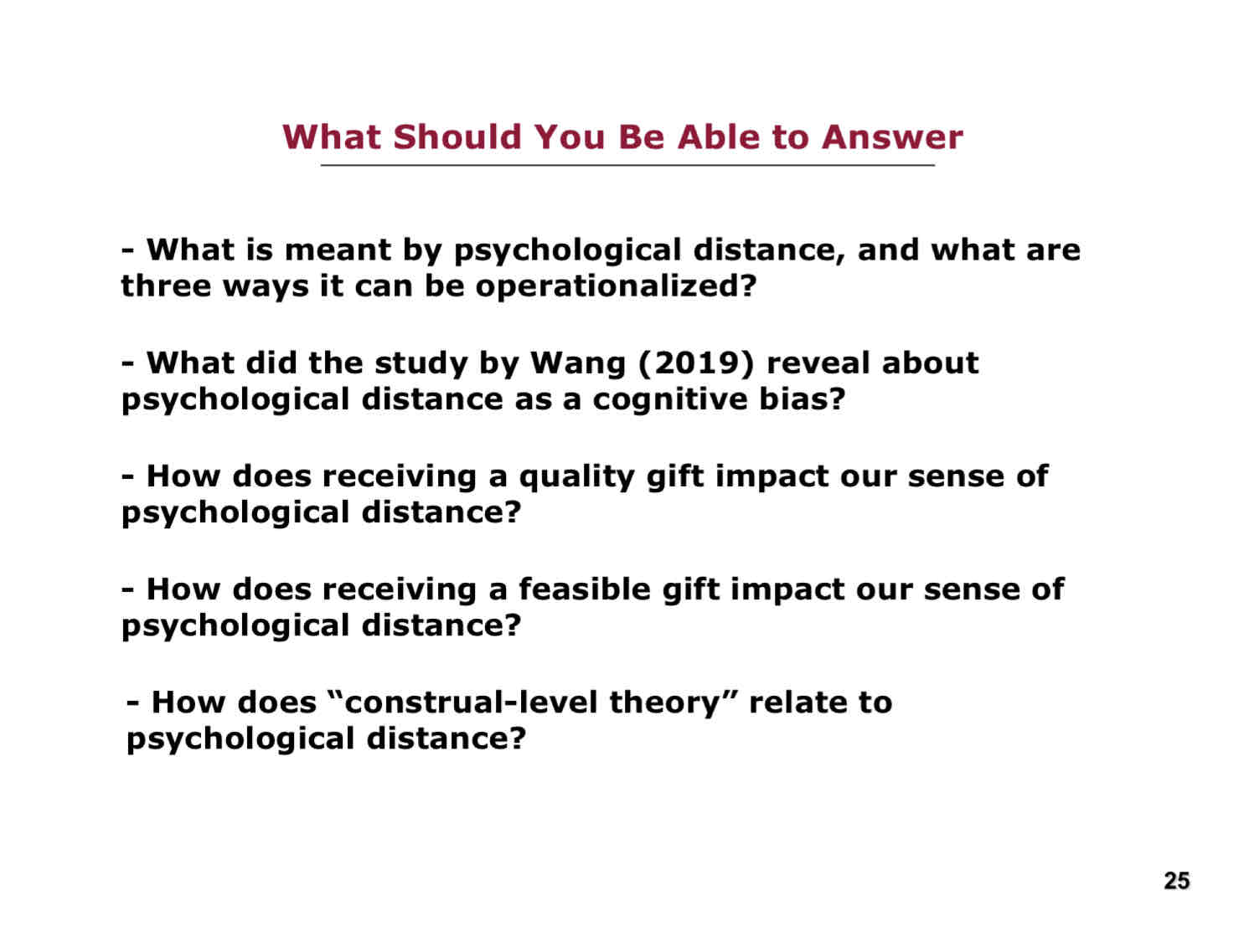
What is meant by psychological distance, and what are three ways it can be operationalized?
What did the study by Wang (2019) reveal about psycholgical distance as a cognitive bias?
How does receiving a quality gift impact our sense of psychological distance?
How does receiving a feasible gift impact our sense of psychological distance?
How does “construal-level theory” relate to psychological distance?
LO: Understand the idea of shared experiences, how it can impact our thinking, and how these impacts are modulate by social group. L21
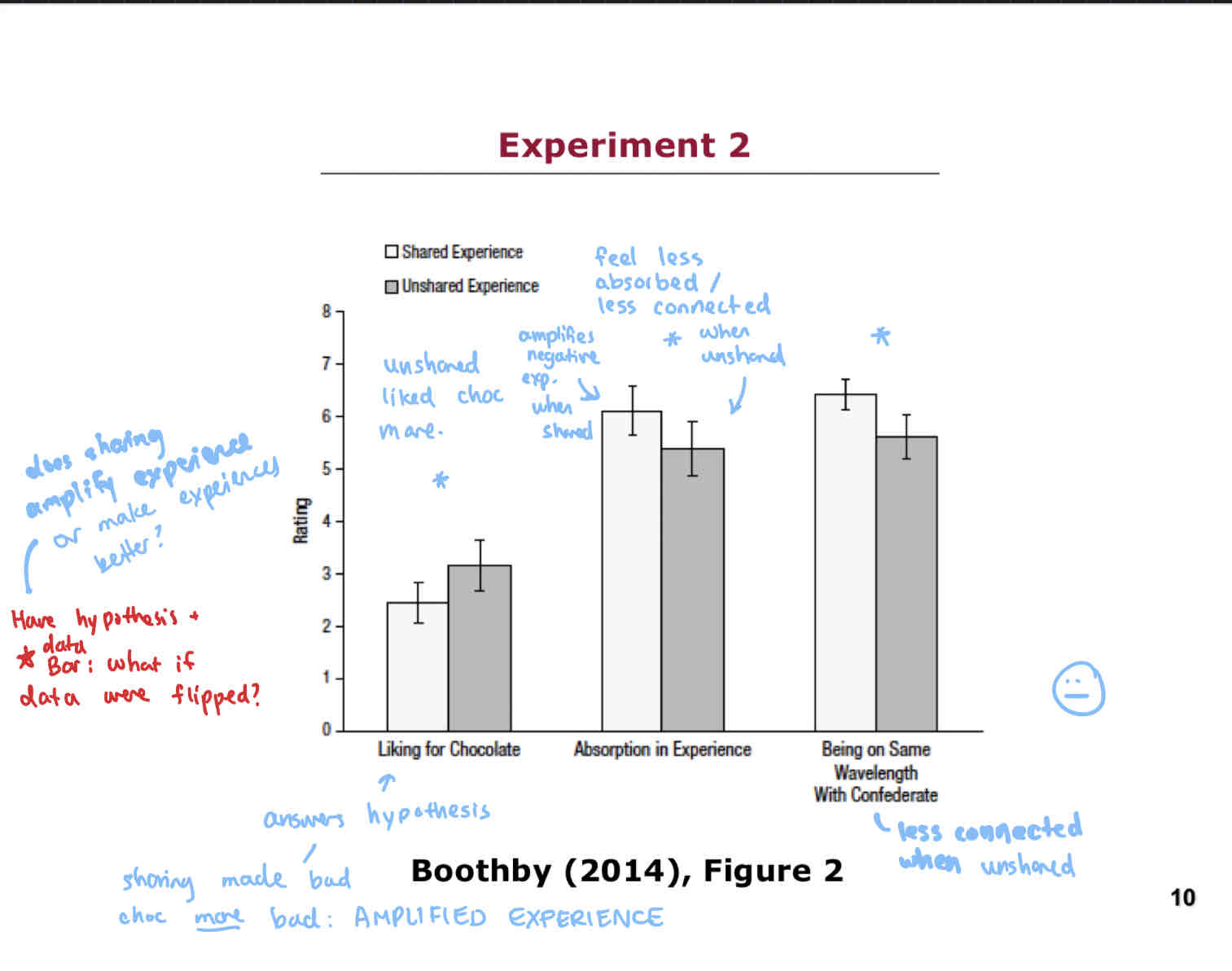
In another study by Boothby (2014), they had two within-subjects conditions:
Shared experience: Try “bad” chocolate while the confederate does the same
Unshared experience: Try “bad” chocolate while confederate does something else
They were asked to rate two things:
How absorbed you were in the experience?
How much you were on the same wavelength with your partner?
A) Why did they switch to “bad” chocolate? What was this experiment trying to determine?
B) Why ask for these two ratings?
C) What were the results?
A) The experiment was trying to determine if the shared experience amplifies either a good OR bad experience.
B) Trying to determine how much someone is mentalizing ??
C)
People who had an unshared experience liked the chocolate more. People who had the shared experience liked the chocolate less. (Significant)
People who had a shared experience were significantly more absorbed in the experience than those who were in an unshared experience.
People who wre in the shared experience reported higher ratings of being on the same wavelength as the confederate.
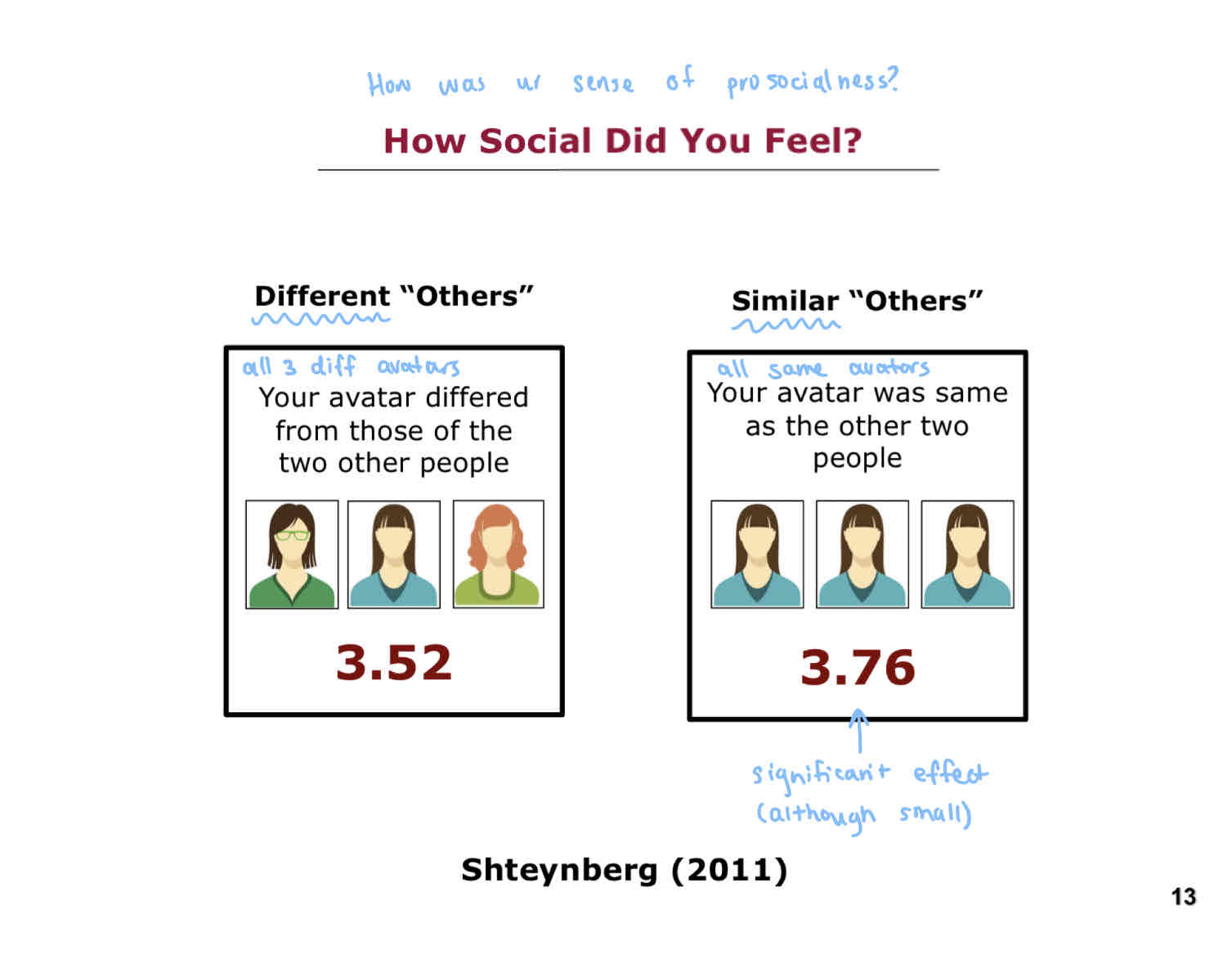
In a study by Shteynberg (2011), they first asked participants to choose an avatar for an online interaction with two people, then rate how social you felt during the interaction.
What did they find?
L21 S12-13
What’s the point? L21 S14
Participants felt significantly more social when their avatar was the same as others, rather than when others’ avatars differed.
This validates the idea that avatars can be used as a way to manipulate social group in shared attention experiments.
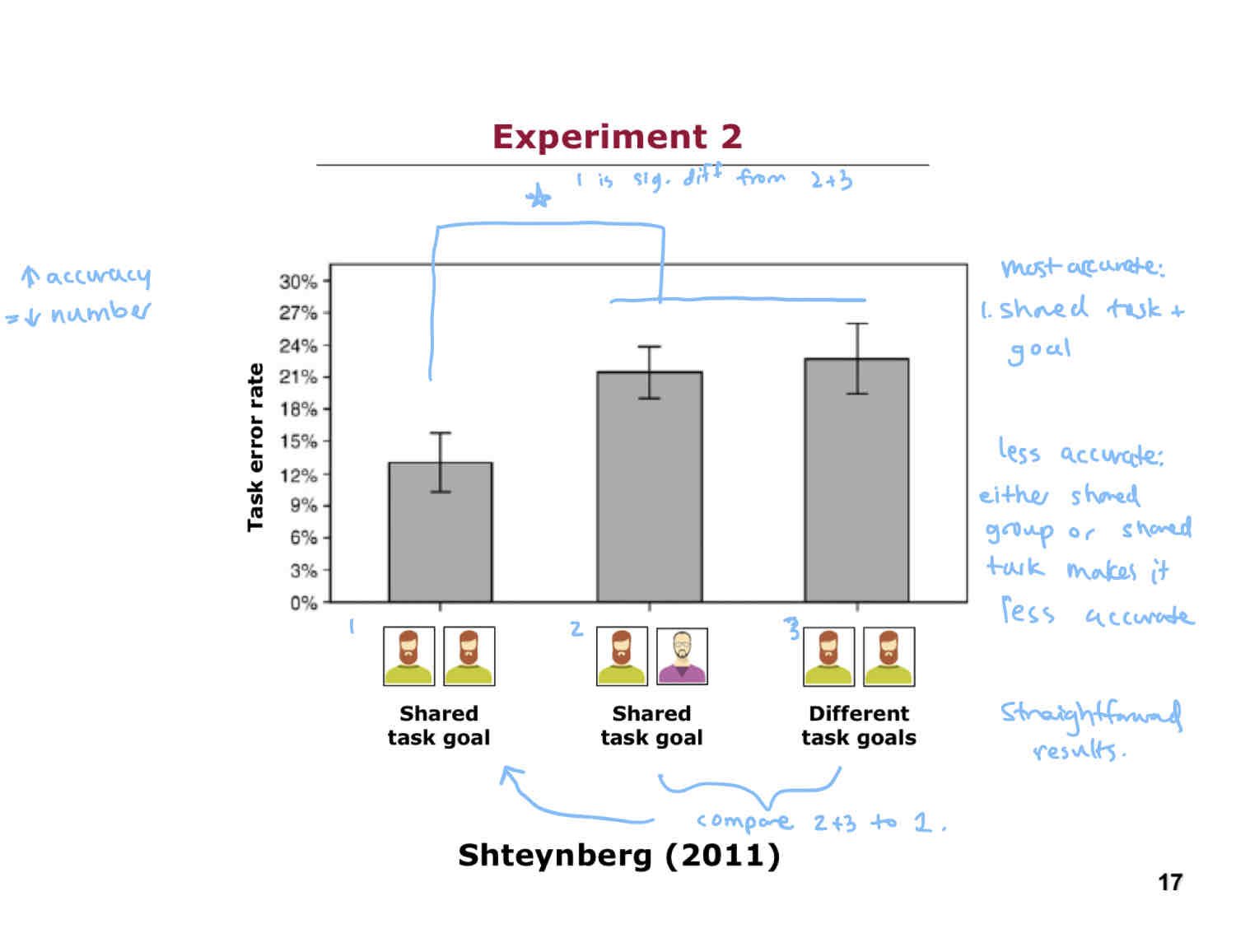
In a second study by Shteynberg (2011), everyone did the same two online tasks “with a partner”:
First, they reviewed a set of 9 nonsense words.
Second, they were asked to identify new vs old nonsense words from a new list of nonsense words
Manipulation:
Social group: The partners either had the same avatar or did not have the same avatar.
Task goal: The participants was either told they had the same goal as their partner or didnt.
What did they find?
L21 S15-17
Having the same avatar and the same task goal had the lowest error rate compared to BOTH the condition where the partners had different avatars and the same task goal, or the same avatar and different task goal.
Don’t over think the results. they are straightforward. LOL
In a 2016 study by Boothby, participants in a within-subject condition were asked to taste/rate a chocolate while a confederate does the same (shared experience) OR taste/rate chocolate while the confederate does something else (unshared experience).
They also had a between-subject condition where they manipulated social distance. In the social proximate condition, participants got acquainted with the confederate before they shared tasting. In the socially distant condition, they did not get acquainted before they shared tasting.
What did they find?
L21 S18-20
Participants enjoyed the chocolate significantly more when the experience was shared with an acquainted confederate.
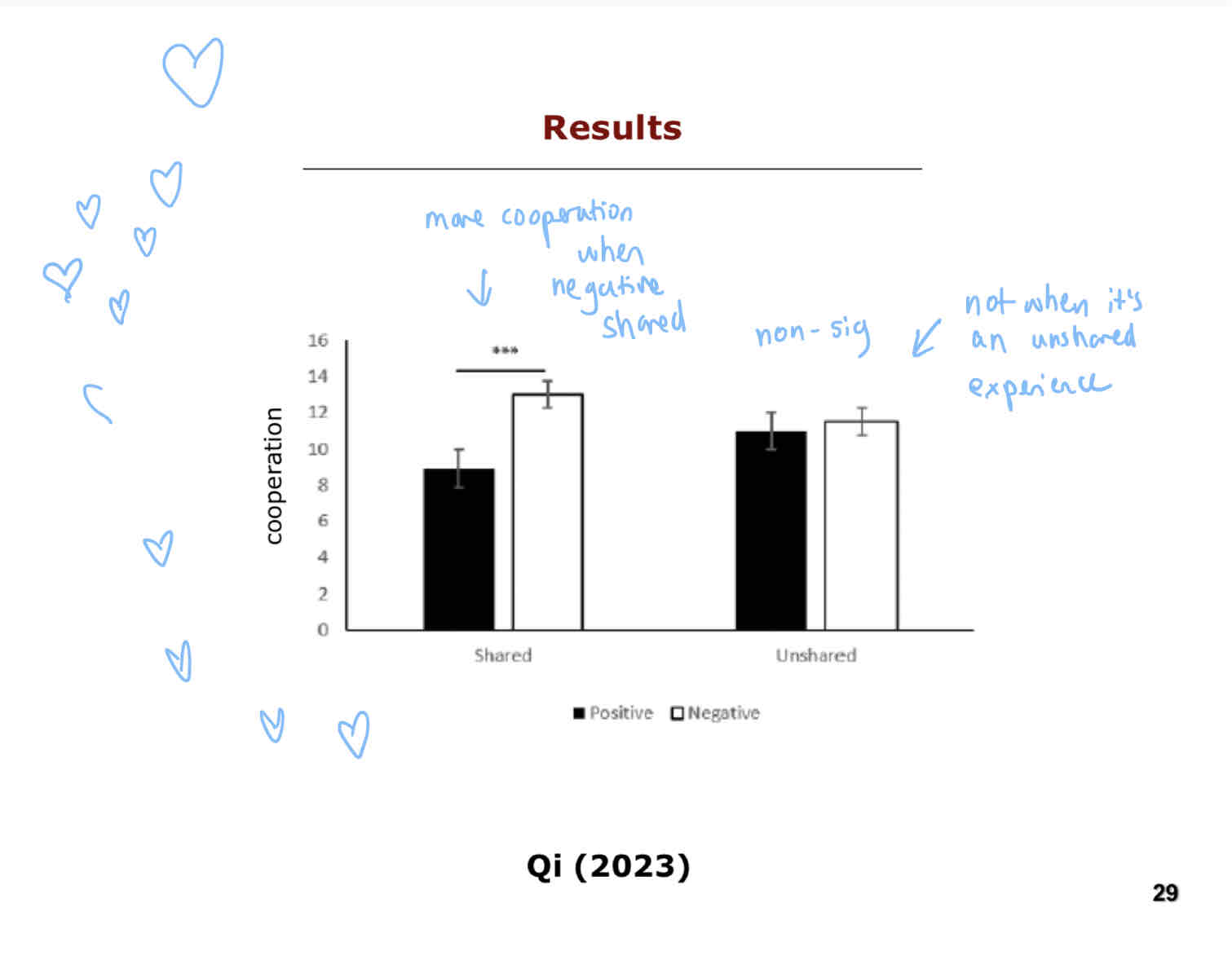
Qi (2023) investigated if people are more willing to cooperate others if we share a negative vs positive experience with them.
In experiment 1, they conducted a between-subject condition. Participants either had a shared positive experience (tasted rock candy) or a shared negative experience (tasted a pepper).
Then, the partners played a cooperation game.
What did they find?
L21 S22-25
People who shared a negative experience showed more cooperative behaviour.
(Kind of like shared enemy; robber’s cave)
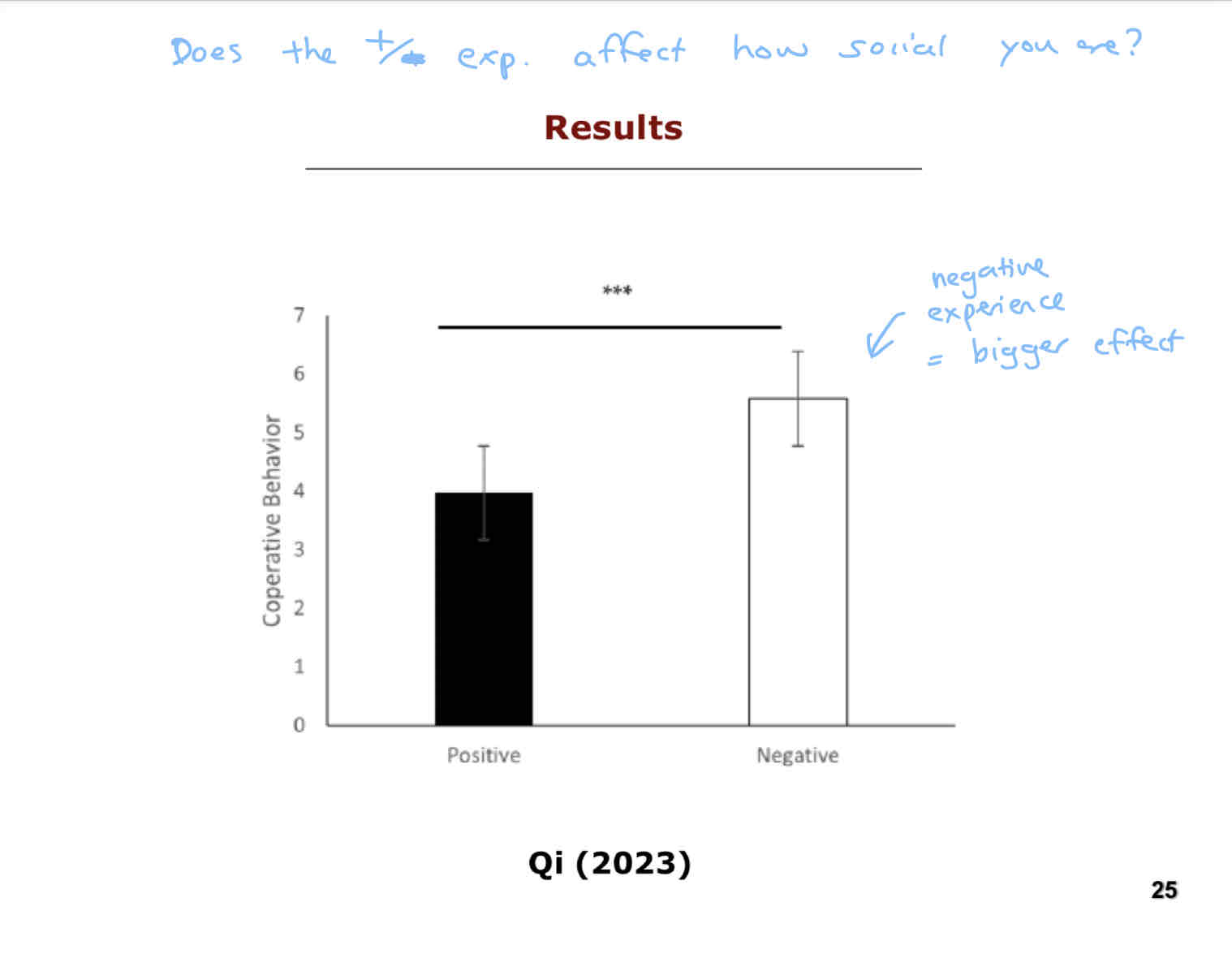
In experiment 2 by Qi, they conducted another between-subjects experiment.
Participants either had a positive experience (taste rocky candy) or a negative experience (taste a pepper).
Sharing was also manipulated between subjects: The partner either tasted the same thing (shared experience) or a different thing (unshared experience).
Then the partners played a cooperation game.
What were the results?
L21 S26-29
Participants showed significantly more cooperate when they had a negative shared experience with their partner, compared to all other conditions (including positive shared experience).
LO: Understand the concept of social power, how it can affect cognition, and how it influences the use of laughter in social situations. L22
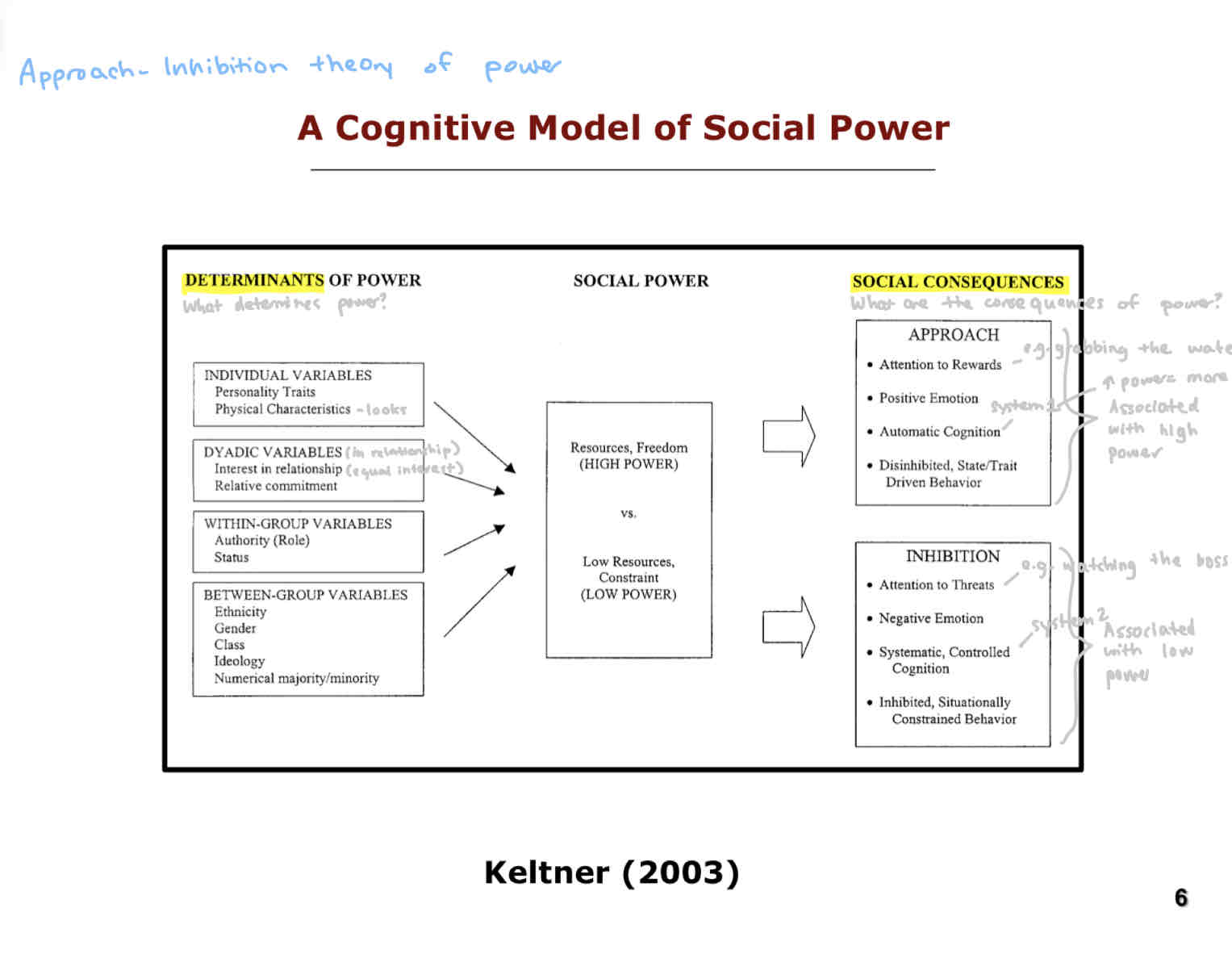
Describe the cognitive model of social power. What are the two most important aspects for our class? L22 S6
There are 3 main parts in the cognitive model of social power:
Determinants of power
Individual variables
Dyadic variables
Within-group variables
Between-group variables
Social power:
High resources
Low resources
Social consequences
Approach
Inhibition
The two most important factors for our class are “Approach vs Inhibition”.
Approach: Attention to rewards, Positive emotions, automatic cognition, disinhibited, state/trait driven behaviour.
Inhibition: Attention to threats, negative emotion, Systematic, controlled cognition, inhibited, situationally constrained behaviour.
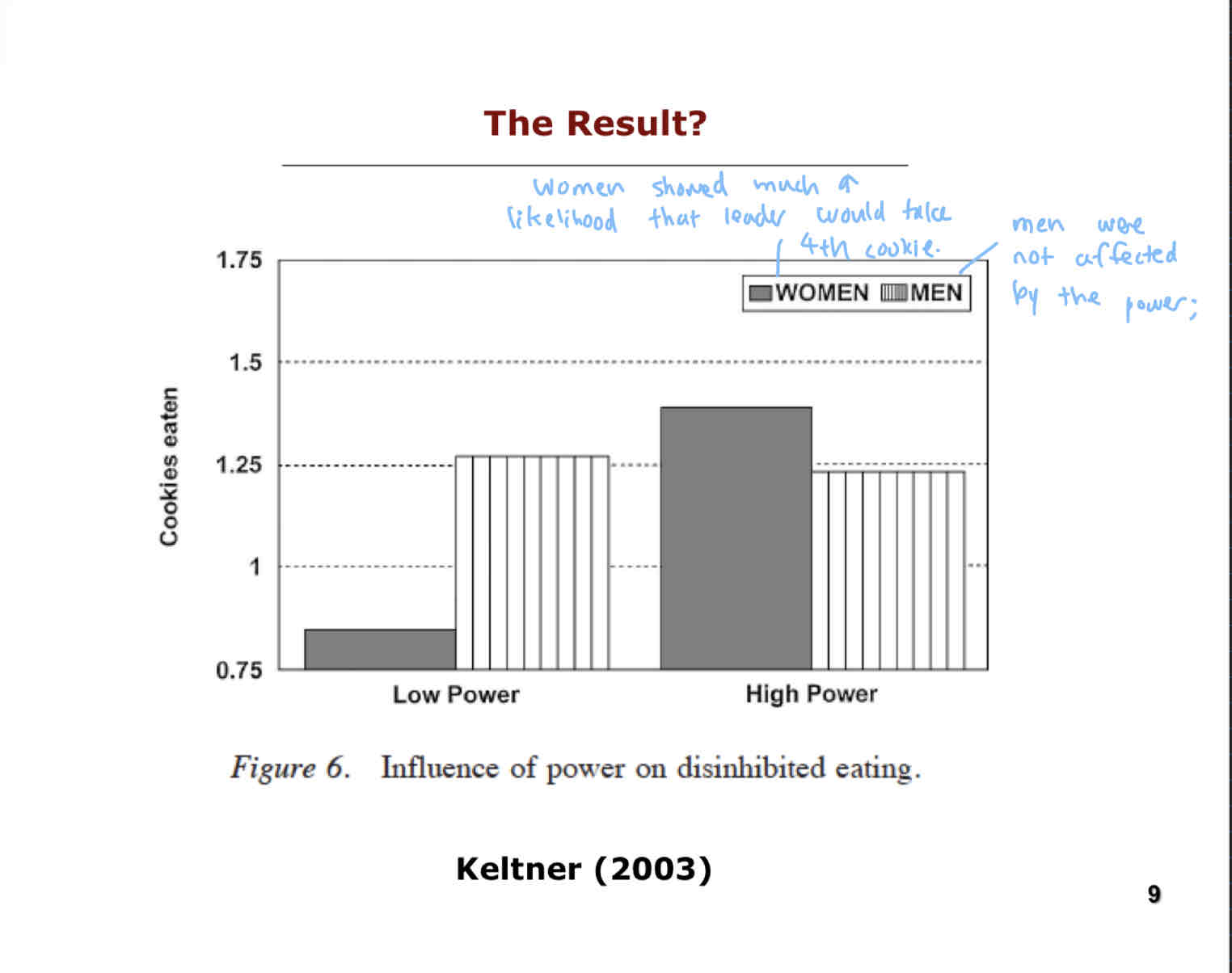
Keltner (2003) conducted a study on whether social power influences disinhibited power.
In their experiment, 3 same-sex people were brought into a room to work on a project, with one designated as the leader.
A plate of 5 cookies were left on the table. The idea was that if someone was disinhibited, they would be more likely to take a 4th cookie (taking tha last one considered rude in the cultural context.
What did they find?
L22 S8
Women showed much higher likelihood that the leader would take the 4th cookie. Men were not affected by the power dynamic.
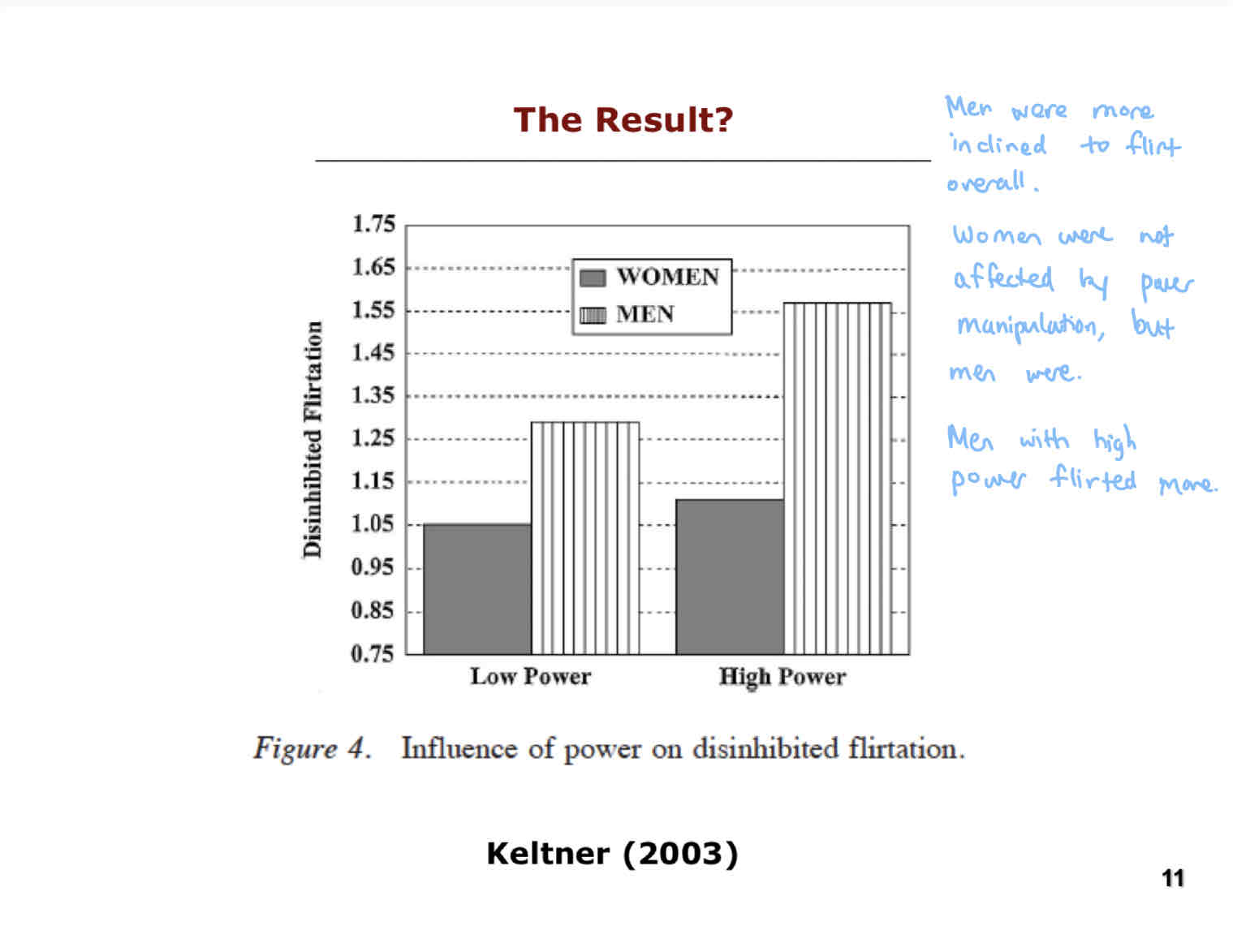
In a second between-subjects study by Keltner (2003), participants were either asked to interact with a member of the opposite sex with equal power conditions, or interact with a member of the opposite sex when one was designated as responsible for giving out extra credit points (power dynamic).
They measured measures of flirtation.
What did they find?
L22 S10-11
Men were more inclined to flirt overall.
Women were not affected by the power manipulation, but men were.
Men with high power tended to flirt more. BOO!
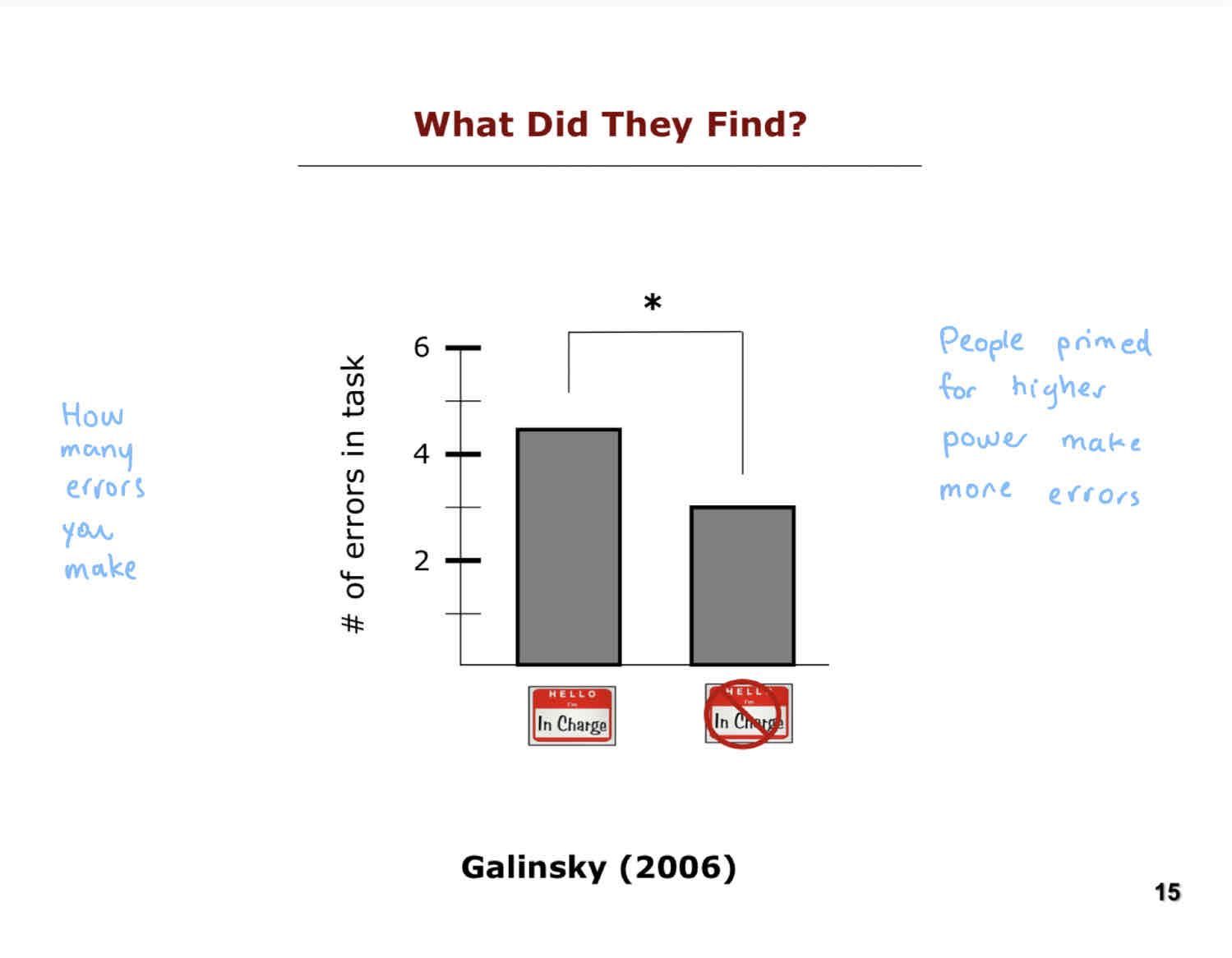
Galinsky (2006) studied if social power impacts social cognition.
They conducted a between-subjects experiment: One group was primed for high power (asked to write about a time when they were in charge of someone else). The other group was primed for low power (write about a time when someone else was in charge of you).
Then, participants were asked to do an emotion recognition task (identify emotions from faces).
What did they find?
L22 S12-15
They found that people primed for higher power tended to make more errors in the emotion recognition task.
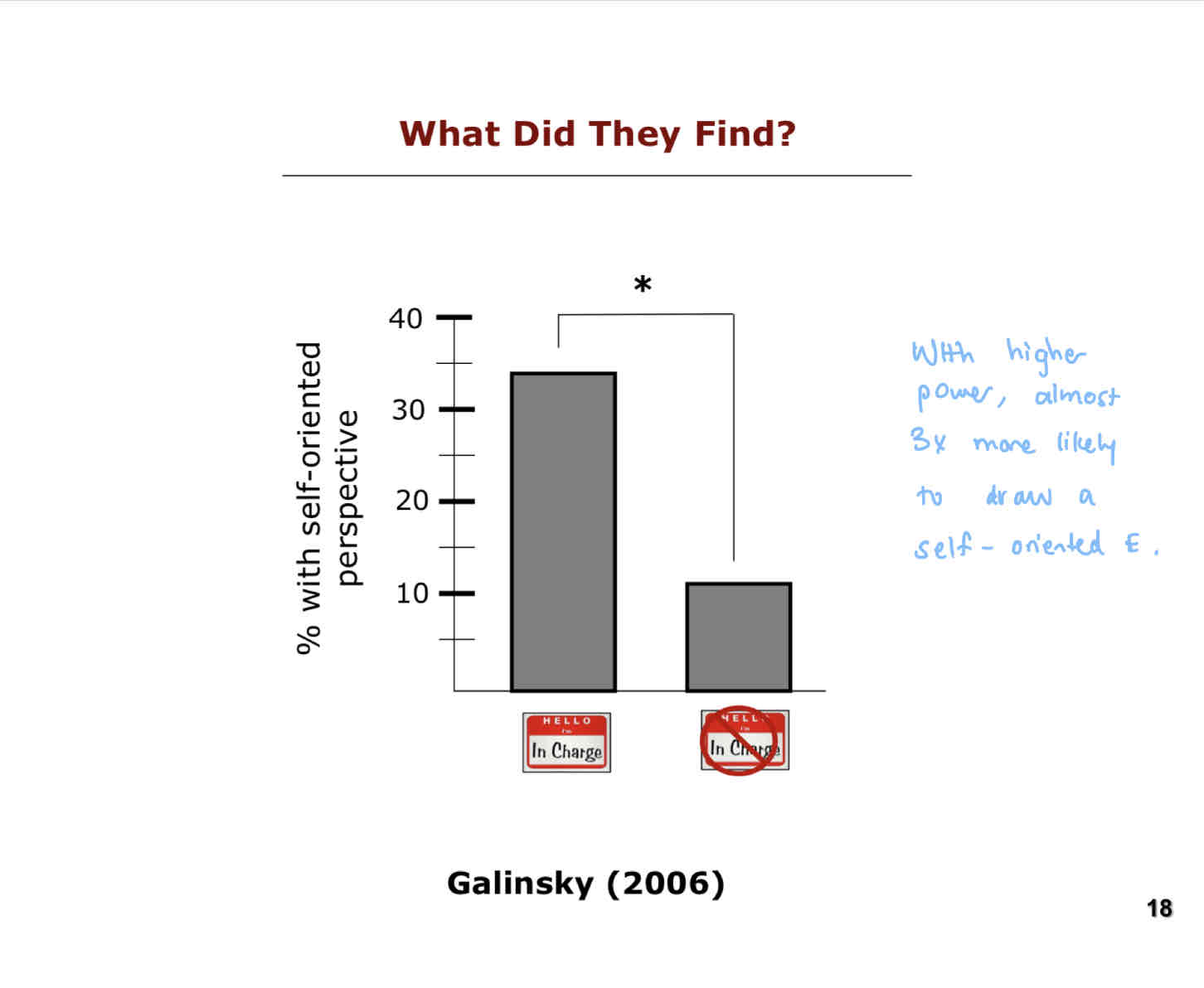
In a second between-groups design by Galinsky (2006), participants were one again primed for high power or low power (as in the last study).
Then, they were asked to write an E on their forehead.
What did they find?
L22 S16-18
When someone was primed with high power, they were much more likely (almost 3x) to draw a self-oriented E.
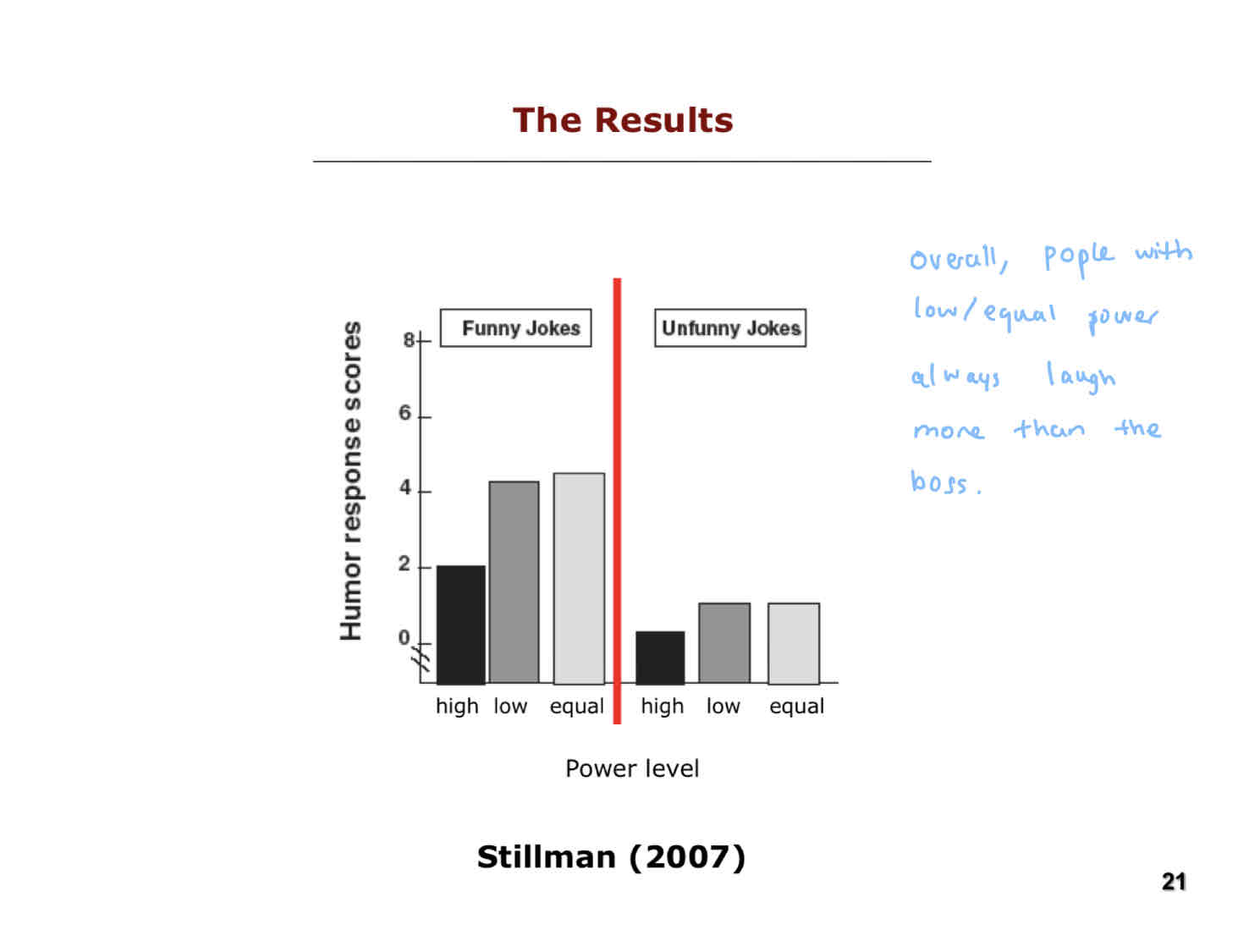
In a study by Stillman (2007), participants watched a video that included some funny jokes and some unfunny jokes.
They manipulated power status. They asked participants to either imagine:
You’re the boss, watching your subordinate (high power)
You’re a subordinate, watching your boss (low power)
You’re a coworkers watching a coworker (equal power)
What were the results?
Why were these the results?
L22 S19-20
Overall, people with low/equal power always laugh more than when they have high power.
Low power makes people more inclined to laugh because it serves to strengthen social bonds and elicit liking in other individuals, which increases the chances of gaining social support and allies. Laughter is a way to connect with someone else.
What you should be able to answer from L 22:
What factors determine social power?
How does social power affect cognition, emotion, attention, and behaviour?
How does social power affect perspective-taking?
Why do people laugh more when lower in social power, relative to higher?
How is the Rudolph video clip consistent with the Social Bonding Hypoethesis?