IB 302: Evolution Exam 1 Review
 Studied by 0 people
 Call Kai
 Learn
Learn Practice Test
 Spaced Repetition
 Match
Match Flashcards
 Knowt Play
1/191

There's no tags or description
Looks like no tags are added yet.
Name | Mastery | Learn | Test | Matching | Spaced | Call with Kai |
|---|
No analytics yet
Send a link to your students to track their progress
192 Terms
What is evolution?
dynamics for the diversification of life. The change in allele frequency over time in a population.
The nuance of evolution
There are about 30 trillion cells in the body, and mitochondria mutates 4-5x faster than the nuclear genome. Mutations accumulate quickly in somatic and smaller # germ-line cells. Another 30 trillion bacteria in the body.
Where does natural selection take place?
Natural selection occurs to an individual- the results affecting the population.
Can occur in cancer cells, bone marrow.
Who evolves?
individuals don't evolve, populations evolve. Parts of the genotype can evolve.
Human height has increased over the years- is this an example of evolution?
No. Environmental affects have played a role in energy and ability to dedicate energy to growth. The genome has not changed.
Humans are able to digest lactose more- is this evolution?
Yes. Allele frequency has changed. Provided ability to access new food source among pastoralist populations.
Is natural selection required for evolution?
No. But it is a major part of the directed effect.
The 5 Pillars of Evolution
1. Evolution happens
2. Occurs gradually (over 100s-1000s of years)
3. Speciation occurs (branching/nodes) Able to trace this back in time.
4. Share a common ancestor (ancestral primate).
5. Much is caused by natural selection due to the adaptation of an allele/genotype. Appearance of design.
What is HIV?
A rapid RNA virus where bodily fluid carries virus into mucous membrane or bloodstream.
Finds CD4 Receptors, binds, fuses, releases. Transcribes RNA into DNA and inserts itself into the nucleus where it replicates.
What is the history of HIV?
Has been around for decades. Destroys the immune system.
In 1993, killed communities of gay men, devastated global populations
(30 million deaths, 3% of deaths worldwide at the time)
Deaths had steep continuous drop after 1993.
HIV Lifecycle
1. HIV Virion, has 2 copies of an RNA genome, integrase, protease and reverse transcriptase.
2. Binding- binds to CD4 with the coreceptor, CD4 is very present in T-Cells (in the gut).
3. Fusion occurs to the host cell. Fusing the viral envelope with the host's cell membrane.
4. DNA synthesis: Uses HIV reverse transcriptase to become DNA and enter into the host cell.
5. DNA Splicing: Uses HIV integrase to then integrate itself into the hosts DNA. Splices host DNA to integrate itself.
6. Transcription: Uses hosts transcription methods to become transcribed.
7. Translation
8. New virion assembly- exits the host cell with HIV protein and assembles into new HIV virion.
9. Budding- buds out of the host cell, new envelope formed.
10. Maturation- mature virus is formed. Fully duplicated copy of the HIV virion- but could be mutated.
Acute phase of HIV
Asymptomatic but highly infectious
CD4 count above 500 cells/mm3. CD4 cells are present in the gut- where the gut has immune cells, begin to develop flu-like symptoms. CD8 cleans this up- but HIV rebounds.
AIDS
After HIV rebounds from CD8- fully destroys the immune system. Immune system being down- means the individual can develop cancers, other illnesses, etc.
AZT drug
- uses 3 inhibitors
- works against the reverse transcriptase, integrates, and maturation stages of the lifecycle of HIV (DNA Synthesis)
Replaces OH group- blocks incorporation of more nucleotides (stops elongation)
Does AZT bad for our immune system? Does it hurt us?
No, Human cells do not use reverse transcriptase, so the drug is fine if you do not prescribe too much.
How does HIV quickly evolve resistance?
RNA transcription occurs that forms mutations.
Reverse Transcriptase: ssRNA --> dsDNA means that mistakes will be made quickly (fast mutation rate)
Copy of provirus- stays behind after budding occurs. Replicates with the host cell.
Fast mutation rate and its large viral population. Many possible modifications from mutations- some deleterious, some advantageous.
Selective pressure from medications and the body's immune system --> so the mutation proliferates and evolve around that treatment sequence. Treatment becomes ineffective.
What other areas of HIV Lifecycle can medications target?
Coreceptor inhibitors, fusion inhibitors, reverse transcription inhibitors.
HAART (highly active antiretroviral therapy)
Combination of drugs effective against AIDS. Hits from multiple directions like a treatment cocktail. Increases probability of survival from AIDS- constrains the evolutionary state space of the virus.
Drug Adherence- HIV
With no treatment, no selection is applied.
Hazard ratio for drug resistance increases as percentage of prescription refilled increases.
Moderate adherence: much time to evolve, higher, higher probability for developing resistance from HIV.
Maximum Adherence: can't evolve, constant application; leads to the best results.
Are humans evolving from these pandemics?
Humans have standing evolution due to the huge populations.
CCR5-delta 32 gene variation
Gene variation in 10% of people in Europe today that makes them resistant to HIV/AIDS
HIV cannot latch onto CD4 and CCR5 to stabilize. Coreceptor does not adhere properly.
Is distribution of delta 32 gene variation attributable to HIV?
No. Europe had low HIV prevalence. Not driven due to fixation.
HIV origins/zoonosis
Used phylogenetics to track the flow of HIV; virus must survive long enough to spread and multiply- don't want the host to die quickly, but also want high contagion probability.
Got HIV from chimps, likely by butchering them for food. Similar to SIVS; been in primates for many decades.
Trahan Affair- HIV
Used phylogenetic tree to track likelihood of whether or not Nurse Trahan developed aids due to chance, or if the Doctor gave it to her in the shot.
Doctor was found guilty- traced back to same branch as the other patients of the doctor.
Endogenous retroviruses (ERVs)
remnants of retrovirus passed down vertically (from germ-line cells) from mother --> infant.
Usually from an exogenous retroviral infection (from outside source)
Two strains of HIV
HIV-1: 95% of infections, from chimps --> humans at 3 different points in the phylogenetic tree (O,N,M)
and HIV-2: more rare, less transmission- less virulent (less copies made), comes from monkeys (Group P: gorillas)
When was HIV first identified?
1959- saw HIV in a blood sample, had been occurring for a long time. Didn't have a firm establishment. Wasn't compatible quite yet.
Used a regression line to go back to 0%, first strain at approximately 1931.
Retrovirus Tradeoffs
Want to be highly contagious and spread- has emission.
But too much production is bad- kills the host. But all hosts die eventually; so needs to produce enough to bud off and infect another host.
Less virulent, but more contagious. Hard for HIV in the gut due to the immune system. Measure of transmission rate- between that and viral rate correlational. Selective Sweet spot
Gestational Period of Aids
sex --> aids
The time between infection and the development of antibodies. Approximately 1-4 weeks.
1735 Linnaeus
Systema Naturae, and the binomial system of classification
(class, order, genus, species)
Animal, plant, mineral.
Asserted that species bred true- were fixed and unchanging in characteristics.
1778 Jean Lamark
distinguished between inanimate things and living objects.
Introduced vertebrates and invertebrates.
1802: coined the term biology.
Believed all species could be linearly ordered in complexity- humans at the top.
1822: George Scrope
Volcanoes can lay down layers of rock, can be eroded over long periods of time.
Species were born and went extinct in the same, long, timescales.
Charles Lyell
Principles of Geology- delineated Eocene, Miocene, Pliocene ages.
Species in the fossil record were not progressive; against the "Chain of Being"
Plate Tectonics
Was proposed in the 1920s, but rejected.
When did Darwin have the idea of evolution?
Had the idea of evolution of species in 1837; but did not publish Origin until 1859.
Selective Breeding
The process of selecting a few organisms with desired traits to serve as parents of the next generation.
Dogs: Selective Breeding
Dogs were originally bred for function. 27 ancient dog genomes- dogs share common ancestor of wolves.
Paleolithic- have five major lineages.
Domestic dogs are the most variable sized mammalian species (40-fold size difference), but all are still able to hybridize.
What single related allele is responsible for size differences?
Plassais found the IGF-related allele (Insulin Growth Factor)
FGF22- short legged dogs.
Darwin pigeon breeding
4 billion passenger pigeons in 1800s, now extinct.
Pigeon breeding was popular in the 1800s.
Used for selection experiments.
Field Mustard, Brassica rapa Watering Response
Franks and colleagues- small herb related to turnip and broccoli rabe. Individual plants live within a single year.
Mid 1990s- seasonal rains was longer --> delayed flowering response.
Mid 2000s, drought -> early reproduction success.
Seeds from 1990s waited to flower, seeds from 04' had early flowering, hybrids were in the middle.
Vestigial Structure
remnants of an organ or structure that functioned in an earlier ancestor. Reduced in function compared to the ancestor.
Examples of Vestigial Structures
Brown Kiwi- tiny, useless wings.
Mexican tetra- populations in different caves lost sight or entire eyes.
Threespine stickleback: freshwater populations lose lateral plates and pelvic spines.
Speciation
the formation of new and distinct species in the course of evolution.
Drosophila and Speciation
Four populations evolved for a year on a starch-based diet, another four on a maltose based diet. Both diets were stressful.
Found less interbreeding between the starch vs maltose individuals. Only partial reproductive isolation (timescales required are too long)
Stages of Speciation
Single variable population --> distinguishable but interbreeding subpopulations --> distinct populations with limited interbreeding --> reproductively isolated populations = species.
Speciation can be bidirectional, reproductive isolation may be genetically based.
Pre and post-zygotic factors for isolation.
Stickleback and Speciation
Smooth array of phenotypes: interbreeding population, distinguishable.
Occasional mating between benthic and limnetic individuals (bottom or higher water column foods)- limited interbreeding
Sex Chromosome evolution; rare hybrids sterile; no interbreeding occuring.
Extinction and Succession
patterns we would predict if present-day species are descended with modification from ancestors that lived before them in the same region.
Diprotodon and Wombats
Glyptodon and Pygmy Armadillo
living transitional forms
Show a mix of features, including traits typical of ancestral populations and novel traits seen later in descendents.
Example of living transitional forms
Leaping Blennies: Terrestrial form never voluntarily go into the water. Just above high-tide line; They breathe air through gills and skin; Excellent climbers
Rockskippers
Aquatic blenny; do not voluntarily leave the water; breathe air via gills/skin; can fling.
Amphibious Blenny: living transitional form; feeds on land at low tide; stays close to water; breathes air via gill/skin, can sort of jump.
All species likely derived from a shared, aquatic ancestor.
Fossil transitional forms
Archaeopteryx: crow sized animal from 150M years ago. Modern flight feathers.
Reptilian skeleton: teeth, three clawed hands, long bony tail.
Living form between a dinosaur and a modern bird (crow).
Living descendants of a common dinosaur ancestor.
structural homology
The study of similar structures in different species. Derived from the same bones- different functions.
Non-homologous similarities
Great white shark and orca killer whale.
descent with modification
each living species has descended, with changes, from other species over time. Nested set of shared traits.
Age of the Earth
Many billions of years of earths history.
Early geologists used relative dating by comparing geological strata.
Modern work uses radiometric dating
Radiometric dating
Uses unstable isotopes of natural occurring elements that decay. Measured in half life unit.
Can be used to cross check time estimates.
Part of sampled earth.
Year Estimates of Isotopic Atoms- Radiometric Dating
Rhobidum --> Strontrium (10 million-4.6 billion)
Uranium --> Lead (10 million - 4.6 billion)
Thorium --> Lead (10 million - 4.6 billion)
Potassium --> Argon (100,000 --> 4.6 billion)
Carbon --> Nitrogen (100-100,000)
What is fossilized poop called?
Coprolite
What is natural selection?
Differences in reproduction and survivorship related to heritable characteristics.
A difference, on average, between survival and fecundity of different phenotypes.
IS NOT EVOLUTION.
The Genesis of the Idea of Natural Selection
1813 (Wells): explain how human populations in different continents differed in phenotypes/disease resistance.
1831: Farming trees for lumber (Matthew)
1858: Evolution by natural selection (Wallace) --> Published his papers with Darwin.
Remained skeptical until 20th century.
Gregor Mendel's work was rediscovered in the 1900s- had modern synthesis in the 1930s.
Artificial Selection
Selection by humans for breeding of useful traits from the natural variation among different organisms (same with dogs): Used for plants as well.
Example of Artificial Selection: Tomatos
Wild Tomato --> Domestic Tomato
Bred for size and transportability; but it also ruined the flavor of the tomato.
Can also be bred for flavor of the tomato. (Improve desired tastes)
Requirements of Natural Selection in the Wild
1. There is variation in phenotype.
2. The variation is inheritable.
3. Differential reproduction or survivorship
4. Nonrandom survivorship
Differential Reproduction
based on a purely environmental trait. Hunger --> what food is available.
Evidence for Change in Beak Shape: Grant's Galapagos Finches
Studied the finches since 1973- 13 species of finches, all closely related.
Known for variation in beak morphology.
Most eat a variety of seeds.
Focused on the medium ground finch on Isla Daphne major- tagged and tracked before and after a major drought.
Measured series of traits: all showed variation. The beak depth was highly heritable (slope is approx. 1)
Differential survivorship due to starvation- average beaksize changed (Directional Selection)
Who does natural selection act on?
Natural selection acts on individuals, consequences occur in populations. Individuals do not change in response to selection, but suffer from the impacts of selection (life or death).
Acts on phenotypes.
What traits does selection act on?
Acts on existing traits.
But new traits can evolve; if advantageous can become fixed due to natural selection.
Important Details of Natural Selection
Not forward looking: cannot anticipate the future.
Does not lead to perfection: can push a population in multiple directions.
Natural selection is nonrandom, but it is not progressive.
Acts on individuals, but not for the good of the species.
What does a phylogenetic tree represent?
Represents many generations of the populations, multiple populations connected by gene flow, or lineage splitting (speciation) events
First described by Linnaeus in Species Plantarum- Shepheard's Purse flowering plant
Tips or Leaves
end points of the branches, representing the individual taxa (species, population) being analyzed. "Terminal" points of evolutionary lineages.
Node
A branching point- an ancestral lineage splits into two or more descendant lineages. Represents common ancestors and relationship between them and their descendants.
Internal Branch
connects two nodes
Terminal (External) branch
connects a tip/leave and a node.
Monophyletic Clade
a subset of a phylogeny that contains an ancestral node and all taxa descended from that ancestral node.
Can be separated from the root by a single cut.
(one, single, only)
Sister Taxa
two descendants of a single node.
Non-monophyletic (Paraphyletic) Clade
Contains an ancestor and some of the descendants. Requires more than one cut to separate the root.
(beside, alongside, closely related to)
Polyphyletic Clade
a paraphyletic clade that also excludes the ancestor.
(many)
Rooted vs unrooted trees
Rooted Tree = Includes a branch to represent the most common recent ancestor of all taxa in the tree
Unrooted Tree = Tree where the location of the root node is not shown (and may be unknown)
- Used to reduce mathematical complexity
- Has no directionality- evolutionary distances remain the same.
How do we root a tree?
Polarize the tree using an outgroup
Many different ways to root the same tree (follow parsimony: simplest explanation)
Different Styles of Phylogenetic Trees
Diagonal Tree, Rectangular Tree, Circular Tree, etc.
Character
A heritable feature that varies among individuals. States are the particular variety that a species has. Change in species as they evolve along a phylogeny.
Outgroup
retain the ancestral state for all the characters used in the analysis. Could be a putative fossil ancestor (extant species) or basal species or genetic state.
Rule of Parsimony
the simplest theory that explains all the evidence is the best one
Identify characters and assume character state changes only occurred once and were never lost.
Pleiomorphism
known ancestral characteristics
Synapomorphies
shared derived characteristics
Apomorphies
derived character states.
Did feathers initially evolve as an adaptation to flight?
No. Evolved rudimentary feathers from Dinosaur --> Sinosauropteryx
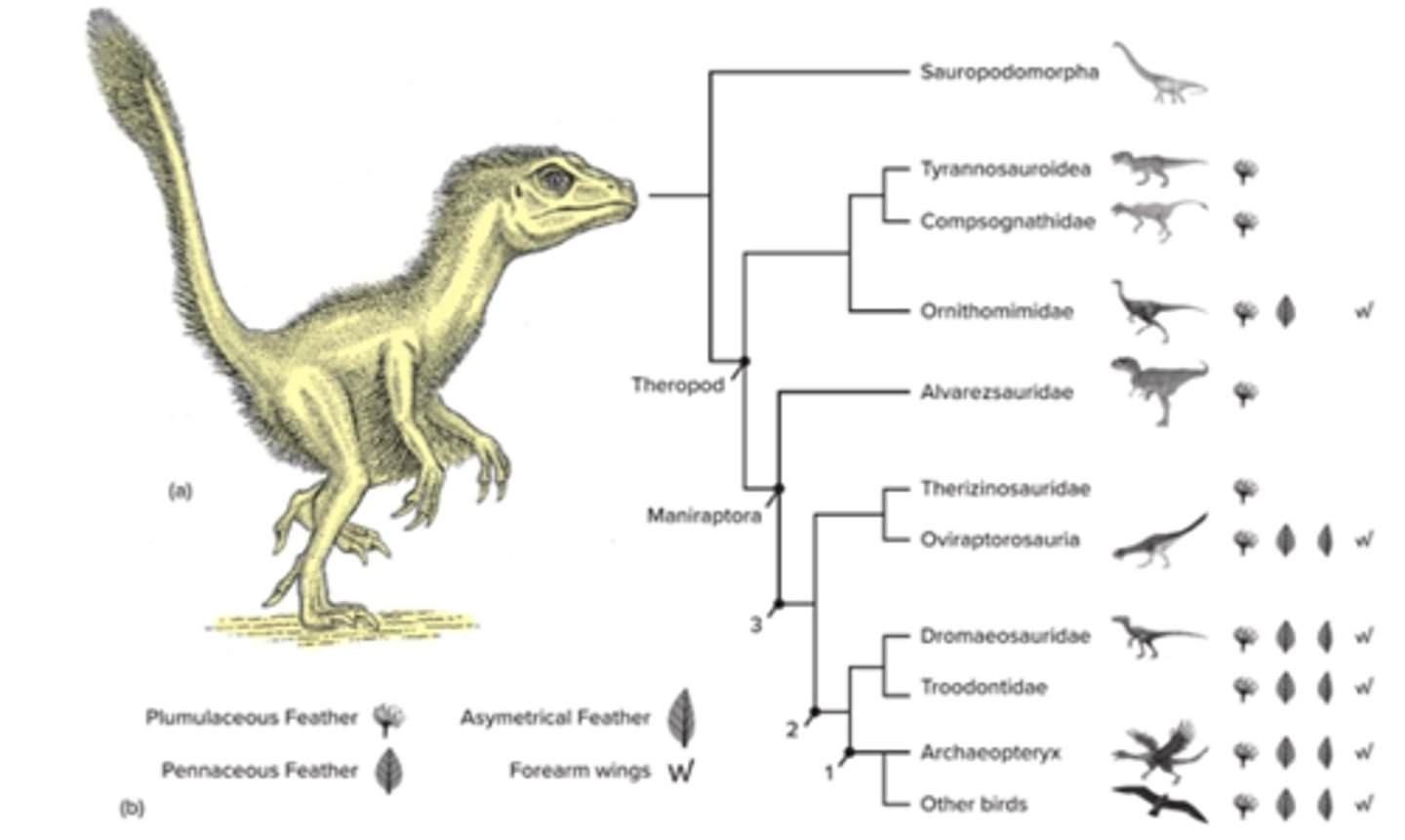
Convergent Evolution
some characteristics evolve more than once (homoplasy); hinders reconstruction of the phylogenetic tree.
Ex: Flying Squirrel, Flying Lemur
How do you reconstruct a phylogenetic tree?
- Follow the rule of parsimony.
- Use an outgroup to root the tree or provide a base.
- Add up the total number of changes required for each possible explanation of tree (there is ambiguity)
If you have 10 species, about how many possible rooted bifurcating trees can you make with them?
(2n - 3)! / (2^(n-2) * (n-2)!)
(2(10)-3)!/(2^(10-2) * (10-2)!)
~30,000,000
Uninformative characteristics
Characteristics that do not distinguish between the hypotheses.
Phylogenetic Trees- Molecular Data
- sequences must be homologous- same nucleotides must be compared.
- Sites are aligned computationally, much difficult at larger evolutionary distances.
- Sites can be informative or uninformative.
Phylogenetic Trees: Models
- Parsimony not a primary method.
- Distance methods: based on measure of nt. differences between sequences.
- Starting method for tree topology
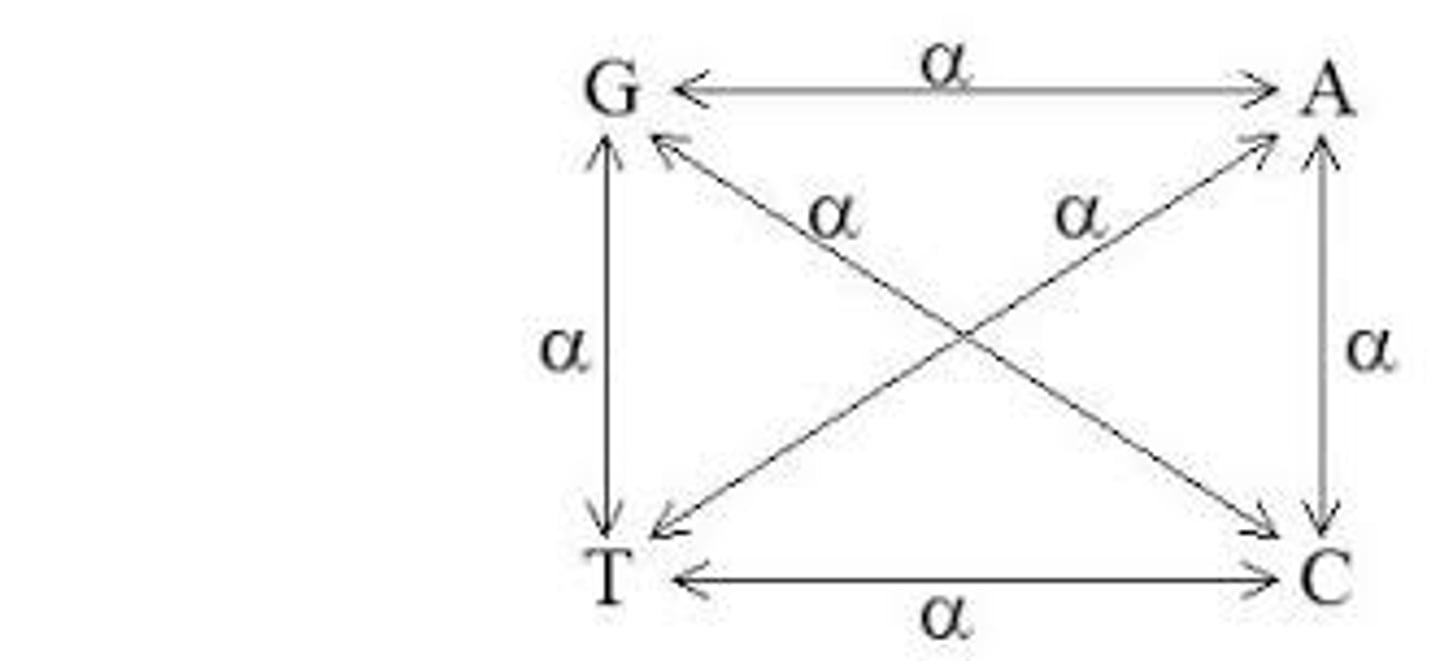
Jukes-Cantor model of DNA sequence evolution
• Nucleotide sequences are equal (25% each nt).
• Four ways a nt could mutate. (Three substitutions+ Reversion) Equally likely.
• Discrete probability distribution. (tells you probability of events occurring)
• Models random events occurring over time
• The potential for mutation over t time steps is: 𝜆 = 4𝜇t
• t: elapsed time, aka branch length, 𝜇: = mutation rate, 𝜆 is event rate.
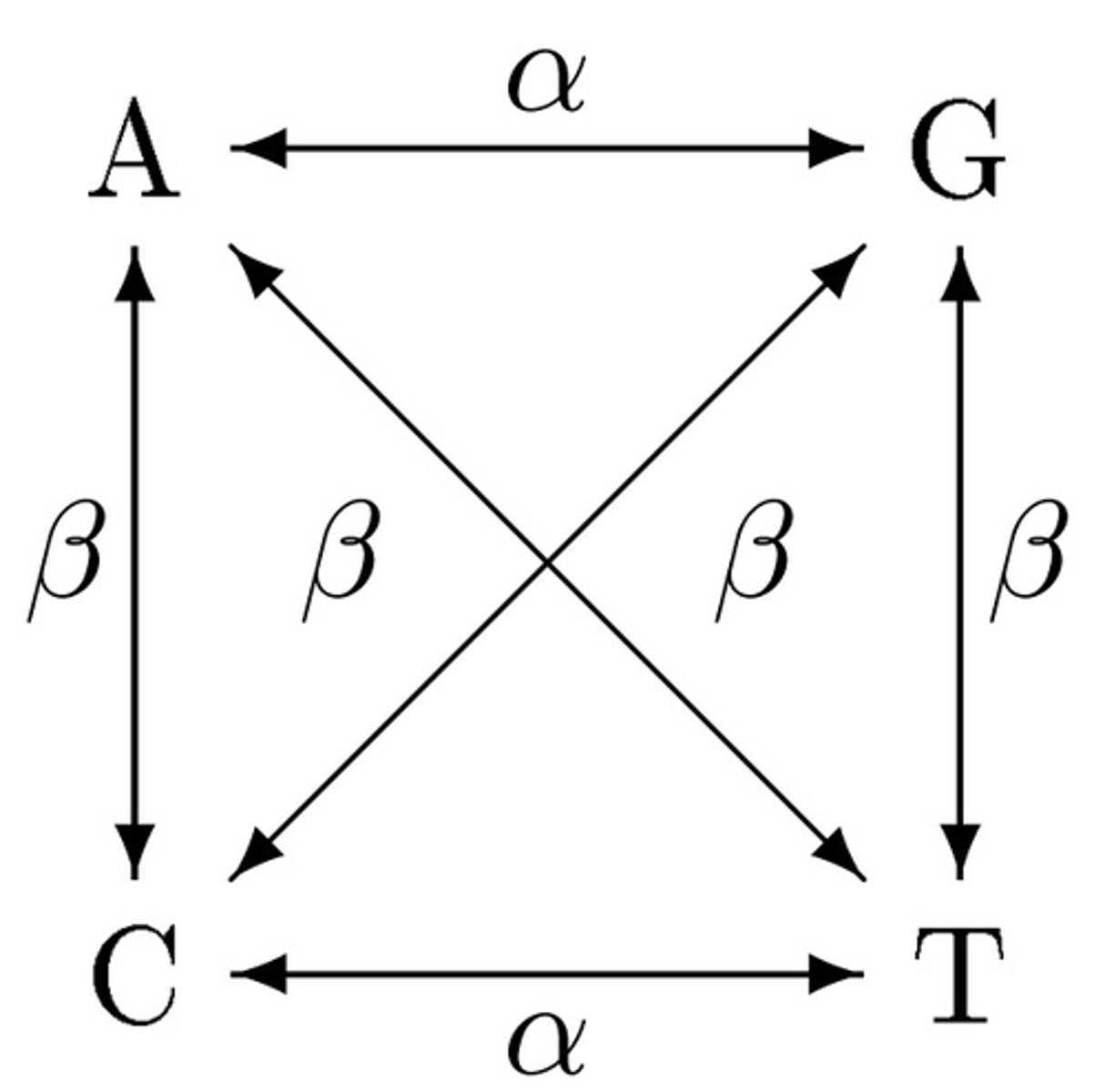
Kimura Model of sequence evolution
Relaxes assumption of equal mutation rate and its steadiness over time. More likely to see certain mutations.
• Two types of mutation, each at own rate.
• Transitions (𝛼): Purine--> Purine, Pyrimidine --> Pyrimidine
• Transversions (β): Purine --> Pyrimidine or vise versa.
What do models do for phylogenetic trees?
Add complexity by adding more parameters:
• Unequal bases and frequencies
• Different 𝛼 and β rates.
• Amount of transversion/transition rates.
Influences rate heterogeneity (mutation rates vary across the population)
Maximum Likelihood Function: Coins
L(Outcome) = p(Data|Model)
• depends on if the model is fair or if it is biased. Biased increases likelihood of the coin landing on heads each time (10 times); Fair, probability is less by 56x
• Probability of it landing on heads each time decreases each coin flip.
Model has no parameters.
Maximum Likelihood Function: Nucleotides
• One nucleotide site, 5 extant (surviving) species: A,C,C,C,G
• t1-t8=elapsed time; branch lengths (how long since speciation occurred).
• Set, x,y,z,w= probability of each change along the branches, set at each node (speciation event)
• Compare likelihoods- ratio test.
• Rearrange (permute) the tips and branch lengths.
• Keep changing parameters to keep increasing likelihoods- can be thousands of calculations- to most likely event (most likely phylogenetic tree).
What does the Maximum Likelihood test calculate?
Calculates the "maximum likelihood" of the event occurring.
For phylogenetic trees, we use branches and tips to see which speciation event is the most likely.
Allows us to analyze what phylogenetic tree most likely matches the actual patterns over time.
Easier than looking at parsimony and least number of changes for large sample sizes.
A 35 year old man smokes a pack of cigarettes a day. The polonium-210 builds up in the man's lungs over time irradiating his lung tissues and causing nucleotide mutations in his DNA. The man has a son, will those mutations be passed on?
No. This is an environmental change to his nucleotides. Is not in his germ line cells.
Which phenomenon provides more raw variation for artificial selection and the creation of domesticated crops?
Transposable elements
 Note
Note  Flashcards (81)