2026 722 BI PT Examination-Evaluation
 Call Kai
 Learn
Learn Practice Test
 Spaced Repetition
 Match
Match Flashcards
 Knowt Play
1/33

There's no tags or description
Looks like no tags are added yet.
Name | Mastery | Learn | Test | Matching | Spaced | Call with Kai | Chat |
|---|
No analytics yet
Send a link to your students to track their progress
34 Terms
objectives

PT examination and evaluation
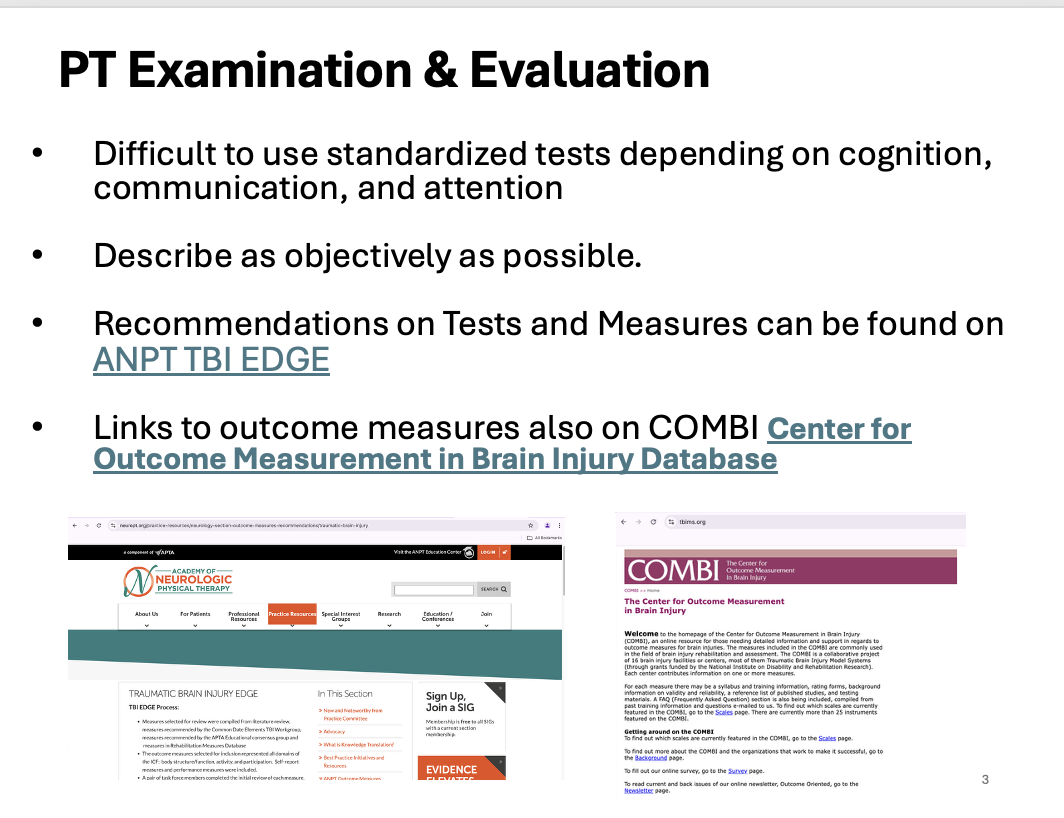
A. Patient / Client History & Review of Systems
_____
This patient is wearing a ICP monitor/drain – in the beginning its focusing on keeping the patient stable
Can get contractures, pressure wounds, etc
·
·PMH, prior level of function, comorbidities; disposition (home, family support), educational & vocational status, hobbies, etc.
·Etiology, results of diagnostic tests, precautions, respiratory status, dysphagia status, bowel & bladder, skin integrity, medications, psychological information (neuropsychological or psychiatric assessments)
·Acute TBI: chart review to determine if medically stable, extent of complications and precautions (e.g., ventilator, ICP monitoring, weight-bearing and/or ROM restrictions, etc.)
·Develop an initial impression (systems approach) of what to expect.

A. Patient / Client History & Review of Systems: nervous
______
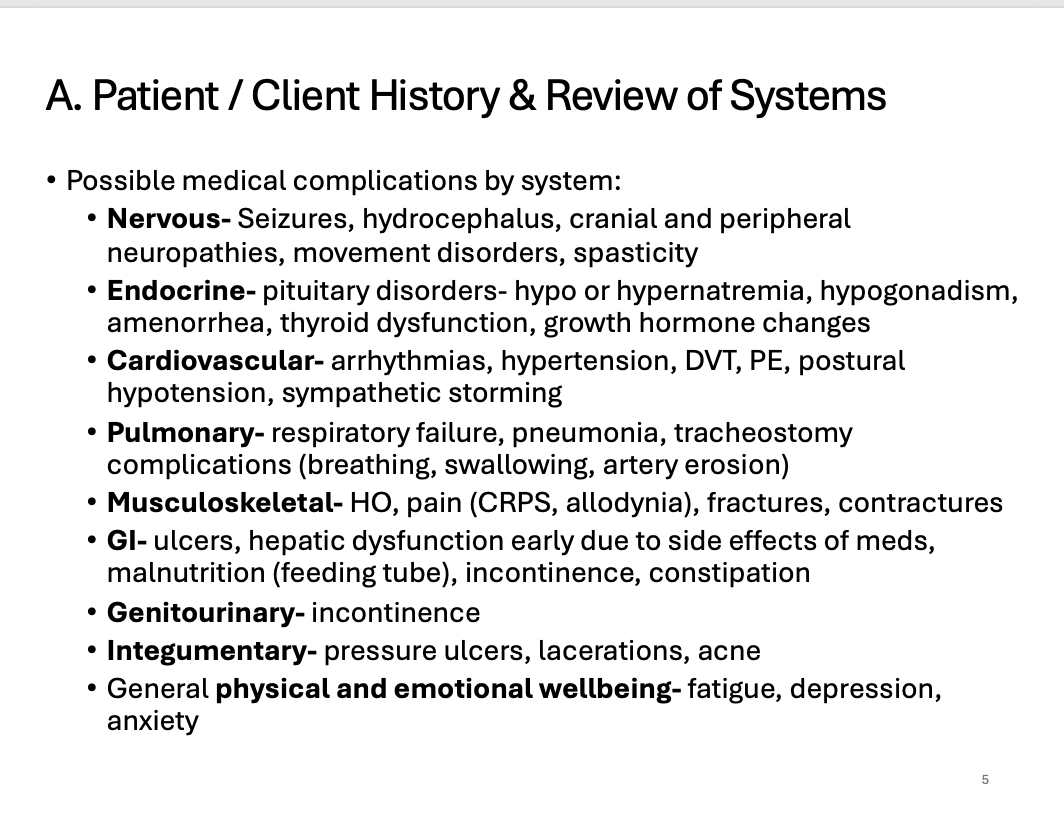
Trachea Innominate Artery Fistula https://www.ncbi.nlm.nih.gov/books/NBK482505/
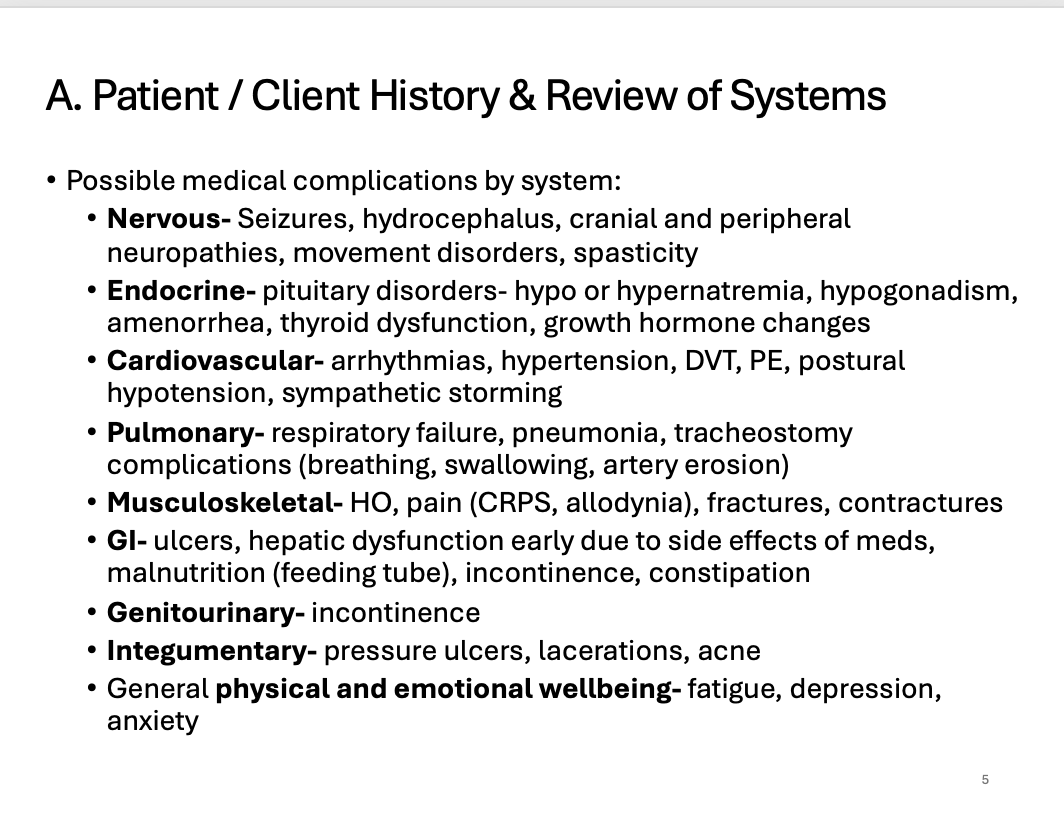
These are all the different types of complications with a brain injury or long term ICU/bedbound patients due to BI
Compression in the bed long term can cause nerve damage and neuropathies
They can have a tone of endocrine issues – a lot of hormones come from the brainstem or diencephalon
cARDIOVASCULAR: IF BRAINSTEM IS MESSED UP YOU CAN GET HYPOTENSION, sympathetic storm, or arythmias (ignore caps lock)
Pulmonary:
MSK: heterotopic ossification most common in shoulder, hips, maybe elbow or knee (HO) and is not in distal extremities
GI: frontal lobe damage may cause incontinence
Integ: acne is common because of changes in endocrine function (hormones), and washing a patient
Order of most common to least: older adults, babies, younger adults, the middle aged adults
A. Patient / Client History & Review of Systems: endocrine
______
Trachea Innominate Artery Fistula https://www.ncbi.nlm.nih.gov/books/NBK482505/
These are all the different types of complications with a brain injury or long term ICU/bedbound patients due to BI
Compression in the bed long term can cause nerve damage and neuropathies
They can have a tone of endocrine issues – a lot of hormones come from the brainstem or diencephalon
cARDIOVASCULAR: IF BRAINSTEM IS MESSED UP YOU CAN GET HYPOTENSION, sympathetic storm, or arythmias (ignore caps lock)
Pulmonary:
MSK: heterotopic ossification most common in shoulder, hips, maybe elbow or knee (HO) and is not in distal extremities
GI: frontal lobe damage may cause incontinence
Integ: acne is common because of changes in endocrine function (hormones), and washing a patient
Order of most common to least: older adults, babies, younger adults, the middle aged adults

A. Patient / Client History & Review of Systems: cardiovascular
______
Trachea Innominate Artery Fistula https://www.ncbi.nlm.nih.gov/books/NBK482505/
These are all the different types of complications with a brain injury or long term ICU/bedbound patients due to BI
Compression in the bed long term can cause nerve damage and neuropathies
They can have a tone of endocrine issues – a lot of hormones come from the brainstem or diencephalon
cARDIOVASCULAR: IF BRAINSTEM IS MESSED UP YOU CAN GET HYPOTENSION, sympathetic storm, or arythmias (ignore caps lock)
Pulmonary:
MSK: heterotopic ossification most common in shoulder, hips, maybe elbow or knee (HO) and is not in distal extremities
GI: frontal lobe damage may cause incontinence
Integ: acne is common because of changes in endocrine function (hormones), and washing a patient
Order of most common to least: older adults, babies, younger adults, the middle aged adults
A. Patient / Client History & Review of Systems: pulmonary
______
Trachea Innominate Artery Fistula https://www.ncbi.nlm.nih.gov/books/NBK482505/
These are all the different types of complications with a brain injury or long term ICU/bedbound patients due to BI
Compression in the bed long term can cause nerve damage and neuropathies
They can have a tone of endocrine issues – a lot of hormones come from the brainstem or diencephalon
cARDIOVASCULAR: IF BRAINSTEM IS MESSED UP YOU CAN GET HYPOTENSION, sympathetic storm, or arythmias (ignore caps lock)
Pulmonary:
MSK: heterotopic ossification most common in shoulder, hips, maybe elbow or knee (HO) and is not in distal extremities
GI: frontal lobe damage may cause incontinence
Integ: acne is common because of changes in endocrine function (hormones), and washing a patient
Order of most common to least: older adults, babies, younger adults, the middle aged adults
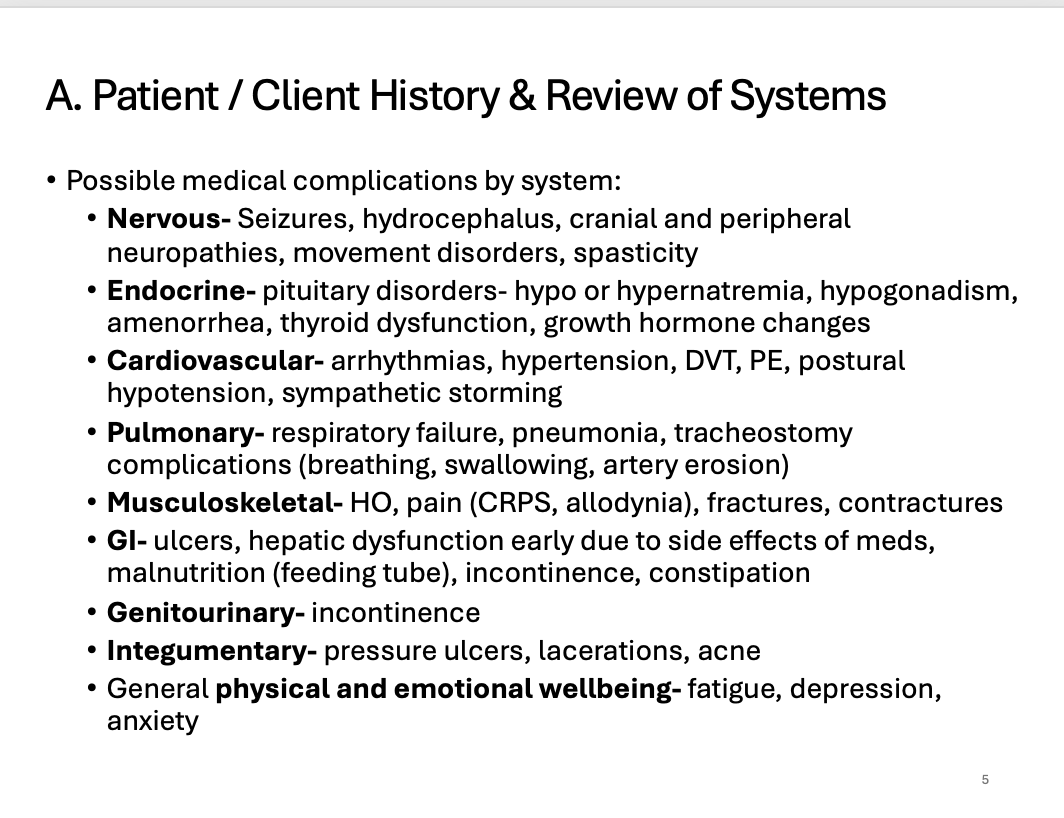
A. Patient / Client History & Review of Systems: musculoskeletal
______
Trachea Innominate Artery Fistula https://www.ncbi.nlm.nih.gov/books/NBK482505/
These are all the different types of complications with a brain injury or long term ICU/bedbound patients due to BI
Compression in the bed long term can cause nerve damage and neuropathies
They can have a tone of endocrine issues – a lot of hormones come from the brainstem or diencephalon
cARDIOVASCULAR: IF BRAINSTEM IS MESSED UP YOU CAN GET HYPOTENSION, sympathetic storm, or arythmias (ignore caps lock)
Pulmonary:
MSK: heterotopic ossification most common in shoulder, hips, maybe elbow or knee (HO) and is not in distal extremities
GI: frontal lobe damage may cause incontinence
Integ: acne is common because of changes in endocrine function (hormones), and washing a patient
Order of most common to least: older adults, babies, younger adults, the middle aged adults
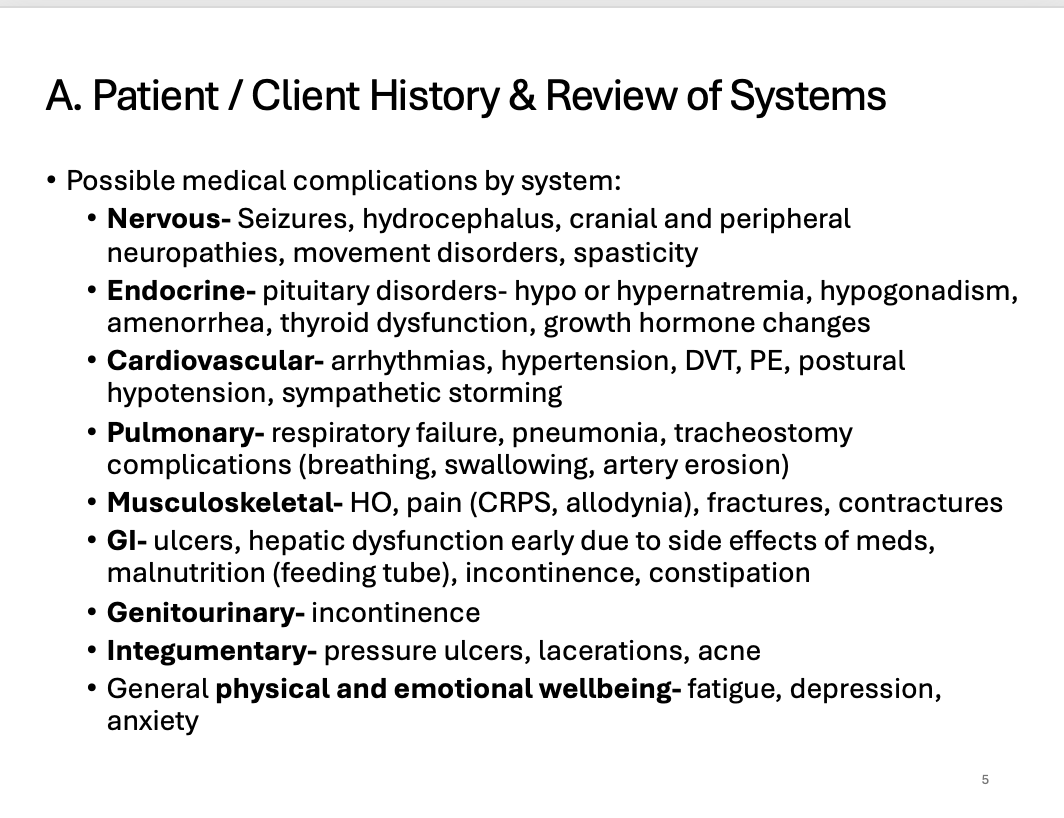
A. Patient / Client History & Review of Systems: GI
______
Trachea Innominate Artery Fistula https://www.ncbi.nlm.nih.gov/books/NBK482505/
These are all the different types of complications with a brain injury or long term ICU/bedbound patients due to BI
Compression in the bed long term can cause nerve damage and neuropathies
They can have a tone of endocrine issues – a lot of hormones come from the brainstem or diencephalon
cARDIOVASCULAR: IF BRAINSTEM IS MESSED UP YOU CAN GET HYPOTENSION, sympathetic storm, or arythmias (ignore caps lock)
Pulmonary:
MSK: heterotopic ossification most common in shoulder, hips, maybe elbow or knee (HO) and is not in distal extremities
GI: frontal lobe damage may cause incontinence
Integ: acne is common because of changes in endocrine function (hormones), and washing a patient
Order of most common to least: older adults, babies, younger adults, the middle aged adults
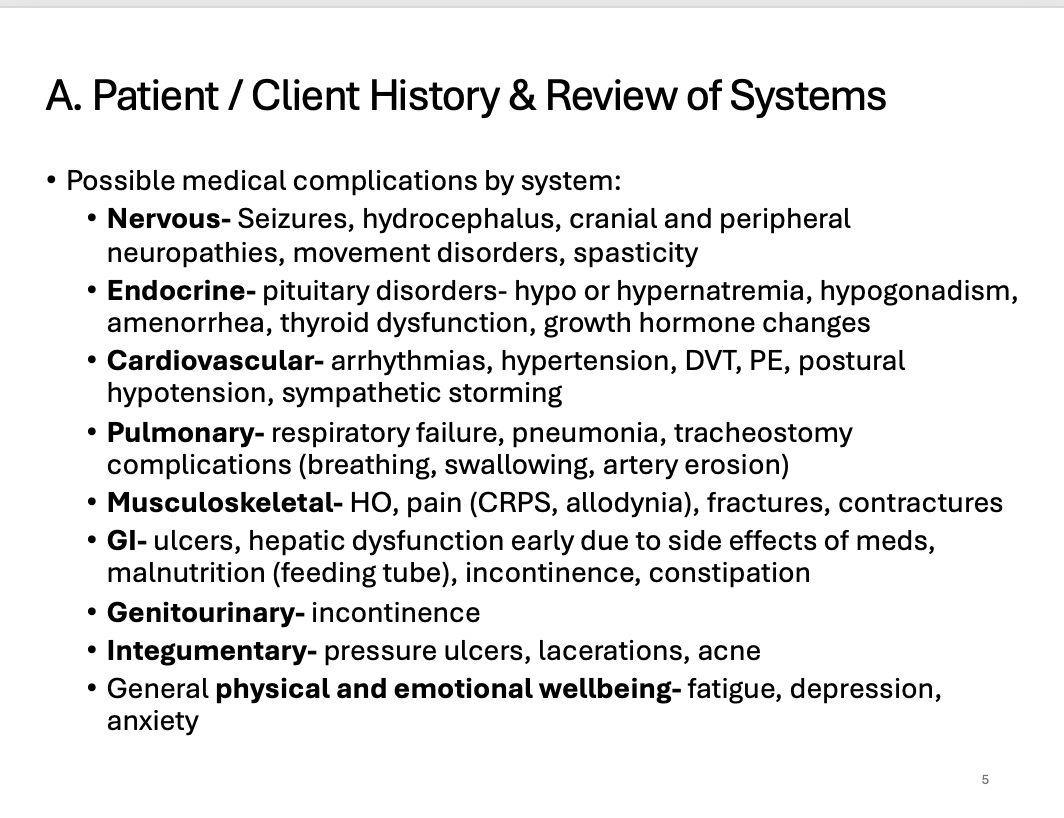
A. Patient / Client History & Review of Systems: Genitourinary
______
Trachea Innominate Artery Fistula https://www.ncbi.nlm.nih.gov/books/NBK482505/
These are all the different types of complications with a brain injury or long term ICU/bedbound patients due to BI
Compression in the bed long term can cause nerve damage and neuropathies
They can have a tone of endocrine issues – a lot of hormones come from the brainstem or diencephalon
cARDIOVASCULAR: IF BRAINSTEM IS MESSED UP YOU CAN GET HYPOTENSION, sympathetic storm, or arythmias (ignore caps lock)
Pulmonary:
MSK: heterotopic ossification most common in shoulder, hips, maybe elbow or knee (HO) and is not in distal extremities
GI: frontal lobe damage may cause incontinence
Integ: acne is common because of changes in endocrine function (hormones), and washing a patient
Order of most common to least: older adults, babies, younger adults, the middle aged adults

A. Patient / Client History & Review of Systems: integumentary
______
Trachea Innominate Artery Fistula https://www.ncbi.nlm.nih.gov/books/NBK482505/
These are all the different types of complications with a brain injury or long term ICU/bedbound patients due to BI
Compression in the bed long term can cause nerve damage and neuropathies
They can have a tone of endocrine issues – a lot of hormones come from the brainstem or diencephalon
cARDIOVASCULAR: IF BRAINSTEM IS MESSED UP YOU CAN GET HYPOTENSION, sympathetic storm, or arythmias (ignore caps lock)
Pulmonary:
MSK: heterotopic ossification most common in shoulder, hips, maybe elbow or knee (HO) and is not in distal extremities
GI: frontal lobe damage may cause incontinence
Integ: acne is common because of changes in endocrine function (hormones), and washing a patient
Order of most common to least: older adults, babies, younger adults, the middle aged adults

A. Patient / Client History & Review of Systems: general physical and emotional wellbeing
______
Trachea Innominate Artery Fistula https://www.ncbi.nlm.nih.gov/books/NBK482505/
These are all the different types of complications with a brain injury or long term ICU/bedbound patients due to BI
Compression in the bed long term can cause nerve damage and neuropathies
They can have a tone of endocrine issues – a lot of hormones come from the brainstem or diencephalon
cARDIOVASCULAR: IF BRAINSTEM IS MESSED UP YOU CAN GET HYPOTENSION, sympathetic storm, or arythmias (ignore caps lock)
Pulmonary:
MSK: heterotopic ossification most common in shoulder, hips, maybe elbow or knee (HO) and is not in distal extremities
GI: frontal lobe damage may cause incontinence
Integ: acne is common because of changes in endocrine function (hormones), and washing a patient
Order of most common to least: older adults, babies, younger adults, the middle aged adults

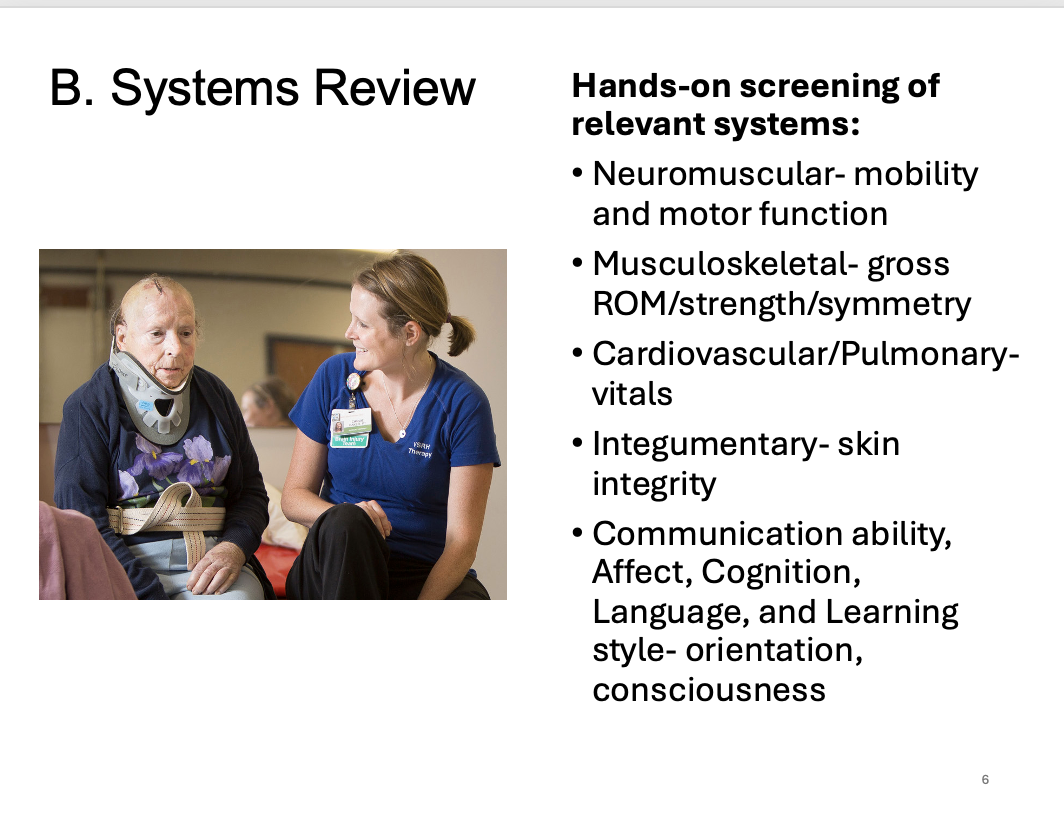
B. Systems Review
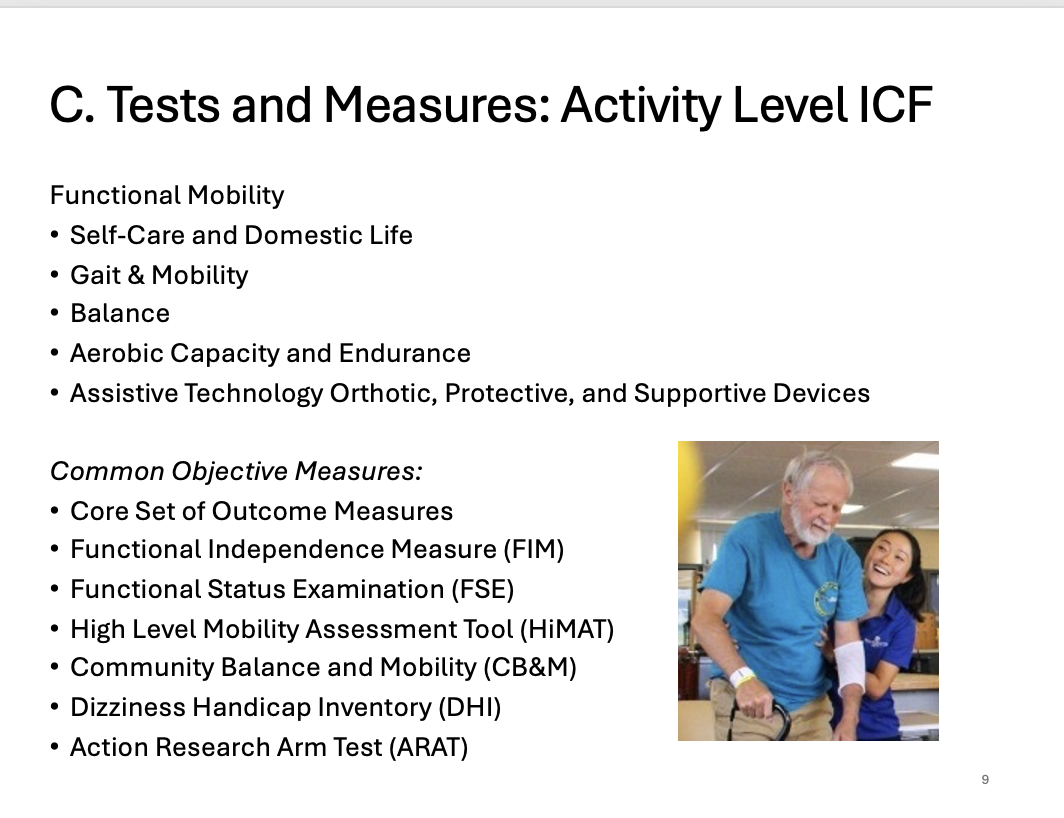
C. Tests and Measures: Activity Level ICF
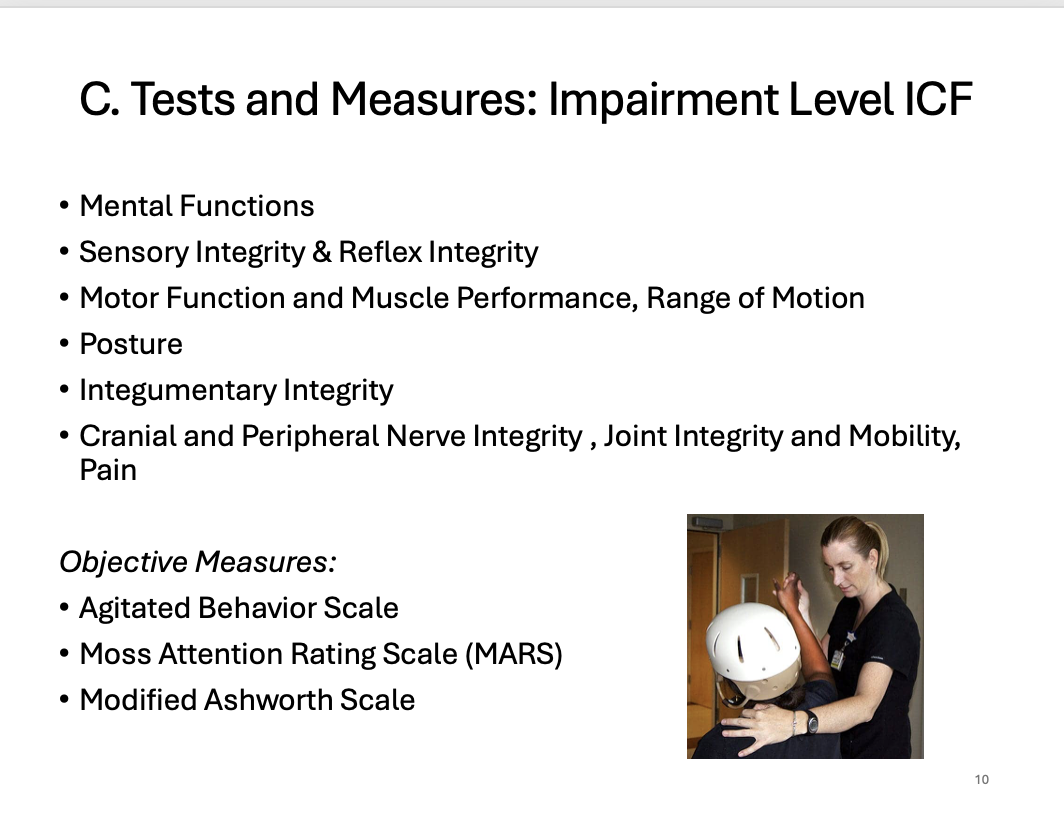
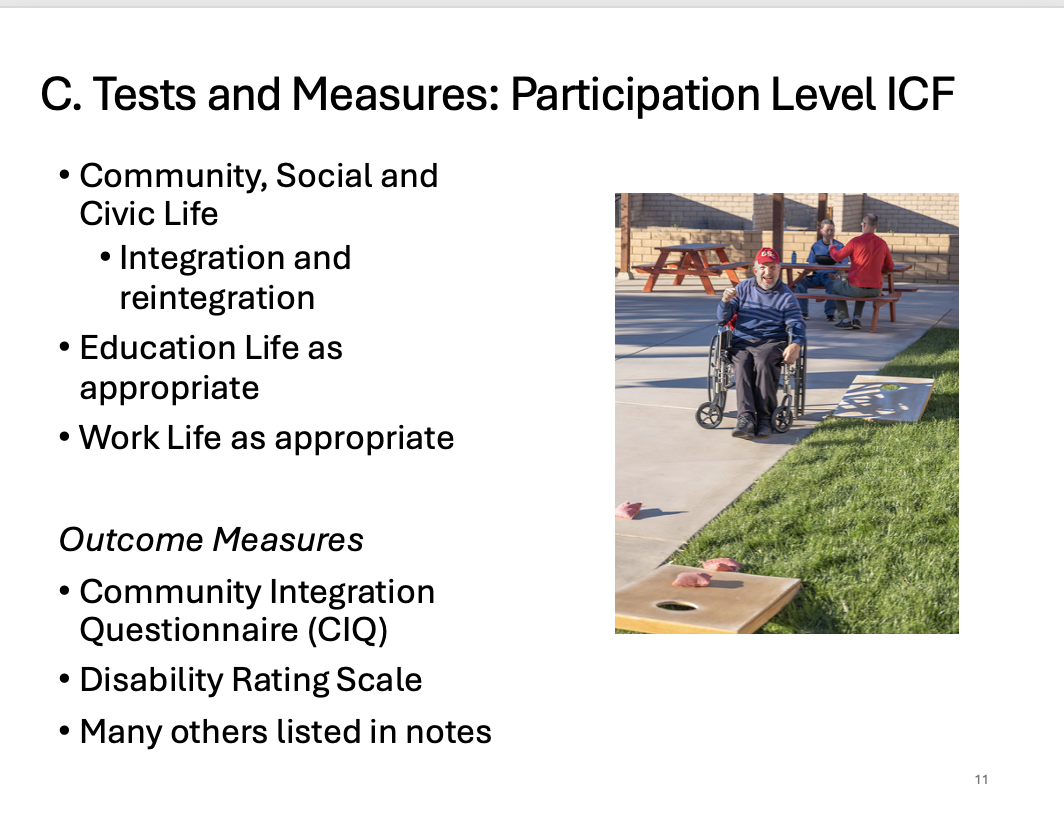
The tests and measures can be broken down – there are measurements that do more than 1 domain of ICF model
C. Tests and Measures: Impairment Level ICF
C. Tests and Measures: Participation Level ICF
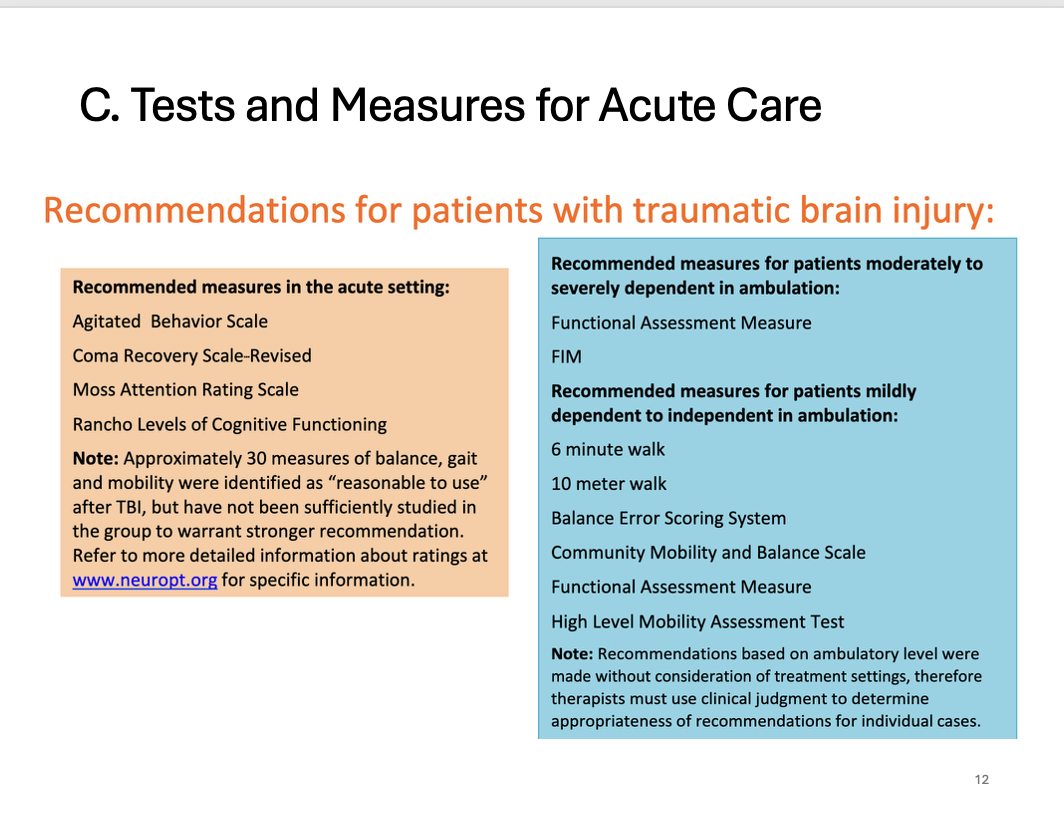
C. Tests and Measures for Acute Care: recommendations for patients with TBI (acute setting; moderate to severe dependence; mild dependence-independent)
C. Tests and Measures for Inpatient and Outpatient: recommendations for patients with TBI

Examination Across Recovery Following TBI

D. Impact of RLA Level on PT Exam and Evaluation
____
L: intubated, sedated, 1-3
M: 4 and agitated
R: participation

Typical Test and Measures Tolerated by RLA Level: LOCF I-III
_____
1-3: tracking, localizing to sound (turning head to your voice), opening eyes,
Tolerating a position of not conscious: look at vitals!! If they are uncomfortable they will change in a major way
When looking at agitation: don’t do an MMT on them, it can be hard to test – test more functional like what you would have to do with dementia; sensation is modified (definitely do not do a sharp dull)

Typical Test and Measures Tolerated by RLA Level: LOCF IV
_____
1-3: tracking, localizing to sound (turning head to your voice), opening eyes,
Tolerating a position of not conscious: look at vitals!! If they are uncomfortable they will change in a major way
When looking at agitation: don’t do an MMT on them, it can be hard to test – test more functional like what you would have to do with dementia; sensation is modified (definitely do not do a sharp dull)

Typical Test and Measures Tolerated by RLA Level: LOCF V-VIII
____
5-8: now that they can follow simple commands you can do some of the screening

Low level (I-III) exam

Low level (I-III) prognosis
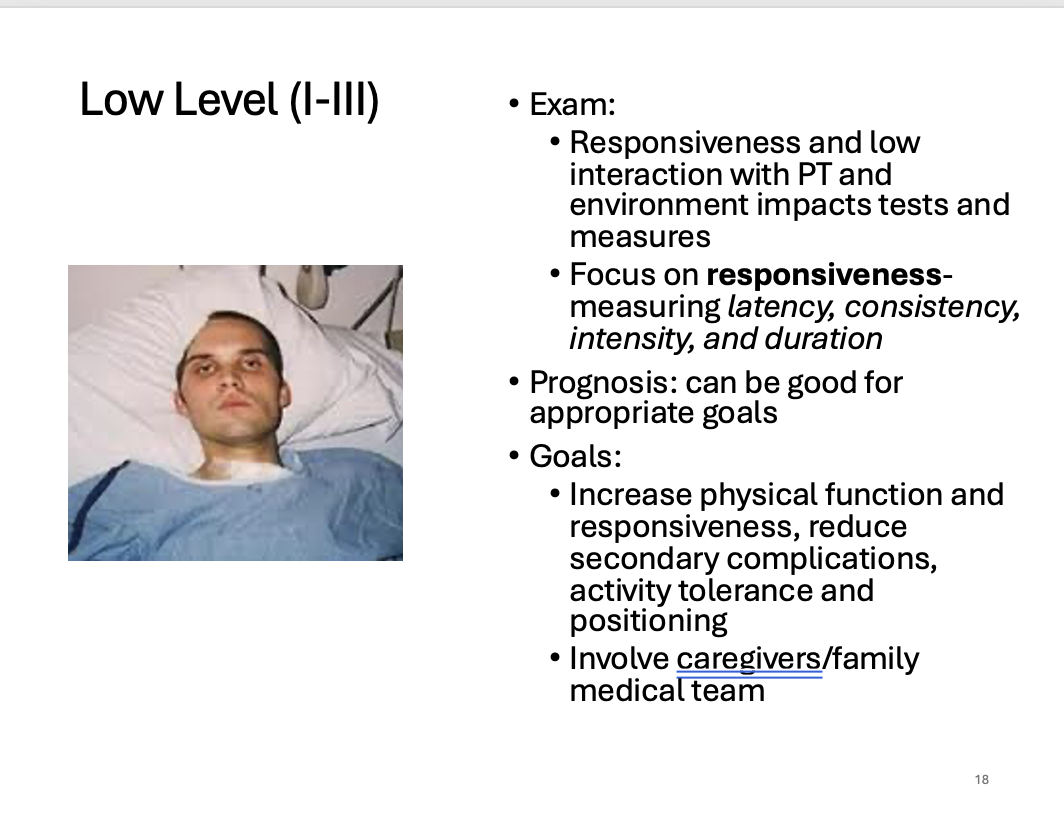
Low level (I-III) goals
____
If you go to roll a patient and they seem to be a 3 and they roll on their side does something happen? Vitals change, chewing, looking at you, yawn
Look at how often, intensity of response
Move position, elevated HOB, anything to wake them up


Hard lump: this could be HO (heterotopic ossification) when we see that we stay out of painful range and look for grimacing or changes in HR or vitals that show hes not okay
Ranchos: 3
Rolling or positioning? Keep in painfree range to roll
Medium Level (IV & V/VI): level IV
____
Can come in and out of agitation based on stress levels and triggers
Expect them to not have any empathy at all – they will be very egocentric
Keep everything s functional as possible and change topic and things as often as you need to
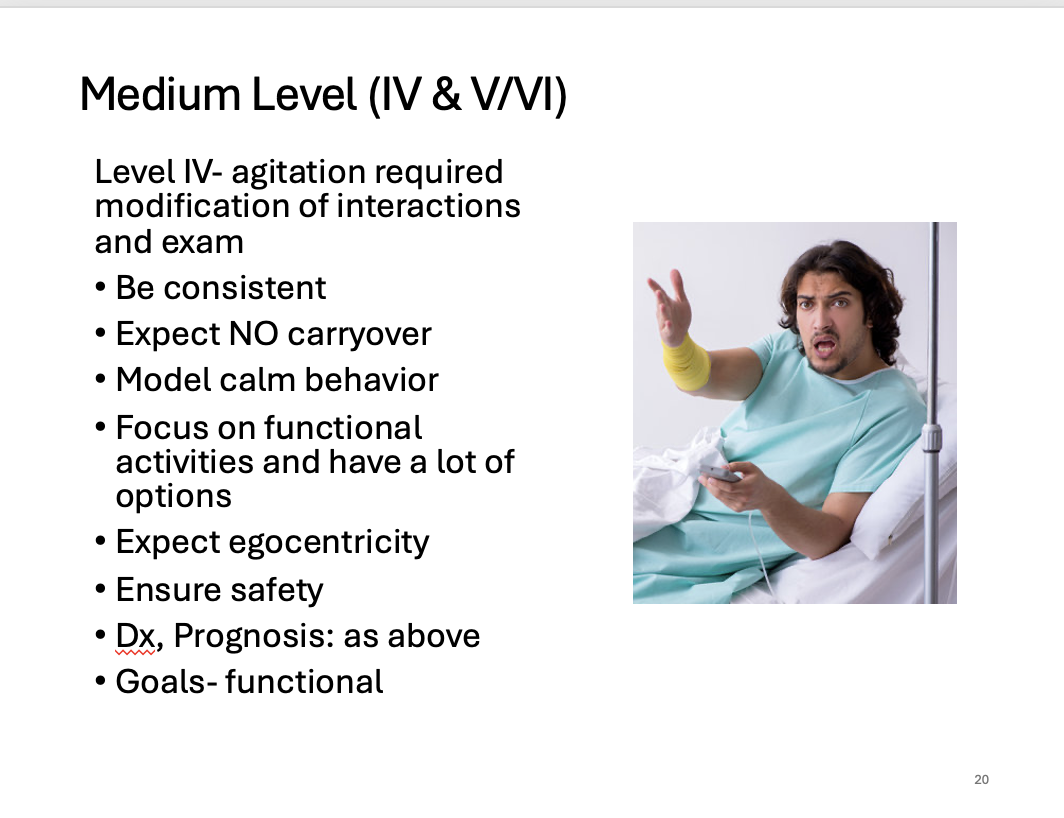
Medium Level (IV & V/VI): level V-VI
Here they start as confused inappropriate then transition to confused appropriate
May have some carry over – the more you practice the steps of something
Use the least amount of words as possible
Ex. Soap, put the soap on your hand


What features of Tom’s presentation tell us he is in RLA Level IV?
All of it -
What should staff tell his mother when she becomes upset by his behavior?
This is not him, this is a normal part of recovery for a brain recovery
Although its upsetting he wont remember it later and he doesn’t mean it
Youcanttry to reason with someone at this stage
High Level (VII & VIII)
____
NEED STRUCTURE STRUCTURE STRUCTURE
Need a schedule

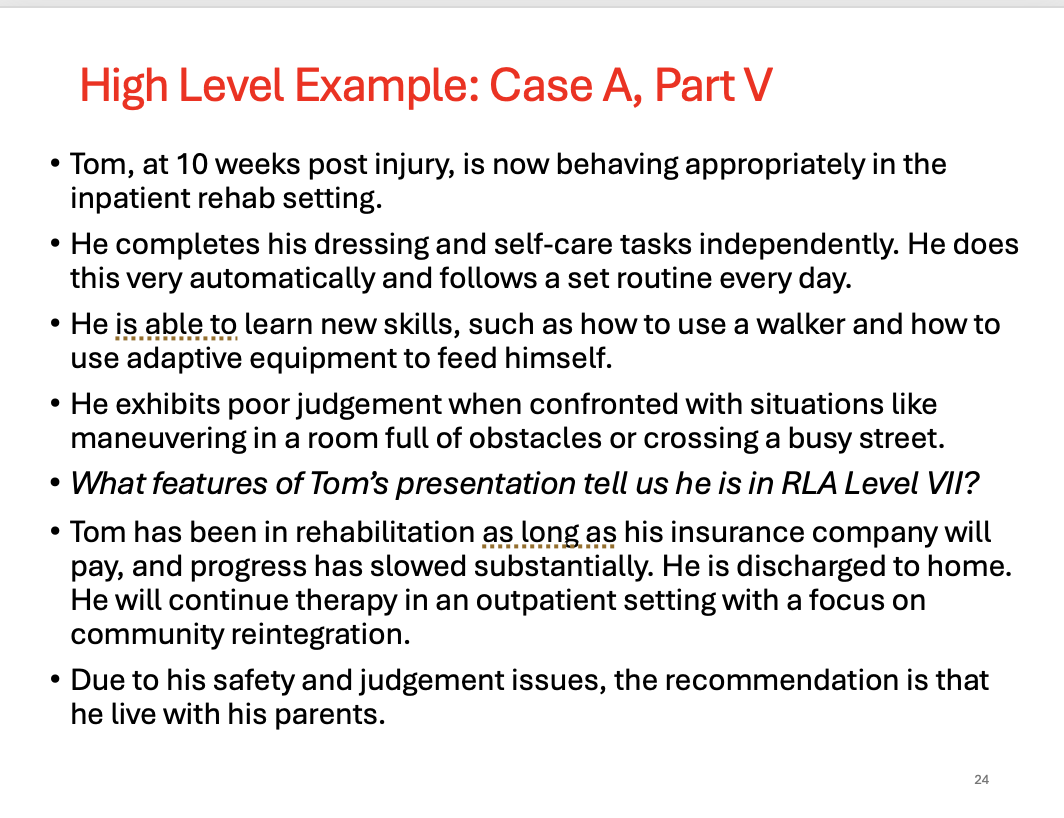
What features of Tom’s presentation tell us he is in RLA Level VII?
Super common to do outomatic tasks if structured but if there is a new complex scenario they cant often navigate it
Due to his safety and judgement issues, the recommendation is that he live with his parents.
He doesn’t have the judgement to live my himself
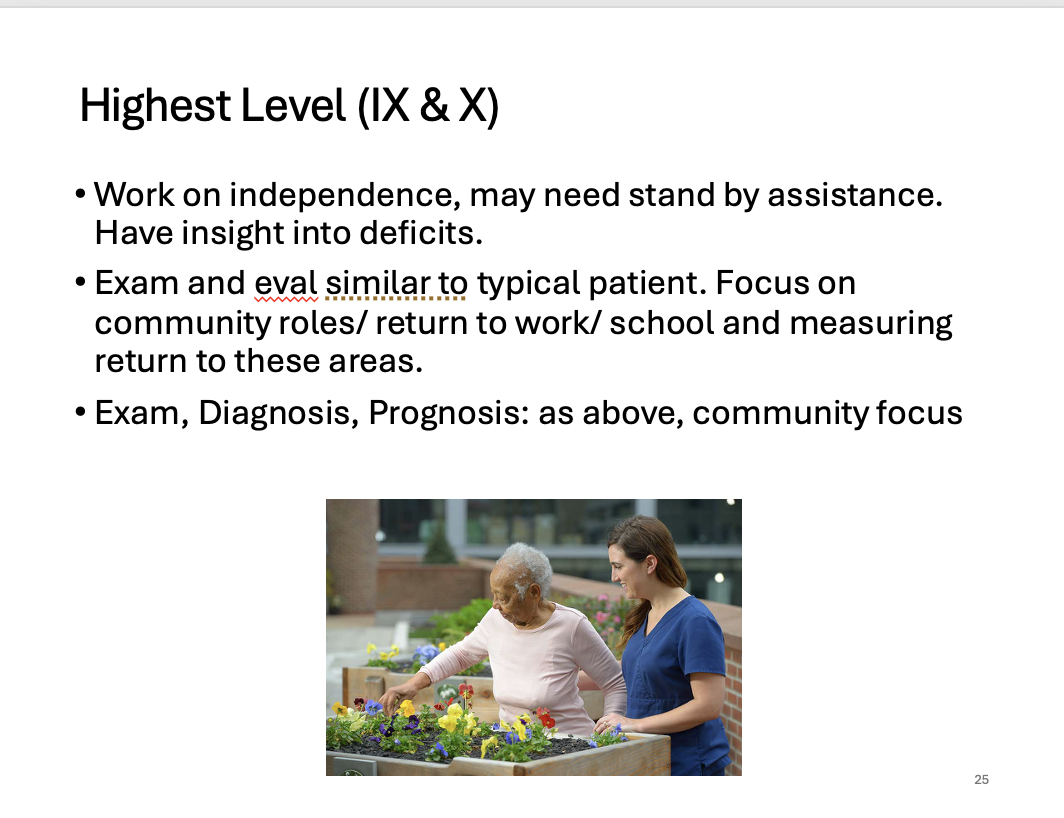
Highest Level (IX & X)
____
There are cash based programs where people can live residential and get help with that (very expensive)
-Controltest(UE/LE) – looking for postural tremor in any of the limbs (cerebellar deficit) (may also see truncal ataxia)
-Who is appropriate for each early, mid, and late
E. PT Diagnosis and Prognosis
_____
Don’t expect to know how to predict at the beginning.
ICU testing eval: reflexes on eval (doctors will be on top of that), contractures, passive ROM, AROM – are we consistently or inconsistently following commands, are we opening eyes, rolling to EOB,
Aggitates: observation of functional mobility, 10 meter, with a TUG they may not turn around, they are very impulsive,
“Hey that wasn’t really safe, you fall a lot”; definitely don’t do a FGA, choose lower level test and if they are doing well in a couple sessions and you are confident they are safe, choose another test