General Pharmacology
 Call Kai
 Learn
Learn Practice Test
 Spaced Repetition
 Match
Match Flashcards
 Knowt Play
1/70

There's no tags or description
Looks like no tags are added yet.
Name | Mastery | Learn | Test | Matching | Spaced | Call with Kai | Chat |
|---|
No analytics yet
Send a link to your students to track their progress
71 Terms
Pharmacology
The study of bodily functions to chemical changes. (Normally in context of drug administration)
To be a drug:
Has to do one or more; treat, prevent, and/or diagnose.
Indication
When to give a drug
Action
What the drug does to the body
Dose
Amount to be given
Contraindication
Harmful or fatal if given in a certain situation
Side Effect
A known effect of a drug that has nothing to do with the reason for taking the drug
Drug types
Prescription and over the counter (OTC)
Generic
Without a trademark; general.
Trade Name
Given by the manufacturer. Trademarked
Tablet
Powders pressed to pill for
Pill
Solid sheet of drug cut into easy swallow shapes.
Gels
Medication in a liquid or gel form
Gelatin Capsule
A carrier with drug inside. Helps for time delay or taste of the drug
Sublingual Spray
Liquid spray placed under the tongue
Suspensions
Heterogeneous mixtures with large, often visible solutes that tend to settle out. Needs to be shaken to ensure patient also gets the drug (solutes that settle out)
Gases
No definite shape or volume; like oxygen
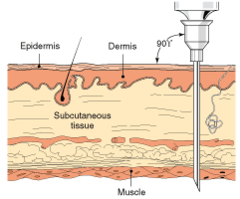
Intramuscular Injection (IM)
Needle placed in the middle of a large muscle. Needle is administered 90 degree angle to the skin
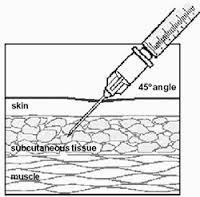
Subcutaneous Injection (SubQ)
Drug delivered in fat layer of the skin. Needle is 45 degree angle to the skin
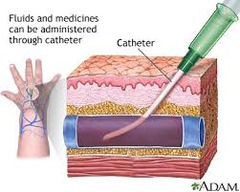
Intravenous (IV)
The fastest and most accurate way to get drugs into circulation. Medication administred straight into a vein
Oral (PO)
Most medications take 20-30 minutes to see benefits. Drugs like Tylenol and alcohol is absorbed very quickly
Rectal (PR)
Liquid, or gel form medication. Benefits in about 30 minutes for most drugs
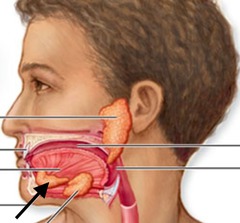
Sublingual
Easy to give and relatively fast. Minutes into circulation
Given under the tongue
Inhalation
Second fastest way into circulation. Administered by inhaling medications.
Intraosseous (IO)
Needle into bone marrow of long bone. Just as fast as IV
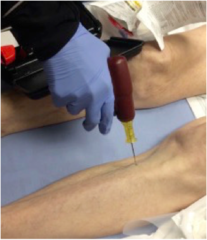
Topical
Placed and absorbed through the skin like a nicotine patch
The 5 rights prior to drug administration
1) Right patient
2) Right drug
3) Right route
4) Right date
5) Right amount
You must check a drug at least two times which includes a final recheck right before administering the drug
Nitroglycerin Indication
Chest pain
Nitroglycerin Action
Smooth muscle dilation, dilates the coronary vessels and reduced the workload on the heart
Nitroglycerin Route
Sublingual, spray or dissolvable tablet
Nitroglycerin Dose
.4mg every 5 minutes up to three times
Re-check 2-3minutes after medication administration
Nitroglycerin Contraindications
Absolute: BP less than 90mmHg
Relative: BP less than 100mmHg
Max dose given, or unspecified tachycardia
Oral Glucose Indication
Hypoglycemia, low sugar levels in blood stream
Oral Glucose Action
Increases blood sugar
Oral Glucose Side effects
None in emergency.
Oral Glucose Route
Mucus membranes (oral or rectal)
Oral Glucose Dose
25-50 grams
Double dose if given rectually
Oral Glucose Contraindication
Do not give if patient is nauseated or vomiting. Do not give if patient is not able to follow instructions
Activated Charcoal Indication
Oral overdose/poisoning
Activated Charcoal Contraindications
Nausea/Vomiting, AMS (altered mental status), liquids, or ingestion of heavy metals or corrosive substances
Activated Charcoal Actuib
Stops absorption through GI tract
Activated Charcoal Route
Oral
Activated Charcoal Dose
25g to 50g or .5g/kg to 1g/kg
-If the patient vomits the first dose, it may be given once more
Epi-Pen Indication
Severe Allergic Reaction
-Dyspnea and lowering BP
Epi-Pen Contraindication
None in emergency
Epi-Pen Action
Increases heart rate, dilates the bronchioles (alpha-beta agonist)
Epi-Pen Side Effects
Tachycardia, anxiety
Epi-Pen Route
Intramuscular (IM) midshaft lateral thigh.
-If patient does not have leg(s) due to amputation, next choice is deltoid
Epi-Pen Dose
.3mg in Adult, .15mg in Pediatrics
Syrup of Ipecac Indication
Oral poisoning or overdose
-note: no longer given in emergency medicine but some daycares may use it, very rare
Syrup of Ipecac Contraindication
Nausea/Vomiting, AMS, consumed heavy metals or corrosive substances
Oxygen Indication
Hypoxia, dyspnea
Oxygen Action
Increases oxygen concentration
Oxygen Contraindications
None in emergency; but not advised in certain situations
Oxygen Route
Inhalation
Oxygen Dose
Depends on condition/device used
Albuterol Indication
Dyspnea due to bronchospasms (or congestion, does not reduce congestion, but congestion can be worse to due bronchospams)
Albuterol Contraindications
None in emergency, allergies
Albuterol Action
Beta 2 agonist (bronchodilation). Dilates smooth muscles in broncioles
Albuterol Side Effects
Anxiety, tachycardia, hypertension, shaking, N/V, dry mouth, sleeplessness
Albuterol Route
MDI or Nebulizer
Albuterol Dose
MDI: 180mcg (90mcg/puff; so 2 total puffs)
Nebulizer: 2.5mg/3mL
Aspirin Indication
Myocardial Infarction (MI)
Aspirin Contraindication
Allergic, do not give to kids under 12 with a fever, any suspected bleeding internal or external
Aspirin Action
Slows platelet clumping therefore reduces vessel blockages, reduces fever, pain, headaches and sore throat pain
Aspirin Dose
325mg in emergency. 82mg (baby aspirin) taken daily if recommended by doctor
Aspirin Route
Oral (chew and swallow)
Aspirin Side Effects
Bleeding
Closed Loop Communication
A communication technique used to prevent misunderstandings; the receiver confirms that the message has been received and understood by repeating back word for word
Example: Physician: give 325mg of Aspirin by mouth
EMT: Giving 325mg of Aspirin by mouth
Things to ask patient before giving drug:
1. May I give it to you?
2. Do you have any allergies?
3. Have you taken any recently?
5 drug rights
1. Right patient. 2. Right medication 3. Right area 4. Right dose. 5. Right time
Make sure you recheck a drug at least once before giving it