Micro Exam #3 Notes
 View linked note
 Call Kai
 Learn
Learn Practice Test
 Spaced Repetition
 Match
Match Flashcards
 Knowt Play
1/73

There's no tags or description
Looks like no tags are added yet.
Name | Mastery | Learn | Test | Matching | Spaced | Call with Kai | Chat |
|---|
No analytics yet
Send a link to your students to track their progress
74 Terms
Actinobacteria
Gram-positive phylum of bacteria
Alphaproteobacteria
Class from which mitochondria are derived
Bacteroides
Gram-negative, non-spore-forming, anaerobic bacteria commonly found in the human gut.
Can cause infections such as abscesses and bacteremia.
Cyanobacteria
Only group of bacteria known to carry out oxygenic photosynthesis
Some species can produce harmful algal blooms
Escherichia coli
Gram-negative, facultative anaerobic rod-shaped bacterium commonly found in the lower intestine of warm-blooded organisms.
Some strains can cause gastrointestinal illnesses, urinary tract infections, and other infections.
Enterobacteriales
Order of Gram-negative, facultative anaerobic bacteria, including many common pathogens.
Includes genera like Escherichia, Salmonella, and Yersinia
Firmicutes
Gram-positive bacteria
Includes genera like Staphylococcus, Streptococcus, and Clostridium
Halobacteria
Extremophilic archaea that thrive in high-salt environments such as salt lakes and salt mines.
Lactobacillus
Important genus of bacteria in dairy fermentation
Microcystis
Cyanobacteria genus known for forming harmful algal blooms (HABs) in freshwater bodies.
Prochlorococcus
Most abundant photosynthetic organism on Earth
Salmonella
Gram-negative, rod-shaped bacteria commonly associated with foodborne illness.
Spirulina
Photosynthetic cyanobacteria commonly used as a dietary supplement due to its high protein content.
Neisseria
Species in this genus causes meningitis and gonorrhea
Streptococcus mutans
This species causes cavities
Streptococcus pyogenes
Bacterium causes strep throat infections
Streptococcus thermophilus
This species is used in dairy fermentation
Streptomyces
Members of this genus are well known for producing antibiotics
Yersinia pestis
Causes bubonic, pneumonic, and septicemic plague, transmitted by fleas.
Staphylococcus
Gram-positive cocci bacteria, often found in clusters.
Various species can cause skin infections, pneumonia, and other infections.
Clostridium difficile
The bacterium causes antibiotic-associated diarrhea
Clostridium botulinum
Bacterium produces botulinum toxin leading to botulism
Clostridium tetani
The bacterium causes tetanus
Vibrio cholerae
Causes cholera
Borrelia burgdorferi
Causes Lyme disease, transmitted by ticks.
Listeria monocytogenes
Causes listeriosis
Mycobacterium tuberculosis
Causes tuberculosis
Mycolic acids
Long fatty acids found in the cell walls of Mycobacterium species, such as Mycobacterium tuberculosis. They contribute to the acid-fast property of these bacteria, making them resistant to certain chemical damages and dehydration.
Pyogenic
Refers to bacteria that produce pus. This involves the stimulation of white blood cells and is a common response in bacterial infections such as those caused by Staphylococcus aureus.
Sepsis
A life-threatening condition caused by the body's response to an infection. It leads to tissue damage, organ failure, and potentially death if not treated promptly.
Nosocomial infection
An infection acquired in a hospital or other healthcare facility. Also known as hospital-acquired infections (HAIs), these are often resistant to antibiotics and can be severe.
Vector-borne disease
Diseases transmitted by vectors (organisms such as mosquitoes, ticks, and fleas) that carry infectious pathogens from one host to another.
Zoonotic disease
Diseases that can be transmitted from animals to humans. These infections can be caused by viruses, bacteria, parasites, and fungi.
Reservoir species
Animals or environments that harbor a pathogen and thus serve as a source of infection for other species, including humans.
Virulence factor
Molecules produced by pathogens that contribute to their ability to cause disease. Examples include toxins, surface coatings that inhibit phagocytosis, and enzymes that break down host tissues.
Cytotoxin
A toxin that kills cells, often proteins that disrupt key cellular processes
Exotoxin
Toxin proteins excreted from the pathogen
Endotoxin
Toxic lipopolysaccharides on outer membrane
Only Gram -
Not soluble, requires direct contact.
Induces response from body: fever
AB toxin
A type of bacterial toxin consisting of two parts: the 'A' component (active) which is typically an enzyme, and the 'B' component (binding) which binds to specific cells allowing the toxin to enter.
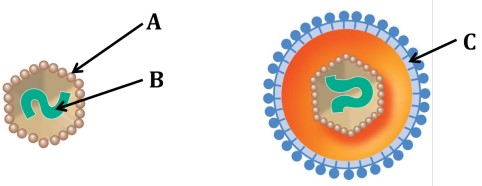
Capsid
The protein shell of a virus that encloses its genetic material.
Phospholipase
An enzyme that breaks down phospholipids, which are a major component of all cell membranes. This can damage cells and is used by some pathogens to invade or damage host tissues.
Bacteriophage/phage
Viruses that infect bacteria. Phages attach to bacteria and inject their genetic material, often causing the bacteria to lyse (break down) as new phage particles are made.
LD50 (Lethal Dose 50%)
A standard measure of the toxicity of a substance, indicating the dose required to kill half the members of a tested population after a specified test duration.
Lower LD50 = More virulent
Opportunistic pathogen
An organism that normally does not cause disease in its host but can do so if the host's resistance is low
Pseudomonas aeruginosa, Staphylococcus aureus, Clostridium difficile
MIC (Minimum Inhibitory Concentration)
The lowest concentration of an antimicrobial that will inhibit the visible growth of a microorganism after overnight incubation.
MBC (Minimum Bactericidal Concentration)
The lowest concentration of an antibiotic that will kill 99.9% of the total initial bacterial population during a specified period.
Bacteriophage (or phage)
Specific name for a virus that infects a bacterium
A
Capsid
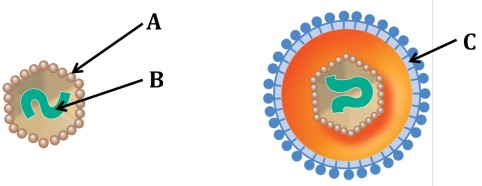
B
Nucleic acid
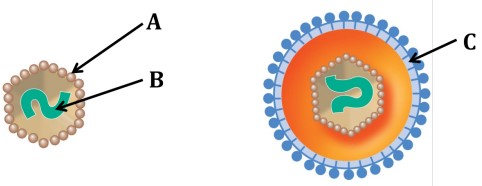
C
Envelope
Both
Viruses use RNA, DNA, or both for their genomes
Both
Genomes of viruses are single or double stranded or both?
Both
Genomes of viruses are linear, circular, or both?
Smaller
Are genomes of viruses generally bigger or smaller than their host?
Attachment, Penetration, Synthesis, Assembly, Lysis
Different stages of viral infection
V. chlorea. Remember that lower LD50 means more virulent—it requires fewer cells to kill 50% of mice exposed to the pathogen.
Imagine that E. coli has a LD50 of 5000 cells per mouse and that V. cholerae has an LD50 of 100 cells per mouse. Which pathogen is more virulent to mice?
Less virulent. Exotoxins generally are more virulent than endotoxins.
Are endotoxins typically more or less virulent than exotoxins?
Phospholipase
Functions as a cytotoxin by degrading the host cell membrane
Adherence/Attaching
Flagella, fimbrae, pili, and glyxocalyx can function as virulence factors
Opportunistic pathogen
Pathogen that causes disease in immunocompromised individuals
Aminoglycosides
Ribosome (translation) | streptomycin, kanamycin, gentamycin
Beta-lactams
Cross-linking enzyme (Cell wall synthesis) | penicillin
Quinolones
DNA gyrase | ciprofloxacin, moxyifloxacin
Rifampins
RNA polymerase (transcription) | Rifamycin
Tetracylines
Ribosome (translation) | tetracycline, doxycycline
100 µg/ml
You grow your bacterial isolate with 10, 20, 50, 100, 200, and 400 µg/ml of the antibiotic gentamycin. Your isolate grows with 10, 20, and 50 µg/ml gentamycin, but not with 100, 200, and 400 µg/ml gentamycin. Based on these results what is the minimum inhibitory concentration (MIC) of gentamycin for your isolate?
Bactericidal drugs
Kill its target bacteria
Bacteriostatic drugs
Only inhibit the growth of their target bacteria. The effects of a bacteriostatic drug are reversible—you can remove it and the bacteria will grow again.
Selective toxicity
The antimicrobial must be effective in killing its target bacteria but at the same time it must not be toxic or must be limited in the harm it causes the host (humans).
Antibiotic Resistance
The bacteria forms a biofilm that prevents antibiotics from reaching the cell.
Antibiotic Resistance
The bacteria forms a physical barrier around itself that prevents antibiotics from reaching the cell (example: mycolic acids in Mycobacterium tuberculosis).
Antibiotic Resistance
A bacterium gains a mutation that impacts the target protein and thus ability of the antibiotic to inhibit cells.
Antibiotic Resistance
The bacterium obtains a gene for an efflux pump that removes antibiotic from the cell.
Antibiotic Resistance
The bacterium obtains a gene for an enzyme that degrades the antibiotic.