Lectures 1-4
 Call Kai
 Learn
Learn Practice Test
 Spaced Repetition
 Match
Match Flashcards
 Knowt Play
1/76

There's no tags or description
Looks like no tags are added yet.
Name | Mastery | Learn | Test | Matching | Spaced | Call with Kai | Chat |
|---|
No analytics yet
Send a link to your students to track their progress
77 Terms
Osteocytes
Inactive and entrapped osteoblasts within bone matrix. Can revert back when surrounding matrix is dissolved.
Osteoprogenitor
A germ cell that turns into other cells in bone.
Osteoclasts
Large, multinucleated cells at bone surface and actively resorb bone.
Primary Ossification
Formation of 1-cell thick layer covering surfaces undergoing remodeling.
Osteoblasts
Mononuclear cells that form new bone (ossification) and originate from mesenchymal cells in bone marrow.
Endosteum
A membrane lining inner surface of bony wall and bone marrow. Layer on the inside.
Periosteum
A dense outer layer of bone that contains vascular connective tissue enveloping bones, except at surfaces of joints. Layer on the outside, covering.
Compact/cortical bone
The hard, dense outer layer of all bones throughout the body. Dense bone where bony matrix is solidly filled with organic ground substance and inorganic salts.
Trabecular/cancellous/spongy bone
A hierarchical, spongy, and porous material composed of hard and soft tissue components. Found in epiphysis and metaphysis of long bones and in vertebral bodies. Can also be in medullary space. Forms matrix for bone marrow.
Medullary space
The hallow part of bone that contains bone marrow.
Epiphyseal/Growth Plate
A hyaline cartilage plate in metaphysis at each end of a long bone.
Metaphysis
The region where epiphysis joins diaphysis.
Diaphysis
The shaft or central part of a long bone, contains mostly compact bone.
Epiphysis
The end part of a long bone, initially growing separately from shaft.
Glycoproteins
Proteins with covalently bound carbohydrates in various patterns. Necessary for mineral regulation.
Proteoglycans
Small leucine-rich______ (SLRPs) necessary for cell proliferation, mineral deposition, and remodeling.
Ground substance
A substance rich in a mineralized calcium phosphate compound known as hydroxyapatite.
Osteon
Cylindrical structures composed of concentric layers of bone tissue called lamellae that surround a central canal.

Haversian/Central canals
Any of the minute tubes which form a network in bone and contain blood vessels that run PARALLEL to length of bone.
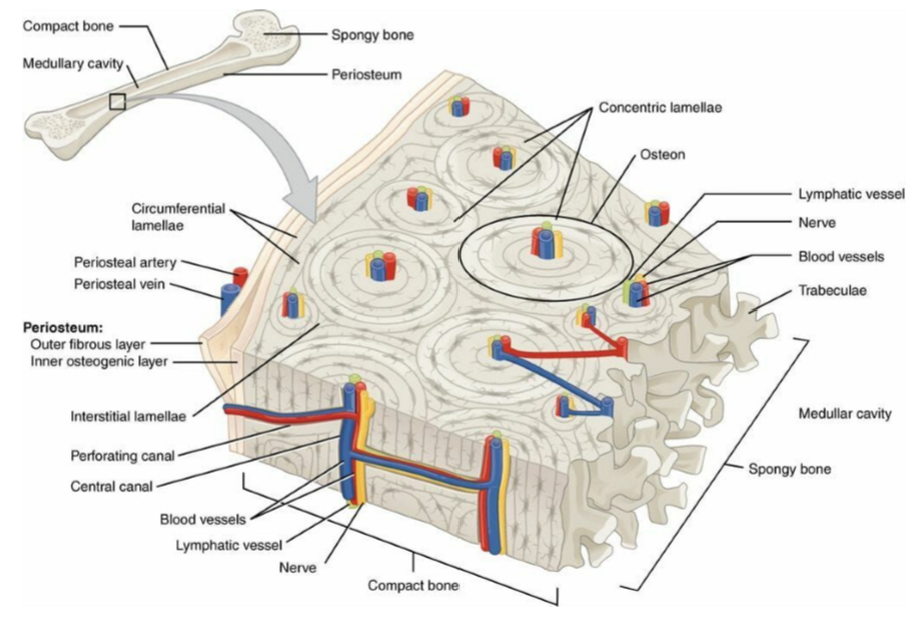
Volkmann/Perforating canals
Channels that contain smaller blood vessels that run PERPENDICULAR to length of bone. Connect Haversian canals to periosteum and medullary cavity.
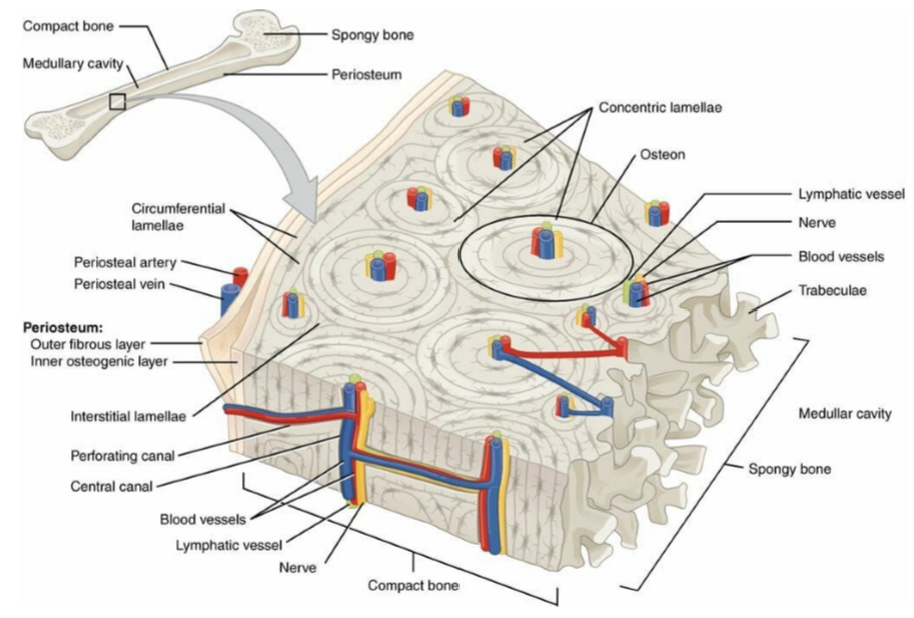
Lacunae
Small areas of holes in bone matrix where osteocytes reside.
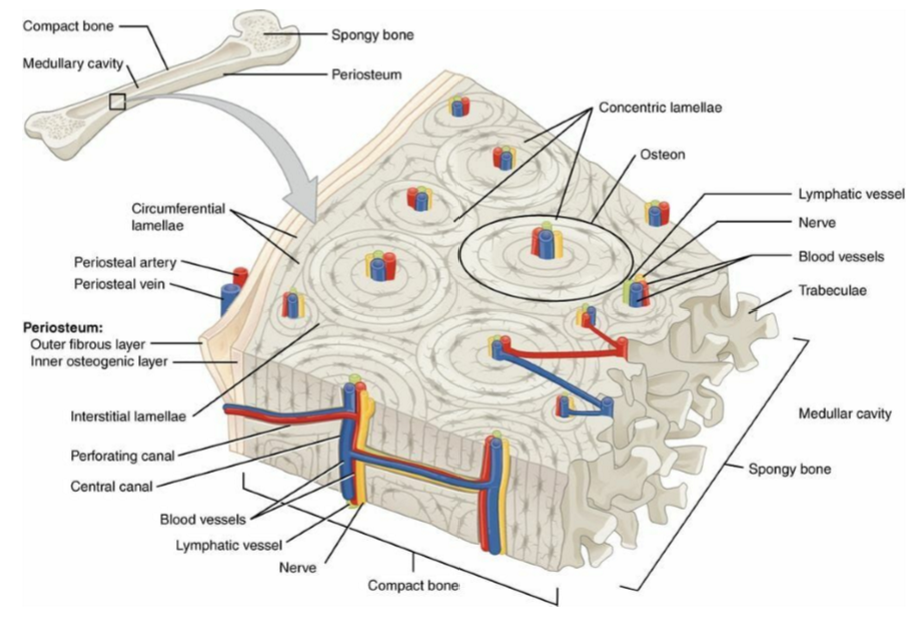
Canaliculi
Tunnels that form a labyrinth of connections between neighboring osteocytes. Where cytoplasmic projections go. Communication.
Trabeculae
Thin columns and plates of bone that create spongy structure along stress lines. Provides flexibility and improves resistance to fracturing.
Red bone marrow
Contains hematopoietic tissue that creates blood cells. Located throughout most flat and long bones in young animals and will recede from long bones with maturity in trabecular spaces. In adults, found in flat bones of vertebrae, sternum, ribs, and pelvis, along with proximal ends of humerus and femur.
Yellow bone marrow
Contains mostly adipose tissue (fat tissue). Majority of marrow, but has potential to convert back to red marrow under severe necessity. Located primarily in long bones.
Ca2+ and phosphorous
Most abundant minerals in bones.
Mg2+, Na+, K+, Cl-, and F-
Other bone minerals
Type I collagen
Main form found in bone (90%). Synthesized mostly by osteoblasts. Hydroxylation with Vitamin C is required.
Tropocollagen
Braided collagen fibrils that have improved strength and rigidity. 5 join together to form microfibril.
Collagen matrix
Microfibrils laid end-to-end in staggered formation in same direction in single bone metabolic unit. Small spaces in between allow initial nucleation of mineral crystals on matrix.
Hydroxyproline
A neutral heterocyclic protein amino acid that’s commonly found in bone and gelatin. Digestion of bone collagen causes concentrations to rise in blood, which is used as a diagnostic indication of bone destruction.
Hydroxylysine
Amino acid unique to collagen-like peptides. Has covalent cross-link norlecine across adjacent collagen fibrils, which stabilizes fibrils. Creates banding pattern on collagen fibrils
Osteocalcin
A protein that is found in extracellular matrix of bone and in serum of circulating blood. Produced solely by osteoblasts - Vitamin K is often present. Inhibits haphazard formation of hydroxyapatite precipitates and mineralization. Hemoattractant of leukocytes (attracts osteoclasts to areas in need of resorption and remodeling) JOB: keeping regulation of bone composition.
Intramembranous ossification (IO)
Bone formation within primitive connective tissue
Endochondral Ossification (EO)
Pre-existing cartilage is turned into bone
Ectopic bone formation
pathologic process in which connective tissues that aren’t usually turned into bone are ossified. Abnormal
Mesenchyme
Tissue characterized by primordial cell types surrounded by large amount of extracellular matrix (loose connective tissue).
Woven bone
Early bone where collagen fibrils remain randomly interwoven. Quick construction but weak, more flexible, higher rate of turnover
Osteoid
The unmineralized, organic portion of the bone matrix that forms PRIOR to the maturation of bone tissue. Can be found in woven and lamellar bone
embryo development
Where does intramembranous ossification begin?
Hyaline cartilage
A translucent bluish-white type of cartilage present in the joints, the respiratory tract, and the immature skeleton
Endochondral Ossification (EO)
Starts as hyaline cartilage. Long bones specifically. Includes: bones in extremities, base of skull, vertebral column, and pelvis. Mesenchyme differentiates into chondrocytes.
Chondrocytes
Lay out in shape of bone being formed. (EO)
Centers of ossification
Within hyaline cartilage and are distinguished by enlargement of chondrocytes in particular areas of cartilaginous bone
Apoptosis
Calcification causes hypertrophies chondrocytes to do _______
Zone of proliferation
formed by chondrocytes that are further from diaphysis
Zone of maturation
formed by chondrocytes that have stopped dividing and have become enlarged
Zone of hypertrophy
formed by hypertrophy and vacuolation of chondrocytes
Zone of provisional calcification
formed by cartilaginous matrix surrounding cells beginning to calcify. Begin mineralization to thicken cartilage.
Somatotropin
Hormone that controls bone growth. From the pituitary gland. Causes local production of insulin-like growth factor 1 (somatomedin), which encourages zone of proliferation chondrocytes to divide
Hyena disease
condition where growth plates in hindlimbs closes prematurely compared to front limbs, happens in heifers secondary to vitamin A toxicosis as calves
Bone remodeling units (BRU)
small units of bone that undergo remodeling at any given time
Activation, Resorption, Reversal, Formation
The steps of bone remodeling (cycles)
Activation
Converts resting/inactive bone surface into that to be remodeled. Either from a random event (trauma) or selective remodeling directed by a signal from bone.
Resorption
Osteoclasts release acids and proteolytic enzymes from ruffled border, which dissolves bone matrix. Makers = quiet, Breakers = busy.
Howship’s lacuna
hole created by osteoclasts during resorption
Reversal
Needs insulin-like growth factor 2 and transforming growth factor (TGF) - beta. Released during collagen matric breakdown, activate cells lining surface to revert to osteoblasts.
Formation
Deposition of osteoid by osteoblasts. Consists mostly of type 1 collagen, proteoglycans, and smaller proteins found in mature bone. Lays osteoid down in lamellae with fibrils parallel to each other. Trabecular bone deposited in curved sheets following hollow shape. Mineralization occurs after time delay but happens quick when activated
Complete fracture
Through entire bone
Transverse fracture
Straight line through entire bone
Oblique fracture
Line at an angle through entire bone
Spiral fracture
Corkscrew line through entire bone
Comminuted fracture
More than 2 parts to a fracture through entire bone
Incomplete fracture
Not entirely through bone
Bowing fracture
Bone is bent
Buckle fracture
Fracture on concave side
Greenstick fracture
fracture on convex side
Avulsion fracture
Bone fragment separates from the rest of the bone, often attached to ligament or tendon
Displacement fracture
ends of fracture not within same area, created a gap
Type 1 fracture
Through growth plate
Type 2 fracture
Through growth plate and metaphysis
Type 3 fracture
Through growth plate and epiphysis
Type 4
Through all three elements (growth plate, metaphysis, and epiphysis)
Type 5 fracture
Crush injury of growth plate
Osteocytic osteolysis
Process of Ca2+ resorption from bone
Vitamin D hormone
Indirectly affects bone Ca2+ concentration in osteocytic osteolysis
Calcitonin
Major Ca2+ regulating hormone. Acts on osteoblasts to inhibit bone resorption.