Bio 2 Exam 3
 Call Kai
 Learn
Learn Practice Test
 Spaced Repetition
 Match
Match Flashcards
 Knowt Play
1/134

Earn XP
Description and Tags
Dr. Hart
Name | Mastery | Learn | Test | Matching | Spaced | Call with Kai | Chat |
|---|
No analytics yet
Send a link to your students to track their progress
135 Terms
Define ecology
Main definition: A branch of science that deals with interactions between living organisms and their surroundings
Haeckel: The scientific study of the relationship between organisms and the environment
Andrewartha/Birch: The study of the distribution and abundance of organisms
Odum: The study of the structure and function of nature (emphasizes study. of ecosystems, including all organisms and functional processes)
Identify the major sub-disciplines of ecology
Physiological ecology: Examines biological responses to external and internal environmental conditions like temperature, light, and exercise
Behavioural ecology: Studies the ecological and evolutionary basis for animal behaviour and the role of behaviour in survival and reproduction
Evolutionary ecology: Examines the evolutionary responses to ecological processes and environmental changes
Population ecology: Studies with the dynamics of populations and factors that affect species abundance and distribution
Community ecology: Examines the interactions between species in an ecological community, and quantifies species diversity and processes that structure communities
Ecosystem/Global ecology: Studies the flows of energy and matter within and between ecosystems
Identify the different levels of ecological organization and recognize the types of questions that are asked at each level
Biosphere: The global zone containing all life on Earth, including land, water, and air. Typical questions include — how do global wind and ocean currents move heat and life around?, and how do worldwide changes in climate affect life everywhere on the planet?
Ecosystem: All the living parts (biotic) and non-living parts (abiotic) interacting in an area.Typical questions include — how does energy flow through food webs?, how do nutrients like carbon and nitrogen cycle through the environment?, and how does a change in temperature or rainfall affect the living parts?
Community: All the different populations (various species) living and interacting in one area. Typical questions include —how do predators affect prey?, how do different species compete for the same food?, how does the loss of one species change the whole group?
Population: A group of individuals of the same species living in the same area. Typical questions include — how fast is this group growing or shrinking, what causes the number of births and deaths?, and what limits how many individuals can live here?
Organism: A single living thing like a plant, animal, or bacteria. Questions can include — how does this animal find food?, how does it survive harsh weather?, and what are its physical and behavioral adaptations?
Describe the importance of biodiversity to ecosystem function
Overall: It drives ecosystem productivity and enhances resilience to disturbances as well as ensuring the delivery of essential ecosystem services
Specifically: Recycles nutrients, allows ecosystems to yield more biomass, the insurance effect, easier to recover, higher resistance, purifies water, pollination, etc.
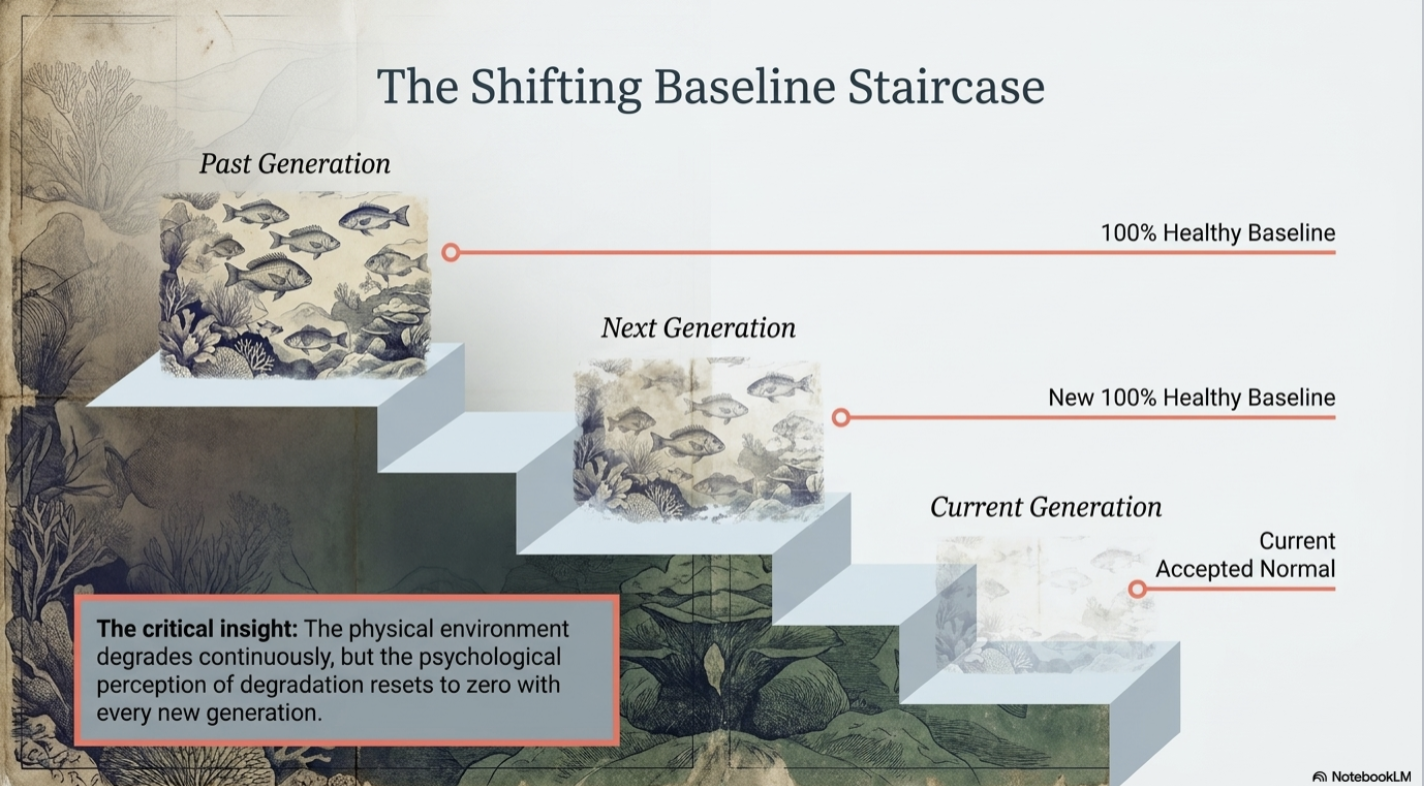
Explain how “shifting baselines” distort our comprehension of the magnitude of biodiversity loss
The Fading Blueprint: A book about how the shifting baseline syndrome blinds people to ecological decline
Concept: Shifting Baseline Syndrome/Environmental Generational Amnesia
Mechanisms: A gradual change in the accepted norms for the condition of the natural environment due to a lack of experience, memory, or knowledge of its past condition. Knowledge goes extinct because younger generations never saw the past conditions, creating a blindspot where failing to pass experience to the future.
Result: We transform the world but we fail to remember what we have transformed. Biological change must exist AND perception must show age-related differences matching data.
Describe and explain how climate and topography shape ecological systems
Identify the major factors that influence climate across the globe
Explain why solar input varies around the globe
Describe the ways that heat is redistributed and how this influences climate in different regions
Identify the major steps in the Hadley cell
Explain how the Coriolis effect produces global wind patterns and surface currents
Describe the process of deep ocean thermohaline circulation
Identify the major steps that occur with the rain shadow effect
Describe how FL summer sea breezes are generated
Identify, compare, and contrast major terrestrial and aquatic biomes
Apply knowledge of atmospheric circulation and climate to identify geographic location of major terrestrial ecosystems (aka biomes)
Be able to identify terrestrial biomes by their climate (temperature and precipitation), growing season length, dominant vegetation, and vegetation structure
Identify the biome best represented by a Walter climate diagram
Be able to give examples of different organism adaptations to different climates and biomes
Match the organismal adaptation to the environment represented in a Walter climate diagram
Describe the key abiotic factors used to characterize and distinguish among aquatic biomes
Compare and contrast the characteristics of freshwater biomes
Define and contrast estuaries with other aquatic biomes
Compare and contrast the characteristics of ocean zones and marine biomes
Define life history
What is parity?
Describe fecundity
What is a life table?
What is parental investment? What are its pros and cons?
Describe longevity in the ecological sense for organisms
Explain how resource allocation works
What is life history? What are the aspects of it?
Describe tradeoffs for organisms
Compare and contrast how life history traits can vary with respect to life form or conditions in the environment
Be able to give examples of different organism adaptations to different climates and biomes
Explain what population demographics are and describe the ways they are measured
Identify the three different types of spatial dispersion patterns of populations
Identify costs and benefits of group living
Explain the role of behavior in partitioning space within a population
Describe the Birth-Death Model of population growth and use it to estimate the per capita growth of a sample population
Calculate the doubling time for a population with a constant per capita growth rate and contrast multiplicative and additive growth rates
Identify the factors that have allowed human population growth to increase multiplicatively (exponentially)
Explain how the age structure of a population can be used to describe population growth
Name the factors that determine intrinsic growth rate (rmax)
Define life history, describe trends in life history strategies among organisms, and identify important trade-offs in life history and resource allocatin
Distinguish between proximate and ultimate causes of behaviors
Describe the 3 types of survivorship curves and explain what they tell us about survival of different age classes in a population
Draw a graph of a population in stable equilibrium
Recognize the difference between exponential and logistic growth curves
Describe the forces that regulate populations in natural systems
Give the logistic growth equation and explain what the variables mean, how the variables are related, and how the variables change at different points along the logistic growth curve
Explain why populations demonstrate fluctuating, periodic cycles of high and low abundance
Define metapopulation and describe ways to maintain connections within a metapopulation
Define climate
Define weather
Define Hadley cell
Define polar cell
Define coriolis effect
Define biome
Define climate diagram
Define intraspecific competition
Define interspecific competition
Define resource competition
Define resource partitioning
Define top-down vs bottom-up processes
Define the evolutionary arms race
Compare and contrast the different types of species interactions
Identify which species interactions are positive, negative, or neutral
Recognize the difference between direct and indirect effects of one species on another
Describe the competition exclusion principle and explain how resource partitioning allows species to coexist
Explain the role of behavior in maintaining distinctions among species
Explain the difference between realized and fundamental niche
Describe the different types of adaptations species use to avoid predators or increase rates of predation
Give examples of direct and indirect species interactions
Give examples of how environmental changes, such as removal of a top predator, may alter species interactions (e.g. cascading effects)
Explain the difference between top-down and bottom-up controls on community structure
Define keystone species and give examples of three types
Describe how species interactions can influence fitness, population dynamics, and species distribution and can result in evolutionary change
Define species diversity
Define species richness
Define relative abundance
Define species evenness
Define species turnover
Define trophic structure
Define dominant species
Define keystone species
Define succession
Define climax community
Define primary succession
Define pioneer species
Define secondary succession
Define ecological transition
Describe the key components of community structure, including species composition, species diversity, and relative abundance
Explain how we quantify spatial and temporal variation in species composition (i.e. species turnover)
Compare and contrast species diversity among communities using two key methods (Shannon Index & Rank Abundance Curves)
Compare and contrast species diversity among different types of ecological communities and their associated biomes
Describe the generally predictable patterns of community development in primary and secondary community succession
Explain what happens in an irreversible ecological transition
Describe and apply the theory of island biogeography in developing conservation strategies that help combat the effects of habitat fragmentation.
Define net primary production