🥣 Cereals, Tubers, and Co-Products

0.0(0)
Studied by 0 people
call kaiCall Kai
Locked
learnLearn
examPractice Test
spaced repetitionSpaced Repetition
heart puzzleMatch
flashcardsFlashcards
GameKnowt Play
Card Sorting

1/14

encourage image

There's no tags or description

Looks like no tags are added yet.

Last updated 11:30 PM on 9/18/26
Name
Mastery
Learn
Test
Matching
Spaced
Call with Kai
Chat

No analytics yet

Send a link to your students to track their progress

15 Terms

1
New cards

Cereals, Tubers, and Co-Products

knowt flashcard image
2
New cards

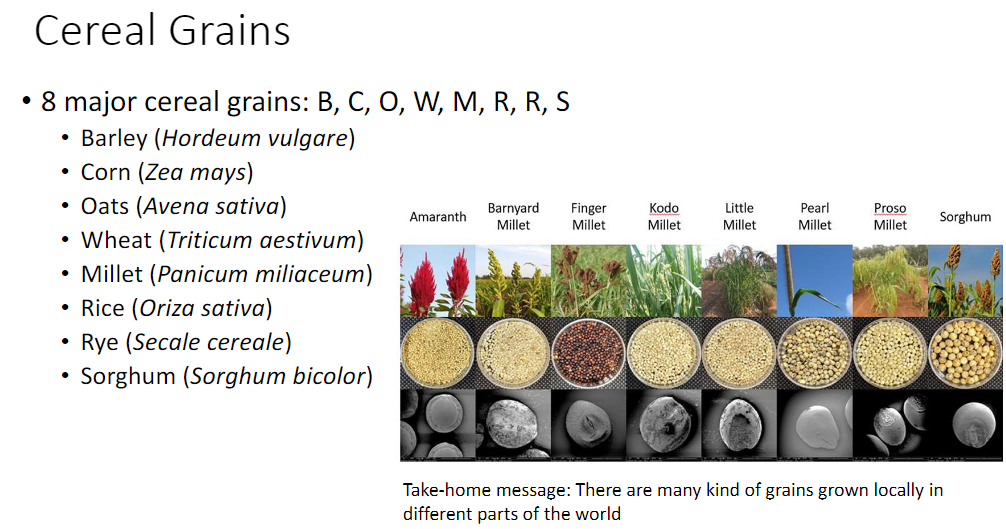
Cereal Grains

8 Major Cereal Grains
  • B → Barley (Hordeum vulgare)
  • C → Corn (Zea mays)
  • O → Oats (Avena sativa)
  • W → Wheat (Triticum aestivum)
  • M → Millet (Panicum miliaceum)
  • R → Rice (Oriza sativa)
  • R → Rye (Secale cereale)
  • S → Sorghum (Sorghum bicolor)
<p><strong>8 Major Cereal Grains</strong><br>  • <strong>B</strong> → Barley (<em>Hordeum vulgare</em>)<br>  • <strong>C</strong> → Corn (<em>Zea mays</em>)<br>  • <strong>O</strong> → Oats (<em>Avena sativa</em>)<br>  • <strong>W</strong> → Wheat (<em>Triticum aestivum</em>)<br>  • <strong>M</strong> → Millet (<em>Panicum miliaceum</em>)<br>  • <strong>R</strong> → Rice (<em>Oriza sativa</em>)<br>  • <strong>R</strong> → Rye (<em>Secale cereale</em>)<br>  • <strong>S</strong> → Sorghum (<em>Sorghum bicolor</em>)</p>
3
New cards

Global Cereal Grain Production – 2020

Annual Production
  • Measured in million metric tonnes (MMT)

Corn
  • 1,173 MMT

Wheat
  • 784 MMT

Rice
  • 508 MMT

Barley
  • 147 MMT

Sorghum
  • 60 MMT

<p><strong>Annual Production</strong><br>  • Measured in <strong>million metric tonnes (MMT)</strong></p><p><strong>Corn</strong><br>  • <strong>1,173 MMT</strong></p><p><strong>Wheat</strong><br>  • <strong>784 MMT</strong></p><p><strong>Rice</strong><br>  • <strong>508 MMT</strong></p><p><strong>Barley</strong><br>  • <strong>147 MMT</strong></p><p><strong>Sorghum</strong><br>  • <strong>60 MMT</strong></p>
4
New cards

Corn production, 1961 to 2020

knowt flashcard image
5
New cards

U.S. Corn Utilization

knowt flashcard image
6
New cards

Fuel Ethanol and Sustainable Aviation Fuel (SAF)

Renewable Fuels
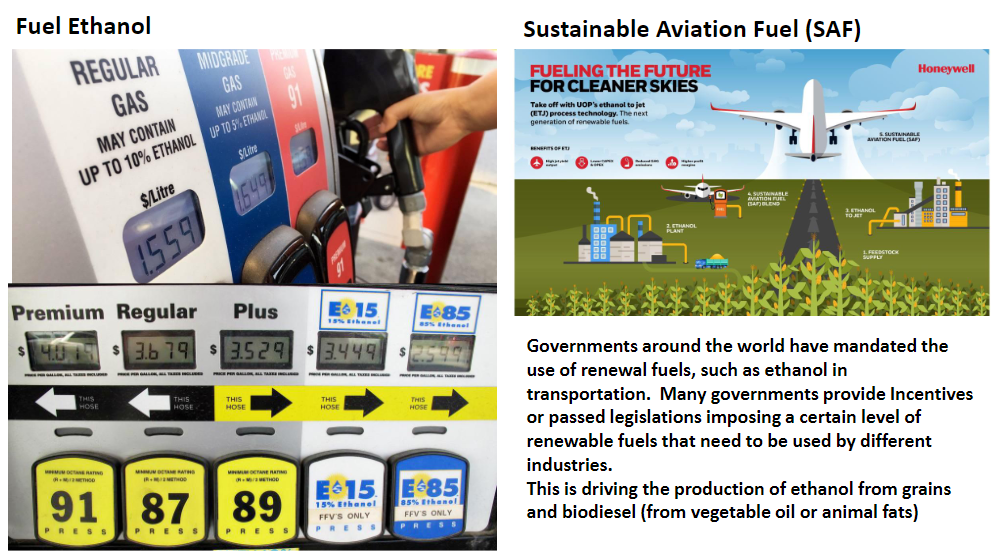
  • Governments around the world have mandated the use of renewable fuels → fuels made from renewable sources
  • Examples → ethanol in transportation and SAF (Sustainable Aviation Fuel)
  • Governments may provide incentives or pass legislation requiring a certain level of renewable fuels to be used by different industries

Production
  • These policies are driving production of ethanol from grains
  • Biodiesel → produced from vegetable oil or animal fats
<p><strong>Renewable Fuels</strong><br>  • Governments around the world have mandated the use of <strong>renewable fuels</strong> → fuels made from renewable sources<br>  • Examples → <strong>ethanol</strong> in transportation and <strong>SAF (Sustainable Aviation Fuel)</strong><br>  • Governments may provide <strong>incentives</strong> or pass <strong>legislation</strong> requiring a certain level of renewable fuels to be used by different industries</p><p><strong>Production</strong><br>  • These policies are driving production of <strong>ethanol from grains</strong><br>  • <strong>Biodiesel</strong> → produced from <strong>vegetable oil or animal fats</strong></p>
7
New cards

Why Use Food Resources for Fuel?

Why Use Grains for Fuel?
  • Precious food resources such as grains are used to produce fuels → ethanol, biodiesel, SAF, etc.
  • Driven by arguably important policies → e.g. climate change mitigation efforts
  • Driven by economics → there is demand and buyers for these products, creating opportunities for farmers to make a profit

Co-Products and Animal Feed
  • Fuel production creates co-products that can be valuable animal feed resources
  • Examples → DDGS, oilseed meals
  • Increased demand for renewable fuels can increase global food production because of these co-products
  • Higher production of corn, soybean meal, canola, etc. → higher production of co-products → more feed ingredients available to the animal feed industry

Economics and Food Supply
  • Agriculture, food production, and animal production are driven by economics
  • Issues of food supply, accessibility, affordability, and security in many regions can be caused by logistical and political problems
  • It is never as simple as that → many factors influence food and feed production

<p><strong>Why Use Grains for Fuel?</strong><br>  • <strong>Precious food resources</strong> such as grains are used to produce fuels → <strong>ethanol, biodiesel, SAF, etc.</strong><br>  • Driven by arguably important <strong>policies</strong> → e.g. <strong>climate change mitigation efforts</strong><br>  • Driven by <strong>economics</strong> → there is demand and buyers for these products, creating opportunities for farmers to make a profit</p><p><strong>Co-Products and Animal Feed</strong><br>  • Fuel production creates <strong>co-products</strong> that can be valuable <strong>animal feed resources</strong><br>  • Examples → <strong>DDGS, oilseed meals</strong><br>  • Increased demand for renewable fuels can increase <strong>global food production</strong> because of these co-products<br>  • Higher production of <strong>corn, soybean meal, canola, etc.</strong> → higher production of co-products → more feed ingredients available to the <strong>animal feed industry</strong></p><p><strong>Economics and Food Supply</strong><br>  • <strong>Agriculture, food production, and animal production</strong> are driven by <strong>economics</strong><br>  • Issues of <strong>food supply, accessibility, affordability, and security</strong> in many regions can be caused by <strong>logistical and political problems</strong><br>  • It is <strong>never as simple as that</strong> → many factors influence food and feed production</p>
8
New cards

Corn Production in Ontario

Corn Production
  • Corn is widely grown across southern Ontario

Grain Corn – 2004–2015
  • Average acreage → 769,000 ha (1.9 million acres)
  • Average yield → 9.53 t/ha (152 bu/acre)

Corn Silage
  • Additional 118,000 ha (0.3 million acres) grown as corn silage for livestock feed

Uses of Grain Corn
  • 55% → used for feed
  • 45% → used for industrial purposes

<p><strong>Corn Production</strong><br>  • <strong>Corn</strong> is widely grown across <strong>southern Ontario</strong></p><p><strong>Grain Corn – 2004–2015</strong><br>  • Average acreage → <strong>769,000 ha</strong> (<strong>1.9 million acres</strong>)<br>  • Average yield → <strong>9.53 t/ha</strong> (<strong>152 bu/acre</strong>)</p><p><strong>Corn Silage</strong><br>  • Additional <strong>118,000 ha</strong> (<strong>0.3 million acres</strong>) grown as <strong>corn silage</strong> for <strong>livestock feed</strong></p><p><strong>Uses of Grain Corn</strong><br>  • <strong>55%</strong> → used for <strong>feed</strong><br>  • <strong>45%</strong> → used for <strong>industrial purposes</strong></p>
9
New cards

Grain Milling By-Products – Dry Milling

Dry Milling
  • Large volumes of cereal grains such as wheat, rice, and corn are dry milled
  • Used to produce a variety of food and industrial products

Wheat
  • Dry milled to produce wheat flour for human consumption
  • Process generates by-products used widely in animal feeds
  • Wheat bran
  • Wheat middlings
  • Wheat shorts

Rice
  • Dry milled to remove the husk and bran → produces white rice
  • Process produces several by-products
    • Rice bran
    • Deoiled rice bran (DORB)
    • Rice polishings
    • Broken rice
    • Rice bran oil
  • These products are commonly used as animal feed ingredients in major rice-producing countries
<p><strong>Dry Milling</strong><br>  • Large volumes of <strong>cereal grains</strong> such as <strong>wheat, rice, and corn</strong> are dry milled<br>  • Used to produce a variety of <strong>food and industrial products</strong></p><p><strong>Wheat</strong><br>  • Dry milled to produce <strong>wheat flour</strong> for human consumption<br>  • Process generates by-products used widely in <strong>animal feeds</strong><br>  • <strong>Wheat bran</strong><br>  • <strong>Wheat middlings</strong><br>  • <strong>Wheat shorts</strong></p><p><strong>Rice</strong><br>  • Dry milled to remove the <strong>husk and bran</strong> → produces <strong>white rice</strong><br>  • Process produces several by-products<br>    • <strong>Rice bran</strong><br>    • <strong>Deoiled rice bran (DORB)</strong><br>    • <strong>Rice polishings</strong><br>    • <strong>Broken rice</strong><br>    • <strong>Rice bran oil</strong><br>  • These products are commonly used as <strong>animal feed ingredients</strong> in major <strong>rice-producing countries</strong></p>
10
New cards

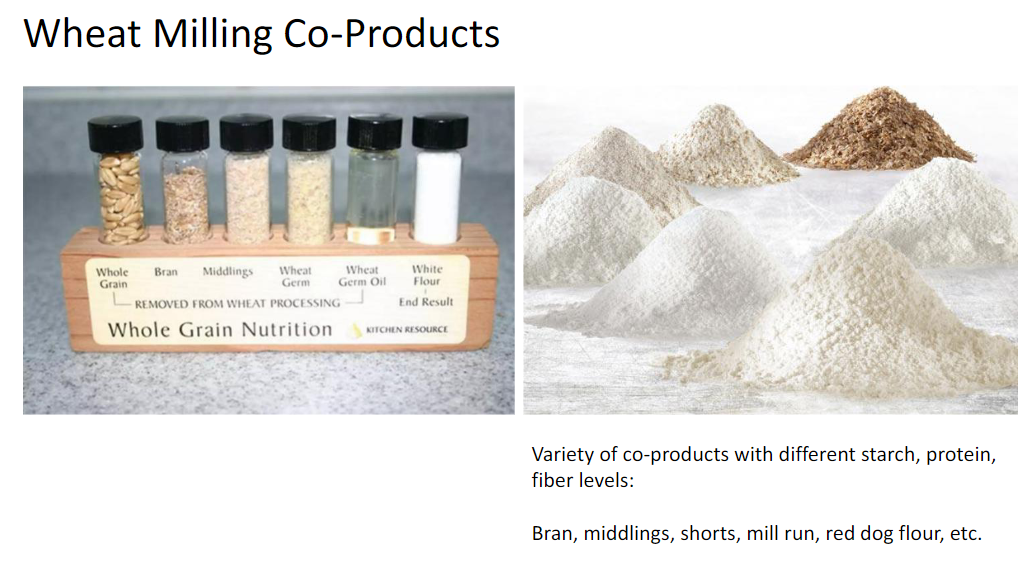
Wheat Milling Co-Products

Co-Products
  • Variety of co-products with different levels of starch, protein, and fiber
  • Bran
  • Middlings
  • Shorts
  • Mill run
  • Red dog flour
<p><strong>Co-Products</strong><br>  • Variety of <strong>co-products</strong> with different levels of <strong>starch, protein, and fiber</strong><br>  • <strong>Bran</strong><br>  • <strong>Middlings</strong><br>  • <strong>Shorts</strong><br>  • <strong>Mill run</strong><br>  • <strong>Red dog flour</strong></p>
11
New cards

Grain Milling By-Products – Wet Milling

Wet Milling
  • Corn and other grains can be wet milled to extract different components
  • Corn is soaked in warm water for 48–60 hours
  • Grain is then ground into a slurry → mixture of grain and liquid
  • Slurry is screened to remove corn bran
  • Then centrifuged → separates the starch

Corn Gluten Meal
  • Remaining protein-rich fraction → corn gluten meal
  • If wheat is wet milled → wheat gluten meal

Steep Water
  • Steep water → water in which corn grains were soaked
  • Contains part of the soluble nutrients of corn
  • Also contains fermentation products → e.g. lactic acid
  • Can be partly dehydrated → produces corn steep liquor

Ethanol Production
  • Corn grains can be fermented with yeast to produce ethanol (EtOH)
  • Ethanol → used as a fuel source
  • Components of the grain remaining after fermentation + yeast biomass are recovered and dried
  • Produces dry distiller’s grains and solubles (DDGS)
  • DDGS is widely used in swine, poultry, and ruminant feeds

<p><strong>Wet Milling</strong><br>  • <strong>Corn and other grains</strong> can be <strong>wet milled</strong> to extract different components<br>  • Corn is soaked in <strong>warm water for 48–60 hours</strong><br>  • Grain is then <strong>ground into a slurry</strong> → mixture of grain and liquid<br>  • Slurry is <strong>screened</strong> to remove <strong>corn bran</strong><br>  • Then <strong>centrifuged</strong> → separates the <strong>starch</strong></p><p><strong>Corn Gluten Meal</strong><br>  • Remaining <strong>protein-rich fraction</strong> → <strong>corn gluten meal</strong><br>  • If wheat is wet milled → <strong>wheat gluten meal</strong></p><p><strong>Steep Water</strong><br>  • <strong>Steep water</strong> → water in which corn grains were soaked<br>  • Contains part of the <strong>soluble nutrients</strong> of corn<br>  • Also contains <strong>fermentation products</strong> → e.g. <strong>lactic acid</strong><br>  • Can be partly dehydrated → produces <strong>corn steep liquor</strong></p><p><strong>Ethanol Production</strong><br>  • Corn grains can be <strong>fermented with yeast</strong> to produce <strong>ethanol (EtOH)</strong><br>  • <strong>Ethanol</strong> → used as a <strong>fuel source</strong><br>  • Components of the grain remaining after fermentation + <strong>yeast biomass</strong> are recovered and dried<br>  • Produces <strong>dry distiller’s grains and solubles (DDGS)</strong><br>  • <strong>DDGS</strong> is widely used in <strong>swine, poultry, and ruminant feeds</strong></p>
12
New cards

Corn Wet Milling Process

Initial Processing
  • Corn cleaners → clean the corn
  • Steep tanks → corn is soaked
  • Steep water → water from soaking
  • Steep water evaporators → concentrate the steep water

Germ Separation
  • Germ separators → separate the germ from the corn
  • Germ extractors → extract components from the germ
  • Germ → used to produce oil and germ meal

Grinding and Separation
  • Grind mills → grind the corn
  • Washing screens → separate hull
  • Centrifugal separators → separate components based on density
  • Gluten → protein-rich fraction
  • Starch washing hydro-cyclones → wash and separate starch

Products and Co-Products
  • Gluten meal
  • Gluten feed
  • Germ meal
  • Condensed fermented corn extractives
  • Oil
  • Starch
  • Sweeteners
  • Ethanol

Other Components
  • Pigments → 200–550 ppm

<p><strong>Initial Processing</strong><br>  • <strong>Corn cleaners</strong> → clean the corn<br>  • <strong>Steep tanks</strong> → corn is soaked<br>  • <strong>Steep water</strong> → water from soaking<br>  • <strong>Steep water evaporators</strong> → concentrate the steep water</p><p><strong>Germ Separation</strong><br>  • <strong>Germ separators</strong> → separate the germ from the corn<br>  • <strong>Germ extractors</strong> → extract components from the germ<br>  • <strong>Germ</strong> → used to produce <strong>oil</strong> and <strong>germ meal</strong></p><p><strong>Grinding and Separation</strong><br>  • <strong>Grind mills</strong> → grind the corn<br>  • <strong>Washing screens</strong> → separate <strong>hull</strong><br>  • <strong>Centrifugal separators</strong> → separate components based on density<br>  • <strong>Gluten</strong> → protein-rich fraction<br>  • <strong>Starch washing hydro-cyclones</strong> → wash and separate <strong>starch</strong></p><p><strong>Products and Co-Products</strong><br>  • <strong>Gluten meal</strong><br>  • <strong>Gluten feed</strong><br>  • <strong>Germ meal</strong><br>  • <strong>Condensed fermented corn extractives</strong><br>  • <strong>Oil</strong><br>  • <strong>Starch</strong><br>  • <strong>Sweeteners</strong><br>  • <strong>Ethanol</strong></p><p><strong>Other Components</strong><br>  • <strong>Pigments</strong> → <strong>200–550 ppm</strong></p>
13
New cards

Ethanol – DDGS Production

Ethanol Production Process
  • 1. Milling → corn is milled into meal
  • 2. Liquefaction → water is added and the meal is cooked
  • 3. Starch Breakdown → starch is broken down into sugar
  • 4. Fermentation → yeast is used to ferment the sugar into ethanol
  • 5. Distillation → ethanol is separated by boiling off and condensing it
  • 6. Water Removal → residual water is removed
  • 7. Denaturing → ethanol is made undrinkable

<p><strong>Ethanol Production Process</strong><br>  • <strong>1. Milling</strong> → corn is milled into <strong>meal</strong><br>  • <strong>2. Liquefaction</strong> → water is added and the meal is <strong>cooked</strong><br>  • <strong>3. Starch Breakdown</strong> → <strong>starch is broken down into sugar</strong><br>  • <strong>4. Fermentation</strong> → <strong>yeast</strong> is used to ferment the sugar into <strong>ethanol</strong><br>  • <strong>5. Distillation</strong> → ethanol is separated by <strong>boiling off and condensing</strong> it<br>  • <strong>6. Water Removal</strong> → <strong>residual water</strong> is removed<br>  • <strong>7. Denaturing</strong> → ethanol is made <strong>undrinkable</strong></p>
14
New cards

Roots & Tubers

Cassava
  • Manihot esculenta

Potato
  • Solanum tuberosum

Yam
  • Dioscorea spp.

Sweet Potato
  • Ipomoea batatas

<p><strong>Cassava</strong><br>  • <em>Manihot esculenta</em></p><p><strong>Potato</strong><br>  • <em>Solanum tuberosum</em></p><p><strong>Yam</strong><br>  • <em>Dioscorea</em> spp.</p><p><strong>Sweet Potato</strong><br>  • <em>Ipomoea batatas</em></p>
15
New cards

Cassava

Uses
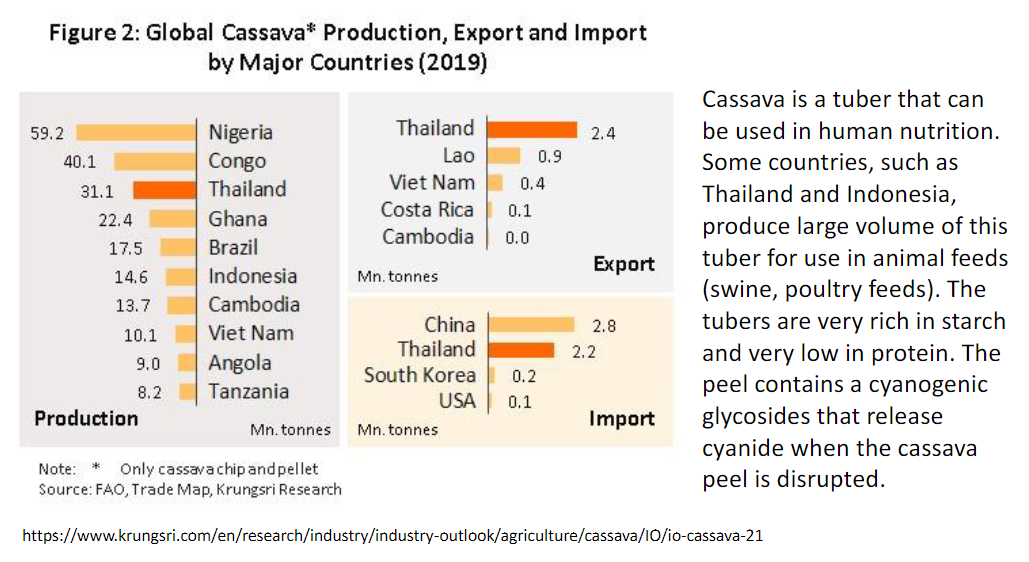
  • Cassava is a tuber that can be used in human nutrition
  • Countries such as Thailand and Indonesia produce large volumes of cassava for use in animal feeds
  • Used in swine and poultry feeds

Nutritional Composition
  • Tubers are very rich in starch
  • Very low in protein

Cassava Peel
  • Peel contains cyanogenic glycosides
  • When the peel is disrupted, these compounds release cyanide
<p><strong>Uses</strong><br>  • <strong>Cassava</strong> is a tuber that can be used in <strong>human nutrition</strong><br>  • Countries such as <strong>Thailand and Indonesia</strong> produce large volumes of cassava for use in <strong>animal feeds</strong><br>  • Used in <strong>swine and poultry feeds</strong></p><p><strong>Nutritional Composition</strong><br>  • Tubers are very rich in <strong>starch</strong><br>  • Very low in <strong>protein</strong></p><p><strong>Cassava Peel</strong><br>  • Peel contains <strong>cyanogenic glycosides</strong><br>  • When the peel is <strong>disrupted</strong>, these compounds release <strong>cyanide</strong></p>