BT3 - Finals (Reinforced Concrete)
 Studied by 26 people
 Call with Kai
 Learn
Learn Practice Test
 Spaced Repetition
 Match
Match Flashcards
 Knowt Play
1/115

Earn XP
Description and Tags
Handout 1: Reinforced Concrete Construction
Name | Mastery | Learn | Test | Matching | Spaced | Call with Kai |
|---|
No study sessions yet.
116 Terms
Reinforced Concrete
Concrete in which steel reinforcement is embedded in such a manner that the two materials act together in resisting forces,
Joseph Aspdin
Patented an artificial cement that he named portland cement after English Portland Limestone
Ancient Romans
Discovered mortar which contained all the essential ingredients of modern Portland Cement ; Inventors of Concrete Construction
True
True or False: Concrete has no form of its own
False
True or False: Concrete is strong in tension but weak in compression
Cement
A calcined mixture of clay and limestone, used as an ingredient in concrete and mortar
Mortar
Cement + sand + water
Plaster
Cement + Lime + Sand + Water
Grout
Cement + Sand + Considerable Amount of Water
True
True or False:: Too much water will weaken concrete
Abram’s Law
“The Compressive Strength of Concrete is Inversely Proportional to the Ratio of Water to Cement”
Pozzolanic Admixture
Used as substitute for cement (35%) for structures in high temperatures and seawater installation
Water Reducing Admixture
An agent or super plasticizers that improves workability and maintain consistency of concrete
Type I: Normal
Type of Cement: Portland Cement for General Construction
Type II: Moderate
Type Of Cement: Sulfate Resistant, where heat build up can damage the structure
Type III: High Early Strength (HES)
Type of Cement: Cures faster (3-7 Days) and gains earlier strength
Type IV: Low heat
Type of Cement: Generates less heat hydration where heat build-up can significantly damage the structure and used for massive concrete structures
Type V: Sulfate Resistant
Type of Cement: Used where resistance to severe sulfate action is required that damage the structure when it leach out from the soil
¼ in
Fine Aggregates / Sand consists of sand having a particle size smaller than _________ or 6.4mm
Coarse Aggregates
Consisting of crushed stone, gravel, or blast-furnace slag having particles larger than the ¼ in. (6.4mm)
6 Gallons per 40kg of Cement Bag
Average Water-Cement Ratio
Accelerator
Speeds up the setting of concrete to reduce the whole curing period or for early removal of forms
Retarder
Delays or extend the setting time of concrete especially during hot weather condition allowing more time to place, consolidate and finish the concrete
1:1:2:6
Concrete Ratio for Class AAA
1: 1 ½ : 3 : 6
Concrete Ratio for Class AA
1:2:4:6
Concrete Ratio for Class A
1:2 ½ : 5:6
Concrete Ratio for Class B
1:3:6:6
Concrete Ratio for Class C
1:3 ½ : 7 : 6
Concrete Ratio for Class D
28 Days
Concrete is normally considered fully cured after _______
Shrinkage
The end of the concrete curing process
Drying Shrinkage
A reduction in volume of concrete, mortar, or plaster caused by loss of moisture
Setting Shrinkage
A reduction in volume of concrete prior to the final set, caused by hydration of the cement paste.
Slump Test
Standard Test Method to measure the consistency of freshly mixed concrete including mortar and stucco
Compressive Cylinder Test
A quasi-quality control test based on 7-28 days curing period to determine the compressive strength of a concrete specimen.
Ready Mixed Concrete
Concrete mixed at batch plant for delivery by an agitator to construction site
Shrink Mixed
Concrete Partially mixed at the batch plant then mixed completely in a truck mixed en route to construction site
Transit Mixed
Concrete dry batch at a batch plant & mixed at the truck mixer en route to construction site.
Gunite
or ―”shotcrete” for lightweight construction, where concrete mix is pumped through a hose and sprayed at high velocity over reinforcement until desired thickness is reached.
True
Reinforced Concrete is also called Beton arme or Ferroconcrete
Plain Concrete
Concrete having no reinforcement, or reinforced only for drying shrinkage or thermal stresses
Balanced Section
A concrete section in which the tension reinforcement theoretically reaches its specified yield strength as the concrete in compression reaches its assumed ultimate strain.
Cast-in Place Concrete
Concrete which is deposited in the place where it is required to harden as part of the structure
True
True or False: Cast-in-Place concrete is also called Cast-In-Situ or In-Situ Concrete
Ferrocement
Constructed of cement-sand, mortar over wire mesh that has been preshaped over a mold
200mm (H) × 400mm (L)
Length and Height Measurements of CHB
Beton Brut
Concrete left in its natural state after formwork is removed, especially, when the concrete surface reflects the texture, joints, and fasteners of a form board.
Reinforcement
A system of steel bars, strands or wires for absorbing tensile, shearing and sometimes compressive stresses in a concrete member or structure.
Development Length
The length of embedded reinforcement required to develop the design strength of reinforcement at a critical section
Embedment Length
Length of a embedded reinforcement provide beyond a critical section
Beam
A rigid structural member designed to carry and transfer transverse loads across space to supporting elements
Simple Beam
Refers to a beam having a single span supported at its end without a restraint at the support
Semi-Continuous Beam
Refers to a beam with two spans with or without restraint at the two extreme ends.
Cantilever Beam
A beam supported on one end and the other end projecting beyond the support, beam or wall.
Continuous Beam
A term applied to a beam that rests on more than two supports
Concrete Cover
The amount of concrete required to protect steel reinforcement from fire and corrosion, measured from the surface of the reinforcement to the outer surface of the concrete section
Bond
The adhesion between two substances as concrete and reinforcing bar
Bond Stress
The adhesive force per unit area of contact between a reinforcing bar and the surrounding concrete developed at any section of a flexural member.
Hook
A bend or curve given to the end of a tension bar to develop an equivalent embedment length
Bottom Bar
any of the longitudinal bars serving as a tension reinforcement in the section of a concrete beam or slab subject to positive moment
Top Bar
any of the longitudinal bars serving as a tension reinforcement in the section of a concrete beam or slab subject to negative moment
Web Reinforcement
Reinforcement consisting of bent bars or stirrups, placed in a concrete beam to resist diagonal tension.
Stirrup
Any of the U-Shaped or closed-loop bars placed perpendicular to the longitudinal reinforcement of a concrete beam to resist the vertical component of a diagonal tension
True
True or False:
Cement shall conform to one of the following specifications for Portland Cement:
1. Specifications for Portland Cement (ASTM 150)
2. Specifications for Blended Hydraulic Cements (ASTM C595) excluding Types S and SA which are not intended as principal constituents of structural concrete.
False
True or False: Water used in a concrete mixture may be either dirty or clean.
True
Minimum clear spacing between parallel bars in a layer shall be not less than 25mm
75mm
Minimum Concrete Cover for Cast in Place Concrete Cast against and permanently exposed to earth
40mm
Minimum Concrete Cover for Cast in Place Concrete Beams, Columns, Primary reinforcement, ties, stirrups, spirals
Short Column
A column having an unsupported height not greater than 10 times the shortest lateral dimension of the cross section.
Long Column
A column having an unsupported height with more than 10 times the shortest lateral dimension of the cross section.
Vertical Reinforcement
Longitudinal Reinforcement placed in concrete column to absorb compressive stresses, resist bending stresses and reduce the effects of creep and shrinkage in the column
Lateral Reinforcement
Spiral reinforcement placed in a concrete column to laterally restrain the vertical reinforcement and prevent buckling
Spiral Reinforcement
Lateral reinforcement consisting of an evenly spaced continuous spiral held firmly in place by vertical spacers
Bundled Reinforcement
Reinforcement employed consisting of two to four bars tied in direct contact with each other
250mm
Minimum Diameter of SPIRAL Column
200mm
Minimum Thickness of TIED Column
4 - 16 mm ⌀
Minimum number of bars in TIED column
6 - 16mm ⌀
Minimum number of bars in a SPIRAL column
10 mm ⌀
Minimum Diameter of Lateral Ties in a TIED column
10 mm ⌀
Minimum Diameter of Spiral Ties for SPIRAL column
False
True or False: When the beam crosses a girder, rest beam bars below the girder bars
Composite Column
A type of column where structural steel is embedded into concrete core of a spiral column
Combined Column
A column with a structural steel encased in a concrete of at least 7cm thick reinforced with wire mesh surrounding the column at a distance of 3cm inside the outer surface of the concrete covering
Lally Column
A fabricated post made of steel provided with a plain flat steel bar or plate which holds girder, girt or beam.
Reinforced Concrete Slab
A rigid planar structure of concrete designed to act together with principal and secondary reinforcements in resisting applied forces
Live Load
Refers to those movable loads imposed on the floor
Dead Load
Refers to the static load such as the weight of the construction materials
Environmental Load
Consist of wind pressure and suction, earthquake load, rainwater on flat roof and forces caused by temperature changes or differentials
Construction Joint
A joint where two successive placements of concrete meet
Isolation Joint
Often called Expansion Joint, it allows movement between concrete slab and adjoining columns and walls of a building
Control Joint
Joint that creates lines of weakness so that cracking that may results from tensile stress occurs along predetermined lines
One-Way Slab
A concrete slab of uniform thickness reinforced in one direction ; Suitable only for relatively short spans
Two-Way Slab
A concrete slab of uniform thickness reinforced in two directions ; Economical for medium spans with intermediate to heavy loads
Waffle Slab
A concrete slab reinforced by ribs in two directions ; Can carry heavier loads and spans longer distances that flat slabs.
Continuous Slab
A reinforced concrete slab extending as a structural unit over three or more supports in a given direction ; Subject to lower bending moments than a series of simply supported slabs
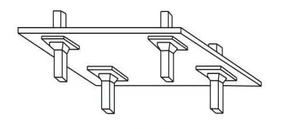
Flat Slab
A flat plate thickened at its column supports with column capitals and drop panels to increase its shear strength and moment-resisting capacity
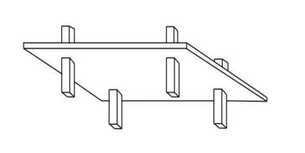
Flat Plate
A concrete slab of uniform thickness reinforced in two or more directions and supported directly by columns without beams or girders
Foundation
The lowest division of a building, its substructure or other construction, constructed partly or wholly below the surface of the ground, designed to support and anchor the superstructure above
Shallow Foundation
A foundation system type employed when the soil underlying is stable
Deep Foundation
A foundation system type employed when the soil underlying is unstable