FUNDA - PRELIM
 Call Kai
 Learn
Learn Practice Test
 Spaced Repetition
 Match
Match Flashcards
 Knowt Play
1/51

There's no tags or description
Looks like no tags are added yet.
Name | Mastery | Learn | Test | Matching | Spaced | Call with Kai | Chat |
|---|
No analytics yet
Send a link to your students to track their progress
52 Terms
1752 (Benjamin Franklin)
Demonstrated the nature of electricity using a kite, string, and key.
1776 (James Watt)
Commercialized the steam engine; his name is attributed to the SI unit of power
1786 (Luigi Galvani)
Observed bioelectricity causing muscle twitching in frogs
1792 (Alessandro Volta)
Invented the chemical battery; named as the unit of electric potential (volt)
1827 (André-Marie Ampère)
Formulated the foundations of electrodynamics; named as the unit of current
1827 (Georg Simon Ohm)
Formulated the relationship between voltage, current, and resistance (Ohm's Law)
1882 (Thomas Edison)
Deployed the first commercial direct current (DC) generators to illuminate New York City
1885 (George Westinghouse & Nikola Tesla)
Developed and commercialized alternating current (AC) generators and motors
Work or Energy (W or E)
Measured in Joule (J); the capacity to do work
Electric Current (I)
Measured in Ampere (A) (1 A = 1 C/s)
Power (P)
Measured in Watt (W); the time rate of expending or absorbing energy
Electric Charge (Q)
Measured in Coulomb (C).
Voltage (V)
Measured in Volt (V) (1 V = 1 J/C)
Prefix & Multiplier
tera: 12
giga: 9
mega: 6
kilo: 3
deka: 0
milli: -3
micro: -6
nano: -9
pico: -12
Charge of an electron (e)
-1.602 x 10^-19 C
Law of Conservation of Charge
Charge cannot be created or destroyed; it is only transferred
Law of Conservation of Power
Total power delivered to a circuit equals total power absorbed
Power Formula
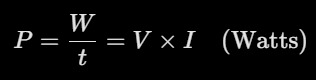
Voltage Formula

Charge Formula

Law of Conservation of Power Formula

Active Elements
Capable of generating electrical energy (e.g., DC/AC voltage and current sources, transistors, integrated circuits
Passive Elements
Incapable of generating energy
Resistor
Regulates current flow and limits voltage by creating voltage drops
Diode
Restricts electric current to a single direction
Capacitor
Stores and releases electric energy in an electrostatic field
Inductor (Coil)
Creates an electromagnetic field to impede alternating current (AC) while passing direct current (DC)
Transformer
Transfers electrical energy across circuits via electromagnetic induction
Active Elements examples
DC/AC voltage and current sources, transistors, integrated circuits
Passive Elements Examples
Resistor
Diode
Capacitor
Inductor (Coil)
Transformer
Conductor
Low-resistance material that readily permits current flow (e.g., Copper, Aluminum, Brass, Silver, Gold, Platinum, Carbon)
Insulator
High-resistance material that blocks current flow
Conductor Examples
Copper
Aluminum
Brass
Silver
Gold
Platinum
Carbon
Insulator e.g.
Plastic
Rubber
Glass
Porcelain
Air
Paper
Mica
Ceramics
Mnemonic
Bad beer rots out your guts but vodka goes well
Ohm’s Law
Current (I) is directly proportional to voltage (V) and inversely proportional to resistance (R) at a constant temperature
Ohm’s Law F

Branch
Represents a single two-terminal circuit element (e.g., a resistor, diode, or source)
Node
A point of connection where two or more branches meet
Loop
Any closed conducting path through a circuit
Kirchhoff's Current Law (KCL)
Based on the Conservation of Charge; The algebraic sum of currents entering and exiting a node is zero
KCL F

Kirchhoff's Voltage Law (KVL)
Based on the Conservation of Energy; The algebraic sum of all voltages around any closed loop is zero
KVL F
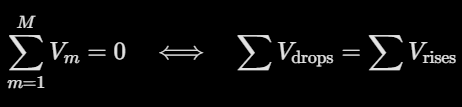
Voltage Drop in Sign Convention (Clockwise Loop)
Entering a positive (+) terminal and exiting negative (-); written as +V
Voltage Rise in Sign Convention (Clockwise Loop)
Entering a negative (-) terminal and exiting positive (+); written as -V
Series Equivalent Resistance

Voltage Division Rule (VDR - Series Circuits)
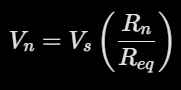
Current Division Rule for two parallel resistors (CDR - Parallel Circuits):

Current Division Rule for N parallel resistors (CDR - Parallel Circuits):

Delta to Wye

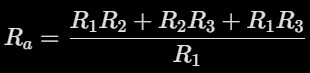
Wye to Delta