Sentence Structure

0.0(0)
Studied by 0 people
call kaiCall Kai
Locked
learnLearn
examPractice Test
spaced repetitionSpaced Repetition
heart puzzleMatch
flashcardsFlashcards
GameKnowt Play
Card Sorting

1/10

encourage image

There's no tags or description

Looks like no tags are added yet.

Last updated 9:14 AM on 6/28/26
Name
Mastery
Learn
Test
Matching
Spaced
Call with Kai
Chat

No analytics yet

Send a link to your students to track their progress

11 Terms

1
New cards

Sentence Structure

  • A sentence is a collection of words assembled in such a way that they present a complete thought or idea

  • There are four sentence structures in English: simple, compound, complex and compound-complex sentences

  • Mastering these different types of sentences will allow you to highlight varying relationships between ideas, improve your written expression and add variety to your writing.

2
New cards

Independent clause

  • And independent clause can stand alone as a sentence

  • It contains a subject a verb and it is a complete idea
<ul><li><p>And independent clause can stand alone as a sentence</p></li><li><p>It contains a subject a verb and it is a complete idea</p></li></ul><p></p>
3
New cards

Dependent clause

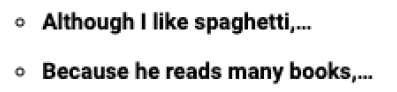
  • A dependent clause is not a complete sentence

  • It must be attached to an independent clause to become complete

  • Also known as a subordinate clause

<ul><li><p>A dependent clause is not a complete sentence</p></li><li><p>It must be attached to an independent clause to become complete</p></li><li><p>Also known as a subordinate clause</p></li></ul><p></p>
4
New cards

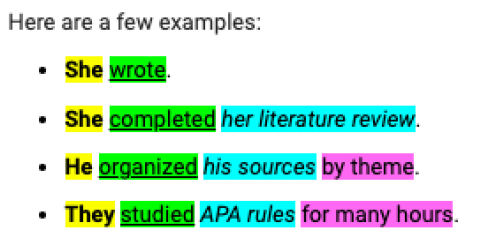
Subject

  • A person, animal, place, concept or thing that does an action

  • Determine the subject by asking “Who or What?”
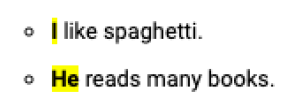
<ul><li><p>A person, animal, place, concept or thing that does an action</p></li><li><p>Determine the subject by asking “Who or What?”</p></li></ul><p></p>
5
New cards

Verb

  • Expresses what the person, animal, place, concept or thing does/is doing

  • Determine the verb by asking the question “What was the action or what just happened?”

<ul><li><p>Expresses what the person, animal, place, concept or thing does/is doing</p></li><li><p>Determine the verb by asking the question “What was the action or what just happened?”</p></li></ul><p></p>
6
New cards

Object

  • A person, animal, place, concept or thing that receives the action

  • Determine the object in a sentence by asking the question “What/who does the verb effect?”
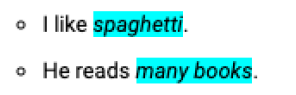
<ul><li><p>A person, animal, place, concept or thing that receives the action</p></li><li><p>Determine the object in a sentence by asking the question “What/who does the verb effect?”</p></li></ul><p></p>
7
New cards

Prepositional phrase

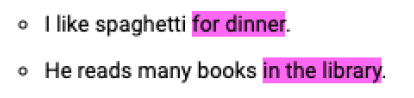
  • A phrase that begins with a preposition and modifies a word in the sentence

  • A prepositional phrase answers one of many questions

    • Where?

    • When?

    • In what way?

    • Etc.

<ul><li><p>A phrase that begins with a preposition and modifies a word in the sentence</p></li><li><p>A prepositional phrase answers one of many questions</p><ul><li><p>Where?</p></li><li><p>When?</p></li><li><p>In what way?</p></li><li><p>Etc.</p></li></ul></li></ul><p></p>
8
New cards

Simple Sentences

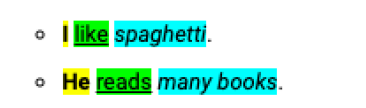
  • Contains a subject and a verb

    • It may also have and object and modifiers

  • Only contains one independent clause

<ul><li><p>Contains a subject and a verb</p><ul><li><p>It may also have and object and modifiers</p></li></ul></li><li><p>Only contains one independent clause</p></li></ul><p></p>
9
New cards

Compound Sentences

  • Contains at least 2 independent clauses

  • These two independent clauses can be combined with a comma and a coordinating conjunction or with a semi colon

<ul><li><p>Contains at least 2 independent clauses</p></li><li><p>These two independent clauses can be combined with a comma and a coordinating conjunction or with a semi colon</p></li></ul><p></p>
10
New cards

Complex Sentences

  • Contains at least 1 independent clause and 1 dependent clause

  • Dependent clauses can refer to the subject (Who, Which), the sequence / time (Since, While) or the casual elements (Because, if) of the independent clause

  • If a sentence begins with a dependent clause, note the comma after the clause

  • If the sentence begins with an independent clause there is not a comma separating the two clauses
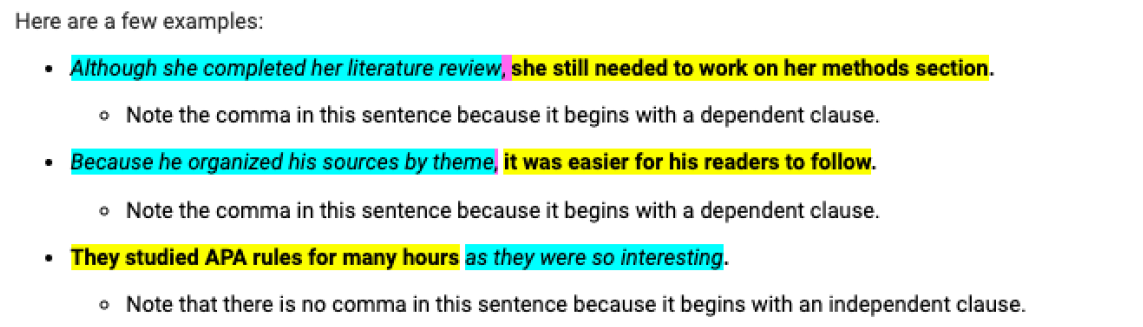
<ul><li><p>Contains at least 1 independent clause and 1 dependent clause</p></li><li><p>Dependent clauses can refer to the subject (Who, Which), the sequence / time (Since, While) or the casual elements (Because, if) of the independent clause</p></li><li><p>If a sentence begins with a dependent clause, note the comma after the clause</p></li><li><p>If the sentence begins with an independent clause there is not a comma separating the two clauses</p></li></ul><p></p>
11
New cards

Compound - Complex Sentences

  • Sentence types can be combined

  • A compound-complex sentence contains at least 2 independent clauses and 1 dependent clause

<ul><li><p>Sentence types can be combined</p></li><li><p>A compound-complex sentence contains at least 2 independent clauses and 1 dependent clause</p></li></ul><p></p>