CBNS101 lecture 3-4
 Call Kai
 Learn
Learn Practice Test
 Spaced Repetition
 Match
Match Flashcards
 Knowt Play
1/90

There's no tags or description
Looks like no tags are added yet.
Name | Mastery | Learn | Test | Matching | Spaced | Call with Kai | Chat |
|---|
No analytics yet
Send a link to your students to track their progress
91 Terms
Where does protein synthesis begin?
Cytosol
General function of nucleus:
DNA storage and synthesis
General function of cytoplasm:
protein synthesis, some intermediary metabolism
General function of endoplasmic reticulum:
assembly of membrane proteins, lipid synthesis, Ca2+ storage
General function of golgi apparatus:
modification and transport of membrane proteins to/from other destinations / outside
General function of mitochondria/chloroplasts:
ATP production
Which organelle has the most membrane area?
ER
Spontaneously assembling structures of proteins and RNA held by multiple weak interactions between these scaffold molecules
Biomolecular condensates
What is the function of the dynamic, liquid like feature of biomolecular condensates?
To recruit client macromolecules
What are 2 functions of biomolecular condensates/ membraneless organelles?
Assembly of biochemical molecules
Storage
What are 4 ways to move proteins between compartments?
Translocation
Gated transport
Vesicular transport
Engulfment
What is protein translocation?
Directly transporting protein from the cytosol into another organelle
What is gated transport?
Movement of protein/RNA through nuclear pore complexes from nucleus to cytosol
What is vesicular transport?
Uses membrane-enclosed vesicles to bud off one compartment and fuse with another, can transport many molecules at once
What is engulfment?
Double-membrane sheets encircle portions of cytoplasm or other organelles
How do transporters know where to transport the protein?
Signal sequences of the protein, which are recognized by specialized receptor proteins that mediate transport
What are 2 ways a signal sequence can be arranged inside a protein?
A signal peptide or a signal patch
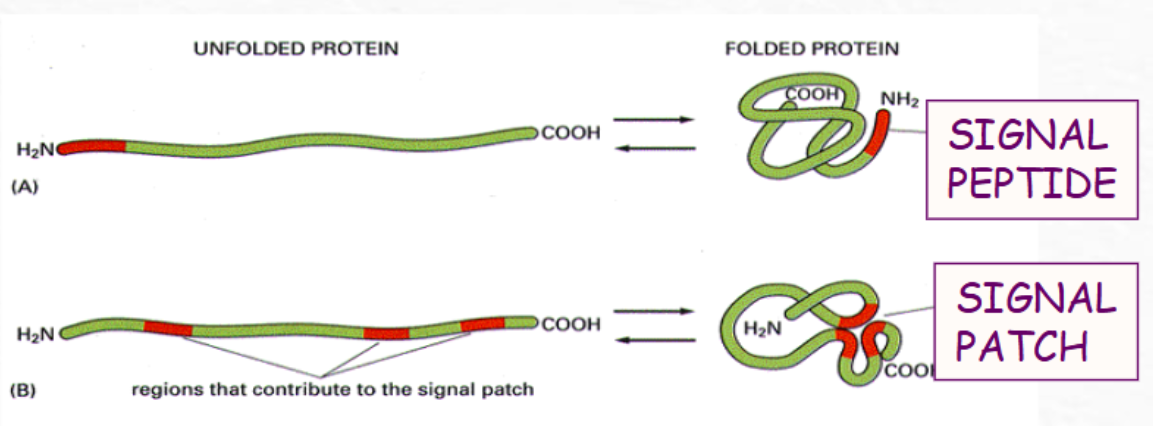
True or false: Signal sequences of proteins bound for same organelle are functionally interchangeable
True
Experimentally, how do we know that signal sequences are necessary and sufficient?
Necessary: cutting of sequence mis directs protein
Sufficient: Transfer of sequence to a different protein causes it to be transported
What things need to enter the nucleus?
DNA and RNA polymerases, transcription factors, splicing factors, components for ribosome assembly
What things need to exit the nucleus?
mRNA, assembled ribosomes
What is the function of the inner nuclear membrane?
To tether and bind to the nuclear lamina, which is a mesh of polymerized proteins proving support
The outer nuclear membrane is continuous with?
The ER membrane
Where is the perinuclear space?
In between the inner and outer nuclear membrane
What is the function of nuclear pores/the nuclear pore complex?
Transports molecules in/out of the nucleus
How does the membrane of ER, Golgi, and secretory organelles differ from the membrane of the nucleus?
Only the ER, Golgi, and secretory organelles have a phospholipid bilayer
What are nuclear pore complexes made up of?
Proteins called nucleoporins
What types of molecules cannot passively diffuse across the nucleus?
Proteins larger than ~5nm
What domain of nucleoplasmin contains the signaling sequence and how do we know?
Cleave the domains and fluorescently label them. Inject them into a cell; the tail regions were transported into the nucleus, while the head stayed in the cytoplasm
Transport through nuclear pores is regulated by requiring:
A nuclear localization signal / sequence on the transported protein
What is the nuclear localization signal (NLS) made up of?
A chain of basic amino acids in the transported protein
What kind of movement across the nucleus requires an NLS?
Active import
What signal does active export out the nucleus require?
nuclear export signal (NES)
What are some ways nuclear import/export receptors interact with NLS/NES?
Directly, indirectly, or through an adaptor protein.
Nuclear transport receptors (NTRs) contain multiple, weak binding sites that bind with ___________ repeats. What does the binding do?
Phenylalanine-glycine repeats. Binding allows the receptor and its cargo to move through the nucleus.
How is directionality set for nuclear transport?
Ran GTPase and the energy of GTP hydrolysis
This GTPase regulatory protein switches from GTP to GDP state through GTP hydrolysis.
GTPase-activating proteins (GAPs)
This GTPase regulatory protein promotes GDP dissociation and binding of GTP.
Guanine nucleotide exchange factors(GEFs)
Where is Ran GAP found? What about GEP?
GAP—>cytosol
GEP—>nucleus
Describe the cycle of import into the nucleus.
Import receptor binds cargo in the cytoplasm and transports it into nucleus—>in the nucleus, Ran-GTP binds to receptor, receptor releases cargo—>Import receptor with Ran-GTP transports back to the cytoplasm
The Ran GTPase-activating protein (GAP) in the cytoplasm causes Ran to hydrolyze GTP, becoming Ran-GDP—>Ran-GDP dissociates from import receptor, freeing it for another cycle of import
Binding of Ran GTP to import receptors triggers _________(binding/release) of cargo and occurs in the _________.
release; cytoplasm
Binding of Ran GTP to export receptors triggers _________(binding/release) of cargo and occurs in the _________.
binding; nucleus
What kinds of proteins can shuttle back and forth between the nucleus and the cytoplasm freely.
If they are small enough for diffusion, or contain both an NLS and NES
How to regulate NLS/NES sequences?
By phosphorylation nearby
What is nuclear factor of activated T cells (NF-AT)
Transcription factor that activates immune response genes
What happens to the Nuclear factor of activated T cells (NF-AT) when a t cell is activated?
NF-AT is dephosphorylated, blocks NES, reveals an NLS, and transports it into the nucleus for transcription.
The perinuclear space is continuous with the:
ER lumen
Proteins destined for Golgi, lysosome or outside of cell start synthesis in the :
ER
The ER is a continuous network of:
Branching sheets and microtubules
What is the function of the rough ER?
Protein synthesis, translocation into ER
What is the function of the smooth ER?
Sites where transport vesicles bud off, sites for catalysis by membrane bound enzymes, makes contact with other organelles
What were Blobel’s observations about mRNA translation with and without ER microsomes?
No microsomes: secreted protein larger than produced protein, no translocation into microsomes later.
With microsomes: the produced protein was the correct size and found in the microsome
What conclusion did blobel’s experiment suggest?
A signal sequence in the protein directed it to the ER and was cleaved during translocation
Fill in the blank: In co-translational transfer, _______ binds to the signal sequence and moves the protein from the ribosome-mRNA complex to the ________ surface. There, it binds to a ______ _______. The ribosome docks on a protein __________, translation continues and the protein is transferred into the ______. Finally, a ______ _________ protein cleaves off the signal sequence, leaving a free protein in the ER lumen.
Signal Recognition Particle (SRP), rough ER, SRP receptor, translocator, ER, signal peptidase
What happens when a SRP binds to a signal sequence?
The SRP wraps around the ribosome and slows translation; binding also exposes a binding sit on SRP for the receptor.
What are the two spatially separated populations of ribosomes
Membrane bound and free ribosomes in the cytosol
Define polyribosomes
clusters of ribosomes bound to a single messenger RNA (mRNA) molecule, allowing for quick translation of the mRNA
The protein translocator is called the ______ complex
Sec61
Is the signal sequence hydrophilic or hydrophobic?
hydrophobic
What is post-translational translocation?
When translocation across membrane can occur after protein synthesis
Describe the structure of the protein translocator.
an aqueous pore that is plugged by an alpha-helix when resting. The incoming signal sequence displaces this plug to open the channel.
If the N-terminal flank is already stably folded or has a net positive charge, what side of the membrane will the N terminus be?
Outside(in the cytosol)
If the N-terminal flank is short and unfolded, and a net positive charge resides on the C-terminal side of the hydrophobic segment, what side of the membrane will the N terminus be?
Inside(lumen)
How are single pass proteins with large N terminus domains meant to end up in the lumen translocated?
N terminal signal sequence initates translocation.
N terminus is threaded into the ER and folds there
In multiple pass transmembrane proteins, successive transmembrane segment is inserted into the membrane in an orientation that is ________ to the previous one
Opposite
Function of BiP Chaperone:
detects unfolded or misfolded proteins by binding to exposed hydrophobic regions, preventing them from aggregating or prematurely exiting the ER.
Function of protein disulfide isomerase(PDI):
Oxidizes SH on cysteines to form disulfide bonds, which stabilizes the folded proteins
The majority of protein glycosylations are:
N linked
What does it mean for glycosylation to be N linked?
Oligosaccharide is attached to a nitrogen of asparagine
What are O linked glycosylations?
Oligosaccharide is added to the OH group of serine, threonine, etc.
How are improperly folded proteins recognized?
By slow oligosaccharide trimming in the ER
What are the general steps that occur with improperly folded proteins
Recognition, then translocated out of the lumen to the cytosol, de-glycosylated, ubiquitinated, and degraded.
What complex are proteins degraded?
Proteasome
How do Mitochondria and chloroplasts receive membrane lipids from ER ?
Non vesicular membrane contact sites
What are the 4 different sites of action in the mitochondria proteins must be directed to?
Outer membrane (OM)
Intermembrane space
Inner membrane (IM)
Matrix space
Matrix space proteins have a signal sequence in the ___-terminus.
N
Is the signal sequence of matrix space proteins cleaved off?
yes
Proteins from these areas of the mitochondria have internal signal sequences that are not removed.
Outer membrane, inner membrane, intermembrane space
The Translocator of the outer membrane (TOM) recognizes the signal sequence and imports applicable proteins into:
The IMS
What proteins are inserted by SAM? Where?
B barrels; usually outer membrane
Where does the TIM23 Complex insert proteins?
Matrix space or inner membrane
Where does the TIM22 Complex insert proteins?
Inner membrane
Where does the OXA Complex insert proteins?
Inner membrane
What keeps mitochondrial precursor proteins unfolded?
Chaperones in the hsp70 family