LSU CHEM 2261 Exam 1 - Davila Fall 2026
 Call Kai
 Learn
Learn Practice Test
 Spaced Repetition
 Match
Match Flashcards
 Knowt Play
1/52

There's no tags or description
Looks like no tags are added yet.
Name | Mastery | Learn | Test | Matching | Spaced | Call with Kai | Chat |
|---|
No analytics yet
Send a link to your students to track their progress
53 Terms
Formal Charge
Valence e - (nonbonding e + (1/2)(bonding e))
Constitutional Isomers
Same Molecular formula, different connectivities
Delocalized Electrons
electrons that are shared by more than 2 atoms
Resonance energy
extra stability a compound gains for having delocalized electron
sigma bond
bond formed by head to head overlap of atomic orbitals; of any bond the first is a sigma, rest are pi

pi bond
bond formed by side to side overlap of p-atomic orbitals

antibonding molecular orbitals
contain a node between the nuclei
VSEPR model
pairs of valence electrons around an atom repel each other
sp3 hybridization
atom can only form single bonds
sp2 hybridization
molecules containing a double bond
sp hybridization
molecules containing an atom with triple or double bonds
acid
donates a proton
base
accepts a proton
conjugate acid
the base after it accepts the proton
conjugate base
the acid after it gives away the proton
Acid dissociation constant (Ka)
measures the strength of an acid
Induction
shifting of electrons in a bond as a result of the electronegativity of nearby atoms.
Lewis Acid (electrophile)
a substance that accepts 2 electrons.
Lewis Base (nucleophile)
a substance that donates 2 electrons.
Alkanes:
hydrocarbons that contain only C-C and C-H single bonds. Molecular formula: Cn H2n+2
Constitutional isomers:
The number of isomers increases dramatically as the number of carbon atoms increases.
Cycloalkanes:
CnH2n
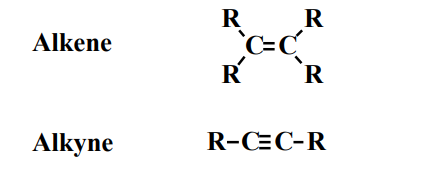
Alkenes:
Unsaturated hydrocarbons that contain a C=C bond with Molecular formula: CnH2n
Cis-Trans Isomers:
Compounds that have the same molecular formula, same connectivities but different arrangement in space.Alkynes:
Alkynes:
Unsaturated hydrocarbons that contain a C≡C bond with Molecular formula: Cn H2n-2
Aromatic Compounds:
Hydrocarbons related to benzene

Alkyl (R) groups:
obtained by removing a hydrogen atom from an alkane.
primary carbon
bonded to one other carbon, a primary hydrogen is bonded to a primary carbon.

secondary carbon(2 degree , sec-)
bonded to two other carbons, a secondary hydrogen is bonded to a 2o carbon.

tertiary carbon (3o , tert-)
bonded to three other carbons, a tertiary hydrogen is bonded to a 3o carbon

quaternary carbon
bonded to four other carbons.

alcohol
replacement of H of an alkane by OH, NH2 or a halogen (F, Cl, Br, or I)
Functional group
an atom or group of atoms where most of the chemical reactions occur. They usually contain multiple bonds or lone pairs of electrons.
Functional group that contains C-C multiple bonds:
functional group that contain carbon bonded to an electronegative atom:

functional group that contain a carbonyl group (C=O):

Melting point trends

Boiling point trends

Cycloalkanes
CnH2n

Newman projections
viewing the molecule along the C-C bond, so the back C is hidden by the front C.

Torsional strain
repulsion between the bonding electrons of one substituent as they pass close to the bonding electrons of another substituent.
Steric strain
results when atoms or groups are too close to each other.
anti conformation
the largest substituents are opposite each other , most stable conformation

gauche conformations
the largest substituents are adjacent to each other

Angle Strain
(deviation from 109.5° bond angle)
Torsional Strain
(repulsion of the bonding electrons between nearby substituents)
Steric Strain
(caused by atoms or groups of atoms approaching each other too closely)
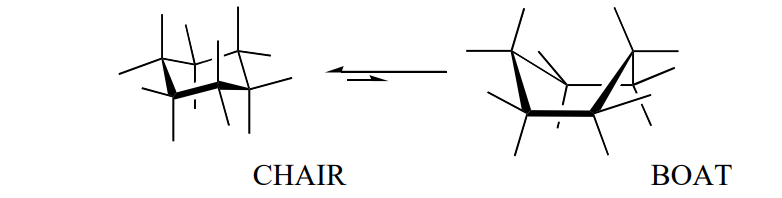
CHAIR and BOAT
Conformations in Cyclohexane, Both conformations are free of angle strain; however, the boat conformer has more torsional and steric strain than the chair.
Ring-flip:
cyclohexane interconverts between two chair conformations (interconversion of axial and equatorial positions):Substituents in axial positions

Substituents in axial positions
1,3-diaxial interactions (unfavorable steric interactions).
Substituents in equatorial positions
have fewer steric interactions (favorable).
Stereoisomers
have different spatial orientation
Cis-trans stereoisomerism
(cis = same side, trans = opposite side)
