Metal Biomaterials
 Call Kai
 Learn
Learn Practice Test
 Spaced Repetition
 Match
Match Flashcards
 Knowt Play
1/59

There's no tags or description
Looks like no tags are added yet.
Name | Mastery | Learn | Test | Matching | Spaced | Call with Kai | Chat |
|---|
No analytics yet
Send a link to your students to track their progress
60 Terms
Metals Outline
bond - metallic
thermal/electrical conductivity - yes bc e- aren’t stuck at 1 spot but free so can move around
reactivity - varies
crystalline (mainly) or amorphous (mercury)
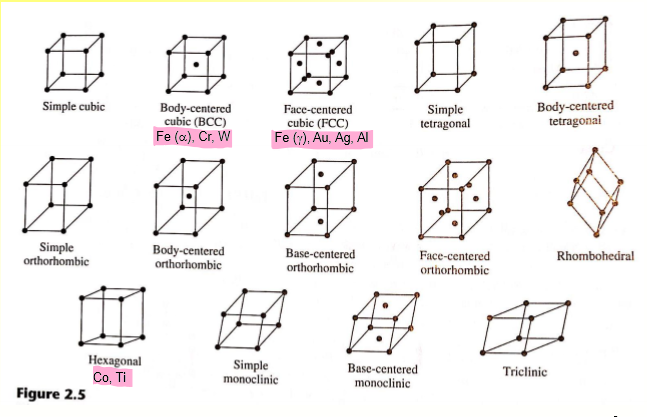
Unit Cell - Metal
configuration of atoms in a small section of the crystal that is repeated in 3D; smallest component of a crystal (repeat unit)
Unit Cell - Metal Picture
Point Defects
2 exceptions: vacancy and interstitutional; alloys are solid solns. and impurity atoms have been added to improve properties (mechanical strength, corrosion resistance, etc.); these areas tend to have higher energy
Vacancy
type of point defect; just a missing spot that can be filled by a substitutional atom
Interstitial
type of point defect; an extra atom added called an impurity atom
Line Defects
edge dislocation and secrew dislocation but most are actually a mix called mixed dislocation
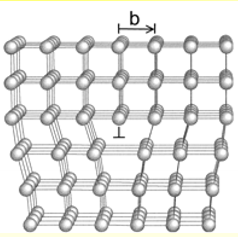
Edge Dislocation
regular plane but there is an additional one added; type of line defect
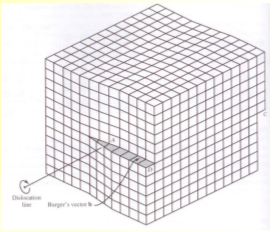
Screw Dislocation
type of line defect; rotation on plane so it pops out of the structure
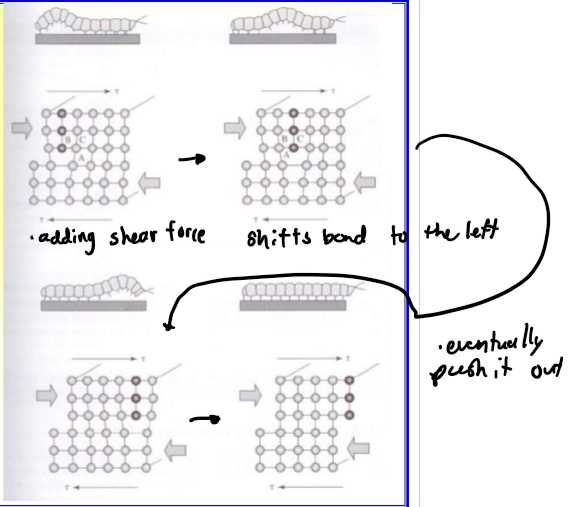
Dislocation Glide
plastic deformation occurs by movements of dislocations
only small stress needed to cause deformation as only 1 row of bonds at a time is broken
occurs more easily on planes w/ higher atomic density (slip plane) than w/ lower atomic density
presence of dislocations and their ability to readily move/interact under the influence of stresses induced by external loads (malleability)
Dislocation Glide Picture
Malleability of Metallic Materials
the presence of dislocations and their ability to readily move and interact under the influence of stresses induced by external loads; why can take metal and make sheets, jewelry, etc.
Slip Planes Picture
diff. crystal structure = diff. unit cell

Elastic vs Plastic Deformation Picture - Metals
for elastic - as add shear force, shifts to accomodate stress but not enough so breaks
for plastic - shear force causes a dislocation glide so can handle more stress

Planar Defects
either in external surfaces or grain boundaries

Planar Defects - External Surface
atoms at surface not bonded to max possible # of nearest neighbors so possess higher energy than those located inside a crystal
Planar Defects - Grain Boundaries
if amorphous; atoms here are in a higher energy state than those in the center = higher chem. reactivity; total interfacial energy is lower in materials w/ larger gains since fewer boundary areas than ones with smaller grains
Total interfacial energy is lower in what?
materials with larger grains since there are fewer boundary areas than ones with smaller grains
3 Common Strengthening Mechanisms - Metals
adding point defects
adding line defects
adding planar defects
goal is to prevent motion of dislocation (want it to be harder for thing to deform)
Adding Point Defects
1/3 common strengthening mechanisms for metals; solid solution strengthening (alloying) → stops dislocation
Adding Line Defects
1/3 common strengthening mechanisms for metals; strain hardening (cold working) → prevents dislocation by adding more dislocations but they are controlled (have higher energy)
Adding Planar Defects
1/3 common strengthening mechanisms for metals; grain size strengthening (thermal processing) → increase the # of grains by thermal processing (annealing) bc that increases the energy at the boundaries
Corrosion of Metal
the unwanted chem rxn of a metal with its environment that results in its continuous degradation to oxides (usually much weaker), hydroxides, or other compounds (usually oxidation rxn);
What is an agressive environment for metals as implants and why?
the tissue fluid in the human body bc it contains water, dissolved oxygen, free radicals, proteins, and various ions
Corrosion Resistance - Metals
a very important aspect of biocompatability; can have loss of mechanical strength or electrical function and/or corrosion products can lead to metal sensitivty/allergy (Ni and Cr) and/or oxidative stress (metal ions oxidize and can cause constant imflammation)
Electrochemical Reactions
anode - metal is oxidized by losing ve- (M → M+n + ne-) (spontaneous and n → charge, can be 1, 2, or 3)
cathode - reductions occur which consume e- (M+n + ne- → M or 2H3O+ + 2e- → H2 increases + 2H2O or 1/2O2 + H2O + 2e- → 2OH- (pH = 7) or O2 + 4H+ + 4e- → 2H2O (pH < 7))
corrosion occurs through coupling of these 2 reactions (redox)

Cathode Recactions
reductions occur which consume e-
M+n + ne- → M
2H3O+ + 2e- → H2 increases + 2H2O
1/2O2 + H2O + 2e- → 2OH- (pH = 7)
O2 + 4H+ + 4e- → 2H2O (pH < 7)
Nernst Potential
when a metal is placed in a solm. of its salt, M ←> M+ + e- at equilibrium the electrical potential reached is called half0 cell potential
Standard Half Cell Potential (Eo)
potential of the metal in a 1N soln. of its salt at 25 degrees C against H electrode
E = E0 + (RT/nF)ln(M+n) (nernst equation)
Half Cell Potential
at equilibrium the electrical potential reaches this; this is the characteristic of the metal and it can be measured against a standard reference electrode; tendency of metals to corrode is partyly determined by this
Electrode Potential
influenced by temp/ and conc. of the ion; E = E0 + (RT/nF) ln(M+n) where F (Faraday’s constant = 96485 C/mol) and R (universal gas constant = 8.303 J/mol*K)
Standard Electrochemical Series
noble metals have high + standard electrode potentials, active base metals have high - standard electrode potentials; more - = higher tendency to be oxidized
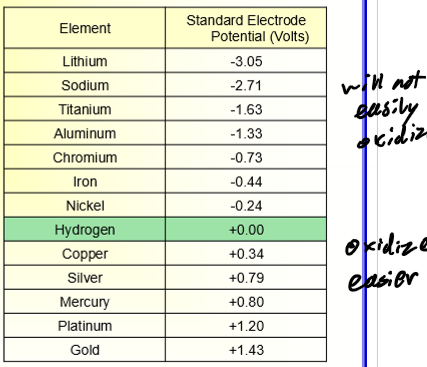
Why doesn’t the standard electrochemical series always work to predict tendency of corrosion in practice?
because some metals rapidly become covered w/ a passivating oxide film which protects the metal from further corrosion; so even thought they oxide easier, does not mean they will corrode easier
Driving Force of Corrosion
comes from upsetting the equilibrium of metals transient dissolution by removing the accumulating metal ions or accumulating electrons; removal of e- can be realized by completing a battery (accerelate corrosion like this)
Driving Force of Corrosion in a Bio Environment Surrounding a Metal Implant
metal ions can be taken away in 2 ways: (disrupts balance)
a. forming complex w/ proteins (ions + proteins)
b. mixing effect caused by relative movement of the implant or the fluid around the implant
Galvanic Corrosion
when electrical contact is made between electrodes M and N, e- flow from M → N, thus upsetting the equilibrium and cause continued dissolution of M (more reactive metal and corrodes until disappears) and protection of N (less reactive metal)
in practice → regional variations in electrode potential over an alloy surface cause this (why need to avoid metal on metal contact)
Influence of the Biological Environment
corrosion can be arrested by preventing either anodic/cathodic rxns
bio molecules upset equilibrium by consuming anodic/cathodic products
proteins and cells can interact w/ the changes formed at the interface and affect electrode potential (attach to surface) ALSO bacteria (can produce acid) and inflammatory cells (can lower pH) can change pH (can accerlate corrosion)
bacteria may take up H (food) (cathodic product)
stability of oxide layer is dependent on availability of oxygen
Stability of the Oxide Layer
dependent on the availability of oxygen; absorption of protein and cells onto surface could limit diffusion of O to surface or diffusion of molecules from surface; environment can affect this
What metals are immune to corrosion?
noble metals like Au and Pt but they are expensive and not mechanically strong (relatively soft metals); very + Eo
What metals are very reactive?
Al, Cr, and Ti bc they are so reactive that they immediately react w/ the O in the air and form a robust passivating layer that remains passive under physiological conditions
Ti - can be used as a pure metal
Al and Cr - can be used in an alloy to improvde corrosion resistance
Practical Causes of Corrosion
pitting, fretting, crevice, intergranular, stress corrosion cracking, and galvanic corrosion
Pitting Corrosion
starts from surface imperfection (bc surface energy in stratch is diff. than rest of material) → pit acts as anode (continued corrosion); ex. stainless steel is vulnerable to thus; a practical causes of corrosion
Fretting Corrosion
rubbing one part on another disrupts the passivating layer, stirs the electrolyte or causes fatigue → accelerated corrosion; a practical causes of corrosion
Crevice Corrosion
region of device w/porr mass transport, chem environment is diff. in crevice from the surrounding (diff. in potential); ex. area of contact between screw and bone plate; a practical cause of corrosion
Intergranular Corrosion
occurs at grain boundaries; a practical cause of corrosion; higher energy regions and higher reactivity + gaps between boundaries let water in
Stress Corrosion Cracking
stressed region is more susceptible to degradation dude to the mechanical energy and if mechanical stress is repeated, fatigue stress corroion takes place; a practical causes of corrosion
Galvanic Corrosion
need to avoid galvanic coupling; a practical causes of corrosion
Commonly Used Metals
stainless steel, cobalt based alloys, titanium/Ti-based alloys, and magenesium
Stainless Steel
most commonly used in medical implants: 316L (L = low C)
addition of Cr → forms a strong adherent surface oxide → high corrosion resistance
What happens when carbon contents in 316L stainless steel are > 0.03%?
carbide Cr23C6 will form and precipitate at the grain boundaries → formation of this depletes Cr so diminisges protective chromium based oxide
so low carbon % = high corrosion resistance bc C reacts with Cr so less chromium oxide as protection
Addition of Cr vs Nickel to Stainless Steel
Cr stabilizes the ferritic (BCC) phase which is weaker than the austenitic (FCC) phase
Nickel stabilizes the austenitic phase
Mechanical Properties of Stainless Steel (316L)
depends on processing conditions becaus ethey produce diff. microstructures;
annealing: larger grain size (lowers # of grain boundaries) → lower strength and more ductile
cold working: greater strength and hardness and less ductile (introduces line defects)
Cobalt Based Alloys Applications
dentistry, artifical joints, eg. stems of prostheses for heavily loaded joints like knee and hip
Titanium and Ti-based Alloys
commercially pure (CP) titanium (ASTM F67) and extra low interstitial Ti-6Al-4V alloy (ASTM F136) most commonly used
the contents of interstitial elements (C, O, and N in CP) and Ti-6Al-4V strengthen the material through solid solution strengthening mechanism
oxide (TiO2) formed on surface of Ti/alloy provides corrosion resistance
very inert in vivo (no degradation product that would cause toxicity)
light (4.5 g/cm3)
specific strength (strength / density) of alloys exceeds any other metal implant material bc low density
What do the contents of interstitial elements (C, O, and N in CP) and Ti-6Al-4V do?
strengthen the material through solid solution strengthening mechanism; oxygen in CP affects yield, tensile, and fatigue strength; high O% = high strength = low ductility
Comparison of Properties Picture

Stress Shielding
high strength of the metal in the implant induces it to assume more than its share of responsibility for the load in the region → this decreases load bord by surrounding tissue and shields it fro experiencing stress → lack of stress causes bone density to dcrease as bone tissue resorbs, eventually baring the location and causing complications in the implant/tissue interface; essentially needs to be tough enough to take load but if it takes too much, bones don’t get any and so they start to deterioriate (Ti good at this)
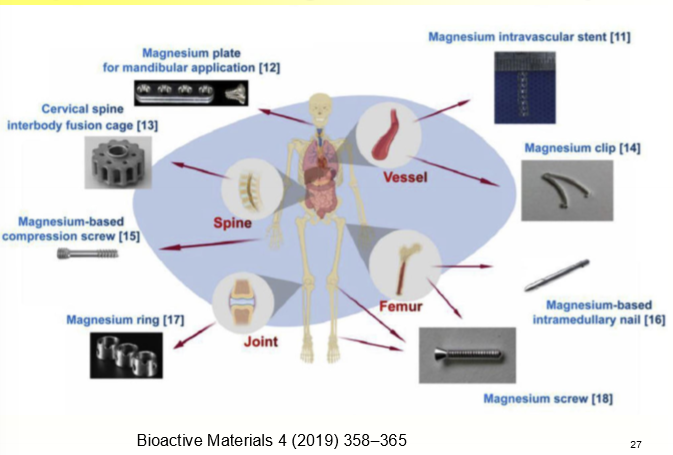
Biodegradable Metal - Mg
used in many biological processes
safe corrosion byproducts
complere degrdarion
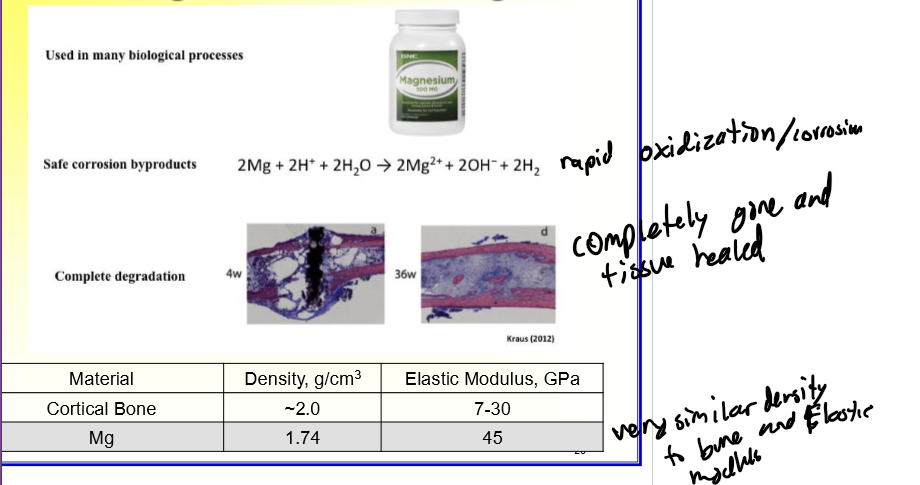
Representative Magnesium Based Implants
not stable so only short term applications